Brian
-
Posts
21,945 -
Joined
-
Last visited
Content Type
Profiles
Forums
Events
Store
Downloads
Gallery
Everything posted by Brian
-
Yep. Very easy to do in Photoshop or one of the others, but I know not everyone is familiar with them. Just reduce the resolution down to maybe 100 or 120 (that will already make a huge difference, as sometimes they are on 300 dpi) Then resize the whole image (not just crop) and it should be fine. But email the pic to one of the guys here, and I am sure they will be glad to post them for you. Can send to me too, but please not if they are over 1 meg each, as I am still on dial-up Brian
-
Convert the pics to .jpg. The tif is likely way too big to upload, and can't be viewed by everyone. What are the indicators that it is a Gendai-to and not an earlier blade in gunto mounts? Always possible someone did a good job without needing to drill another ana? There are however quite a few undocumented smiths still. Brian
-
Sebastian, There is very little chance that the inside of the tsuka is going to fit perfectly and just need the ana repositioned. It will either be too tight, too loose, or just sloppy. Good for you, for asking opinions first. But all the opinions agree, so I guess there isn't any doubt. You have a sword with papers. And a koshirae with papers and tsunagi. Putting them together like you want to do is going to do serious damage to the blade. Extra mekugi-ana are something we live with in old swords due to the fact that we cannot do anythign about it. But it is never something we desire, and would be a very bad idea. Yes..I think your papers showing only 2 ana are going to devalue your sword when they can prove that the new ana was done recently. Everything says don't do it. A professional tsuka-shi can fill the old hole perfectly and drill a new one in the tsuka to match the existing ana. This only if the tsuka fits the new nakago perfectly (which I doubt) Not sure how this would affect the papers on the koshirae though. Brian
-

Help identifying school and value...30" nagasa, 4" kissaki!
Brian replied to Leatherdog's topic in Nihonto
I think people are pretty brave to make some of these calls based on the little we can see. My advice would be to get it looked at in hand at one of the sword shows. I don't see a boring uninspired gunome there, I see quite a wild hamon with maybe even some tobiyaki, and a polish that is not showing off anything that is there. I also see indications of plenty of hataraki and hada. To me, shinshin-to and would be very nice in polish. But as I said, there are not enough pics and the polish isn't good enough to make out any of this for sure. With a 30" nagasa and that kissaki, I would be surprised if it turned out to be simply a gendai-to made for the war effort. Not impossible of course, but wouldn't be typical. Nakago patina is never certain..as removal of a tight tsuka can wear the high points..and climate can advance surface rust. So can artificial methods. If it was bought at a gunshow and not a sword show, I would expect it to have been with the guy for many years as a WW2 bring-back, with less chance of faking. But you never know nowdays. Take it to a show or sword study group, and prove one half of us here wrong Brian -
Hi, I would trust these guy's call, and it is well spotted. A very good exercise. Remember that these tagane are like our own handwriting. If you tend to write your letters of the alphabet a certain way, there isn't much chance you are suddenly going to write the strokes backwards. Of course, when you chisel a stroke, you are always going to show the direction of the stroke from thicker to thinner. (Same as a pen stroke) Brian
-
Sebastian, I would never drill another ana in the nakago to fit the blade to another tsuka. Certainly, this cannot have any advantage at all to the preservation of the sword or its value. Especially if it has hozon papers! Rather get an expert to modify the tsuka, or take it apart and use the fittings to make a new tsuka to match the nakago. My opinion...don't do it! Brian
-
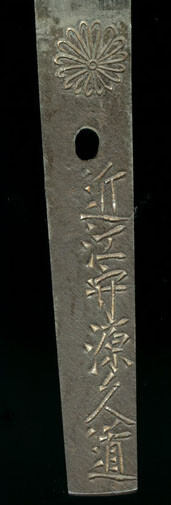
The most glaring difference that is immediately apparent is that the chrysanthemum petals are cut clockwise on this one, whereas the shoshin mei has them anti-clockwise. Ref: http://www.ricecracker.com/japanese_swo ... a/sk14.htm (which btw seems quite a good deal to me at 8K, with origami) Brian
-
Give us an idea of what your budget is. If you are looking at spending $15K or so, then that opens up a whole different ballgame. There are lots of good deals at that level I think. http://www.nihontomessageboard.com/links.html Go to the commercial sections, and see how many dealers there are in English. Browse around a bit. Are you in Germany? If so..we have some excellent members here from there, that will guide you on where to go and how to buy. Don't be hasty, and you will end up with nice items. Brian
-
Hi Wilfrid, Post the pics and descriptions of the swords you are interested in here. Look in the How-To section for instructions on how to upload pics, or upload at photobucket and share the links here. I can tell you that few people are going to tell you how much to pay. That is an impossible task, and is always controversial and subjective. But you might get opinions on if it is a good sword or not, and if it might be a good deal. I think you might be the guy that i heard about considering that "tachi" on eBay for over $15,000? If so..stay away from it! I don't even think it is Japanese, and is certainly not older than 5 years. It would be a major mistake. There are much better deals out there for $20K from decent sellers. That one is junk in my opinion. Regards, Brian (Ps - Don't forget to sign the bottom of your posts with your first name)
-
Ah. I was right Mike is also Historian(333?) and uses Komonjo for his consignment items. He knows what he is selling, and will tell you if it is genuine. Decent seller, and a very gimei sword. Brian
-
James, Very nice looking blade indeed. These osoraku tanto tend to fetch top money, something about the unusual shape maybe? I would have to agree with Jacques. If genuine, it would probably have been sent for papers and would be very big $'s. I like this project: http://www.ksky.ne.jp/~sumie99/ns2.html From the style of the pics, I would take a big guess that this is one of Mike's (Historian) auctions on eBay? Tend to start to recognise the style sometimes. Brian
-
Peter, I think you are going to find that as far as professional, reputable and recommended polishers go...there are none in Australia. This is the impression I am given by the advanced collectors there. Brian
-
Congrats James! That is an excellent result, and certainly shows that if the right steps are followed, there can be a good result at the end. Make sure you send some pics when it eventually arrives back. Congratulations too go out to Ludolf for a very good call and analysis. Well done. Brian
-
Yep..there have been some online complaints about imageshack and random popups lately. One I have been told to try is http://www.imagevenue.com/ Apparently no popups? Worth a try for those that want to use external hosting. Brian
-
James, Search the forum for "Hikone Soten" Quite a few posts about it. Hikone is the town, school is Soten. Lots of info on google too. Brian
-
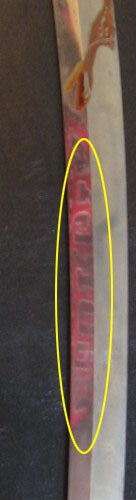
Mr Manguno, What is happening here on the blade, or is it just a trick of the light, marks on the blade or other...? Brian
-
Better get started then, no time to waste. :lol: Andrew, the short answer is that those that have studied the schools extensively start to pick up the points like style of hada, hamon, sugata etc etc and you start to get a feel for where and when a blade was made. This is what the end result of years of study is. As for Seki...like some other schools and traditions, Seki in Mino province was an area of mass production and many of the swords were utilitarian but not high class. There are of course exceptions, but in these schools good weapons were produced, but not great art pieces. You can find very good examples, but if a school/tradition was mainly known for mediocre swords, then they are obviously not as sought after as other more desirable school works. Brian Ps - Refer to John's page here: http://www.johnstuart.biz/new_page_14.htm where he says
-
Before you get jumped on, you should maybe have said as a curiosity or novelty piece I know there are many here who will tell you that you don't learn from studying tired and/or low class pieces. But we know what you mean. Just the first step on the way to upgrading to much better items, right? Brian
-
UK Nihonto and acid etching
Brian replied to carlitobrigante's topic in General Nihonto Related Discussion
Your answer lies right there in the question. They are not serious collectors. Merely dealers or amateurs who want to see a vivid hamon more than preserve a sword. And no..it is not restricted to the UK. I have seen many here in SA, and quite a few in the USA. I think where there are more proper polishers, there is less of this happening. People who feel like they don't have access to proper restoration resources go this route in order to show what they can't see. But in doing this, they seriously damage the sword. I think Ferric Chloride etching is maybe even more common than acid sometimes. It makes the hamon and nioi-guchi vivid white, but is terrible, and obscures everything you want to see. Then there is the terrible effect of opening the grain to the point that even a proper polish will battle to save it. There are probably ways in which it is used legitimately, and in ancient times maybe. But these modern day guys don't know how and ruin the blade. At best, you pay twice. Once for the bad polish, and then even more later to undo what was done. Brian -
Simon, As they used to say in school.. "Did you bring enough for the whole class?" :D Next time you are there, pick up a few extra packets. I am sure you will find a willing market here for a few. Brian
-
Looks like at some stage it was converted into a pendant. I would consult with an expert metalworker or jeweller to see if it is possible to remove the rings without damaging the rest. Yes, there might be a mark, but I would think this would be preferable to having a ring attached to the side. Not a high class tsuba, so I would look at doing that if it were mine. Brian
-
Loren, I think you could fill a book with just the names of the books in Japanese. Check out http://www.japaneseswordbooks.com and http://www.satcho.com for just a few of them. The suggested reading link at the top of the forum is a good place to start though. Brian
-
The only way to check is to compare the workmanship on it. Plenty of these are done by students and prisoners with assistance from Emura, so each has to be judged on its own merits. The last 3 papered Emura blades I saw were all signed "Emura saku" but of course there were many signatures. Oneday someone will examine enough examples to say for sure which signatures were by him, and which were by his students. Best page on Emura is of course on Dr Stein's site, and Ohmura-san also has a good section on him. Just search the NMB for Emura to find more info. Brian
-
I'd like to see a pic of the nakago (tang) before I was to take any guesses. Does seem to have been based on a naginata though. Preferably upload some jpg's, as not everyone will or can open the .pdf. Brian
-
Pictures on an Exhibition....
Brian replied to uwe's topic in Sword Shows, Events, Community News and Legislation Issues
With all due respect, let's please keep posts to English (with Japanese when necessary) or provide translations for everyone..or take it to pm. This is for the benefit of all the members here. Thanks, Brian