sanjuro
-
Posts
2,100 -
Joined
-
Last visited
Content Type
Profiles
Forums
Events
Store
Downloads
Gallery
Everything posted by sanjuro
-
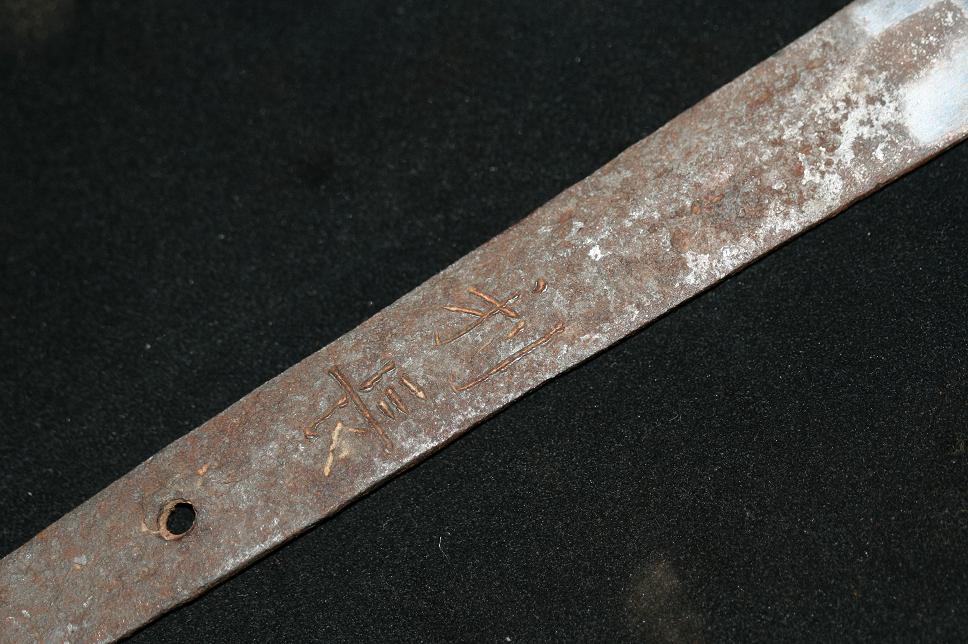
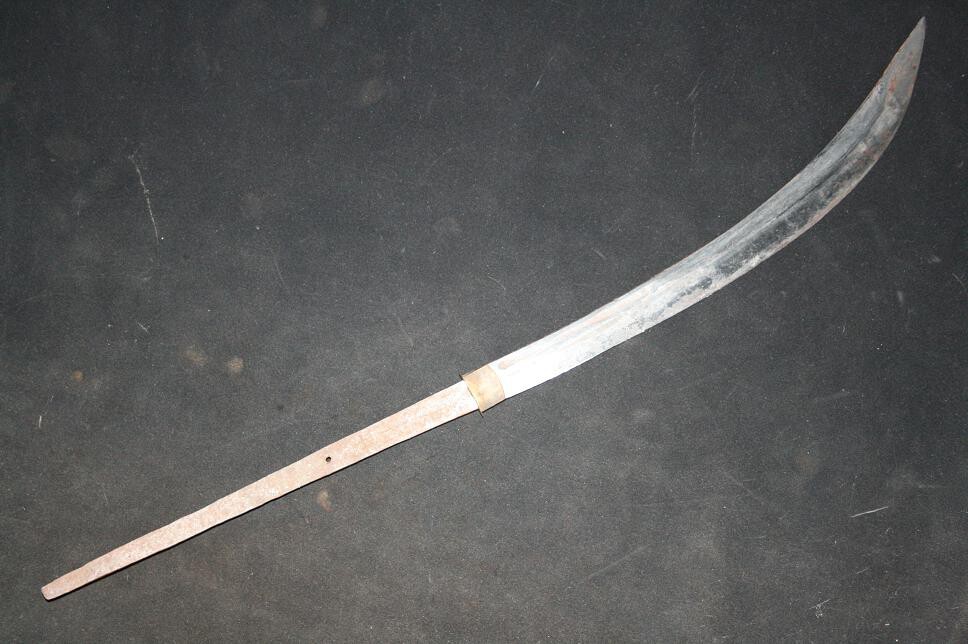
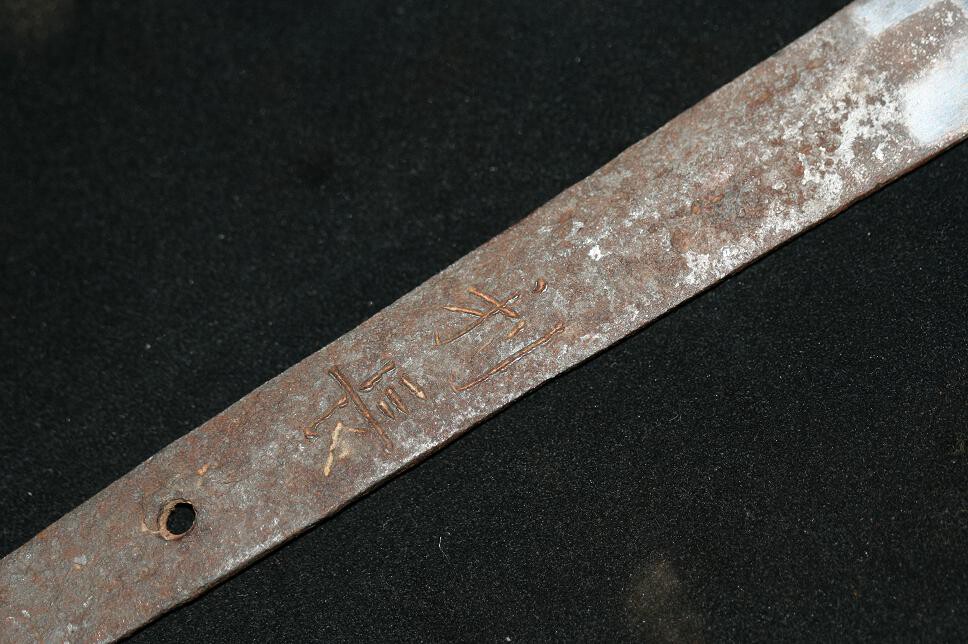
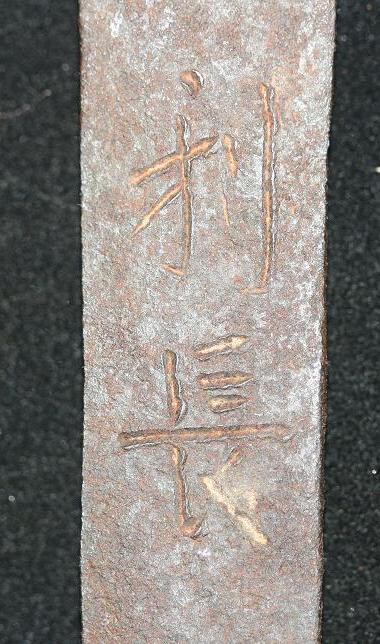
Lee. The mei has a white powder residue in it, in the pics. Possibly to bring up the strokes properly. The pics arent mine. I have removed the powder residue since, and the rusting in the chisel strokes of the mei is consistent with the rest of the nakago. I do agree though it is a fairly crude rendition of the mei. Nice try on the veiled suggestion of a change of ownership, :D but the person who gave it to me is waiting patiently for me to polish it as I have promised. What possesses us to make such undertakings is a mystery to me! :?
-
Thanks George. Makes sense with the seppa and I should have thought of it This seppa was the one directly beneath the habaki. My quest to identify the Naginaterus Horribilis continues.
-
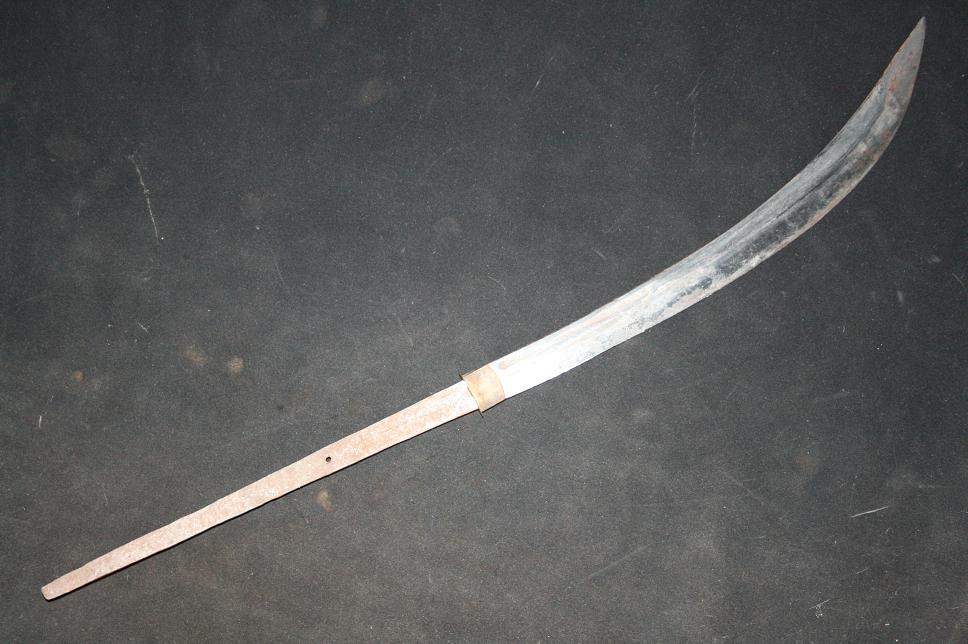
Gentlemen. I was given this naginata blade complete with habaki and seppa, a couple of years ago. I have yet to decide if the gift was well meant or an act of vengeance. The condition is atrocious, and the blade has lain in all its gruesome unkempt glory in drawer awaiting the attention I had intended to give it as a polishing project. I hear the peals of laughter as you all roll around the floor in spasms of mirth, but yes, I am serious! The blade whilst in a sorry state is quite sound and has no major flaws (That I can find). The hamon is a shallow gunome with a wide turnback at the kissaki. I do not think this is a Chinese fake, otherwise I would not trouble you all with viewing this post Your assistance (and forebearance) is requested in identifying its maker. I have the signature as Toshinaga and I thought that those of you with access to oshigata may be able to first confirm this and perhaps narrow it down a bit since there are a whole raft of Toshinaga's. The blade is Edo period (I think) based on size and saki sori type. other than this and what is evident I have no clue. I have posted a minimum of pictures so that your sensibiliies are not too offended by its condition. The picture of the seppa is included as the characters on this are also a mystery : Length about 26.2"(66.7cm), Nagasa 14.7"(37.5cm) : Width(motohaba) 0.9"(2.4cm)

-
Casting flash in the curl within the leaf on image 0835, plus granular intersections on acutely angled ribs on the leaf looks very much like cast copy. Nicely cleaned up, but cast. The ground and low areas also are too granular to have been hand cut into a base plate. IMHO
-
The sheer joy of handling a fine koto blade is why I love Nihonto. Shinto blades feel dead by comparison, and whilst some of them are fine blades also, they can for me never match a fine koto example. As someone else here has said. 'Its all about the steel'.
-
Itame....... A shade too coarse for ko itame.
-
It looks Jizo to me too. I have two swords with jizo boshi similar (But not quite the same) as this. Take it further from there and look for the other features. Length of turnback etc. You'll get there.
-
If you get it half right you are doing well. Remember, a true connoisseur has handled hundreds of blades.
-
Jason As regards the quote: They were old battles. All battles are old when the sun rises on the following day. The lucky ones see the sun rise. Let's turn our attention to Mark's sword shall we?
-
Yoshino period....... Yamashiro. During this period there were only two major schools operating in the Yamashiro tradition. Since the sword has been shortened, much of the usual indicators centred on the nakago are removed and/or altered. It is therefore difficult to assign this sword with accuracy. Yamato and Yamashiro swords are difficult to separate at the best of times. If this were a Muromachi sword,(Post 1394) then these two schools would still be in contention along with the Tegai school, Shikkake school, Nio School and the Mihara school. all of which made swords in the Yamashiro and the Yamato tradition. Remember, this was a period of transition for the two oldest schools of sword making. The more I think about this sword, the more I am brought to the thought of the Tegai school who favoured the Yamashiro tradition, and whose roots lay in the Yoshino (Nanbokucho) period. I still think however that this blade is older than the Tegai school, and my money, along with my gut feeling, would be with the Aoye school. I would love to have this sword in hand. I once had the extreme honour to hold and handle a tachi of this age. Strangely, it too was of the Aoye school, and completely original. The blade was 34 inches in length (nagasa) and was like a bird in the hand. So well balanced was it. ( Yes Yoda..... take your medication and lie down, theres a good fellow). Just MHO..........
-
Hi Jason. You arent getting much action on this inquiry of yours and I think I know why. What you are trying to do is describe the boshi on your sword by lumping together a whole load of terms that basically confuse the crap out of both you and everyone else. It takes years of practice and a lot of knowledge of the meaning of the terms in order to do what you are trying to do. I guess what I'm saying here is that you are trying to run before you can walk. I love your enthusiasm, and it should be encouraged, but there is a big learning curve before you can throw these terms around with any authority. Try this...... What is the single most salient feature of the boshi? the term for that feature is how it should be described. Dont add other terms to it in order to describe it, because you will be creating a description that may read as nonsense. Now, having categorised the boshi as this or that, add a desciption of the other less prominent features. For instance if the boshi is described as Jizo then leave it at that. There are probably fifty different jizo boshi types (big, small etc.) Now without adding to the jizo part, pick out the other features and describe them as a qualifying feature of the boshi. The end product will be more understandable. It may also be wrong, and you will find as you learn more, that your description may become more refined. There is no substitute for looking at as many swords as possible at shows, museums, whatever. The knowledge comes slowly and hand in hand with experience. Best
-
Hi Thomas. I couldnt remember at the time of posting if the saying was one battle or two. I thought if you had heard the saying and I was wrong, that I would most certainly be corrected. I checked.... It was one battle after all Feel free to use it....... I have no monopoly on old Japanese sayings.
-
Jason. All due respect but I dont quite see the relevance of your comment. I took a nine millimetre slug in the thigh in Vietnam... However, it has no bearing on this discussion.
-
Mark. On further inspection of the pics it occurs to me that this blade was much longer than you have estimated. Your estimation is based on the lowest mekugi ana being the original one. I think perhaps that the original was below the present nakago jiri. The reason I think this is because of the Hi end shape which is common on swords whose hi end before the habaki. Those that continue below the habaki usually either simply shallow out or are cut through the nakago length and just drop off the end so to speak. Finishing a hi with a rounded end is more likely when the end was to be seen on the mounted blade. Bear in mind its not an easy task to end a hi so neatly, and you wouldnt do it unless there was a reason. Just a thought......
-
If we have Yamashiro and Nanbokucho correct that leaves only two major contenders for the school. Nobukuni and Aoye.
-
Thanks Joe. OK.... Yamashiro, Nambokucho period possibly, although its hard to be so specific. Certainly no later than your attribution of the Muromachi period, and probably early Muromachi. You have a very nice blade there............ The suriage was done beautifully. So many of this vintage sword were just cut down without a thought to the correct rake of the new nakago. This one retains its proportion and a decent length in the nakago. At a guess I would say the suriage was done fairly early.
-
Lee I actually thought about that believe it or not! The copper however would have heated up very quickly, more quickly than the steel of the nakago. If the habaki was jammed on, the solder at the seam would have liquified and the habaki sprung apart long before the steel reached a heat great enough to damage the temper in the steel. As you say however, we speculate to no avail. The evidence of a botched job is before us and the circumstances of it are academic. The question is.. can it be rectified?
-
Jason. There has been no major samurai military actions in Japan other than police actions and a couple of sieges post 1604, since the battle of Sekigahara in 1598. This sword has been sitting and listening to politics as you put it, for 500 years (Most of its life). The life of a sword is measured by the actions it has seen. Old Japanese saying "The life of a sword equals one battle or 500 years". (Thomas Helm will probably correct me on that). The reasons for cutting down a sword are those given, there are no others apart from blade breakage at the mekugi ana. Any sword such as this one that has survived beyond the Sengoku Jidai without being destroyed in action or lost in action is fortunate indeed, and we are equally fortunate in still having it to ponder upon. We have no way of knowing why this one survived in such good condition. It is likely to have originally belonged to a samurai that was not directly involved in the fighting ie. A senior or very high ranking samurai. After that is anybody's guess. Though I'm not treating your suggestion of an underground fight club seriously, a few facts might dull your enthusiasm for such a thing. On a one to one basis the chances of walking away from a sword fight is one in three. On a battlefield basis over a third of the combatants die in the first clash. Casualties of up to 70% were not uncommon in prolonged engagements. 70,000 men died at Sekigahara alone in a three day engagement. Conclusion....... Dont be too eager to face a man with a sword in his hand when he knows how to use it! Sorry about the lecture everyone............ :D
-
Joe. Would it be possible for you to post a longer shot showing the blade in its entirety please. Sugata even in a blade that has been shortened, is quite important in order to gain a feel of its former appearance, as well as its current appearance.
-
Its pure speculation I know, but the banded gradiation in the discolouration which is in fact a heat signature, indicates that the area did not reach red heat. It would have been necessary for the whole area to have reached red heat in order for either reshaping of the machi or for the straightening of the nakago. There is also no other indication of the nakago being replaced or otherwise tampered with except in a very amatuerish way possibly with an inadequate file, to reposition the hamachi /munemachi. I think in this instance though we may contemplate the extremely sinister, in fact we are simply seeing a less than adequate attempt at moving the machi forward. An attempt perhaps that resulted in the jamming of the habaki on the blade. The heat band being the result of the removal of the jammed habaki. Its fascinating trying to put this together though isnt it?
-
Enthusiastic yes....... However, one must also recognise that a sword having seen much use as a weapon would likely not be in the healthy condition of this blade. Also the multiple mounting holes (Have we stopped calling them mekugi ana?) may only reflect the number of times the blade has been shortened and/or remounted. Enthusiasm mixed with romantic nonsense may not of course see it quite thus. :D
-
Excuse my use of the language.... but in answer to your question. Not on my bloody swords it isnt! That said, there is a whole range of ways to fiddle with patination and I dont doubt that heat may be one of them. I wouldnt think though that anyone wishing to repatinate using any method involving heat would leave so obvious an indication behind. The discolouration is fairly easily removed after all. One wonders if this sword is perhaps a gendaito?
-
Just an initial impression...............The rainbow effect is a result of heat being applied to the area immediately below the colouration. A naked flame will always produce this when applied to steel which is not then brought to red heat. Given that the habaki on this sword appears to be an ill fit, and the line of nakago discolouration is quite sharply defined on its upper edge where the blue colour indicates where the greatest heat was applied, The uncoloured steel above that line was therefore shielded from the heat source. Then I might suggest that the original habaki may have been removed by heating (Collapsed or siezed on the blade). Does the habaki moto appear to have been moved at all? I hesitated in adding this, but if the seller of this sword is representing it in the way you have indicated, then I would think twice about dealing with him. He is either a fool or he is dishonest. There is nothing good about this feature, and the only thing it adds to the blade is extreme doubt.
-
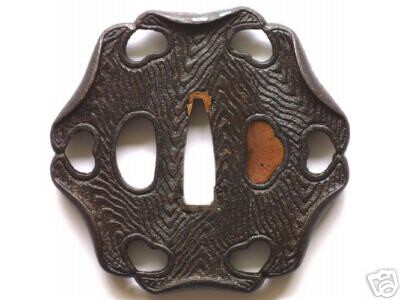
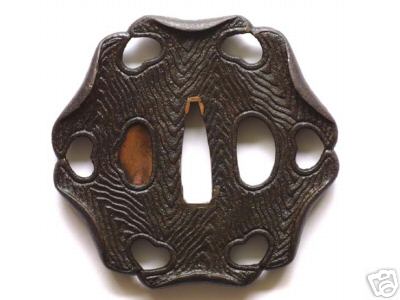
Hi Ron. Sorry.... forgot measurements Flat to flat across the tsuba is 72mm (2 and7/8 inches). high spot to high spot at the inome piercings 77mm (3 inches). In other words the tsuba fits into a three inch circle. The plate is 5mm thick at the nakago ana, and at the mimi where the edge has been hammered back it is 1cm. The nakago ana 28mm (1 and 1/8th inches). In hand its more katana size than wakizashi. The wax sheen in the photos has since been removed in order to reveal the natural patina of the tsuba which is a rich deep brown, a much more pleasing finish. (The removal was done with denatured alcohol). :D
-
Hi Guys. I thought perhaps you may be able to help me firstly to identify this tsuba and give me some idea of what sort of quality it may be. I recently 'inherited' it and have utterly no clue about it. I had intended to list it in 'for sale' but since a price has to be nominated, I'm left completely at a loss. From the preceding you may have gathered I am not a tsuba dude, at least not tsuba of this apparent era. My guess is that its Edo period. No idea of school etc. All input greatly appreciated.