sanjuro
-
Posts
2,100 -
Joined
-
Last visited
Content Type
Profiles
Forums
Events
Store
Downloads
Gallery
Everything posted by sanjuro
-
Mark Green and my new Nihonto
sanjuro replied to jason_mazzy's topic in General Nihonto Related Discussion
New one?????? This sword has a new shinogi? What did you do with the old one? -
Dammit Thomas! I hadn't got to the sayagaki yet! :lol:
-
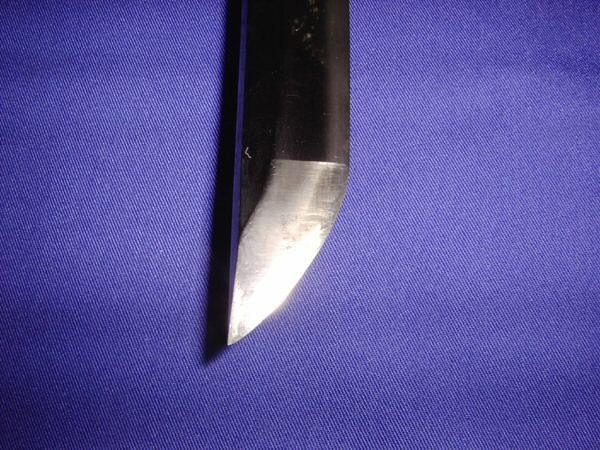
What yokote? It should when present also follow the line (at least nominally) of the ko shinogi. This one has had chips polished out of the kissaki and not quite all of the chips polished out of the ha along the boshi. Theres quite a few small irregularities in the ha of this sword. A polish would need to remove a lot of material to make this blade a clean edge, it would also make this into a dead blade methinks...... IMHO of course.
-
Clive there is a bit on the net about this and I remember having seen an article on all the swords carried by the 47 Ronin. Googling is always good, but in the meantime I'll see if I kept the article or the reference on google. Try Elliot Long's site, Shoshin. I think that may be where I found it.
-
All this sellers swords are sandpapered (at least all the ones I have seen). All have some suspicious little things about them. Things that make you wonder if its all as it should be. The horimono on this one is a little strangely oriented for an unaltered blade. The fading of the horimono is also uneven too close to the habaki moto. Am I being too picky here? Like its been said often enough, dont buy an unpolished sword, especially on ebay. There is no way you know what it is until its too late.
-
Eric Mostly provenance and the style of decoration from what I can deduce. They are so similar as to be almost interchangeable sometimes, particularly if there is little in the way of decoration. Some utensils like this are or rather were, fairly common throughout Asia. A label of Chinese or Japanese is often just the best guess of the dealer unless he obtained them from that specific source. Not being much help here am I? Sorry.
-
Eric. Have you read the NMB thread on Tosu? It may help explain what the Japanese carried as utility items. Yes the Japanese made and carried these things but regardless of them being described as mijikimono they were in fact just another variety of tosu. The Chinese also carried such things. The set in this thread are Chinese.........
-
Too late..... Ford already took it there and the rest of us were just waiting ......... We did know what you were thinking though.
-
Morita San and George. Once again gentlemen my thanks and appreciation for your research efforts. I have gained a greater appreciation of gendaito and showato as a result of your information, and I now look upon such swords with a very different eye. Perhaps in the past I have been somewhat dismissive of gendaito and showato. However, since I am now the owner of the sword I inquired about, it will be the subject and foundation of further inquiries and study on my part.
-
Morita San, John, George. You have been most helpful, and I am endebted to you for your valuable opinions. We have then a fairly clean, fully mounted gendaito, most likely made by a Seki Tosho named Ohno (Yuichi) Akitoshi, but certainly by a tosho at least whose last name was Akitoshi in May of 1944. The general quality of the blade in as much as what can be seen in hand is quite good. A fairly clean hada which because of the polish is hard to quantify, but there are areas where itame (I think) is faintly discernable. The wide sugaha hamon is well edged with a fine misty nie that is not a polishing effect but a tempering effect. I would assess this blade as sound and healthy, regardless of period. Not an outstanding blade, but a good serviceable unpretentious blade. This is only my uninformed impression however. May I prevail further upon your experience of these swords and inquire if this is likely to be a reasonable sword as I suspect? Lets say on a rating of one to ten, ten being the most desirable. Was there perhaps a ranking of either or both of the smiths likely to have made this sword? (I really hate to ask these newbie questions gentlemen, but this is virgin territory for me and I have absolutely no idea of what I may be dealing with).
-
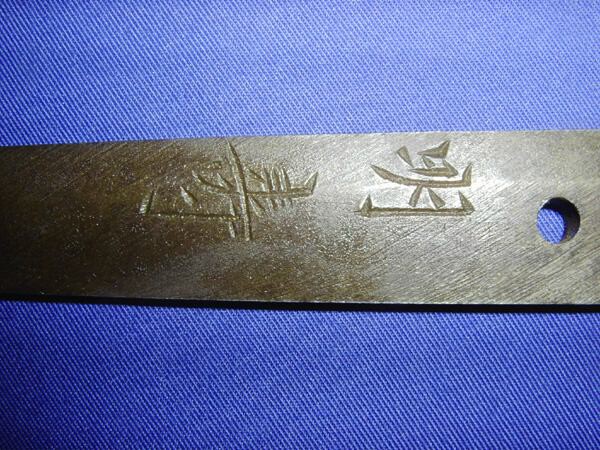
That does restore some of my faith in my own reading of Kanji... Thanks John. Is this one of those art name type signatures or just a commemorative kind of thing? Obviously it isnt a sword by THE Myoju. I'm sorry if I'm very dumb on this subject, its far from my usual area of interest which is Koto Blades. This is quite a learning curve for me. The blade appears to be quite a reasonable blade for what it is, and to be honest I rather like its meatiness, being not polished down to a shadaow of its former self. I'm not about to switch camps, but a good blade is a good blade regardless of when it was made. The owner is a friend and he wants to sell this sword. I would like to help him out, and owning one of these would be no great burden. I guess what I'm really asking here is exactly what would I be buying and how much should I reasonably pay for it. Ebay prices are no help in this because they arent a reflection of real value.
-
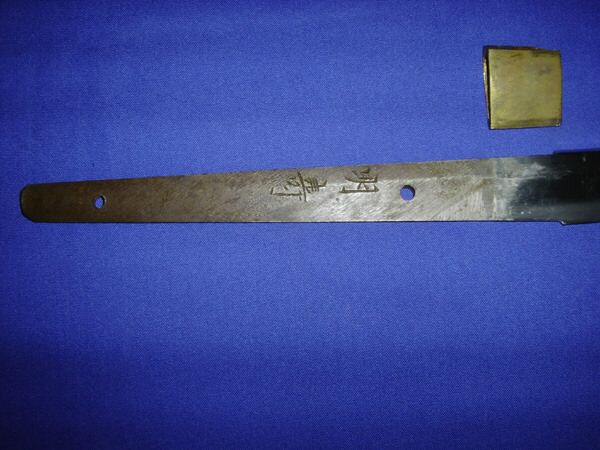
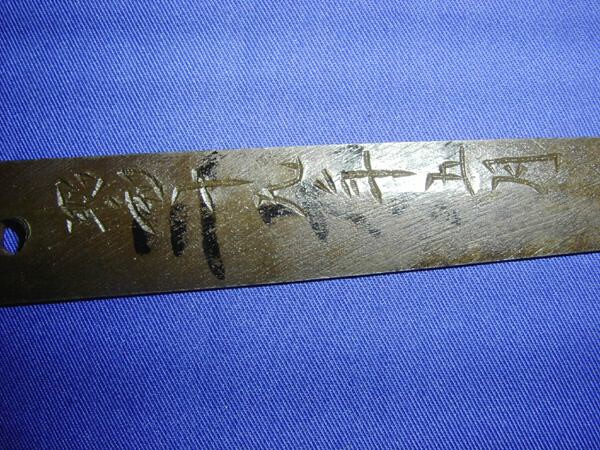
John. Did I read the date wrong? My kanji is rubbish usually, so it wouldnt surprise me. Also why Sukehisa? I didnt think I got the signature that far out. (then again.... my Kanji is woeful as I already stated).
-
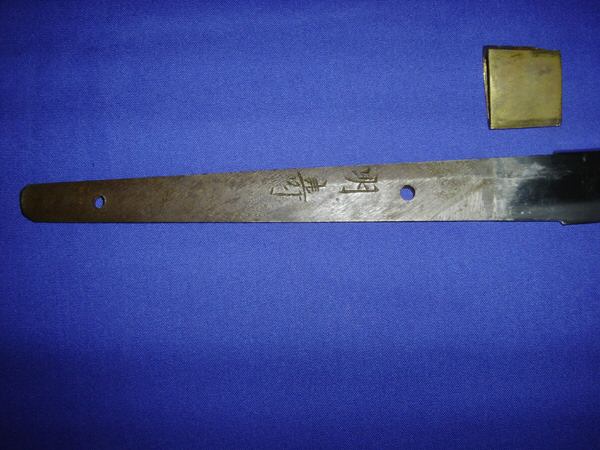
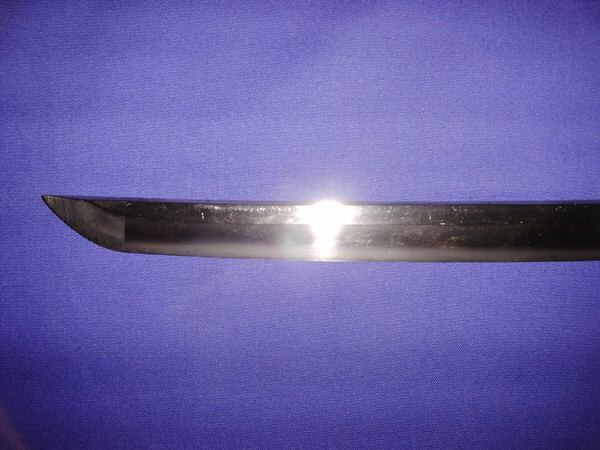
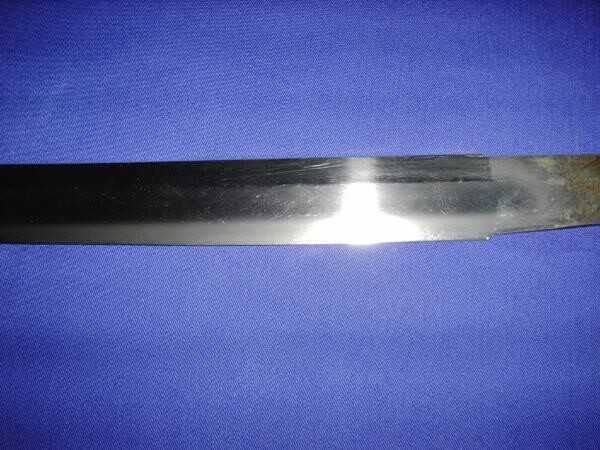
More pics...... There are no stamps of any kind on the nakago.
-
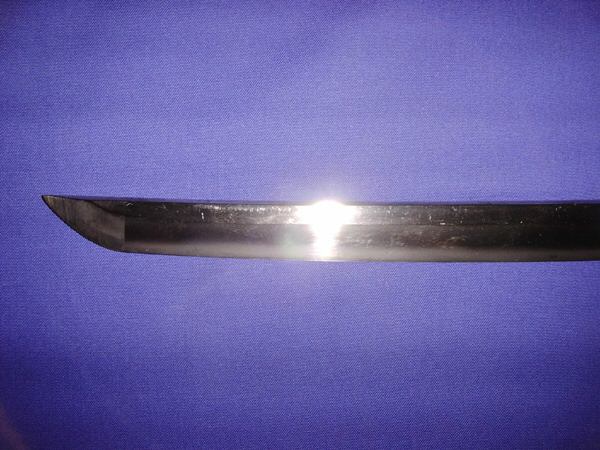
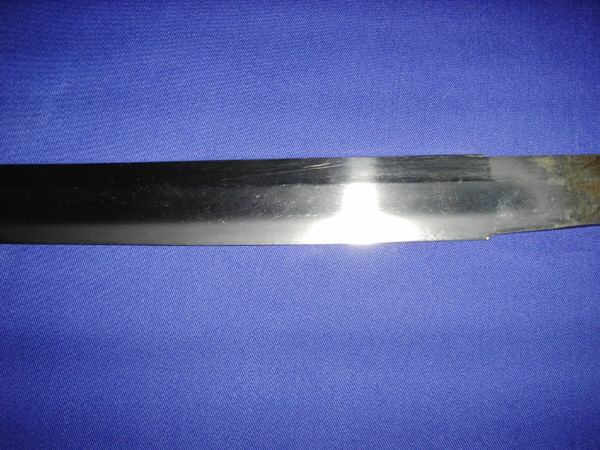
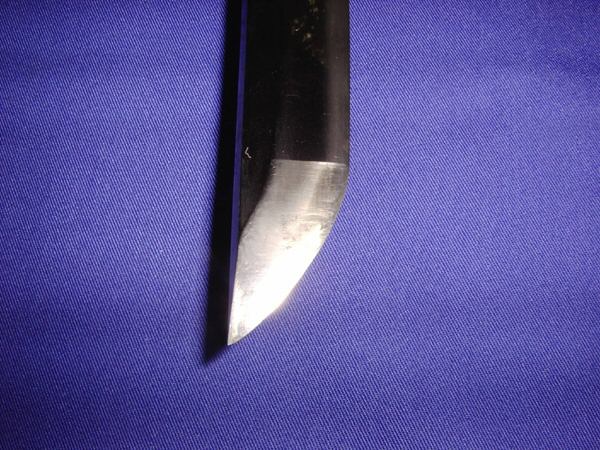
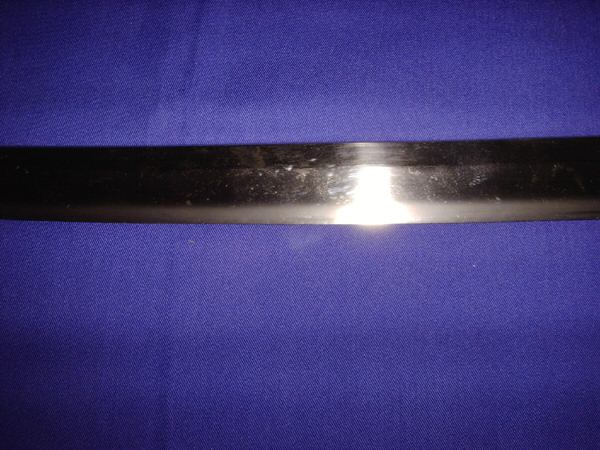
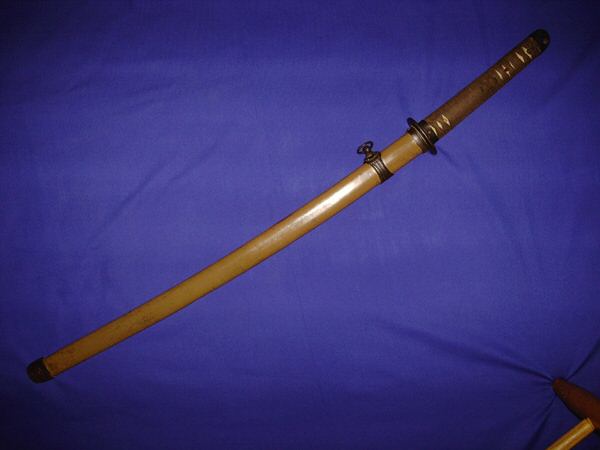
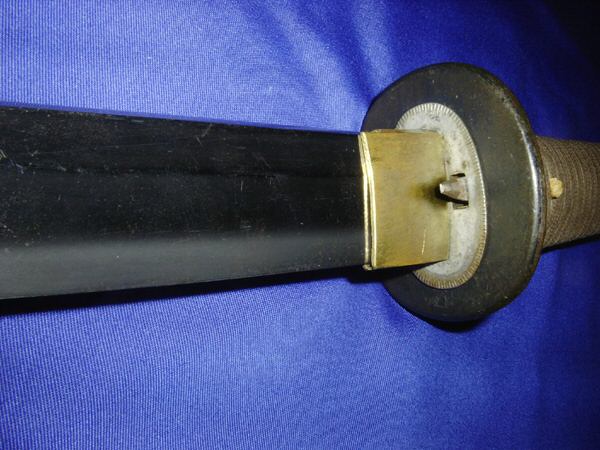
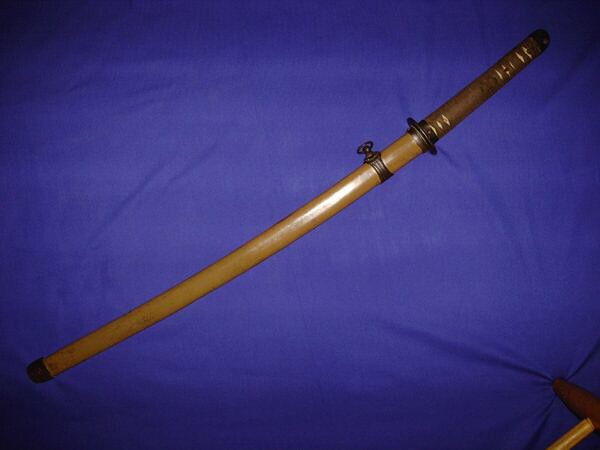
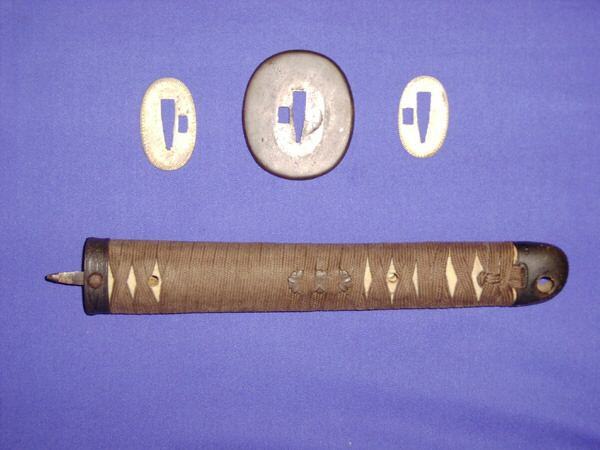
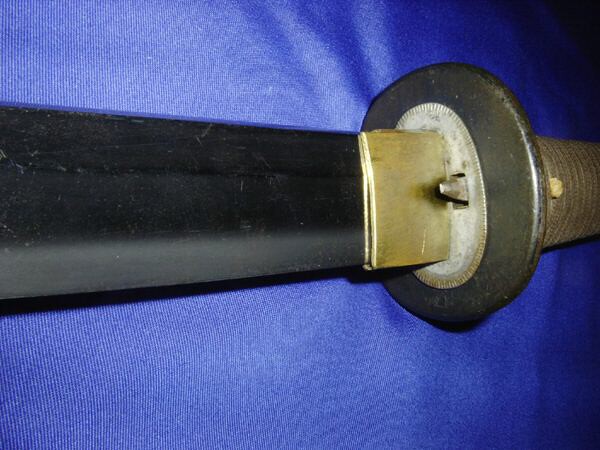
A friend of mine brought a sword to me recently, A gendaito about which he knows nothing. It pains me to admit that I also know nothing beyond the signature and date, simply because this is not my area of expertise. I am aware that there are some signatures and types of sword that were made by true swordsmiths under an art name. This appears to be possibly one of those. SIGNED MYO JU AND IS DATED SHOWA 19TH (1944) MAY. I would appreciate an assessment by those who are more informed than I on this subject. The sword is a gendaito 26 3/8" Nagasa. Mounted in type 44 mounts of fairly decent quality, the blade appears to be machine polished although hand made. Any assistance would be very helpful.
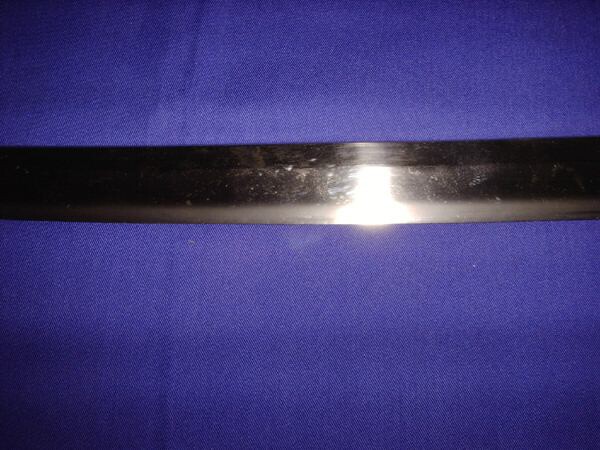
-
Ford Fortunately, the tsuba in question is plain iron with no inlay or softer metal incrustation. Much of the surface is wax free and only here and there in the shallow line carving and texture of the plate has this residue found a foothold. I think the denatured alcohol in the first instance would be the gentlest way of removal. Thankfully, we are not talking about an overall coating of wax, just the remnants of an old coating. The plate is stable and without active rust. Its rather a nice old tsuba with a bit of character. I'll post a pic or two when the alcohol treatment has been done later today, you may be able to tell me something about this tsuba. And thanks for the advice.
-
Thanks Ford. The one tsuba I have that is waxed is actually exhibiting this white residue you mention, hence my question in the first instance. The question begs whether to remove the wax or to re apply wax in order to remove the residue of the old application and renew the finish. Its a 'damned if you do, and damned if you dont' sort of problem.
-
Also other glues may contain chemical compounds and moisture retention properties that cause rusting. Even water based glues have some real nasty stuff in them. Rice glue once dry is completely neutral. Sorry John.... Just an addition to your excellent suggestion and explanation
-
Dow. I'm no expert in the field, but I have three naginata of my own. This one of yours is very nice by the way. Pole (Ebu) is early Edo I think, the blade also since it still has some size to it but has the more pronounced saki zori curve of the early edo examples I have seen. Earlier examples tend to be longer and with slightly less curvature. Nice blade........ Do you intend to have this polished?
-
The info I can get on Google suggests there are two types. One is a secretion of an insect(Japanese). The othe (Chinese ) is prepared from the sap of a tree. I can get the name of the insect and tree if you like, but I'll have to google it again. The tree sap preparation is used on wood. Can you understand why I am confused about this?
-
Thanks David...... Is it wise to use this wax? I assume it is a protective measure, but there is some criticism of its use without explanation. That's really what I was asking about. I have only one tsuba that has been treated with wax, and I was wondering whether or not to remove it or to simply leave well enough alone.
-
In furtherance of my previous post, may I venture the following thought: Attempting to separate that which we think or assume may be Japanese from the welter of influences, complicated by the interpretation of those influences by Japanese artists, of the Edo period for example, is rather pointless if we dont know or cannot quantify what is 'Japanese' in the first place. Since the Japanese as we know them as opposed to the indiginous Japanese, were originally from the Asian mainland and the artistic influences upon them and which they emulated was in the early days primarily Chinese, then it is reasonable to suppose that there is in fact no atypical indiginous Japanese art as such. Yet still there exists an undeniable quality in Japanese art that we identify exclusively with the Japanese. A quality that is neither wholly Chinese, or for that matter fundamentally influenced by any other culture. In order to identify whatever aspects, aesthetics and/or expressions of Japanese art are in fact Japanese, we should I feel, look to historical periods which occur during Japan's isolation from the rest of the world . It is during these periods when Japanese art flourished without outside influence, and surely where we might find the elements and motivations that separate Japanese art from all others.
-
**UPDATED WITH NEW PICS identify my first wakizashi*UPDATE**
sanjuro replied to jason_mazzy's topic in Nihonto
Yeah Henry. The suspense is killing me too! So far, its like foreplay without sex! -
Ibota wax....... Some love it, some advise against using it. Now I'm not a tosogu man although I own a few pieces. Consequently my exposure to this wax is minimal. I know what it is, but how is it used in relation to tosogu, and what are the pro's and con's of it? Where better to ask this question but here among those in the know?
-
Restoration, can it be done?
sanjuro replied to miner1436's topic in General Nihonto Related Discussion
Moss Dont you ever work? its the middle of the day on friday where you are. Hang on......Its the middle of the day on Friday where I am too..... Damn! :D