eternal_newbie
-
Posts
822 -
Joined
-
Last visited
-
Days Won
4
Content Type
Profiles
Forums
Events
Store
Downloads
Gallery
Everything posted by eternal_newbie
-
Looking forward to it - Shitahara work in katana, wakizashi and tanto is usually quite distinctive so it will be interesting to see what it looks like in a jumonji yari.
-
 You're in good company; it is indeed the general consensus among connoisseurs and scholars that Sadamune is superior in jigane and sugata, while Masamune reigns in hamon, hataraki and application of nie in general. In fact, Sadamune is often described as having "the finest jigane in all of Japanese swordsmithing", outshining even Rai and Awataguchi.
 -
There's chikei, and then there's chikei... And then there's Masamune chikei.
-
I really appreciate seeing people's own personal thoughts on exhibits and high-level blades like this. While I don't necessarily rely on them for my own personal evaluation of swords, it's always refreshing to see what kind of different personalities and preferences exist elsewhere in the nihonto world.
-
Congratulations on your sword going Tokubetsu Juyo! The English list of exhibits can be found here, and the English translation of the captions for the exhibits can be found here.
-
Assuming your polisher is a reputable and reliable sort, this is absolutely the case. They will likely also stress that there is no such thing as a perfectly safe polish (unless it's something very light like a shiage retouch) because even the healthiest looking blade could have a flaw revealed when some metal is removed.
-
Some possibilities for 記 based on the rough appearance of the kanji surrounding it: 南記重国 Nanki Shigekuni 英記直宗 Hideki Naomune 武州住内記康重 Bushu [Shitahara] ju Naiki Yasushige
-
Yes, looks like it was chiseled around the nakago-ana, which is generally not something you ever see, especially on older blades.
-
Japanese Sword Museum Juyo Exhibition
eternal_newbie replied to Takezo's topic in General Nihonto Related Discussion
Perhaps unsurprisingly, this blade sailed through the 29th Tokubetsu Juyo token session, and will be on display at the Sword Museum (again) over the next few weeks. You can find the English list of exhibits here, and the English translation of the exhibition setsumei here. Something interesting to note: The explanation for exhibit #11 now quite clearly states that the designation of "Shizu" refers to a group of smiths, among which Kaneuji is considered the leading smith. So it looks as if we have officially exited the period in which an attribution to Shizu should automatically be considered a work of Shizu Saburo Kaneuji (which has been the official position of the NBTHK during Tanobe-sensei's tenure), unless the setsumei specifically mentions that the blade shows his particular workmanship. -
tosho Masamune's Tomb (?)
eternal_newbie replied to Guido's topic in General Nihonto Related Discussion
@Jo92 Unfortunately, the person you are responding to is no longer with us (may he—along with your ancestors—rest in peace). -
This should be in its own separate topic as it is unrelated to the original poster's sword. That aside, the mei (inscription) reads: 小池貞信作 (Koike Sadanobu saku, "Made by Koike Sadanobu") 文久二年七月日 (Bunkyū ni-nen nana-gatsu hi, "The seventh month of Bunkyū 2 [i.e. July, 1862]") I have only managed to find one other example of a sword by this smith: https://www.nipponto.co.jp/swords6/KY331877.htm (this one was made in February, 1863). The Japanese text in the listing of this sword says that this is an alternative signature of Gassan Unryushi Sadanobu (月山雲龍子貞信), however I do not know enough about the Gassan lineage of smiths to confirm this.
-
Some say that the sword finds the owner, and not the other way around...
-
Thank you for your insights; it's great to hear from someone with more experience of Sōden-Bizen than myself. That mumei blade is also a beauty – very much kenzen, as the Juyo panel likes to say in its writeups. A serious collector would be proud to own either, but as you say: they each offer different things to the connoisseur. As for me, when it comes to Sōden-Bizen my favourite smith remains (Enbun) Kanemitsu and the dream is to own a daitō by him someday, even if the prestige of the smith and my relatively modest means dictate that it's likely to remain just that – a dream.
-
On the English-speaking side, Andrew Ickeringill is a polisher who has won awards in Japan and polished many Juyo and TokuJu-level blades, including some by Go Yoshihiro. You can view examples of his work and find his contact details at his website: https://touken-togishi.com/ Unless you are a purist who only likes one specific polishing style, it's generally best to let the polisher decide, or at least suggest, what kind of polish would suit the blade's style and activities best; sometimes they may leave the decision to you when it could go either way (e.g. if both the jigane and hamon are excellent, you might need to choose between highlighting one or the other, or somewhere in between).
-
Among modern Japanese koshirae (iaito, shinken) there seem to be two main styles - the standard tsuka type which is the slightly curved but otherwise near-uniform width form that you dislike, and the other is Higo-style, which is the slimmer, more dramatically waisted form seen on your wakizashi. I also favour the latter and ask for it when ordering iaito (and for my commissioned iai shinsakuto), even though it tends to be more expensive than the thicker "default". Among Chinese copies the problem is even worse; believe it or not, your Hanwei is one of the better tsuka from that early age of production blades. Most of them suffered from what we called "axe-handle syndrome" where the tsuka was (in addition to being far longer and wider than traditional katana) completely straight and of an entirely uniform width from fuchi to kashira, resembling the handle of a polearm or chopping weapon rather than a blade made for slashing and slicing.
-
Agreed, for this reason I cross-referenced the signature dates with the actual era dates and intentionally avoided translating anything not directly related to the historical significance of the blade. If there are any errors in what I wrote, I would welcome any corrections or suggestions.
-
Another part of this is that the way swords are used today is different; particularly the dominance of Toyama-ryu style tameshigiri and ZNKR-style iaido (which has strong ties to kendo, and thus also favours a longer tsuka). Ease of manipulation and single-handed use take a back seat to cutting power and "proper" form according to the mainstream martial arts.
-
It's possible to have both, e.g. https://www.aoijapan.com/appraisal-quiz-695/ but depending on how strong the hitatsura is, the polisher may have chosen to highlight the hamon and nie activity at the expense of any utsuri.
-
Aoi Art currently has this Chōgi (Osafune Nagayoshi) tantō up for auction: https://sword-auction.com/ja/product/31815/as26214-tanto:-bishu-osafune-ju-nagayosi-cho-gi-jowa-6-nen-shogatu-hi-new-year-1350nbthk-tokubetsu-hozon-paperkurashiki-sword-museum-estimation-paper/ Just from a glance, it's easy to see why Chōgi is considered the least Bizen-like Bizen smith; this tantō looks almost like a work by a later mainline Soshu smith such as Hiromitsu. It is signed 備州長船住長義 貞和六年正月日 (Bishū Osafune ju Nagayoshi, Jōwa roku-nen shōgatsu-hi). There's some important context behind this particular blade and mei which is somewhat glossed over in the English listing – I've provided a basic translation here as I think this may be a useful reference point for someone someday. "Until recently, the oldest known sword by Bizen Osafune Nagayoshi was a meitō called the 'Osaka Nagayoshi' and dated Shōhei 15 (1360). That tantō was believed to have been bestowed at Osaka Castle upon Maeda Toshiie, a daimyō who was a retainer and old confidant of [Toyotomi] Hideyoshi. It was then subsequently passed down through the Maeda clan as a family heirloom. However, the tantō [listed here] was recently surfaced, and the mei—dating it to January of Jōwa 6 (1350)—predates that of the Osaka Nagayoshi by 10 years. It had long been considered to be gimei and held in reserve, but after re-evaluating it in light of Tanobe-sensei's judgement, the Japanese Sword Museum [and by extension, the NBTHK] finally authenticated it. With the Osaka Nagayoshi previously established as his earliest dated work, having a blade dated earlier [than 1360] authenticated as a work of this smith was no small feat. Henceforth, the listed tantō may now officially be recognized as the oldest extant work of Nagayoshi. * Reference: TANOBE Michihiro, The Japanese Sword – A Journey Through the Five Traditions of Japanese Sword Making: The Bizen Tradition, p. 182 (The Golden Age of Osafune Swordsmiths)"
-
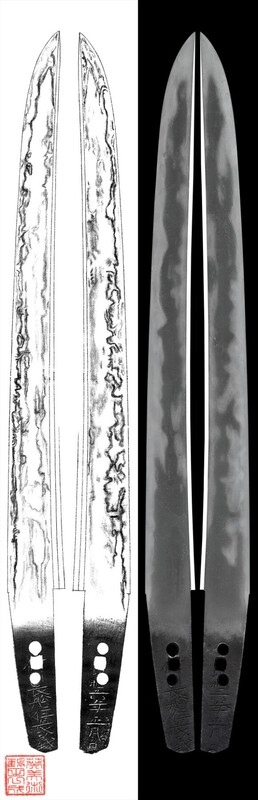
Another work by Kikuhide with a longer mei, signed as Murayama Kikuhide 村山菊秀: https://www.nipponto.co.jp/swords3/KY328328.htm
-
tsuba Signed garō-zu tsuba: Seeking information on maker
eternal_newbie replied to tosogu_eu's topic in Tosogu
As it turns out, a tsuba with a similar motif was discussed on the forum previously: -
tsuba Signed garō-zu tsuba: Seeking information on maker
eternal_newbie replied to tosogu_eu's topic in Tosogu
https://en.wikipedia.org/wiki/Okuri-inu Also known as okuri ōkami. -
Dreaming of Japan...
eternal_newbie replied to MassiveMoonHeh's topic in General Nihonto Related Discussion
Sounds like it went well. Good assembly of some heady Soshu-den names too. If they can consistently pull off events of this quality I wouldn't be surprised to see membership continue to grow at the current rate, if not more. -
That's fair feedback; even in Japan there are those polishers who are considered of sufficient skill to polish Juyo (or higher) level work, and those who are not (or as yet unproven).
-
New Member Introductions
eternal_newbie replied to Dusty62's topic in General Nihonto Related Discussion
Very true, even for contemporary blades. I've seen modern (production) blades put through the wringer for destruction testing, both online and in real life, and the difference between a blade that's brand new and one that's a single shock away from snapping in half can be surprisingly hard to tell, especially if the latter has been repolished using all the restoration techniques available to us in the modern day.