Jesta
-
Posts
230 -
Joined
-
Last visited
Content Type
Profiles
Forums
Events
Store
Downloads
Gallery
Everything posted by Jesta
-
Looking at the images in the listing it would appear that the silver is some sort of wash or thin plating, since it was wear patterns consistent with the ana being used. Very interesting to see this as a feature. It is very subtle, but effective.
-
Nice piece. Is the silver a finish, or an insert? I have seen gold trim inserted into the ana to line it before.
-
SOME THOUGHTS ON BEGINNING THE COLLECTION OF TSUBA by Arnold Frenzel
Jesta replied to Spartancrest's topic in Tosogu
Thank you for making the effort to get this into a useable form. -
Thanks Dale. My guess would be that these were probably produced in large numbers. Possibly, as Jake has suggested, they were to serve the market around the sakura viewing season, something nice to take back home and give to friends or family. Maybe a whole collection of workshops producing similar designs, copying from each other, and putting their own flair on.
-
I see warning signs here too… The waves and figures are not crisp and there appears to be artefacts left over from a casting process. The sekigane appears to be cast too.
-
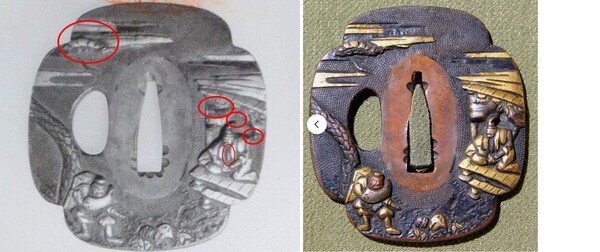
If you look at this comparison, these are the things I noticed: 1. The top of the pine appears to be closer in the papers’ picture. 2. The area above the man’s head appears to be concave in the papers’ picture, and convex in the tsuba. 3. There are missing ribbons/leaves/something in the papers’ picture. 4. The end of the saya is missing in the papers’ picture. 5. The man has something on his chest in the papers’ picture, which he doesn’t seem to have on the tsuba. All of them could be artefacts of the photography in both pics, but they would be enough for me to feel very unconvinced that the picture in the papers and the tsuba itself were one and the same… Given that the Nagoya-mono were apparently mass-produced could it be a very similar design married up to a set of papers at some point in its past?
-
(No accusation intended against the seller, but possible that the papers came from another piece, and got married to this one at some point?) I tried an overlay between the picture of the tsuba and the picture on the papers, and they mostly match up. There are other apparent differences, but they could be due to the poor quality of the photo on the papers. When I do an overlay in Photoshop it does look like the nagako-ana has been enlarged at the bottom, so you may well be right. I am surprised that anyone would do this in this day and age to an antique, but there you go…

-
I’m going to call “suss” on this… If you look at the image in the papers, there are definite differences between the picture and the tsuba offered. I can’t see the picture of the papers clearly enough to see more, but the top and bottom of the nagako-ana seem sufficiently different to call this into question. Do people fake papers as well as tsuba?

-
One thing that did occur to me was that if these are foreign ships then the cross might be a symbol to denote that. It could be artistic shorthand for “foreign”, but that is really speculative…
-
My knowledge of nautical history is severely limited, so I can’t say whether it would be a foreign ship or not. I would say that it doesn’t need to be a capstan: tillers, bollards, and other items on boats and ships of all types also have a cross design. See here as a quick example: My best guess is that art like this (as with other cultures) adopts a relatively standardised shape to depict a certain type of thing (e.g. a ship) with certain key items that help identify it to the viewer. Given the number of things the cross-shape could represent I’m afraid that I can’t see the crucifix as being a more parsimonious hypothesis. Happy to have my mind changed on this… I am interested in why the extreme curl on the bow of the ship was included. I can’t think that this is representative of Portuguese ships of the time (or others that I have seen in pictures), unless it was a super-stylised form that had become common for some reason.
-
This came up in an earlier discussion: (see page 3 for ships) It appears that the cross-like shape is more likely to be a capstan or other ship part, rather than a crucifix. Occam’s Razor would indicate that this is a more likely explanation…
-
The signature looks way too clean and clear for the wear on the rest of the tsuba. The Sothebys one is a good example, there the signature is not raised and clear.
-
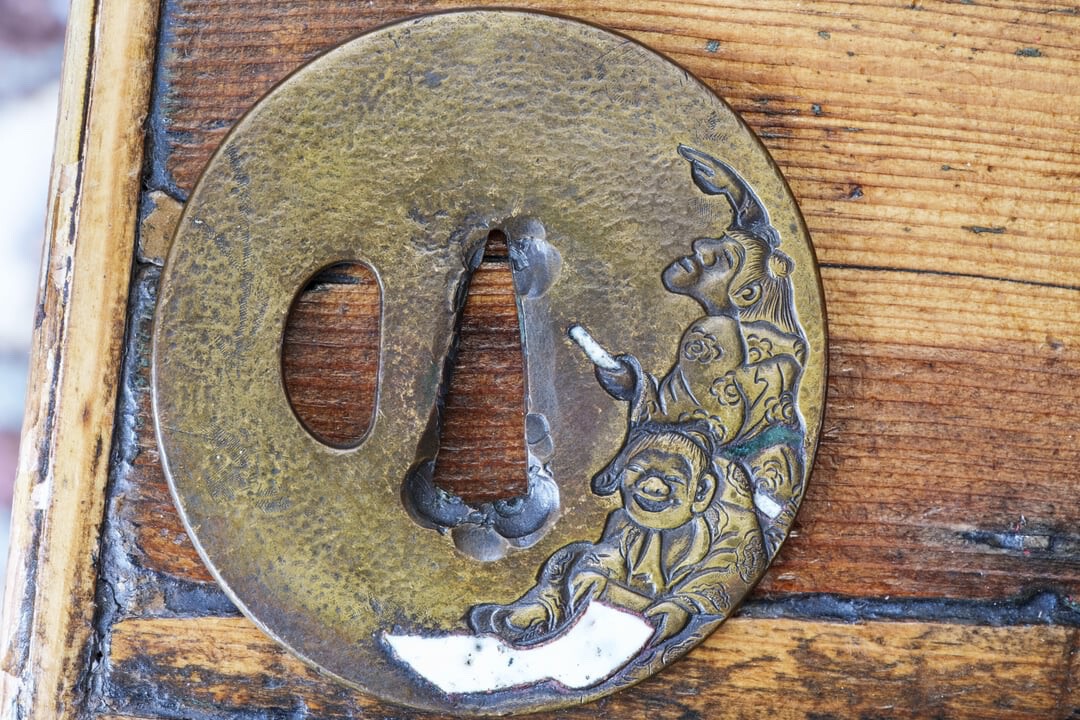
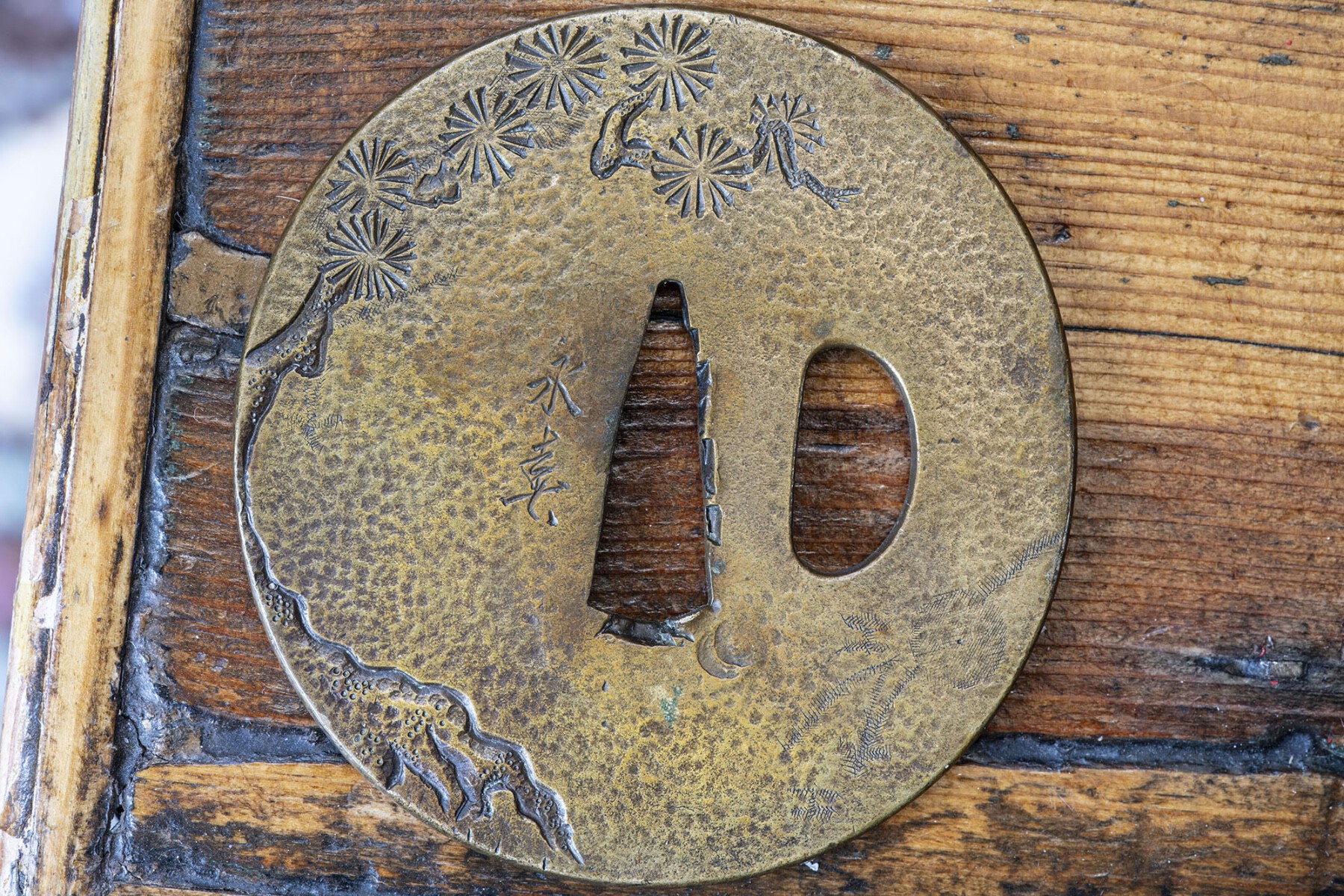
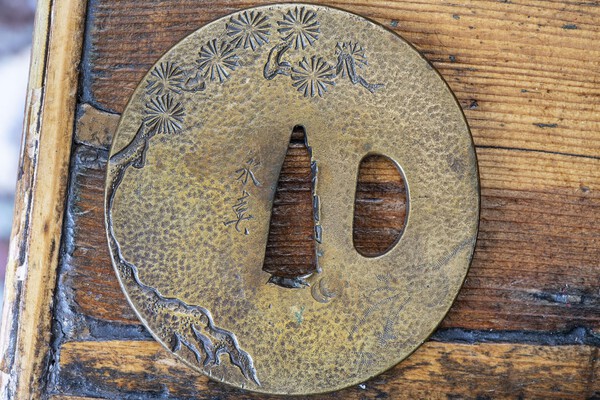
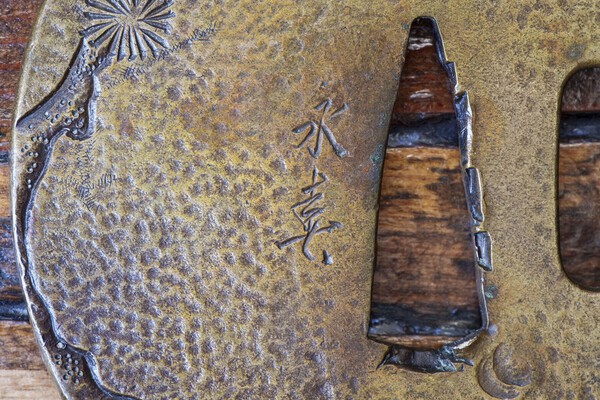
I am training my eye for bad tsuba… This one cropped up in my Reddit feed. My initial instinct is that is a modern fake. Can anyone tell me if I’m right/wrong on this? My reasons are: 1. Feels off… hard to say for sure, but it doesn’t feel quite right. I realise that this is non-falsifiable, but hopefully it will become clearer below. 2. The figures seem to be crude and unrefined. There are crude and unrefined figures on genuine tsuba, but these feel really poor quality. 3. The carving of the design and the signature doesn’t look sharp enough to have been carved, more likely to have been cast. 4. The damage around the nakago-ana feels like it should be linked to multiple mountings, but there is no wear on the seppadai. The damage also feels inauthentic. 5. There are weird cross-hatchings all over the tsuba which don’t seem to serve a purpose. 6. I haven’t seen colouring like the green and white on the figures on an authentic tsuba. Have missed anything obvious, or mischaracterised anything?

-
It would make sense for this to be something more decorative for the wealthy non-samurai to have bought. It’s for a smaller sword, so something that could be carried by non-samurai in the Edo period. It’s not very high-quality, but attractive enough to be appealing, either as a present or just as a nicer piece on a sword. I think that it has been mounted at least once (there is a small mark at the top of the nakago ana), but doesn’t seem to have been remounted, so it probably was not highly-prized.
-
Thank you all for the insights so far. If it is a fake, then they have gone to a whole lot of trouble for not a huge reward… The wear pattern and the rust look pretty authentic. The one I have is different from the eBay one, they are not identical copies (as you are careful to note ) so it would seem more likely to be makers copying each other’s designs.
-
I went to the very small market at the Hanazono Shrine this morning. There were quite few pieces of tosogu ranging from the fake to the old, from the reasonable quality to the really rough, and from cheap to expensive. I picked this one up for a reasonable price, it seemed to be the best balance of the lot. It’s iron, with brass inlay, slightly proud of the surface. It’s small, about 4.5cm x 4cm (guesstimate, I don’t have a ruler on me). Any thoughts on the theme or origins?


-
Thanks everyone. Sadly, I arrive on the 28th, and leave on the 4th, so I will miss both of the recommended markets this trip. I will have to look them up next time, I go.
-
I’m visiting Tokyo at the end of the month, does anyone have any suggestions for markets for tsuba shopping?
-
Definitely the lefthand one. (see above, but I bid on a very similar one as a single lot, and lost). The problem with comparing from pictures is that you really have to go on the quality of the picture to start with. Many sins can be hidden with some creative lighting… I also don’t like bidding on mixed lots because you tend to get some crud with some not-quite-cream… (Edit) Criteria: Artistic merit - the way that the dragon moves through the tsuba is very appealing. Skill: I really appreciate good quality nanako, but I am sometimes swayed by overall design or “feel” (which is why I liked the tanto tsuba posted above) Fit: It needs to work with my current collection as much as possible
-
I think that I lost the auction on that one… Looks very similar to one I bid on once… edit: Looking at the Bonhams link, it wasn’t the one I bid on. That was a single lot, but looked very similar.
-
If not the same person, then probably a high chance that they were made in the same workshop. Given the preference for nanako tosogu with family crests for formal occasions they were probably produced in large quantities.
-
Nice piece. I have one that is almost identical. I really like these little tanto tsuba. It’s interesting to note that yours has space for both a kogatana and a kogai.

-
Well Jean… In my day job, I’m a teacher, so I try to live in the belief that people can learn (despite evidence to the contrary) 🤣🤣
-
You aren’t wrong… It goes with the territory, which I think is why the best advice for beginners is to avoid the auction sites that take no responsibility for what is sold (e.g. eBay), to be prepared to make a few mistakes, to keep those mistakes as cheap as possible, and to learn from them… Threads like this do help, since there is a good chance that someone looking to start collecting may well wander in and read them before buying.
-
Too many red flags for me. The sekigane and the treatment of the water are very similar to one that I bought at the start of my collecting journey: I would find it hard to think that this one is not a modern cast.