Jesta
-
Posts
270 -
Joined
-
Last visited
-
Days Won
1
Content Type
Profiles
Forums
Events
Store
Downloads
Gallery
Everything posted by Jesta
-
I can’t quite see, but if your decoration is silver, or brass, then a little careful application of some polish might bring it out, I like it. These little tanto tsuba are really pretty.
-
Thanks. I was tentatively going in the direction of Nagasaki too. Only because of a hunch really.
-
I meant to ask… Does anyone have any suggestions for the origin of work like this? Also, any suggestions for the shape at the top? Bird?
-
I have had this little tsuba for a while now, and it has always been a bit plain. I could see the pattern in a good light, but I had resigned myself to the fact that it was probably corroded and faded away. I then had a bit of a brainwave and thought that the scrollwork might be silver and therefore just in need of a bit of a polish. Here’s the before and after… It’s not something I would do to a good piece, but this was so far gone that I figured that there was not a lot to lose… But I am very pleased with the outcome.

-
Sensible move. Gotta set a limit and stick to it… There’s always “one more bid” otherwise.
-
Very useful. Thank you.
-
I don’t normally like plugs, but this one is my favourite… (shared previously)

-
Not sure that the second one is Goto. The nanako looks a bit crude, but that could be the patina letting it down. However, the first and third seem pretty high quality. Looking at the image in the book shared by Jack (thank you for the resource) the dragons on mine, and your first and third, seem to share the same characteristics: Long, sinuous shape with four legs Heavy eyebrows Flowing moustaches (?) Three claws in the same style Long, thin spikes along the back Same scales at the chest, and along the back The ken-blade tail The tama pearl They are all set against very detailed and close nanako, which I understand to have been a Goto speciality.

-
My own take is that you can collect for aesthetic reasons first. It remains important to me to collect pieces that are authentic, but I am less worried about being able to attribute each one to a specific school/maker/time etc. You can also look at this hobby as one that you will always have something to ask, you will never end up feeling like you have finished, which is something that I personally appreciate. Every collector of the arts has to contend with the fact that people have been forging stuff since the beginning of collecting. So, get to know the stuff you like, and accept that some of your collection will be questioned from time to time.
-
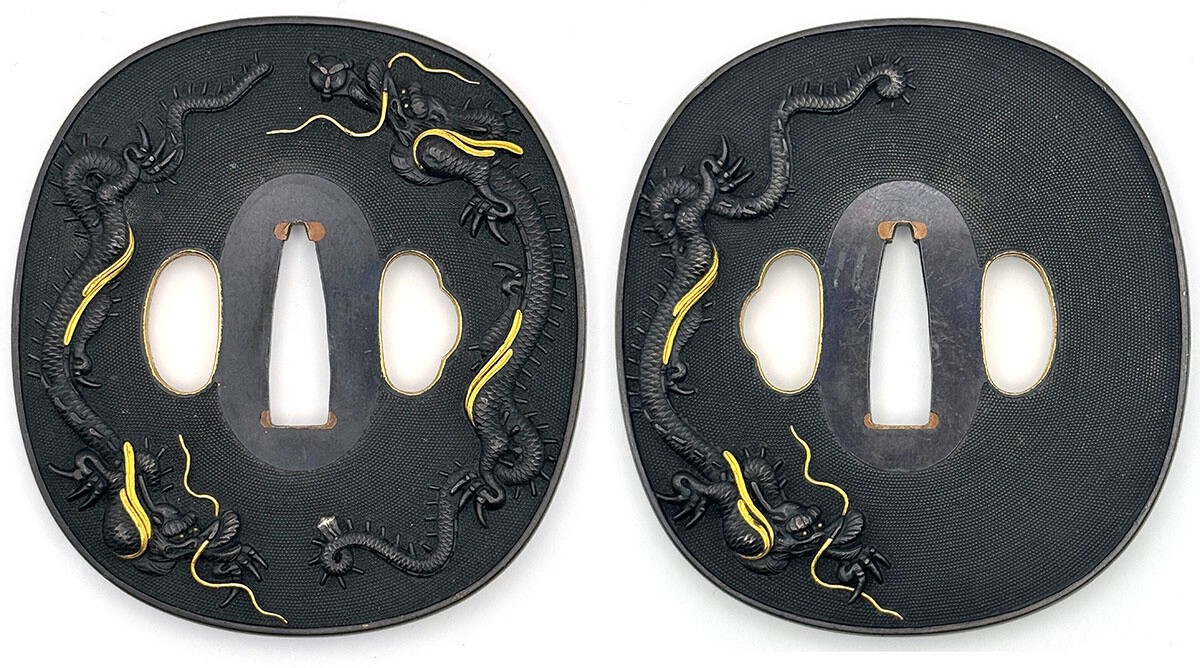
I picked this daisho set up recently. When doing some research on the board (and elsewhere) I noticed that there were some comments about how Goto dragons have certain characteristics. Could anyone point me to any resources on the Goto school and what characteristics their dragons might typically have? There seems to be a wide variety of ways to depict dragons, so any other types would also be welcome for comparison.


-
That is beautiful. Really a worthwhile restoration. Congratulations to you for seeing its potential and to Manuel for the outstanding work.
-
Impressive piece… This is the sort of thing that I refer to as an “anti-tank” tsuba. It seems to be pretty solid and weighty, definitely something that is built to last.
-
Thank you both. Dale, you continue to amaze me…
-
My brother was given this tsuba by some friends. It has NBTHK papers… Any info on the origins or comparisons would be appreciated. Thanks.


-
I can’t comment on the mei, but the rest of the tsuba doesn’t look like Goto work. The nanako look cast rather than punched - take that with the appropriate amount of salt given that I can only look at the photo… This is an example of Goto school work with figures: https://www.bonhams....arly-18th-century-3/
-
Thanks for the clarification. The golden look was unexpected
-
What material is it made of? The gold sheen is not something that I have seen very often…
-
The halo seems to come from ancient Roman and Greek depictions of the gods, particularly the sun gods (with a sun behind their heads). See for example: https://www.research...hrist_fig3_319605856 The same seems to be true of the depictions of angels, where they are depicted as very similar to Greek gods and goddesses with wings. The Biblical descriptions of angels are wild… great balls of eyes and stuff, not the human forms we are used to.
-
I have no idea how they get to “Christian” from either of those… I suppose that they could be Christian, but the representations do not seem to be explicitly Christian.
-
I find this one interesting since it also bears a strong resemblance to the halo of the Buddha. I am not sure how you would be able to immediately attribute it to Buddhism or Catholicism, although that may have been the point… There seem to be a lot of cultural similarities in how the divine is represented, with the Christian halo coming from depictions of Greek deities, and halos also appearing in art from the East, and being depicted in very similar ways.
-
Just received my tsuba from Grev (@kissakai). Very happy, they are beautiful. He was very responsive and helpful when the Royal Mail messed things up. Can recommend him as a seller.
-
Nice nanako background, and I like the rope work. Very nice find.
-
I was given two when I was around 15. I lost one, but still have the other. I have always loved Japanese art, and the connection with my past led me to look at tsuba again. I fell in love with the way that artists take a very mundane item (a sword guard) and turn it into a thing of such beauty and style that it becomes a thing on its own. I love the way that the artists use the constraints of all the different tosogu pieces to make their stories and art visually appealing.
-
Off topic, but I went to East Malaysia to photograph and write about proboscis monkeys…
-
90 degrees is interesting, and I would say that it counts for this taxonomy… Twin lobes, mirrored. The Myoga tsuba is really nice. I remain in awe of your sleuthing abilities…