Jesta
-
Posts
273 -
Joined
-
Last visited
-
Days Won
1
Content Type
Profiles
Forums
Events
Store
Downloads
Gallery
Everything posted by Jesta
-
Quick update: I have been in touch with the auction house. They have agreed to reassess the tsuba and said that they will refund me if they agree with the notes I gave them. I am going to send it back to them today. Fingers crossed. Quite impressed with the willingness to reconsider.
-
I think that Dale has nailed this one. The painting looks almost identical.
-
The root part looks very like ginseng, but the leaves are wrong. There is always a good chance that the artist wasn’t that good at depicting plants, and just went with the space available.
-
It’s all good, I’d rather know, and thanks for your offer.
-
Hi all. Thanks for the notes. To put this to rest… Matsunoki is right, or so I believe. I have run a couple of simple tests to see if it is silver or polished iron. I can’t find any evidence that it is silver, and when I rub the darker areas with a tissue they come away with iron rust colour, so I am going to assume that it is indeed iron. I have written to the auction house to complain that their description was inaccurate and asking for some action, no idea if they will respond with any except a form email, but we will see… I am sad, because it was a piece that I was quite excited about. It is not a cheap mistake, but I am somewhat sanguine about it. It’s still a piece that I like looking at, and learning is always valuable in the end.
-
Thanks for this. I can’t see the first one clearly, but I will check out the book.
-
Thanks. I was the bidder…
-
Interesting point, but I think that it is more likely that the artist wanted to leave the cross-hatching to keep the material-like texture, which I understand to be one of the ways to use this technique, much like nanako resembles silk (and something that I like). (see here for another example: https://japaneseswordbooksandtsuba.com/store/tsuba-kodogu/q784-higo-tsuba-hozon-to-kumagai/) The fact that the pattern covers the whole surface would indicate that the this wasn’t put there just to hold the the design in place. In your example, the technique has been used for exactly that, and only for the design, rather than for a material aesthetic.
-
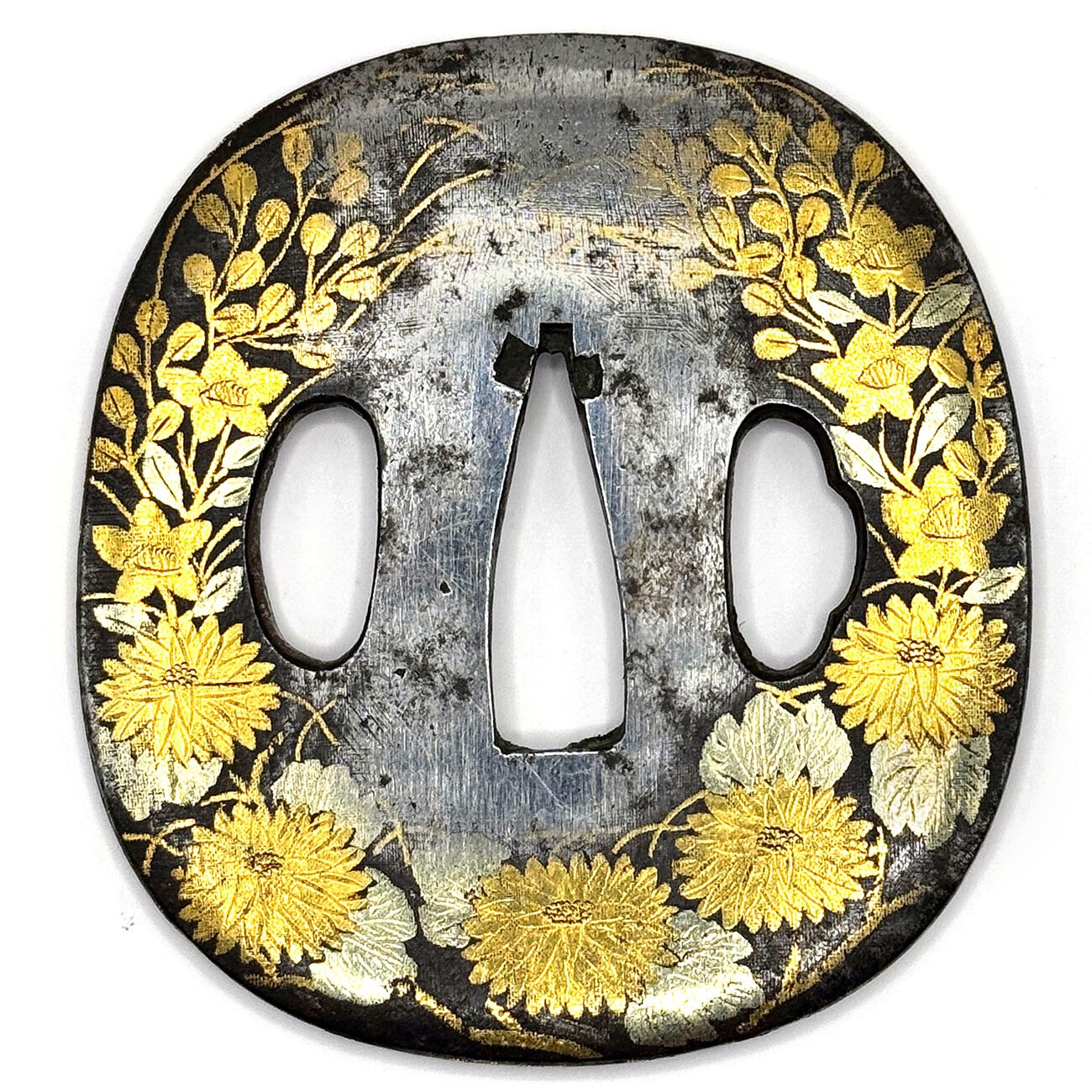
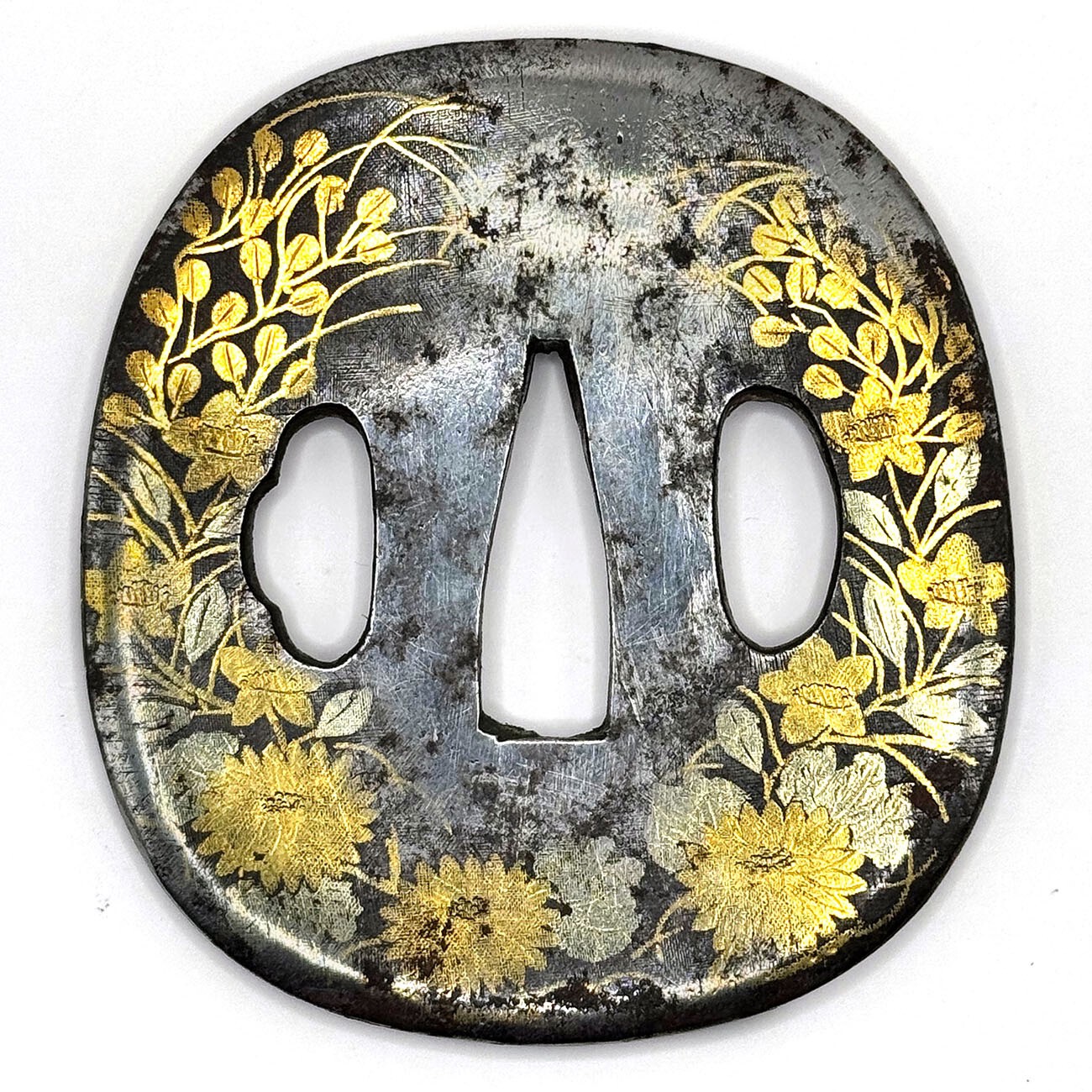
This one has just arrived, and I am sharing my excitement… It is iron, and has some good nunome-zogan, using two different shades of gold, with the ground in what I think is silver. This one in the Ashmolean looks like similar work (https://jameelcentre.ashmolean.org/collection/921/per_page/50/offset/200/sort_by/date/category/other/start/1799/end/1895/object/21029), but doesn’t note a possible origin. Does anyone have any ideas where it might have come from?


-
I think that it is largely going to depend on your budget… I did see this one: https://www.aoijapan.com/tsuba-mumeiunsignedkaga-kinko-nbthk-hozon-tosogu/ Or this one: https://www.zacke.at/auction/lot/58-a-fine-silvered-iron-tsuba-with-autumnal-flowers/?lot=75950&sd=1# (I bought this one, waiting for it to arrive)
-
Very pretty. Are you looking for theme, or to match the crafting type, or both?
-
More information on the battle of Uji here https://www.militaria.co.za/nmb/topic/51989-race-across-the-uji-river-1180-tsuba-and-fuchi-kashira/
-
Raise to $190
-
Then, I will go to $160
-
$140…
-
Yeah… that’s what I did when I saw it. It felt off, so a reverse search and so many examples come up. I am very surprised that an auction house like Christies would allow this sort of crap to go on sale. Again, a little bit of research would show that it’s at the very least suspicious enough to pull…
-
Thanks… I was just doing a reverse image search, and came across one of the discussions… I came on here to edit my post The one for sale now at Christies looks almost identical to the one Dale posted, it may even be the same one…
-
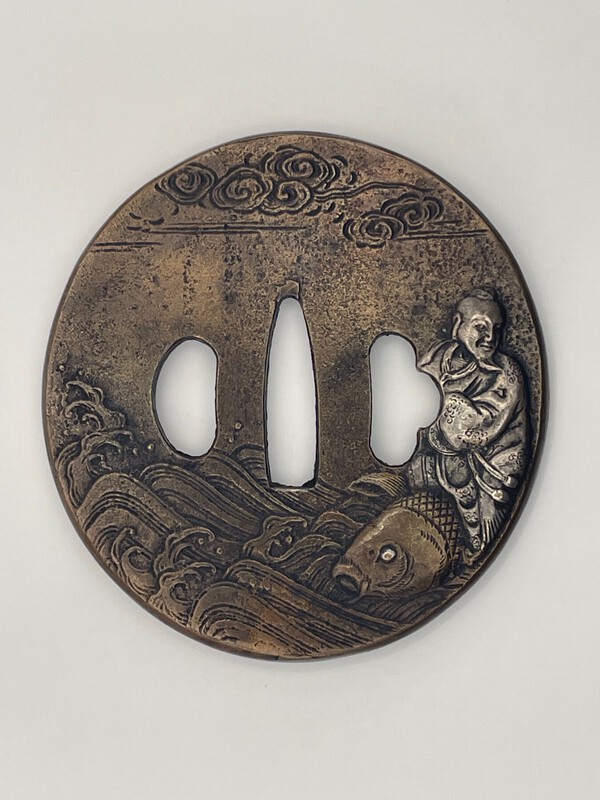
What do you all think of this one: https://onlineonly.christies.com/s/art-asia/soft-metal-inlaid-metal-tsuba-shoki-652/260894?ldp_breadcrumb=back It is a design that seems to come up a lot, both Bonhams and Christies have sold (or are selling) tsuba with this exact design. Looks fairly suss to me…
-
$100 from me
-
Alfred Church’s words hit hard… I reckon that a 1000 would be a reasonable number to end up with. I shall continue working towards that goal
-
Post some more photos, close-ups and other side. Also search up the terms that Dale mentioned. There will be a lot of info in other threads on the board.
-
My initial instinct was that this was a modern copy. I’m glad to have been wrong 😀
-
For some reason, this design seems quite popular. When I do a reverse image search it turns up quite a lot:
-
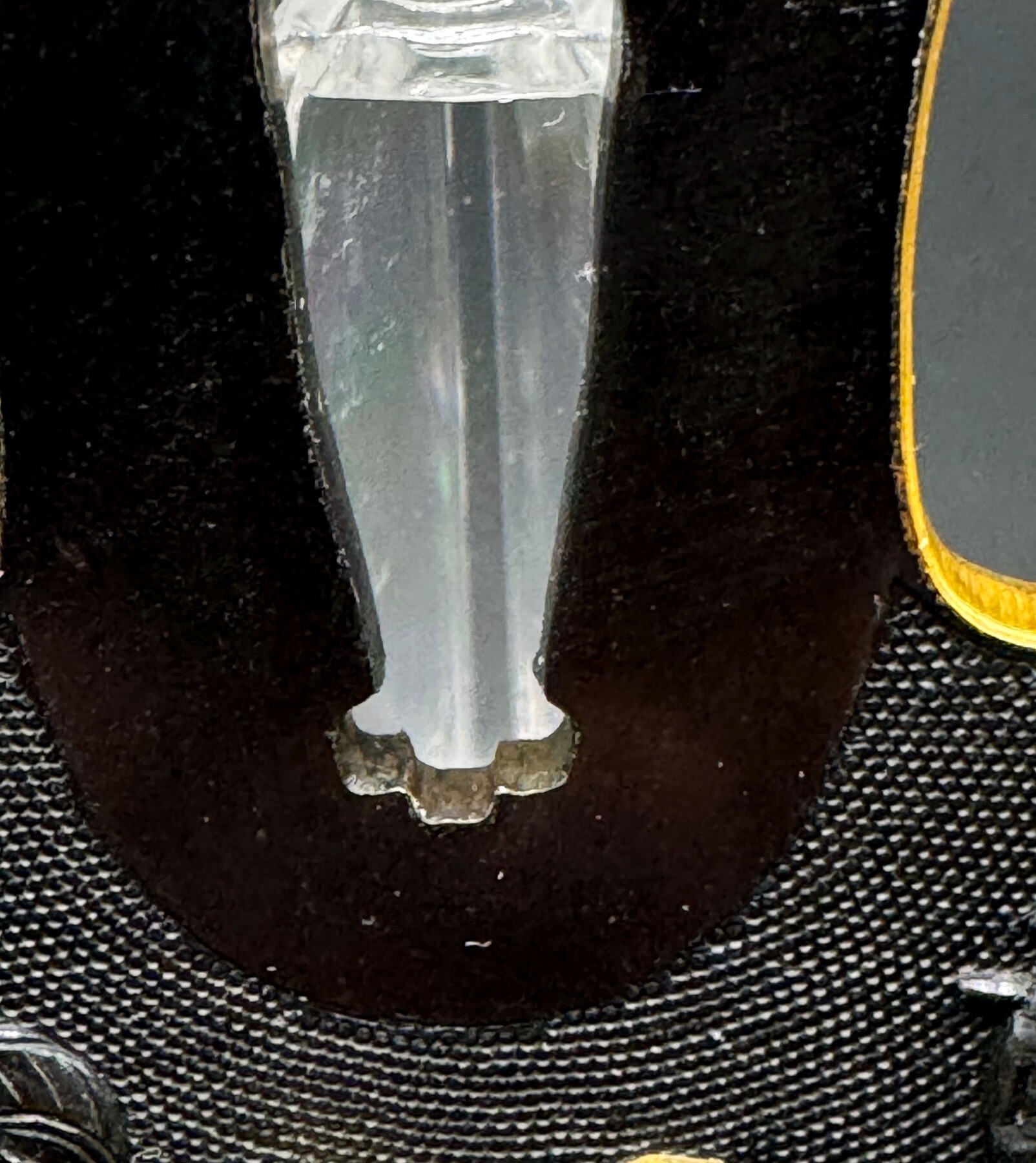
I think that on some of the higher end pieces the sekigane was applied very carefully, and even smoothed back to blend with the main body of the tsuba. I have a couple of examples of this, one with the sekigane in place (but you can clearly see that they are copper and not coloured parts of the main body), and one with the carefully carved spaces for the sekigane left unfilled (shot upside down so that you can see it clearly). Looking at these it appears that the smith (or person who out the tsuba onto a blade) had carefully carved spaces for the sekigane (rather than just chopped the usual holes we see so often) into the nakago-ana. These were then filled with copper, and then the copper was carefully ground back to a smooth finish, and fit with the tsuba.


-
I am sure that Dale will have some examples, but I have not seen any obvious fakes with nanako looking that clean. This is especially true of pieces where the nanako goes over a rounded mimi. It may be possible to cast something like this, but so far every attempt I have seen at mass-produced nanako has ended up with muddy and relatively large nanako, which don’t look convincing. The figures and clouds are too low-res for me to make any other comment, except to say that to my eye they look ok. The changes in colour in the sekigane are likely to have been caused when the piece was removed from the blade. The friction would have scraped any patina off.