cabowen
-
Posts
6,786 -
Joined
-
Days Won
10
Content Type
Profiles
Forums
Events
Store
Downloads
Gallery
Everything posted by cabowen
-
From what I can see in the photos, it doesn't look to me to be Muromachi. I can see why they would say gendai. The nakago and mei are very crisp. Many Muromachi period mei are quite rustic- this one looks like modern calligraphy...The jigane looks almost too clean and orderly for a Seki Muromachi period blade. There are several areas we can not see which would help in determining the age- is there ubu-ba? What does the hamachi look like? The mune-machi- has it been polish several times? Etc....
-
"kaeri" means "return" and needs an adjective with it to mean anything...."kaeri fukai" or "kaeri nagai", for example. You can surely find exceptions to the general rule if you look around but be sure to consider all factors when arriving at a conclusion.
-
Good looking blade on ebay.
cabowen replied to bigjohnshea's topic in Auctions and Online Sales or Sellers
-
I can make out parts of it but not enough to translate a complete meaning. It is probably part of a poem or song. There are a few people here who could translate this; perhaps they are working on it and will post...give it some time....
-
A general, rule of thumb, if you like, is the longer the turnback, the later the blade when it comes to koto. Nakago looks Muromachi to me. With that kaeri, that would fit...just speculation...
-
I didn't want to mention the use of a file as in the wrong hands and without experience, you may either cause damage or not know how to "read" the result. Using a soft metal to rub against a sharp edge is the standard way to tell, as Brian demonstrated, with a sharp sword. Since yours isn't sharp, that won't work. Standard hardness testing puts a dent in the test piece which while small isn't something I would want. Ultrasonic testing is a better route. Call some local machine shops to see if they have an ultrasonic tester- they might test it for you.
-
Good looking blade on ebay.
cabowen replied to bigjohnshea's topic in Auctions and Online Sales or Sellers
Maybe Eisho 3 Nen 8 Gatsu hi... 永正三年八月日 -
The edge being dull and thick is what you would expect in a blade that has yet to be polished...It may have had only the first stone or two, then they stopped....Just conjecture, like I said. Just have a window done on it. Then you will know if it is hard or not. Shouldn't cost much at all.... Morita san is indeed a treasure...
-
Good looking blade on ebay.
cabowen replied to bigjohnshea's topic in Auctions and Online Sales or Sellers
Ubu, sue Soshu....Soshu ju Kunitsugu.... -
Shinano no Kami Fujiwara Daido Shinano no Kami Minamoto Nobuyoshi edit: duh, two swords indeed...removed joint comment as Mark is correct below.....and I agree, the Nobuyoshi looks very sketchy....
-
Personally, since I primarily collect swords for their artistic merits, which are only visible in a polished blade, I would find little of interest in a blade that has not been polished. While indeed interesting from a historical perspective, without any additional background, provenance, etc., to me it is just an unpolished blade....just my opinion. Of course, there may be a variety of reasons why it wasn't....could be it was found to have a hagire, as one possibility. No doubt there are many possibilities and we could conjecture and spin rationale for pages, but ultimately, it is something probably never known for certain. I would have it polished, but again, that is just me....I'm curious to see what the other interesting item is.......
-
With the mei being cut and the sori complete, it is almost surely hardened. You would need to have a window done to know for sure....or etch it with vinegar, which I would not advise....
-
The MIkawa smith moved to Hokkaido late in life. He was from the Naotane group.
-
Normally the mei is not cut until after the edge is hardened but it wouldn't surprise me if it was made for some type of offering, kabuki, or other such use, that it might not be hardened. I would bet it is hardened but I know of one other large blade (2"+ wide, wakizashi) signed by a Sukesada that was never hardened and probably made for display or some other non-use... Very interesting sword though...There are two shinshinto Naoyoshi in the Meikan. One from Dewa, one from Mikawa.
-
Excellent job! Very detailed with well documented research. I was pleasantly surprised to see a few blades by the smith Oguri Motoshige, having brought him to Chicago for a show some years back. He is an excellent smith and a very talented hori-shi as well...
-
For every one of those jackpots, there are probably 10,000 or more sad stories....caveat emptor has never been truer, even if you have done your homework...
-
nidai minamoto yoshichika saku kore
-
life and death perhaps...
-
There are many surprisingly nice WWII era blades by smiths whose names remain in the shadows. I am often approached by people wanting advice on starting out/collecting gendaito and my mantra is to learn what a good sword is and then collect them, rather than names, as that is where the bargains often are...While this has some condition issues, it is obviously in a different league than the usual mass produced showa-to and could prove to be a very enjoyable blade when restored.
-
I best retract my comment as this looks traditionally made.... There are several Seki smiths who worked in Bizen den. Not many, but a few...
-
That is very interesting! Thank you!
-
Curtis, I think it is in good enough polish for shinsa. You could choose the low cost route and submit for shinsa in 2016 in Tampa. That gives you time to save some money for a proper polish if it warrants the expense. There is a fully trained polisher in Canada, Takeo Sakai I believe his name is...You could contact him regarding a polish should you go that route as it would probably be less costly than sending to Japan, though I could be wrong...
-
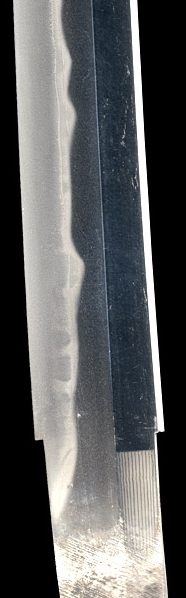
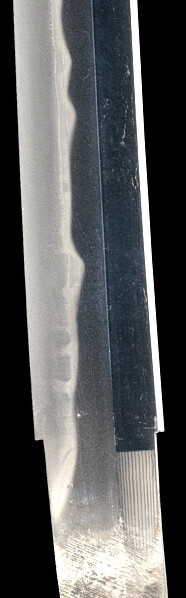
It is indeed Nakata Kanehide; made when he was 72. Not exactly typical style for him...From the Sanmei web site, the hamon at the hamachi is a typical choji, then it changes to what appears to be midare. It was probably a bit cooler at the hamachi, and formed the choji, but hotter above and formed midare instead...Sometimes these things happen...
-
応法光院 山崎旭勝 六十三才需 Made at the request of Mr. Yamazaki Hiyoshi (not sure of the pronunciation) of the Hoko'in (a temple probably) at the age of 63
-
Hi Chris, I have asked this to Yuji of Tokugawa arts sword. I am waiting for his answer. Thank you for the observation. Is it possible that in Japan, a smith's student can use the signature of his master if they forged the sword together? Sure, but most students make work in line with their master.....I am not saying this can not be Nakata, just that the difference in work styles makes me wonder...