cabowen
-
Posts
6,786 -
Joined
-
Days Won
10
Content Type
Profiles
Forums
Events
Store
Downloads
Gallery
Everything posted by cabowen
-
The tatara process that produces tamahagane also produces cast iron. It is one thing to make cast iron, quite another to cast it as Ford has illuminated....
-
Perhaps this photo was taken during the visit of these same people to the ceremony at the Minatogawa Jinja? Any idea Morita san who 丸一さん is?
-
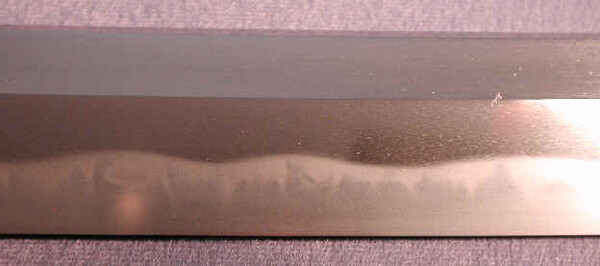
I wonder if this is Nakata Kanehide who worked during WWII???? Workmanship is quite different (soshu nie versus bizen nioi). Possibly a different Kanehide? Here is an example of a typical Nakata Kanehide ji-ba:
-
Hmmm, I thought I made a rather compelling case for it to be ubu??? As others have said, it's a nicely made sword. It's good you are hitting the books and trying to make some sense of it. By all means, get it to shinsa and share the results when you can....
-
I have no idea what view the NTHK-NPO holds as I have never discussed this with them. Next time I have a chance, I will inquire.
-
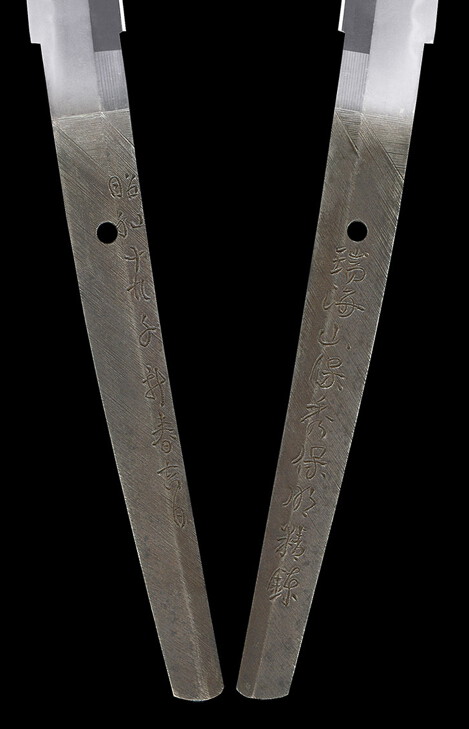
Interesting how they both sign with the same 俊秀門人. Are they both similar in workmasnship too? I have seen a tanto by Numazawa Toshimitsu signed the same way... The Yasuhide tanto was made after Toshihide had passed away. I imagine several students stayed on after he died and continued until the end of the war. I would bet a good place to look for info on these two smiths would be the book on the Horii family published some time ago titled "Enishi" if I recall correctly... I would wager that Horii Toshihide made more tanto than any other gendai tosho. Horii Toshihide is said to have had 10 students. We know that during the period November 17-23, Showa 15, Horii Toshihide attended a sword forging ceremony to commemorate the 2600 year of the empire at the Minatogawa Jinja. He went with 7 of his deshi. Those seven students were: 堀井信秀 (his son Nobuhide)、堀井胤次 (his son Tanetsugu)、渡部保秀 (Watanabe Yasuhide)、沼澤俊光 (Numazawa Toshimitsu)、長谷川俊長 (Hasegawa Toshinaga)、中尾忠次 (Nakao Tadatsugu)、藤田忠光 (Fujita Tadamitsu (brother of Tadatsugu). Tadamitsu and Tadatsugu were from Hizen and spent only a short time with Horii. Since we don't see Arisaka Yasuaki in this group, he may have become a student after Showa 15.... Please find below a joint work made by Yasuaki and Yasuhide. It looks just like a typical Toshihide blade and the workmanship looks first rate... I found this info which may be of use: Yasuhide was the early mei of Yasuhide (different kanji for Yasu 安). He was born in Taisho 4 in Sobetsumachi. He became a student of Horii Toshihide in Showa 12 at Horii's forge in Muroran. He retired from working at the forge for the Nihon Seikojo in Showa 50 and moved to Wakagusacho where he opened his own forge and signed his works "Hokushu ju Watanbe Yasuhide...
-
Not sure I would call that ko-nie Ron....looks pretty big to me... Not sure which Akihide you are talking about...Not aware of any Akihide students of Horii Toshihide. Do you mean Kurihara Akihide? I don't think he studied under Toshihide... Tanto looks nice! Thanks for the pictures.
-
actually, most walls were covered with a coating of lime based render called shikui but your point is valid nonetheless; blades were not sharpened on walls....
-
I have had swords treated with both choji and camellia oil rust. The appeal to me of the Break Free Collector product is that it was specifically designed to prevent corrosion for extended periods, has been tested, and has been proven by testing to do exactly what it was designed for.
-
On NHK tomorrow
cabowen replied to Ian's topic in Sword Shows, Events, Community News and Legislation Issues
Indeed, let's..... For those who missed it, the program was about the master polisher Sasaki san and his two current live-in students; he states his belief clearly that the live-in apprenticeship is the only way to properly learn the craft. One live-in student has been with him 9 years, the other, about ready to go independent, 11. They spend most waking moments learning the art. One of his former students, who has won first prize a few times in the polishing contest, still comes by when he has questions to consult his teacher. During the course of the program we see the students interact with their teacher as he critiques their work and offers suggestions and encouragement; this back and forth is a crucial part of their training and is seen as essential in advancing their development. The program illustrates quite plainly the long and difficult schooling endured to become a properly trained togi-shi, making it clear that it isn't something one learns on one's own, be it from books, video, or even a few weeks or months here or there of guided instruction. In this regard alone, it is an invaluable must see.....By all means, do... -
This is my favourite piece.
cabowen replied to Nickupero's topic in General Nihonto Related Discussion
To each his own... -
On NHK tomorrow
cabowen replied to Ian's topic in Sword Shows, Events, Community News and Legislation Issues
Hopefully it succeeded in providing an insight into why some of us have been vocal in our belief that any amateur polishing should not be pushed nor promoted. -
It's his family name and the smith choose to include it in his signature....just that simple.... Any pictures of the tanto? Is it dated?
-
On NHK tomorrow
cabowen replied to Ian's topic in Sword Shows, Events, Community News and Legislation Issues
Wow, I really enjoyed this....I thought it very well done and it showed clearly the character and personality of Sasaki san, the very picture of a traditional craftsman. I only have met him a few times but he is exactly as depicted. A treasure of a man... Good to see lots of familiar faces as well. Note that the contest was not the NBTHK contest, but that of the newer group of craftsman that was formed awhile back. This will be broadcast several more times today. Catch it if you can. It is a rare window (pun not intended) into the world of the togi-shi.... -
On NHK tomorrow
cabowen replied to Ian's topic in Sword Shows, Events, Community News and Legislation Issues
starts here in about 9 minutes: http://www3.nhk.or.jp/nhkworld/ -
Yes, I haven't changed the kanji- the meaning is the same...
-
Ah, the restorative powers of uchiko.....
-
maybe.... 小菊散圖鐔 - ki kiku chishi ko-giku-bara zu tsuba
-
Here are the words of John L. posted in reference to another Soten example that was posted here: As I said, I am not a tsuba expert, just playing the percentages. Perhaps your pictures aren't doing the item justice or I should put my glasses on! In any case, like I said, let's see what those who specialize in this area have to say....At least now you know where to look!
-
I'm hardly an authority when it comes to tsuba so I could very well be wrong, but there are boatloads of fake Soten around and like a Kotetsu signed blade, it is usually almost a sure bet that the signature when found is false. You might google as I suggested and compare valid pieces to your own. I am sure others much more knowledgeable than I will chime in at some point...
-
Low or high humidity, don't use uchiko. High humidity, oil more frequently, use microfiber to remove oil, or, if the oil has dried, remove it with alcohol on a clean cotton patch, then wipe with microfiber, then reoil with oil on a clean cotton flannel patch. While doubtful that samurai trapped out in the rain carried priceless swords, it is almost certainly the case that the polish on practical blades in use was not obsessed over and most likely not done to the standard seen today on art swords. Jean, I couldn't agree more with your assessment of the NBTHK care instructions. Out of date for sure, and without instruction, if followed blindly, sure to cause issues for a polish. Anyone near water or in a humid climate surely need to oil; those who aren't best keep an eye on things, as the Patron Saint of All Thing Steel, Neil Young, warns us, "rust never sleeps"....
-
江州彦根住入道宗典製 Koshu Hikone ju Nyudo Soten Sei Made by the priest Soten living in Hikone, Koshu. Please google "Soten" and you will find a wealth of into. Genuine pieces are rare. I could be wrong but yours would seem typical of the copies usually seen...
-
Many togi-shi have complained about the shortage of stones for many years now, just as many saya-shi complain about the poor quality of ho wood, and smiths complain about the decrease in quality of the tamahagane. Fortunately, most experienced togi-shi have a large stock of toishi but new togi-shi are in a difficult position... We should indeed endeavor to preserve polishes and forgoing the uchiko is a step in the right direction. But let's remember that while uchiko can ruin a polish, it has never ruined a sword. Far more damage is done to swords by those not properly trained to polish them. It usually necessitates a complete repolishing, if possible, to correct the damage. This is why a cheap polish is really the most expensive, both in terms of the financial costs and in terms of the steel that is lost. As for uchiko, it produces what are called hike-kizu. They are very fine scratches. Any experienced polisher can remove them in most cases rather easily as they do not require a complete, new polish, rather, just the shiage, or finishing work. The amount of steel removed is next to nothing. I have had this done several times. Some togi-shi do not want to do this work though if the shitaji, or foundation polish, is poor. Obviously it is preferable to avoid the issue in the first place. I see no reason to use uchiko these days. It think it telling that the first microfiber cloth I received came as a gift perhaps 15 years ago from a very famous and highly rated togi-shi. I haven't used uchiko since. Somehow though, sadly, the cleaning ritual just seems to lack a certain je ne sais quoi when done with microfiber, don't you think, Jean?
-
The small bottle is most likely choji oil made for swords, the large bottle is, as said, camellia oil, which is used for edged tools, and can be used for swords. The small bottle with the cork appears quite old....Of the two, I would use the camellia oil.