Iaido dude
-
Posts
514 -
Joined
-
Last visited
-
Days Won
3
Content Type
Profiles
Forums
Events
Store
Downloads
Gallery
Everything posted by Iaido dude
-
Thanks, David. I was reading earlier today the passage in Owari To Mikawa No Tanko about the 36 core designs. Tsuba based on these seem to have been the product of a collaboration between Renya as designer and possibly numerous tsuba craftsman working in both Edo and Owari including "Yamakichibei, Toda, Fukui, Tokai, or Ono Fukushige." In Owari To Mikawa, the Yagyu oniguruma design is slightly different than my Ohno tsuba in that the spoke and wave motifs appear to cohabitat in the ji-sukashi design (wave as an option only??) and there are distinct kogai and kozuka hitsu-ana. Overall, though, the similarity is clear.

-
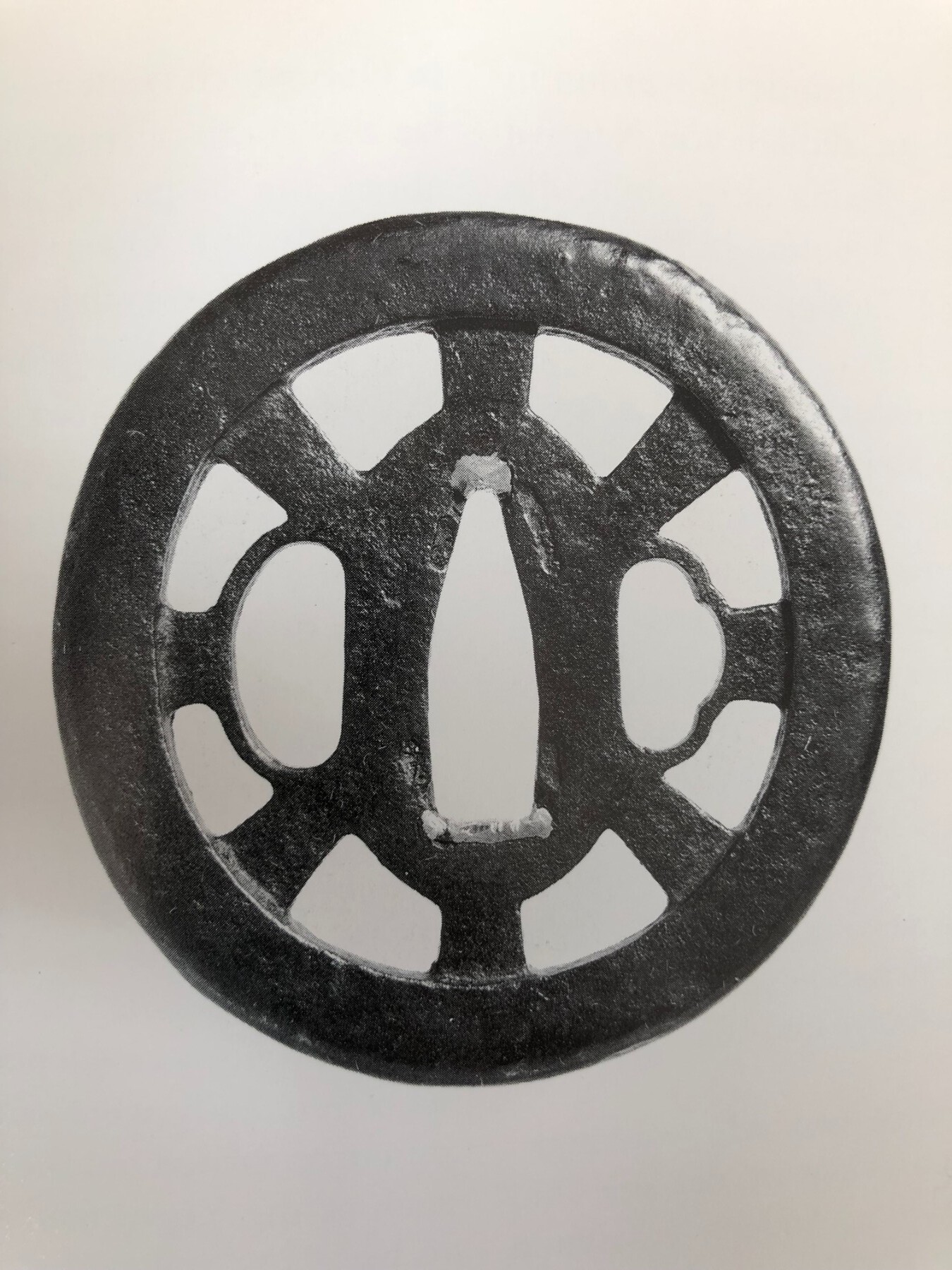
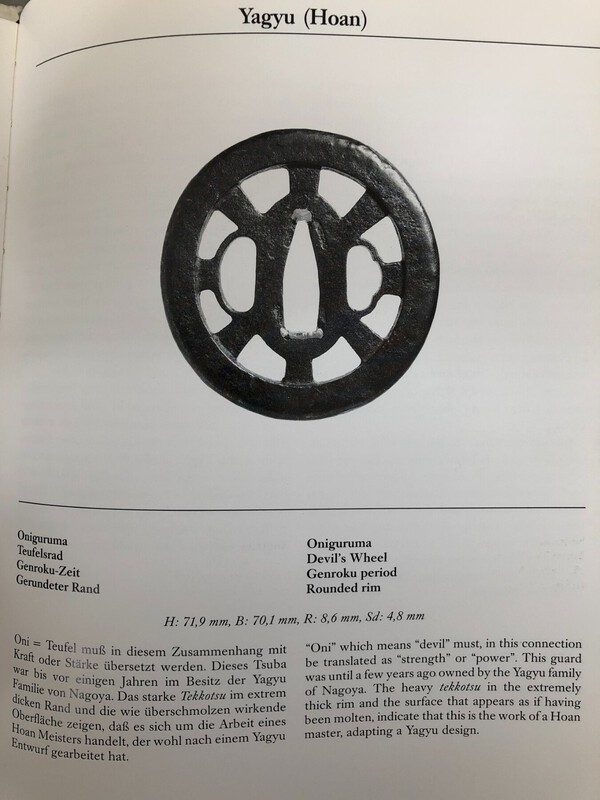
Thanks for your guidance on this Ohno. The one that you pointed out to me from Eckhart's book is actually larger and thicker, although misattributed to Hoan. It also has a rounded rim, which may have pointed Echkart to Hoan. If he is correct that it was possibly a Yagyu motif produced in the Genroku Period, then it is more recent that my Ohno kuruma. I've been confused about the possible transition from what I believe to be a buddhist symbol of the path to enlightenment to an oniguruma (devil's wheel) unless it is has been co-opted to represent a Yagyu sword school technique. That makes some sense. From my limited experience from published sources, there is little if any hint of religious iconography in the Yagyu tsuba tradition.

-
The smaller kogai hitsu-ana would be foreign to Ohno, but in keeping with Akasaka. Did the 4th generation use sanmai construction? I was under the impression that the 4th generation master managed to take this tradition to another level and that sanmai contruction was a technique used on inferior and "production line" tsuba.
-
I recently purchased a tsuba intending for it to be fitted on my iaito, but the nakago ana is too short (22 mm). What is puzzling is that the diameter of the tsuba is 75 mm, which seems to be intended for a katana. Were there some narrower tang forged for katana of the mid- to late Edo? It looks to be Shoami. Nice strong design of double tomoe and plants with rectangles for the hitsu-ana (not familiar with this design).


-
I’ve also seen kuruma as the name of a sword movement in Yagyu Ryo iaido, which is fascinating. Steve, thanks for the clarification.
-
I wonder if anyone can comment on the use of the terms kuruma and guruma, which are not obviously synonymous to me. Thanks.
-
Thank, you all for your comments and for introducing these other examples of Ono tsuba, which I am actually familiar with from earlier NMB posts and seller sites, and have admired for so long. I think Jake's comment about a Confucian influence on the Buke during the Momoyama Period makes sense given the influences from within Asia and Europe. There is a general sense of newness, experimentation, and revitalization, but it is also a truism that the most revolutionary trends tend to be the most short-lived and easily extinguished. If Tea Culture provided the aesthetic scaffold for Kanayama/Owari category tsuba, then production would have been for as short a period as 40 years or so. There would be a transitional period both aesthetically sociopolitically between late Momoyama and earliest Early Edo. I think we are seeing a number of interesting developments in Ohno design and execution through this period. I do think that the thickness of the rim is an important distinction from Kanayama as well as the relatively large amount of positive silhouette, both of which combine to give a sense of solidity and weight. Just look at the one Steve sold on NMB--quite massive. The Kurumu wheel on many other Kanayama tsuba are quite narrow, so I am inclined to think that the wider wheel and thicker rim is intentional and consistent with being a distinguishing feature of Ohno tsuba. It also seems to me that Kanayama and Owari tsuba generally have less positive silhouette and narrower rims, but they importantly also tend to be square or at least rounded square. These are not the elegant rounded rims of other "schools." The square rim imparts, to my eye, more of a sense of the "quiet strength" of the samurai that Sasano wrote about, with Owari being exemplary in this regard. I agree with Jake that the ship tsuba sold on the Mandarin site is not representative of Ohno guards. I’m not averse to challenging shinsa.
-
My first Ohno tsuba (arrived this week) portrays the Kuruma or Dharma Wheel, a pictorial representation of the Noble Eightfold Path or Eight Right Paths, of Siddhartha Gautama (commonly known as the Buddha), and of walking the path to enlightenment. It is an ancient symbol, appearing since the time of early Buddhism in India. The Noble Eightfold Path consists of eight practices: right view, right resolve, right speech, right conduct, right livelihood, right effort, right mindfulness, and right samadhi (meditation). Through this practice one seeks to end ignorance and the cycle of rebirth. My collecting focus has recently narrowed even further to Owari Province tsuba of the Momoyama and Early Edo Period that depict zen buddhist beliefs and practices. This tsuba has characteristic features of the Ohno category of early guards that dates to circa 1615 (plus/minus) during a transitional period between late Momoyama and the beginning of Early Edo periods. It is relatively small (we will come back to a comparison with big brother Kanayama), dramatically "dished" with an initial step off from the wide rim to the central motif that is itself further thinned as one proceeds to the seppa-dai, covered by every description of tekkotsu, and finished with tsuchime and perhaps yakite (not clear to me what this looks like). Each spoke of the wheel is thick, unlike the thinner ones I have seen in Early Edo examples of the kuruma motif. The paired half-quatrefoil hitsu-ana are well-formed with a bit of iron removed on that for the kogai. The overall effect is that of martial strength (yaki) married to Tea aesthetic principles including wabi, sabi, mono no aware, and yugen. Height 69 mm, Width 66.8 mm, Thickness 7 mm at mimi (4 mm at the seppa-dai). Steve Wazsak challenged me to compare this representative early Ohno tsuba to Kanayama tsuba from which similar features were "borrowed." The smiths of these two categories working in Owari Province clearly developed their skills in the forging of iron, compositional elements, and motif designs while looking over each other's shoulders as it were. Ohno guards generally seem to be thicker and more substantial by virtue of a majority of the design rendered in positive silhouette. This becomes quite clear when my Ohno is compared with two Kanayama tsuba of the Momoyama Period, one of even smaller size comprised of double commas (published in Owari To Mikawa No Tanko, page 240), and a larger one with the motif of thunderbolts (Sasano Gold Book, #75). I would not consider the thunderbolt less powerful, but it is clearly more relaxed. It's not clear what forces were at play that led Ohno smiths to incorporate some changes to the sensibility of classic Kanayama tsuba. Perhaps this evolution was dictated by a change in taste during the transition to the Tokagawa confirmatory culture of the Early Edo, although the buddhist theme endures even while zen gives way to Confucianism.


- 58 replies
-
- 10
-

-
Thanks, David. I suspect that the cover has the attribution written on it. I'm going to pass on this one, as a spectacular and powerful Ohno (my first) that was just offered to me is now in the process of being purchased from Choshuyo. It is a Karuma motif identical to the one on your website, but a bit earlier and easily mistaken for a thickish Kanayama. Probably late Momoyama based on features including abundant tekkotsu and a very rustic appearance. The Karuma itself is sunken by 3 mm from the 7 mm rim, which is quite dramatic. Ohno are massive in that way in their appearance.
-
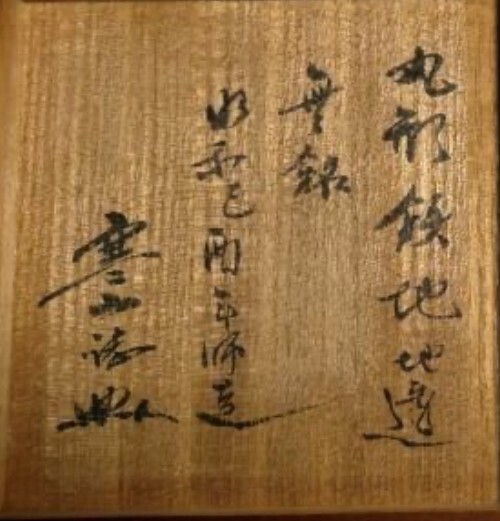
No worries. I can't afford to acquire more than one tsuba at a time, but like you I only add excellent and high end pieces to my collection. I have been using studying Japanese on Duolingo every day for about a week. I aspire to have your study streak! Would you kindly take a look at the Kanzan sensei hakogoki for translation help? It's supposed to have come with a tsuba attributed to (den) Kanayama by NTBHK, but I don't recognize the kanji for Kanayama in the calligraphy. It's possible that it is on the lid (this is a tsuba that I am considering). The rim appears rounded (maybe round-cornered square) and the size is 73.4 x 72.4, which makes me think it is more likely Kyo-Sukashi --something that may have come up in shinsa. I wonder if the hakogaki provides a clue, although I suspect is says something about rice cakes as a motif.
-
Thanks, David. I have enjoyed your website immensely. Let me know if you are ever interested in letting go of any of your lovely Kanayama, Owari, Hoan, Nobuie, or Yamakichibei tsuba. I have begun Japanese lessons on Duolingo. It is a really effective method. Of course I'm also driving my family crazy, but in truth they also learn along with me.
-
It is a very attractive guard. Kebori is deep and even. Composition that incorporates the leaves organically into the rim and seppa-dai is aesthetically pleasing. Congratulations, David, and happy birthday.
-
How would you approach the attribution of this tsuba with a variation of three paulownia leaves?
-
Hi David. What kind of lighting did you use? I see that you are using a screen, but I can't see where the lighting source is. I've always wanted to do this kind of photography rather than what I am doing in natural sunlight (we get so much of it here in Florida).
-
Still interested in high end early Kanayama, Owari, Yamakichibei, Hoan, and Nobuie sukashi tsuba.
-

Nishigaki Kanshiro Paulownia? Hakogaki Translation?
Iaido dude replied to Iaido dude's topic in Tosogu
Well, what do you know? Cool. This tsuba is nearly identical in form to plate 203 in Sasano's gold book. A bit longer in height. The leaf edges and kibori are worn (especially below and upper left of omote, better preserved on ura), but the remnants still have tracings of the original kebori design. This Nidai design isn't as fluid (a bit stiff), tasteful, and refined as Shodai from my brief study, but I think it succeeds on its own merits. It's like a Frank Lloyd Wright home built into a cliff with an original tree preserved and growing through it. It feels wild and untamed. -
Thanks Steve. You will of course recognize the two excellent ex-Waszak guards flanking the centerpiece of the thunderbolt Kanayama tsuba (plate 75, Sasano gold book). The little guy is here to stay, but always good to know it’s value.
-
Nishigaki Kanshiro Paulownia? Hakogaki Translation?
Iaido dude replied to Iaido dude's topic in Tosogu
Thanks very much. I’ve noticed that sometimes the usage doesn’t translate so clearly, but it makes sense that the reference is to an appearance not unlike Jackson Pollack throwing ink at a canvas. Who wrote the hakogaki? Maybe those kanji under the lid are a mei. So, at least the author thought this was mumei Kanshiro. The identification is outside my knowledge base, but has me intrigued. Price won’t break the bank and certainly not the market value of millions of JPY for Shodai or Nidai Kanshiro, but it would be interesting to get a better sense of whether this is a later generation Higo or a very good homage piece. -
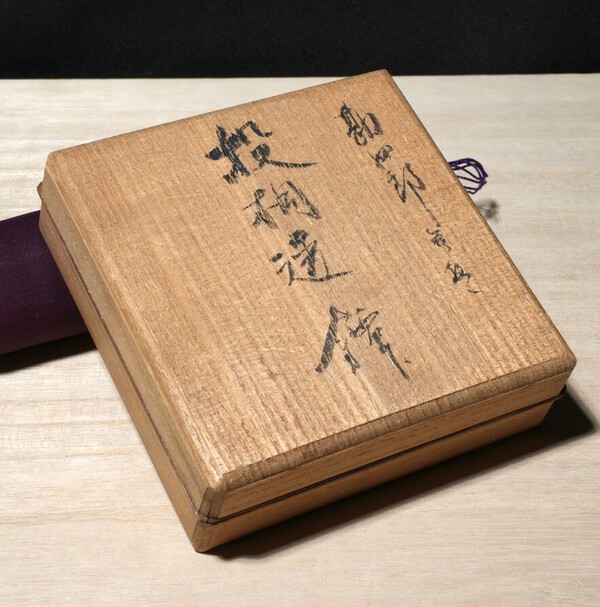
There is a listing on Jauce of a nice classic paulownia design with hakogaki that my translator app can’t decipher. Kebori is weak, but composition is exactly like a 2nd generation Kanshiro. Hard to tell if smaller hits-ana for kogai is instead a reflection of Akasaka school or just the reflection of a composition/design element. Any thoughts? https://www.jauce.com/auction/h1143443304


-
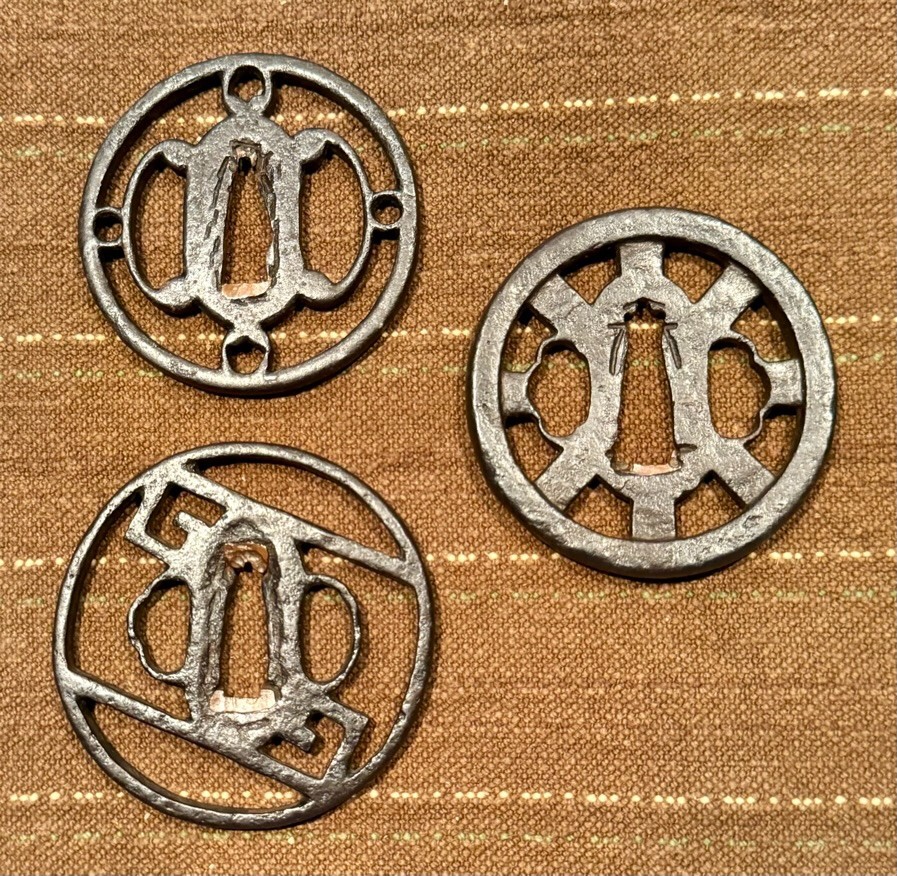
First of all, thanks one and all. I think I must have acquired this piece as part of a trade involving a sword--or who knows, I just have no recollection of it. There was just a little tag with "$175" written on it. At that time, there is no way I could have known anything about tsuba, little alone a Kanayama tsuba. One way or another, I must have thrown that crude little "accessory" into a shoe box and forgotten about it. My jaw really dropped as I flipped to page 240 and saw a photo of my little tsuba. Owari To Mikawa No Tanko was published in 1983. I lived in Singapore from 1997-2005. So a good 15-20 years in between before it ended up with me. It must have belonged in a known collection in Japan, perhaps changing hands into obscurity upon the death of the owner and being sold off or liquidated. Whether it deserves to command a higher price than it would otherwise if not published, I don't know. It's a classic example of a small Kanayama tsuba chock full of tekkotsu of every description and just dripping with wabi tea aesthetic of the Momoyama period. Compared with similar high end Kanayama tsuba in my collection and with the added value of being published, I would put the value at $1,500-$2,000. However, it is invaluable to me and inseparable from my own history as a collector. I have no plans to part with this little treasure--horidashi, as Tim writes. Here is a photo of my small collection of early sukashi tsuba (the little guy is on the far right). Ignore the few iron plates on the left (all mid-late Edo), which I am selling off.

-
Gentleman, I just got my copy of Owari To Mikawa No Tanko. Plate #240 is actually my tsuba. The groove in the nakago-ana really clinches the identification. Unbelievable. I think it actually speaks well of the commentator that the discussion is on the composition and integration of the large motifs into the hisu-ana and as a connective element of the rim. Rather than the meaning of the motifs, there is discussion of the features of the forging process. Thanks again for your contributions to this thread. I've learned so much.

-
Gentleman, I just got my copy of Owari To Mikawa No Tanko. Plate #240 is actually my tsuba. The groove in the nakago-ana really clinches the identification. Incredible luck to have blindly purchased a $175 tsuba 25 years ago in Singapore, only to come full circle to its provenance. Thanks so much, one and all for urging me not to take a blow torch to "fix" this tsuba .

-
I found the certificate that I managed to keep in pristine condition . I think I might just keep this one. The scene apparently referring to The Twenty-four Filial Exemplars, also translated as The Twenty-four Paragons of Filial Piety (Chinese: 二十四孝), a classic text of Confucian filial piety written by Guo Jujing (郭居敬)[1] during the Yuan dynasty (1260–1368). That's from Wiki.
-
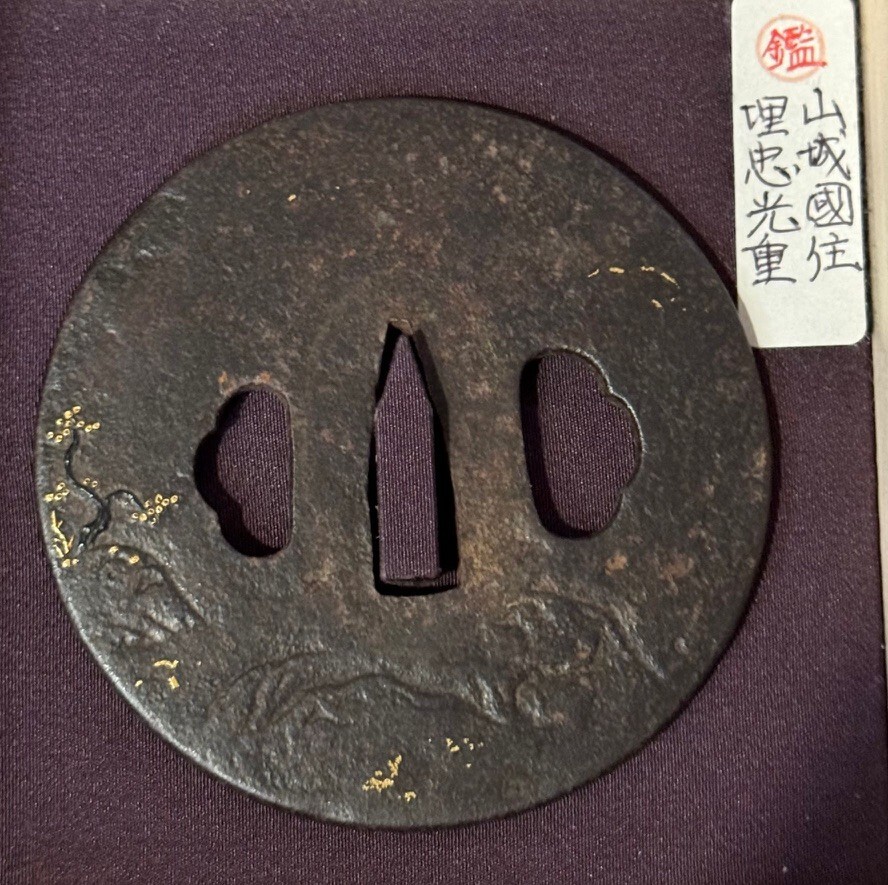
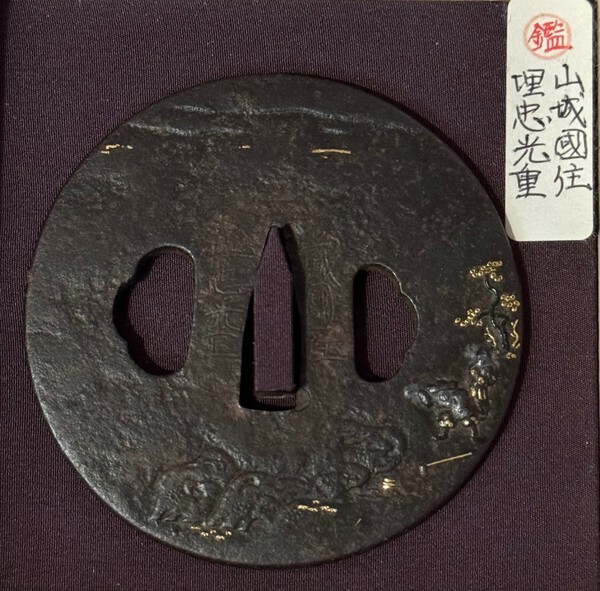
This tsuba has somehow ended up in my small and somewhat scattered collection from a distant past (25 years ago??) while I was living in Singapore and before I started collecting early sukashi tsuba at the beginning of this year. I just had David help out with the mei translation. Haynes H05405.0. Based on death before 1781 (An Ei), this tsubako appears to be a contemporary of the 7th (Shigehide) and 8th (Yoshihisa) generation of the Umetada Kyoto School. The writing on the white stickies are from the previous owner (there is another one on underside of lid). There is a carved and overlaid scene of two figures at 4:00 with landscape elements beneath clouds on omote. The tree and rocks wrap around to the ura. There are two kogai hitsu-ana of differing sizes. 74 mm (perfectly round), 4.7 mm, 4.0 at mimi. Comes in newish paulownia box. $350 (or best offer)


-
Tsuba in everyday objects - the culture of Tsuba
Iaido dude replied to Spartancrest's topic in Tosogu
Manuel, the tansu is spectacular. I take it you made the tsuba-shaped plates as well. I'm so impressed. I do woodworking, including restoring vintage guitars, but metal work is something completely new.