Iaido dude
-
Posts
536 -
Joined
-
Last visited
-
Days Won
3
Content Type
Profiles
Forums
Events
Store
Downloads
Gallery
Everything posted by Iaido dude
-
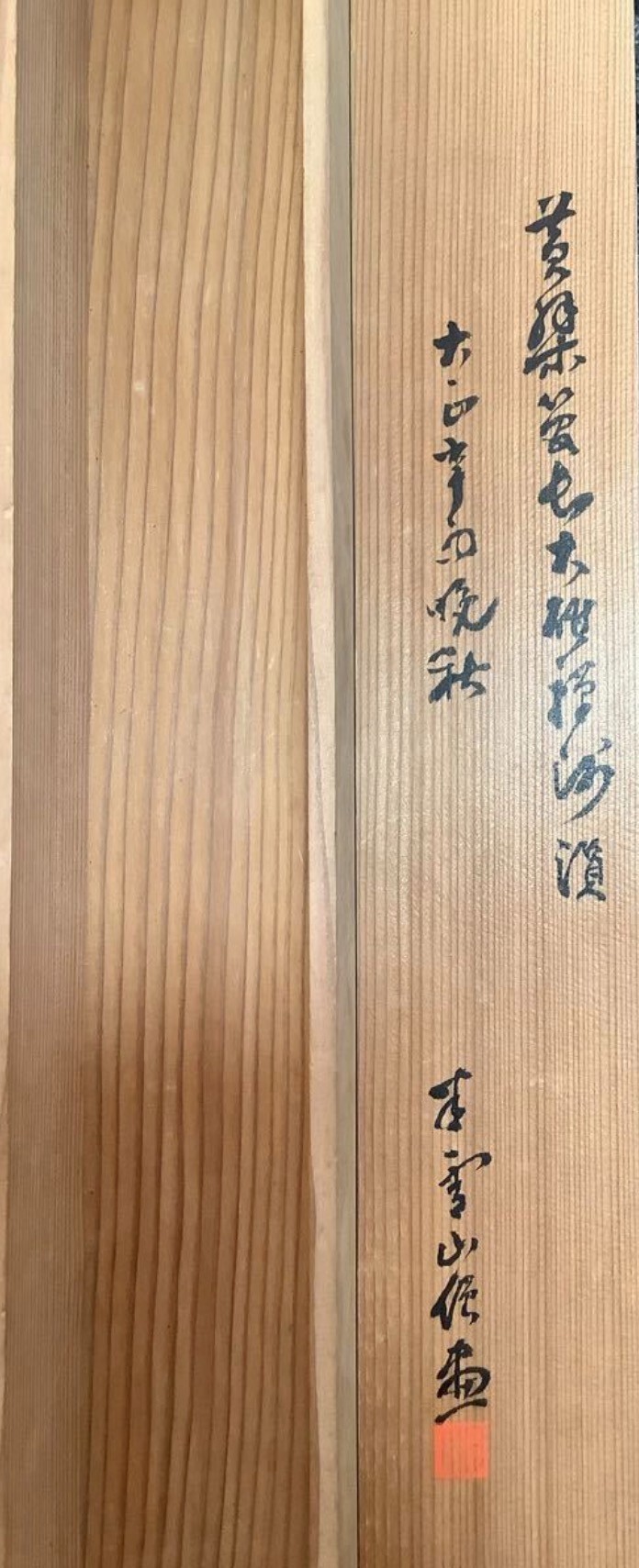
 I would be grateful for a translation and for any confirmation of the seals for Ike no Taiga (1723-1776), a leading figure of the literati painting (Nanga) movement that was deeply intwined with Sencha tea culture introduced from China. This is the only work attributed to him in my collection and hangs in my clinic office. I don't have enough experience with the calligraphy style of Ike no Taiga to discern whether he brushed this work. During the course of his career, he used different artist names that are reflected in the seals found on his works. It also seems like the attribution is reversed—Hamuroyama Sōshūmin is the calligrapher and Ike no Taiga is the painter. The painting appears to have been done by a member of the Hamuro family that converted to Obaku Zen and rebuilt a family temple Jōjū-ji (浄住寺 dating to the 9th century) in Kyoto as an Obaku temple in 1689--a temple whose formal mountain name is Hamuro-san (葉室山). The Obaku monk Tetsugyu Doki became its founding restorer (kaisan). The only relationship that I could find between the collaborating painter Hamuroyama Sōshūmin (葉室山僧脩民) and Ike no Taiga has to do with their affiliated temples--Jōjū-ji (Obaku sect) and Jōkō-ji (浄光寺 Shodo sect) where Taiga is buried--which are situated directly adjacent to each other in the same temple district in Kamigyō Ward, Kyoto. A stone marker at Jōkō-ji, erected in 1777, reads "Ike no Taiga Cemetery Path" (池大雅墳墓道). Although a lay painter and calligrapher, Ike no Taiga had a lifelong connection with the important Obaku temple Manpuku-ji, where he received instruction in calligraphy and Buddhism starting at age 6. Although there is not much available biographical source material for Hamuroyama Sōshūmin, the historical context strongly suggests a plausible tie. They were neighbors in the same temple district, participants in the same Sencha-infused literati culture, and members of a social network that included artists and Zen clergy. The monk would represent the exact type of cultured, tea-drinking cleric with whom a painter like Taiga would naturally have interacted.


-
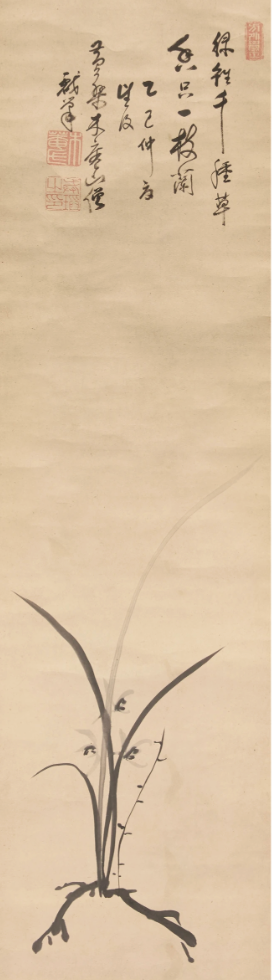
Yamaoka Tesshu is not associated with literati painting styles. He has collaborated with his daughter Kogetsu on pieces in which he brushes the calligraphy, but she paints cherry blossoms or lotus. Here, in an item currently on auction, I was surprised to see an example of Yamaoka's own painting of orchids.
.thumb.png.5849806cab1da30192f4ff899717bb42.png)
-
Thanks John and Steve. Interestingly, Xi Jinping has cast himself in the mold of the Chinese philosopher-king, guided by Confucian dictates.
-
John, please let us know what Confucian ideals are symbolized by the orchid. We find the Four Gentlemen theme on a number of kinds of arts and crafts including tsuba.
-
Thanks very much, Baby Joe! This makes perfect sense, as Mu’an is referencing the quiet, unnoticed, cultivation of the Zen mind. Brilliant. I rarely acquire calligraphy without knowing the meaning, but Mu’an’s painting is enough reason, and he doesn’t f—k around when it comes to calligraphy inscriptions. This one goes on the wall when it arrives, next to my other work by Mu’an invoking the name of Kanzeon Bosatsu (Chinese Guanshiyin Pusa).
-
I just acquired this calligraphy and painting of orchids on auction from Roseberys (London) along with a group of other unmounted calligraphy/painting. This subject was the theme of other works by Mokuan. Translation assistance would be appreciated. The subject and style of the painting follows that of literati painters with whom the early Obaku monks associated closely with as they brought their Zen tradition along with Chinese art and culture to Japan, where it was highly influential. However, the calligraphy style is late Ming dynasty. The different shades of ink wash that Mokuan uses to paint the leaves gives the composition great balance and an ethereal impression of delicacy, purity, and dignity. Mu'an Xintao (木庵性瑫, 1611-1684), known in Japan as Mokuan Shōtō, underwent Zen training in China at Wanfusi with three of the greatest Ch'an masters of the early 17th century: Miyun Yanwu (1566-1642), Feiyin Tongrong (1593-1661), and finally Obaku (Huangbo) monk Yinyuan Longqi (Ingen Ryuki, 1592-1673), who bestowed on him dharma transmission in 1650. He followed Yinyuan and an entourage of a dozen other monks from southern China to Nagasaki to help with the founding of Manpukuji, which Mu'an took over as its second abbott when Yinyuan retired in 1664. Over a period of 17 years he oversaw the expansion of Manpukuji and the founding of numerous other Obaku temples throughout Japan, including Zuishoji, the principle Obaku temple in Edo. Below is a very refined work of the same theme by Obaku Xihe Zhiyin (西河知音), painted c. 1692 and in the collection of the National Museum of Asian Art (Smithsonian), done shortly after Mokuan's death it would seem. I haven't been able to place Xihe in the Obaku genealogy, but he likely came to Japan as a member of the entourage of Obaku monks that accompanied Ingen or Mokuan. The notes accompanying this piece on the web site: "The orchid's long and gracefully fluttering leaves often overshadow its inconspicuous flowers. The delicate flowers represent the purity of seclusion for scholars. Orchids grow untended-like the scholar who cultivates his own talents but is unrecognized by others. The blossoms exude a subtle fragrance that symbolizes the purity of men. This painting was likely executed by a Chinese Buddhist monk of the Obaku sect of Zen Buddhism. In the 1650s, a large number of monks migrated from China to Japan after the fall of the Ming dynasty and the rise of the foreign Manchurian government."


-
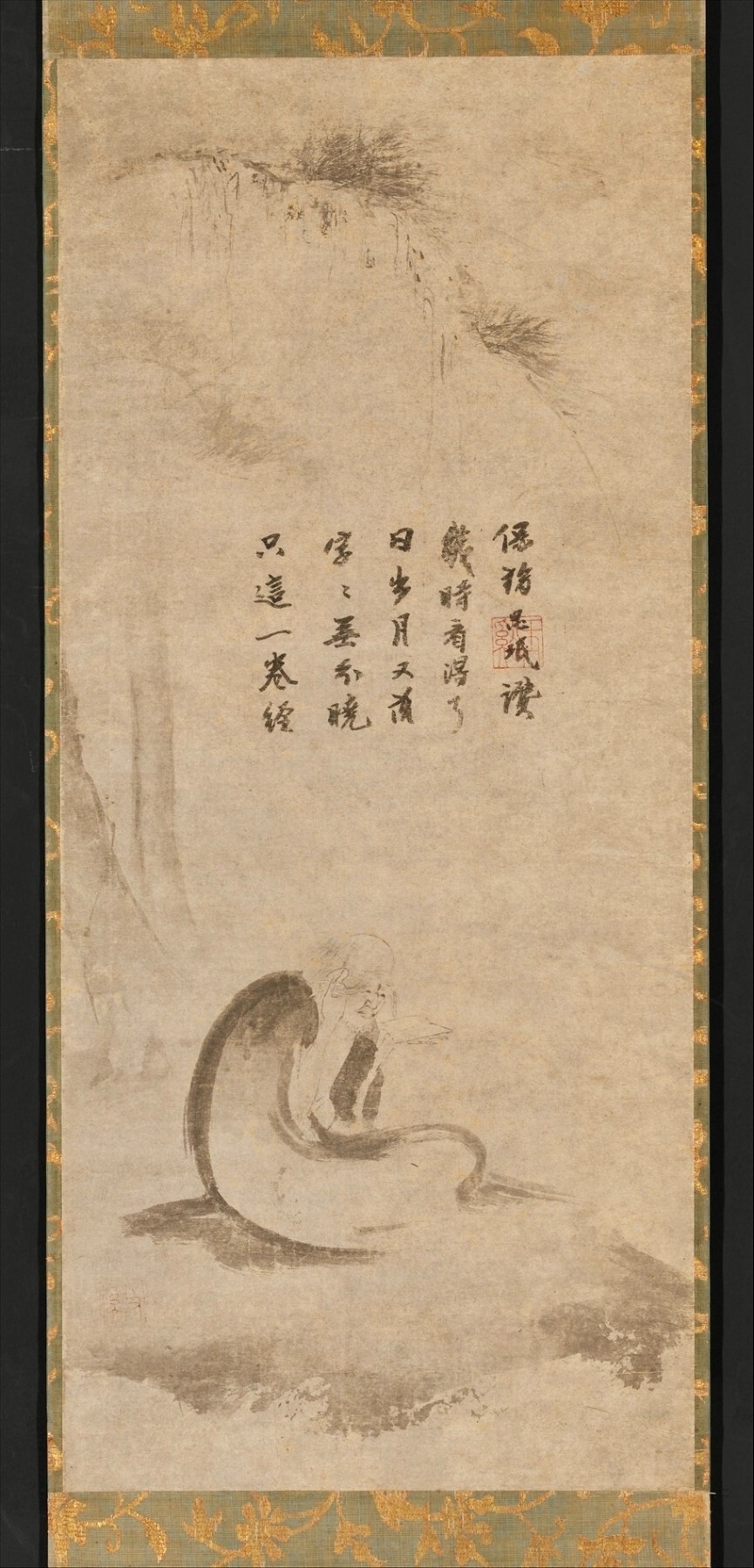
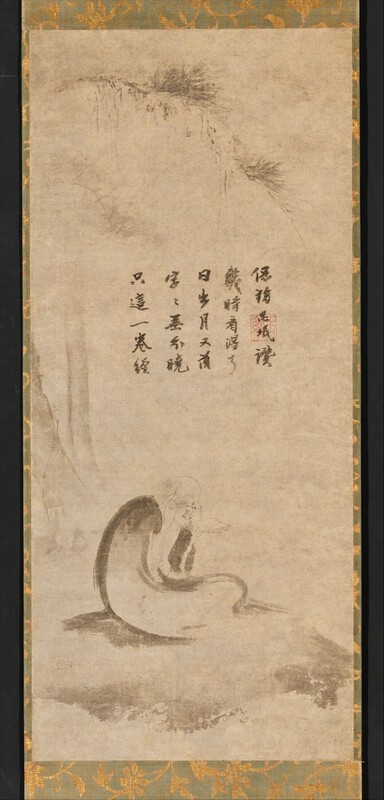
With great research assistance from Hiro. Jitsuden Docho (実傳道釣) is known to have been a disciple of Mokuan Shoto (木庵性瑫 1611-1684) through a lineage database maintained by the Dharma Drum Institute of Liberal Arts and from among a list of 250 Ōbaku-related ink works donated to Komazawa University by Mr. Mochizuk (i望月氏). There is scant additional biographical information. The inscription of the current work reads: 繙經參月心 (fān jīng, cān yuè xīn) Translating/reading the scriptures, contemplating the moon-like mind (literal meaning) Turning the pages of the sutras, I contemplate the mind that is like the moon (poetic meaning) What is intriguing about the current work is that the painting is nearly identical to a treasure in the collection of The Metropolitan Museum of Art by Sokuhi Nyoitsu (another student of Mokuan) called "Reading a Sutra by Moonlight." The inscription in the latter suggests that enlightenment is not to be found in scripture such sutra (e.g. "words and letters"). This rejection of reliance on scripture is one of the principles of Zen Buddhism and attributed directly to the semi-lengendary Bodhidharma himself. Although not quite as crisp and precise as the version in The MET, it seems possible that the accompanying painting, which appears to be cut off at the bottom, is also by Sokuhi Nyoitsu, and that the signature and seals have simply been lost. Jitsuden and Sukohi were contemporaries in a small community of early Obaku monks who would have had many opportunities to meet and to interact or collaborate regularly. However, it may be that Jitsuden is suggesting that study of scripture can be a tool for achieving direct insight and awakening, much like koan study is used in Rinzai Zen practice for this purpose. If true, it would be a departure from traditional Zen belief and understanding. Would Sukohi have contributed the painting if this were the case? Perhaps this work is a deeper exploration of the role of study in facilitating the direct experience of kensho or satori. Exegesis of the two phrases of the inscription supports this hypothesis: 繙經 (fān jīng) — Engaging with sacred texts (specifically Sanskrit), but not merely intellectual study; "turning over" implies intimate, repeated handling, suggesting devotion or deep familiarity. 參月心 (cān yuè xīn) — In Ch'an/Zen Buddhism, "contemplating the moon" often refers to looking beyond words to direct insight. The famous metaphor says: the finger pointing at the moon is not the moon itself — teachings (sutras) are the finger; the enlightened mind is the moon. Here, cān yuè xīn suggests using scripture to investigate one's own original, luminous, and still nature — "mind-as-moon." The inspiration for the theme of "Reading a Sutra by Moonlight" may come from works such as this one with inscription by Yuxi Simin 玉谿思珉 (d. 1337). The painter is unknown. Prior to acquiring the present work, I have never seen another depiction of this theme except for a clear fake: In this one volume of sutra, The words have no clear meaning. The sun rises, the moon sets, When will I finish reading it? Inscribed by Simin of the Baofu [Temple]. [Seal]: Yuxi 只這一卷經,字字無分曉。 日出月又落,幾時看得了。 保福思珉讚。 [印]:玉谿


-
- 2
-

-
Also in the collection of The Metropolitan Museum of Art is a calligraphy/painting from the 14th century showing the same pictorial theme of "Reading a Sutra by Moonlight" and the belief since the beginning of Ch'an Buddhism after the arrival of Bodhidharma (Daruma) in the 5th/6th century CE that enlightenment cannot be attained by study alone. Commentary from catalog: Chan/Zen art and philosophy blend strict rigor with playful irreverence. The dignified image of an aging master learnedly poring over an abstruse scripture is undercut by the poetic inscription, which suggests that true enlightenment may just as well be found elsewhere Yuxi Simin 玉谿思珉 (d. 1337), 5 columns in semi-cursive script, undated; 1 seal: In this one volume of sutra, The words have no clear meaning. The sun rises, the moon sets, When will I finish reading it? [1] Inscribed by Simin of the Baofu [Temple]. [Seal]: Yuxi 只這一卷經,字字無分曉。 日出月又落,幾時看得了。 保福思珉讚。 [印]:玉谿 [1] Trans. from Wen C. Fong, Beyond Representation: Chinese Painting and Calligraphy 8th–14th Century. New York: The Metropolitan Museum of Art, 1992, p. 361.
-
My wife helped me translate Jitsuden's calligraphy: 繙經參月心 (fān jīng cān yuè xīn) Translating/reading the scriptures, contemplating the moon-like mind (literal meaning) or Turning the pages of the sutras, I contemplate the mind that is like the moon (poetic meaning) It's difficult to discern whether this is also a rejection of a reliance on "words and scriptures" like the work known to be by Sokuhi in which the monk is reading the sutra in the moonlight. Or could it be that Jitsuden is suggesting that study of scripture can be a tool for achieving direct insight and awakening, much like koan study is used in Rinzai Zen practice for this purpose. If the latter, it would be a departure from traditional Zen belief and understanding. Would Sukohi have contributed the painting if this were the case? Perhaps this work is a deeper exploration of the role of study in facilitating the direct experience of kensho or satori. 繙經 (fān jīng) — Engaging with sacred texts, but not merely intellectual study; "turning over" implies intimate, repeated handling, suggesting devotion or deep familiarity. 參月心 (cān yuè xīn) — In Chan/Zen Buddhism, "contemplating the moon" often refers to looking beyond words to direct insight. The famous metaphor says: the finger pointing at the moon is not the moon itself — teachings (sutras) are the finger; the enlightened mind is the moon. Here, cān yuè xīn suggests using scripture to investigate one's own original, luminous, and still nature — "mind-as-moon."
-
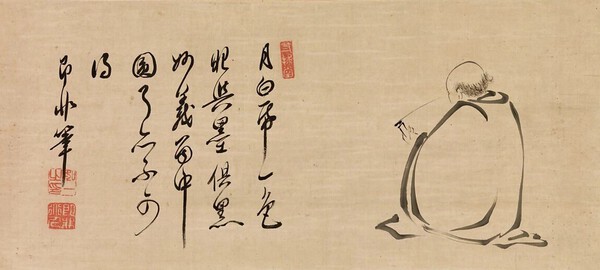
Thanks, Hiro. I have emailed Komazawa University to try to get connected to a curator at the Museum of Zen Culture and History. The relationship of Jitsuden Kocho to Mokuan Shoto, both Obako monks seems to be confirmed in two separate databases now. Sukohi Nyoitsu appears next to Mokuan, which is a known association, as both were students of Ingen. There are numerous collaborative works, truly wondrous, by Ingen, Mokuan, and Sukohi (known as the three brushes of Obaku), including the one below that were donated from a single American collection to The Metropolitan Museum of Art. The order from right to left is Ingen, Mokuan, and Sukohi. I saw these pieces in January while in NYC. They were not on display, but the assistant curator was kind enough to show them to me.

-
The translation of Sukohi Nyoitsu's inscription to the painting is marvelous. He suggests that the wisdom the monk seeks in the sutra resides elsewhere. This rejection of reliance on "words and scripture" is one of the principles of Zen Buddhism. Only personal experience of enlightenment is to be trusted. 月白紙一色 眼与墨俱黑 妙義个中圓 了亦不可得 Moon and white paper are of one color. The pupil of the eye and the ink are both black. The marvelous meaning, lodged in the circle, Is beyond comprehension. —Trans. Jonathan Chaves
-
Hiro, here is another related puzzle. The artist is said to be Jitsuden Docho (実傳道釣), whom I have confirmed to have been a disciple Mokuan Shoto (木庵性瑫) through a lineage database maintained by the Dharma Drum Institute of Liberal Arts https://authority-dev.dila.edu.tw//person/search.php?aid=A030882. The author of this work is a bit difficult to place historically because I can't seem to find any additional biographical information or other works of his for comparison of the mei and seals. In addition, although Jitsuden was well-regarded as a calligrapher, he is not known to be a painter. The subject matter highly resembles the same subject matter as a famous work called "Reading a Sutra Under the Moon," (The Met) which painted by Sokuhi Nyoitsu (即非如一)--a contemporary of both Mokuan and Jitsuden. Because the bottom is cut off, any mei and seals on the original are now lost. Still, I wonder if the painting is by Nyoitsu. It is clearly painted on silk cloth rather than paper. Inscription by Jitsuden Kocho. Painting possibly by Sokuhi Nyoitsu. Sukohi Nyoitsu


-
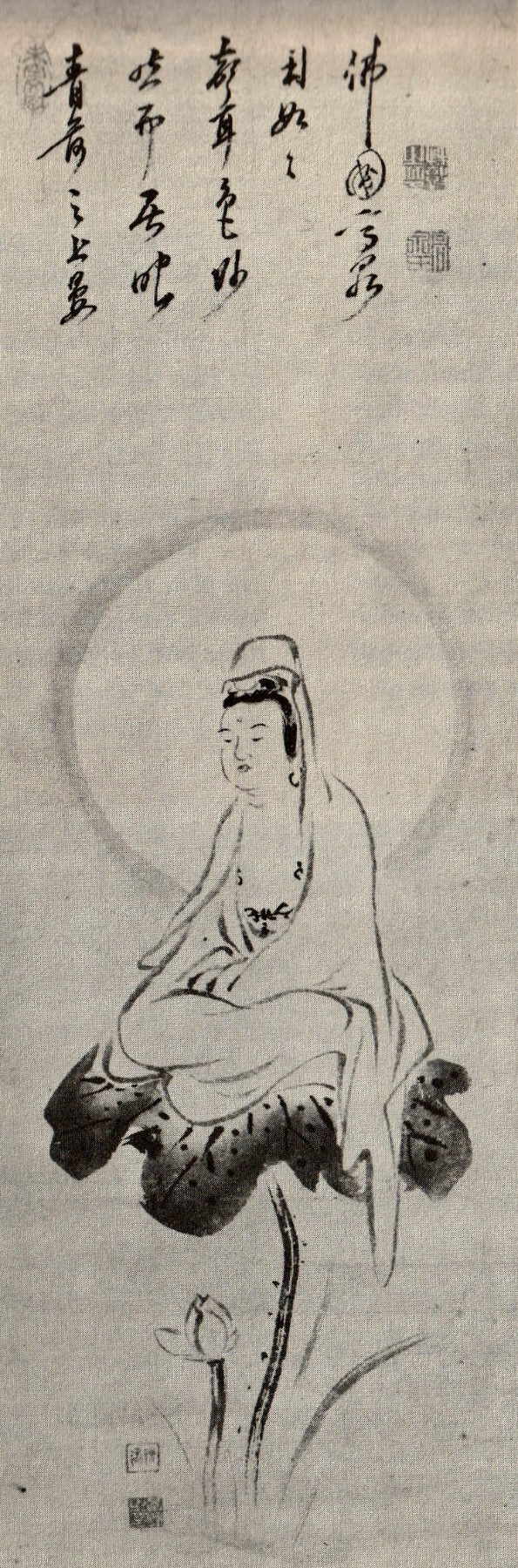
Thanks, Hiro. I have found additional evidence that Tokuho was not just a minor Obaku monk disciple of Kosen. As you have shown, he had two dharma heirs of his own. Here is another simplified lineage chart in Stephen Addiss' exhibit catalog "Obaku: Zen Painting and Calligraphy." In this volume of works belonging to American collections, another Kannon collaboration by Kosen/Tokuho is also featured. Here Kannon is depicted on a lotus rather than an outcropping above water. The translation is: Up on a green leaf, Kannon is quiet and peaceful, With eyes that hear sounds and ears that see colors-- How marvelous, how useful! Kosen's seals from this painting and two others in the catalog are shown here along with their translations.


-
Thanks, Steve. Greatly appreciated. Trying to decipher seal script is sometimes challenging. The Obaku monks from China practiced seal carving as an art form. Steven Addis has written that they tend to use the same set of three seals such that forgeries can be detected on close examination to determine if a seal(s0 appears altered. However, each artist also has a long career in most cases, using different seals depending on the context (different audience, different temple location, different artist name, etc.).
-
One of the interesting aspects of this is that Kosen used block/regular script throughout. His mei and the seals on the Kannon that I originally posted don't match other examples that I have found online and in books, but the top right seals of the two inscriptions for Kannon paintings appears very similar and contain the same characters carved on two distinct seals.
-
Tokuho Dosho became a disciple of Kosen at Manpuku-ji in 1670. So, I believe you have solved the mystery. It makes perfect sense that master and disciple collaborated on this work. I’m having a calligrapher/scholar in Singapore translate the kanji. smaller seal: Tokuho larger seal: Mei Dosho I have to learn from your reference sources how to identify seals that are based on seal script. Thanks so much.
-
Thanks, Hiro. I’ll follow up on your leads as to the identity of the painter through the seals you have tackled. I was surprised that he didn’t do the painting, as Kosen is admired as a fine painter as well, although his works are not numerous enough to know if he ever painted Kannon. Can you make out any of the brushwork?
-
Obaku Kōsen Shōton (Gaoquan Xingdun 高泉性潡 1633-1695) was born in Fuchow, China, and studied with Ingen. He would later become the 5th Abbot of Mampukuji. He ranks as among the very best Obaku calligraphers and was also an excellent painter, although there are a different set of seals on the bottom right, suggesting that he collaborated on this work. Would appreciate help with the translation, which is clearly kanji.


-
Enso Painting by Chuho Sou (1759-1838)
Iaido dude replied to Iaido dude's topic in Other Japanese Arts
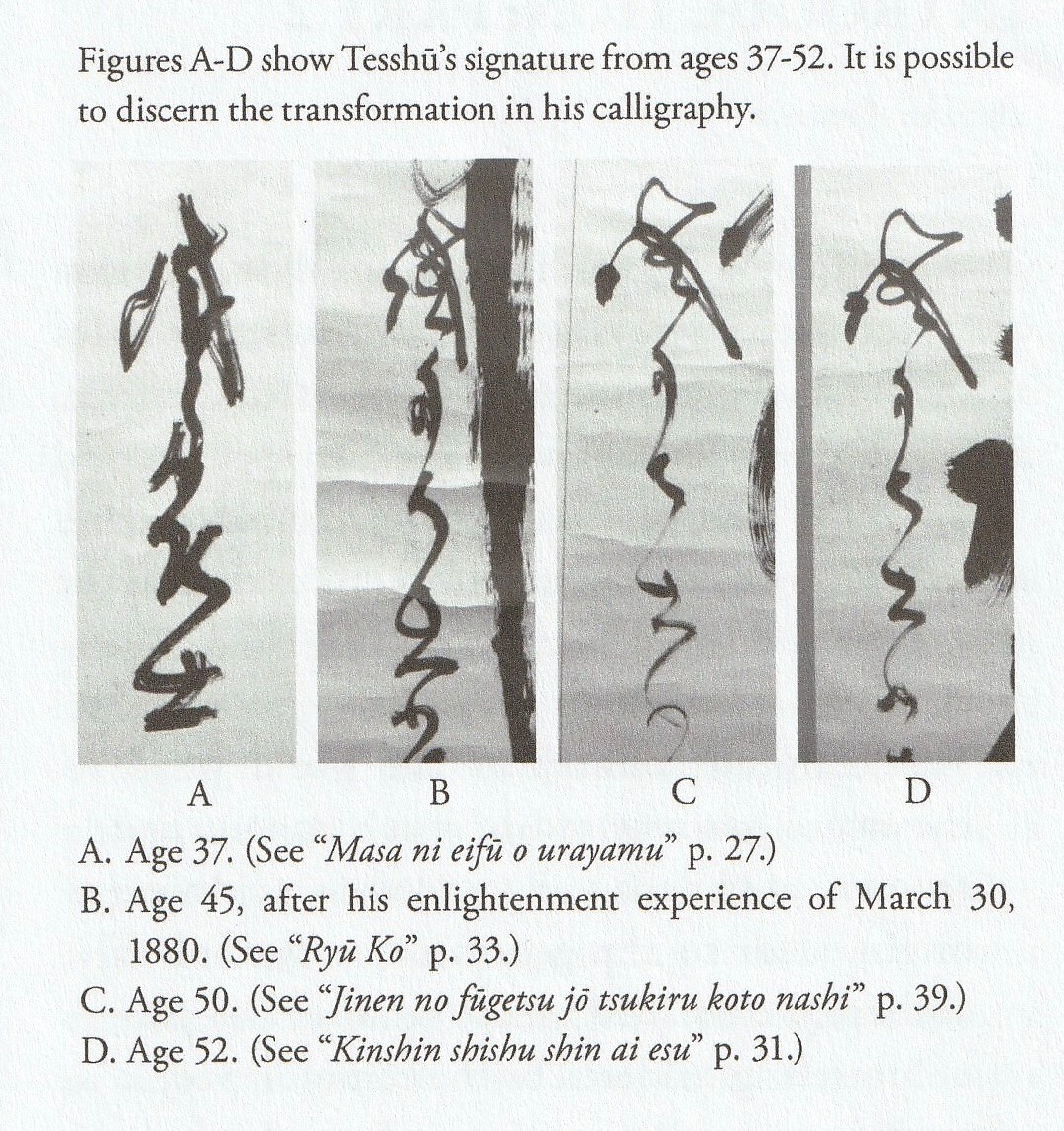
Absolutely. One of the concepts I have been taught is that what we paint evolves as our minds evolve, becoming truer as we discover the depths of our True Self/Original Nature--like a spiritual diary. I have seen motifs rendered before and after Zen masters had their enlightenment experiences; they often brush the same motif hundreds or thousands of times during their lives. There is greater and greater clarity. Keep at it!! If you would like to see examples of Enso painted by Zen masters through the ages, you should get the book "Enso--Zen Cirecles of Enlightenment" by my friend Audrey Seo. Here is my Kaisan Sokaku included in this lovely book. Compare Yamaoka Tesshu's mei from age 37-52 as his enlightenment deepened. They have even done an analysis of the ink grains in his strokes to show the complete absence of hesitation when the grains line up in one direction. He brushed more than 1 million works, as part of his practice, but also as a means of raising funds for a temple and providing for lay Zen practitioners. Yamaoka literally wanted to save all of the souls in Japan living in his time. I have works by him across this timeline. He died at age 52 of stomach cancer. It is said that he is the only known case of a Zen master from the Meiji who died upright in meditation.

-
Yagyu Shojo Calligraphy (Meirekireki rododo 明歴々露堂々)
Iaido dude posted a topic in Other Japanese Arts
Yagyu Shojo (柳生紹尚 1926-1989) was the Rinzai chief priest of Hotoku-ji (法徳寺) subtemple of Daitoku-ji (大徳寺). His calligraphy is prized among practitioners of Zen and Japanese tea ceremony (chinoyu). In this calligraphy, Yagyu brushes a phrase that is well-known in Japan: Meirekireki rododo 明歴々露堂々 Signature: 大徳法孫柳生紹尚 Daitoku Hoson Yagyu Shojo Seals: 大徳法孫 Daitokuji (prefatory); unclear; 紹尚 Shojo The literal meaning is "bright, clear, and unmistakable (明歴々), like dew in the open air (露堂々), with nothing to hide." 露 (dew, revealed) was also brushed by Tetsugyu in my collection as part of the phrase "Self Revealed." Figuratively, 明歴々露堂々 represents a state of mind where the truth is not hidden, but is completely evident and open to view--often in the concrete world of mountain streams, frost-covered leaves, and a lone flower growing through a crack in the concrete. It suggests living authentically, without pretense or obscurity. In Zen, it signifies that ultimate truth is not a hidden mystery but manifests openly and directly. If we don't perceive it, it is simply because we are not looking or our perception is clouded. The origin of this phrase is Zenrin Kushū (禅林句集), one of the compiled collections of "capping phrases (jakugo)" used in Zen koan training. In Rinzai Zen tradition, the practitioner is directed not to grasp a koan by fixing on its words or looking for intellectual explanations. One has to embody the koan so that self and koan are one. Once a particular koat has been completed, the roshi will instruct the practitioner to bring a verse or phrase that captures the insight of that koan. This phrase is called a jakugo. The sense is that although the awakened state of enlightened seeing can be likened to pure gold, undefiled by language ("not founded by words or letters"), in order to be conveyed to others, it has to be mixed with the sand of language (i.e. jakugo). I especially appreciate the beauty of his semi-cursive (gyosho) rendering of 露 in the scroll, as compared to the block/regular (kaisho) writing on the tomobako. There is an Obaku/late Ming Dynasty influence that also reminds me of Mokuan, another master calligrapher and disciple of Ingen.



-
- 1
-
-
Enso Painting by Chuho Sou (1759-1838)
Iaido dude replied to Iaido dude's topic in Other Japanese Arts
I'm a Zen student of the Chosei Zen Dojo in Madison, WI that follows the Chozen-ji Rinzai lineage that was established by Tenshin Tanouye Rotaishi and his teacher Omori Sogen as the first training monastery outside of Japan. Later, Kenneth Kushner Roshi founded Chosei Zen on the mainland. Gordon Greene Roshi, current Abbot and my teacher, then established the Spring Green Dojo nearby as a rural training community. I live in Florida, but do both virtual and in-person intensive training with Chosei Zen and private training with Gordon. We all practice a martial art and a Japanese fine art to enhance our Zen training because it's an extremely physical practice through posture and breathing. Tanouye Roshi believed that we could enter Zen through the body and that "Zen without the accompanying physical experience is nothing but empty discussion." In my case these physical practices are kyudo, iaido, and shado. When we do calligraphy, often copying from a manual by Yamaoka Tesshu that he brushed for his wife, it feels like martial arts. The brush is like a sword. Breathing and focus are critical. Ink is laid down not through the wrist, but through the entire body. It is said that painting the Enso is one of the most illuminating activities for a Zen calligrapher. The result is a direct reflection of the state of one's mind, here and now, in this very moment. When I gaze on the Enso works displayed in my home, I feel the presence of Zen masters and their teachings (Nakahara Nantenbo in particular), stretching back 400 years and even more. The transmission of the mind-seal (inka shomei) from master to disciple ensures that the experience of enlightenment and the teaching of dharma is an unbroken strand that reaches all the way back to Siddhartha Gautama. -
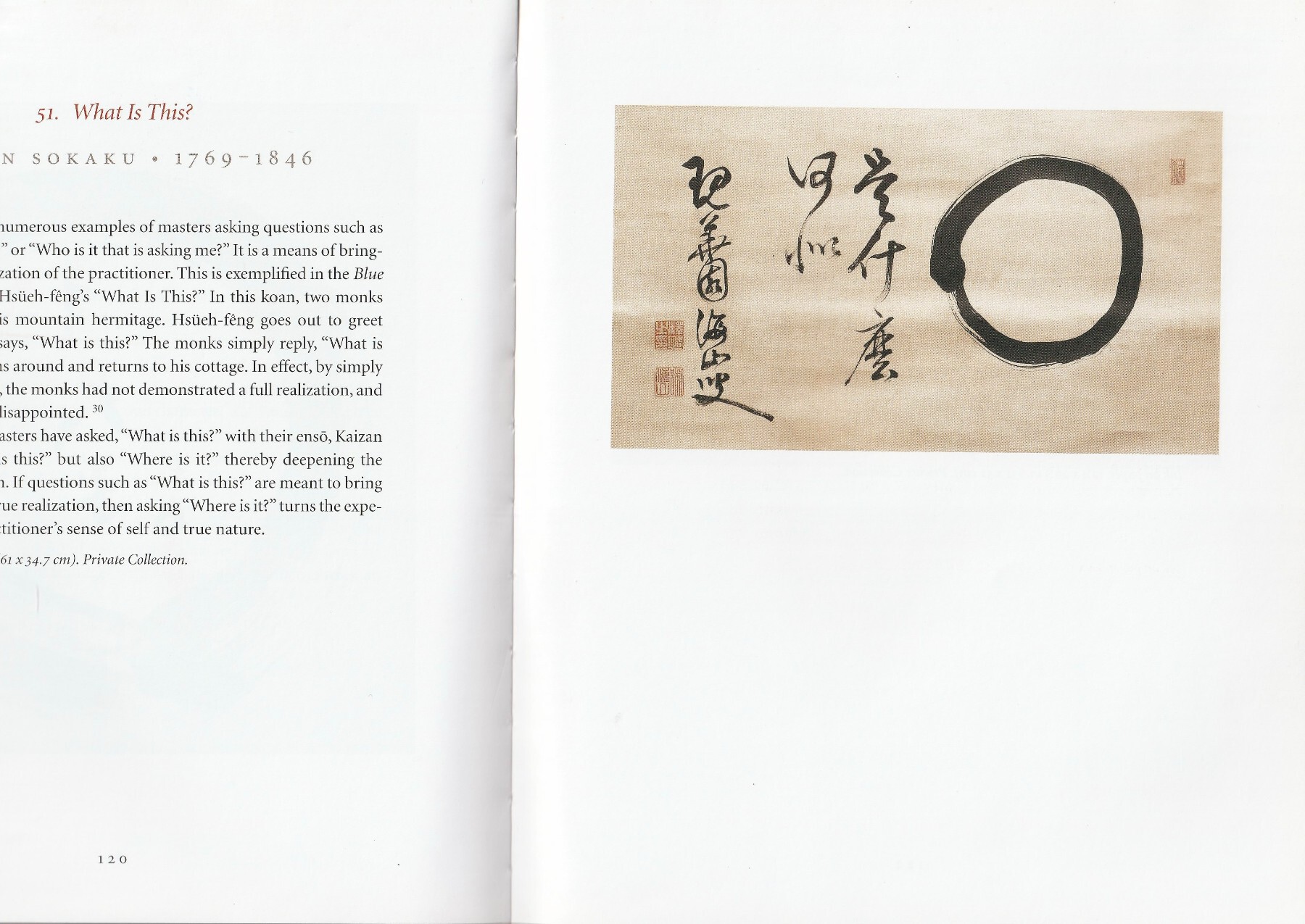
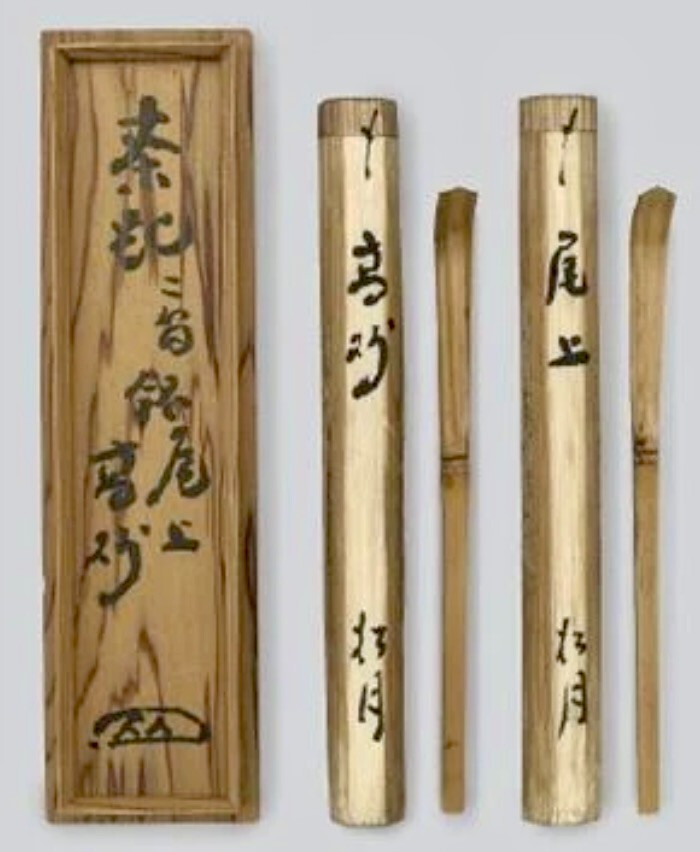
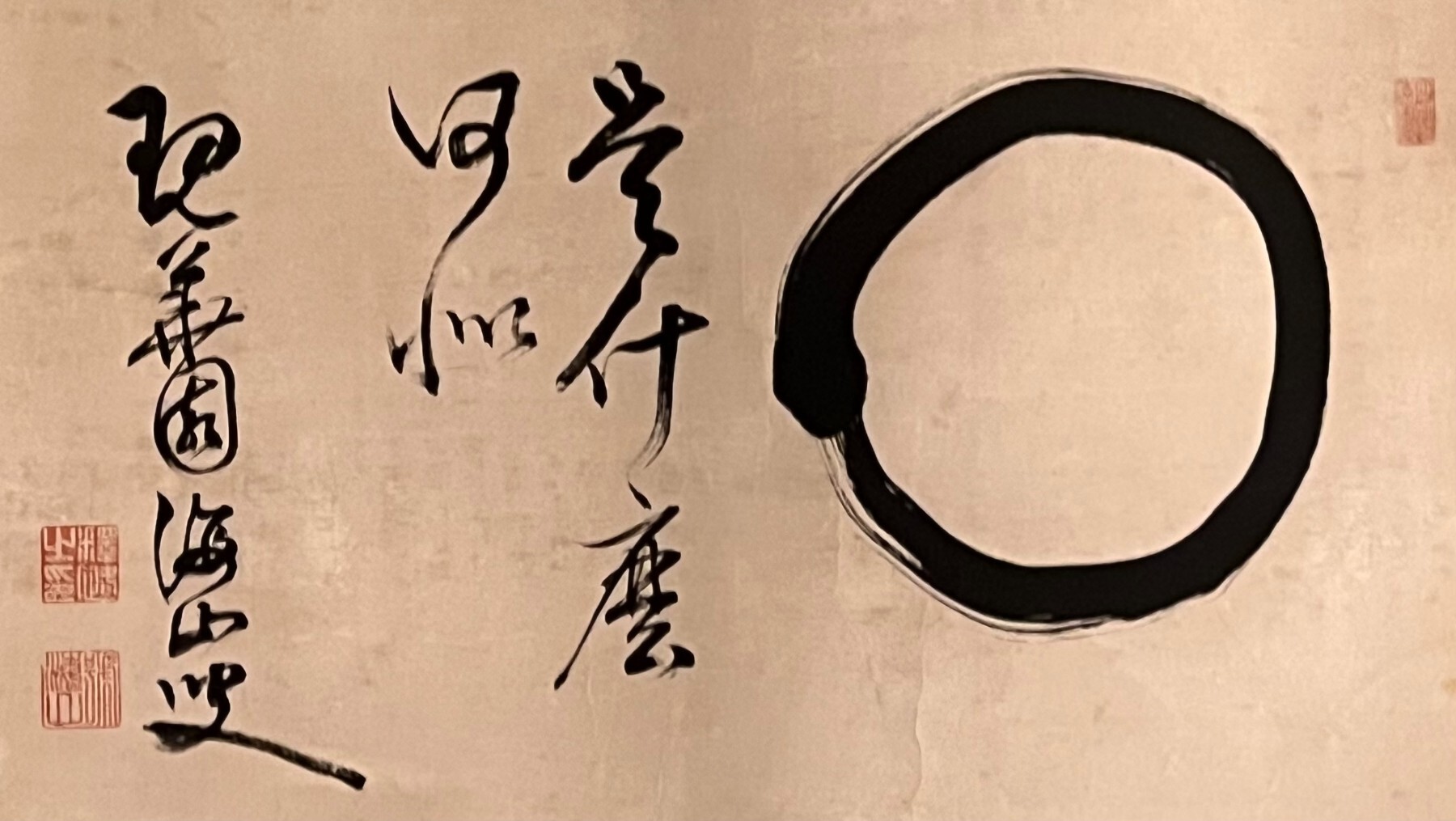
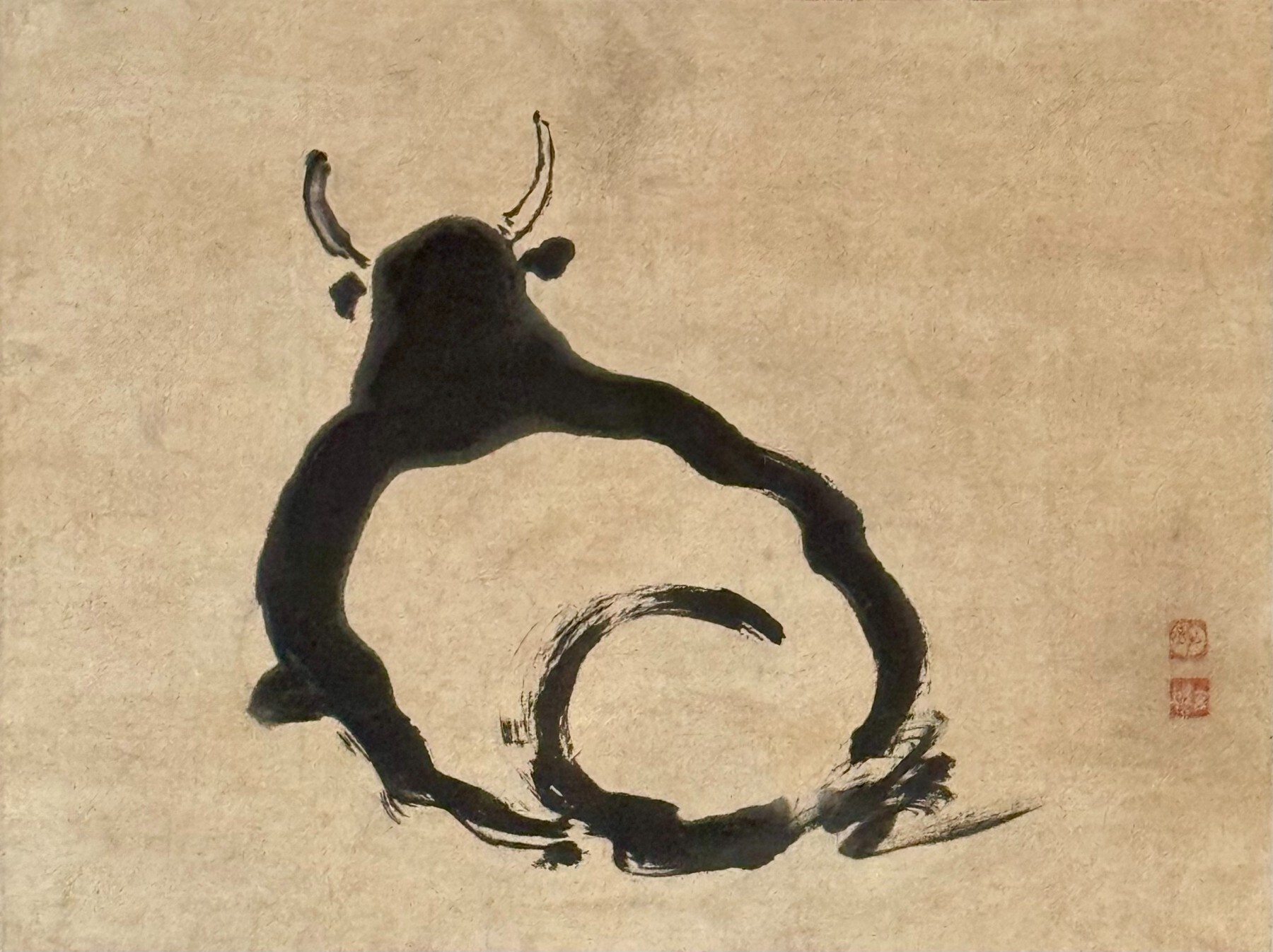
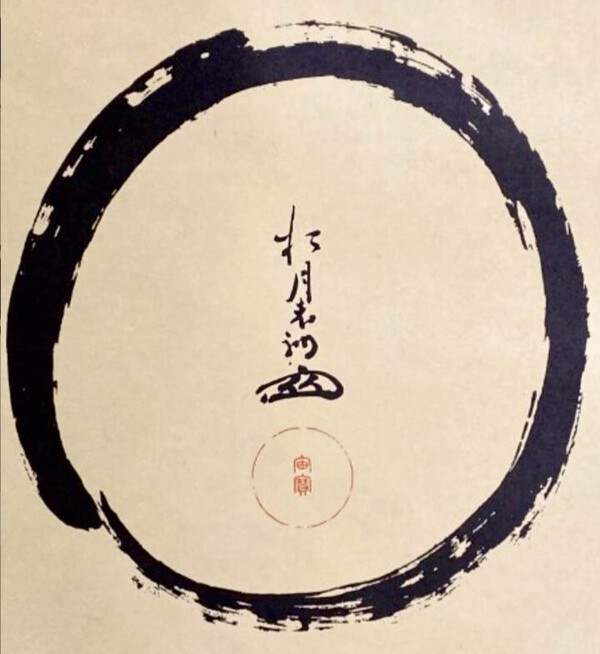
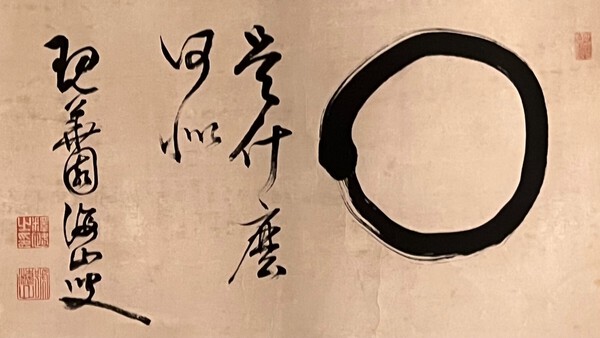
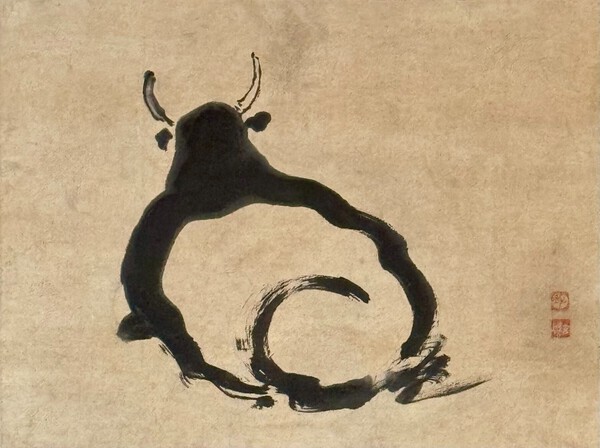
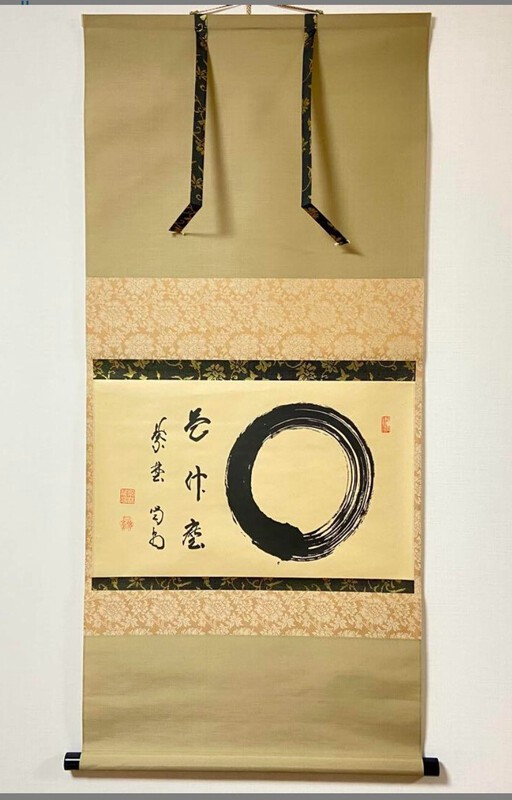
Chūhō Sōu (宙宝宗宇, 1759-1838) was the 418th chief priest of Daitokuji Temple in Kyoto. His Buddhist name was Chūhō, his given name was Sou, and he was known as Shogetsu (昇月), which means "Rising Moon." He trained under Sokudo Soki, the 406th bishop of Daitokuji Temple and was a highly revered Japanese Zen master, calligrapher, potter, and tea connoisseur. Chūhō admired and was influenced by his contemporary Jiun Onko. Two works below are excellent examples of his unique style and deep comprehension of the Zen aesthetic and the enlightened mind. This is the 3rd work by Chūhō Sōu in my collection. Here he signs as Shōgetsu rōsō (松月老僧), meaning "Old priest 'Moonlight on the Pine Trees.'" The colophon that appears at the bottom is found on some of his brush works and crafts such as tea scoops. Together with his characteristic seal, this work is confirmed to be authentic. I now have seven Enso paintings with and without calligraphy by notable Zen masters from the 18th to 21st centuries. The artists start painting at different positions of the circle, but always going clockwise. The two most contemporary ones start at the bottom. This one is unique because the mei and stamp are within the Enso, as if to say that the artist is also infathomable and fathomable, empty and full, and infinite within the finite. Here are other Enso in my collection. From left to right: Kaisan Sokaku (1768-1846), Kogan Gengei (1748-1821), Nakahara Nantenbo (1839-1925), Tachibana Daiki (1898-2005), Hosoai Katsudo (1919-1985), and Kobayashi Taigen (1938-). I consider unadorned iron plate tsuba to be "Enso" that you can hold in your hand and carry in your pocket.




-
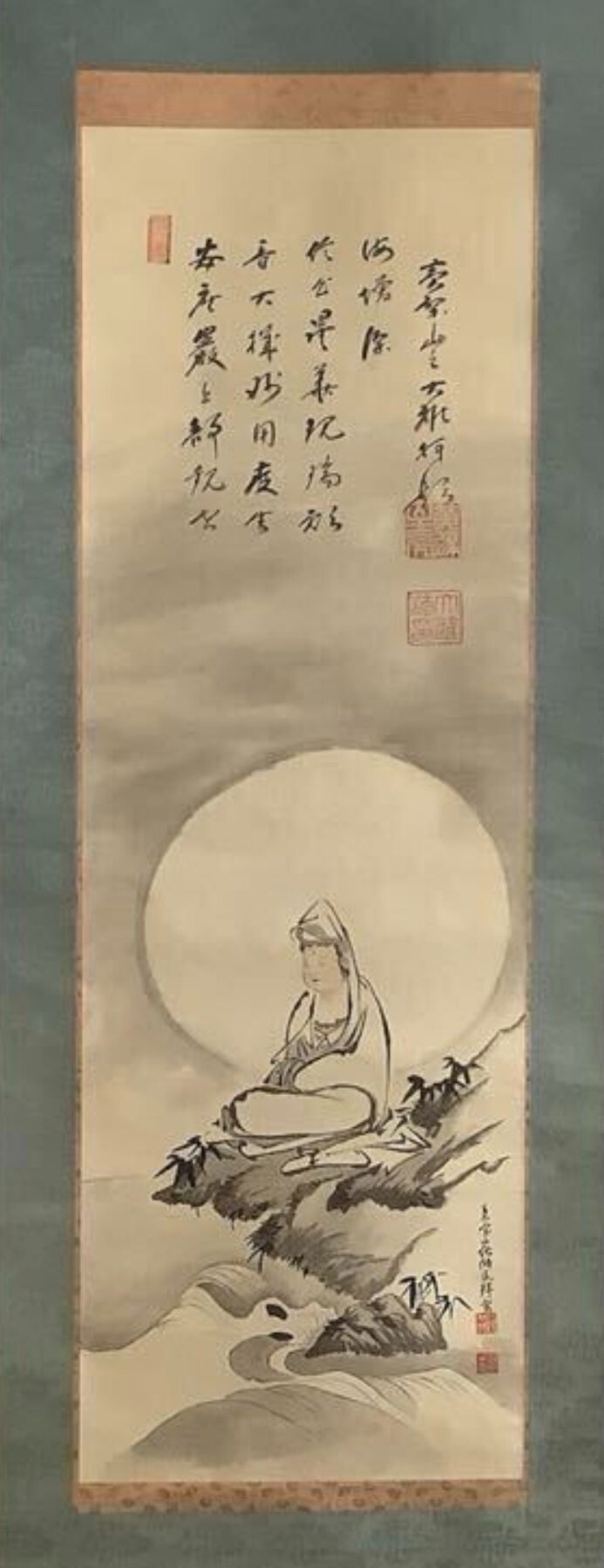
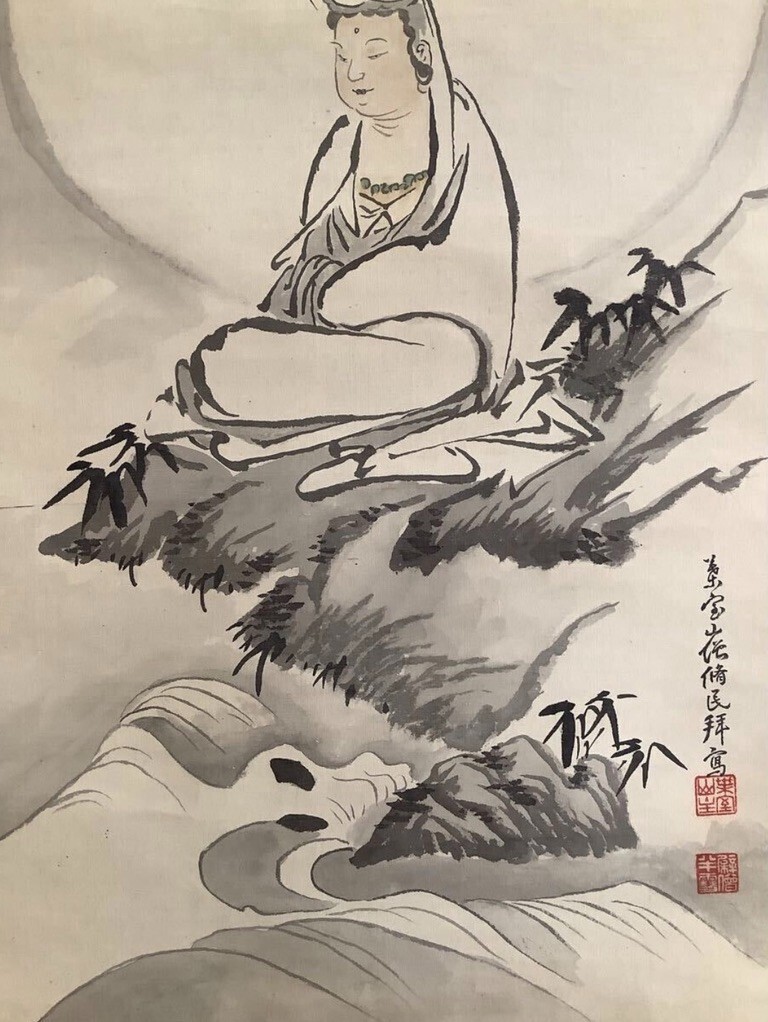
This is a new one for me—a Nantenbo Kannon painting. It’s a common subject matter of the Bodhisattva of compassion who hears and sees all suffering. Just the first time I’ve seen Nantenbo tackle this subject from among thousands of this prolific Zen master’s works that I have studied. Translation is a bit uncertain to me. Kannon was the patron Bodhisattva of fishermen who founded many seaside temples dedicated to her (actually originated as a male figure). This is a touching and unusually personal portrayal of Kannon, sitting in a kind of watery setting with branches around her, gazing down and to the side. She is usually sitting on a giant lotus pedestal, rather regal and all powerful as she emanates compassion like a superpower. This is a quiet scene. I wonder if it is reflected in the calligraphy. I do know that the kanji for Kanzeon bosatsu is 觀世音菩薩. Thanks in advance for your help.


-
- 1
-
-
I hear you. The 18 year old in me is frustrated to find himself in a 63 year old body. However, I am sometimes surprised at how much less pain I feel after intensive training. I did a 4 day zen intensive training recently consisting of 8 hours a day of zazen, chanting, and hojo walking. I was pretty convinced I couldn’t do that much sitting meditation without severe pain. I actually had less pain after the first day. Very encouraging.
-
Hi, John. There is a reason I have an archery backstop. I’ve only ever shot through the screen of the covered patio once—evidenced by a small exit hole. My wife doesn’t know about this. Imagine the skill it takes to his a smaller target at 28 meters standard distance for what is called enteki. I’ll be doing that next weekend. Yes, as a general rule in most styles the prescribed distance between the feet is the length of the arrow. If you use an arrow that is too long (it should just be long enough so that the tip is close to the string at full draw), the distance between the feet will be too be too great and the stance too wide to maintain good balance and support. We didn’t used to live so long a century ago. Now we deal with the wear and tear of life with advanced age and morbid obesity grinding down joints and the lower back. A lot of what I do for older patients is address painful orthopedic issues and neuropathy from long-standing diabetes.


.png.28bbf9378799c0d835331087564f0802.png)