Iekatsu
-
Posts
306 -
Joined
-
Last visited
-
Days Won
1
.thumb.png.4c5df79fec171b2dc4a23af38e280a4d.png)







Iekatsu's Achievements






-
The second one is definitely Nerigawa.
-
I agree with the others sorry, I can see why you thought it was earlier, the shape language is similar to early examples. Condition aside it is still a nice Hanbo.
-
Another good example, id say this one is slightly older than Curran's example, but not by much, maybe late Muromachi-Momoyama. The fact is that we don't really have a super reliable way to date Kagamishi Tsuba, there are couple associated with Uchigatana Koshirae of the same period, but other than that no manfuaturing sites or other evidence is avaialble to draw from.
-
Interesting, I have a couple of examples with a silmilar polished surface that I think "may" be cast and then have had Nanako etc added, but I still need to have them tested to see if they are bronze. Given the details that can be captured in a cast, I wonder why the extra steps would be necessariy and that the glassy surface properties could be from polishing, or even wear. I will post some similar examples later.
-
Nice example, you might want to treat and stabilise the rust, some oil and TLC will go a long way.
-
As in cast into water as a blank, like Ford demonstrated, or cast in a mold and then the design and details added by hand?
-
I am still skeptical, there are a couple of reasons that I think it might not pre-date the Edo period. I think your dating is rather optimistic, looking at extant examples, we do not start seeing defined Seppa-dai until the late Muromachi period, and they only become common place from the Momoyama period onward. While the shape of Hitsu-ana can be useful in determining relative age, there are many variables at play, particularly with an oval shaped example, which could have been reshaped and adjusted many times. If the Hitsu-ana is indeed cast into the design, that would also generally indicate later dating. Concerning the motif, while animal and creature motifs are not uncommon, the way the dragon has been rendered does not align with any other examples I have seen, I also still do not think that the way the design is rendered aligns with Sasano's #10, but perhaps some additional photos from different angles might help with this. The shape being being Kaku-gata is interesting, not something typically seen with Kagami-shi, but something that is common in Namban style Tsuba, as are squarish Seppa-dai and and flat faced rims. Cast bronze Tsuba were definitely produced in the Edo period, they are usually pretty easy to spot because they follow Edo period trends and styles, some Namban Tsuba were also cast in bronze. The dates for Tsuba of this type are all over the place, there is a lot of "vibes" based dating for early Tsuba in general, not just in the Kagamishi book and Tosogu no Kigen, but many other publications. There is very little evidence to support how the date attributions are made. We are all guilty of accepting these at face value and a lot more research needs to be done in this area.
-
How sure are you that one is cast Curran? To my eye it looks like Momoyama period Ko-kinko, a nice example may I add. I don't see any of the usual hallmarks of casting.
-
Much appreciated Tim. Concerning your Tsuba, I don't really see the similarities to #10 in the Sasano book. Given the shape, motif and style I think it might be Edo period, not that there is anything wrong with that.
-
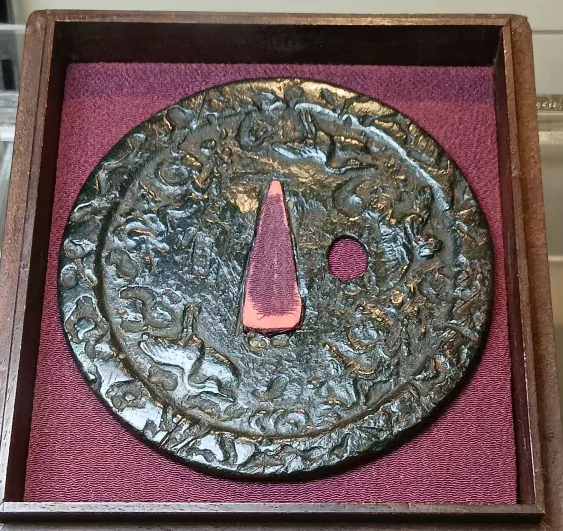
I agree, Kagami-shi is a misnomer, there is no evidence of a link to mirror makers. I have coined my own terminology to categorise this variety. It is just another NBTHK category that needs to be revised. Here is the other Kagami-shi from the DTI that you mentioned.
-
Very interesting, could we trouble you for a scan? I'm sure several of us would really appreciate it.
-
That is an amazing example, I can see why you like it.
-
A really nice example Les, I recognise it from the DTI. There is quite a lot of variation in Kagamishi Tsuba, something I hope to write about in the future.
-
I did not know a translation existed, Id be keen to get a copy too. I would love to see the Tsuba you picked up if you are willing to share Les.
-
I agree with Piers, repurposed from something else, likely post period.