IBot
-
Posts
69 -
Joined
-
Last visited
-
Days Won
1
Content Type
Profiles
Forums
Events
Store
Downloads
Gallery
Everything posted by IBot
-
This is just a 'flash in the pan idea' . I have a fairly standard Sakai gun that has the stock embellished with all the usual brass inlays, including an extended pine tree running along the underside. These inlays have no functional purpose and obviously cost money to produce. This set me thinking as to why so many guns are so over-decorated. We know that during the Sengoku era there were a large number of guns that were plainly mounted - essentially utilitarian. Could it be that some of these were re-mounted in fancy brass encrusted stocks during the Edo era specifically to look impressive for the daimyo gyoretsu? Ian Bottomley
-
I've made a couple of hibasami in the past, some of which are really easy to make since they have a tab that fits into dovetail groove behing the pan, the other type is less so. The missing one illustrated by Peter is of the latter type but it isn't too bad. It is important to use a piece of brass that fits tightly into the notch at the front end of the pan. Cut it to length and round the front end. You then have to cut away some of the width so that it sits on the top of the pan fitting against the barrel with the back end buttiing against the breech band of the gun. It will now hold in place from side to side but can be lifted out of position. Looking at the breech end of the barrel with the hibasami in place you will see a notch cut in the barrel just above the pan. Make a mark on the rear face of the hibasami at the position of this notch. If you own a milling machine the next bit is dead easy. Cut a long notch from the mark along the back of the hibasami the length of the notch in the barrel. If you haven't a milling machine you will need to make a small chisel to cut the notch. Most guns have the upper part of the pan cover that butts against the barrel when closed, thinned off. You need to file the bottom edge of the hibasami so that this thinned edge of the pan cover can slide under it. Finally fit the hibasami in place and drive a sliver of brass into the notches of barrel and hibsami to stop the latter lifting out of place and the job is done. Ian Bottomley
-
Julian, The problem with this bright red lacquer is that the particles of pigment, vermilion or mercury suphide, have to mask the dark brown colour of the lacquer itself. This involves using a large amount of pigment in comparison with the quantity of lacquer needed to hold the particles together. As a result, the coating of red lacquer is somewhat porous, there being insufficient lacquer to fill the spaces between the pigment particles that fill up with dirt particles. You often see this problem on the inside of face masks which resist all attemps to come clean when wiped with alcohol. The problem with your helmet is that the lacquer on both the red and black areas has become degraded by exposure to light. Lacquer when first applied is a complex structure in which the lacquer particles are surounded by an adsorbed layer of water molecules forming what is known as a micell. Exposure to light results in the water layer being driven off leaving the dull degraded surface. Ian Bottomley
-
Paz, I have to agree with Colin with regard to the lack of knowledge displayed by many UK auction houses, but equally I wouldn't know a genuine Irish peat container from a galvanised bucket so each to his own. I also find that many auction houses tend to illustrate those parts of swords they think are important or interesting and not what members of this forum would need to make a judgement. Most however will add further images if you ask - don't forget it is in their interest to get the highest price they can. As for the quality, yes, a great deal of junk turns up, but there are exceptional swords as well. It is up to you to spot them and hopefully win one. Ian Bottomley
-
Jean, I agree with you about using replia bows. It would be easy enough to buy modern kyudo bows and paint them up to look like old ones. Yes a fabulous museum and a credit to Peter Janssen. Ian B
-
Jean, I was fortunate enough to be invited to the opening of the 'Samurai Museum' in central Berlin. The collection amd museum are owned by Peter Janssen, a gentleman who has devoted much of his life to collecting Japanese arms and armour and prossibly has one of the finest collection outside Japan. You look at case after case of superb swords or fittings, the contents of which are in pristine condition with blemish free lacquer, stunning mounts and blades in perfect polish. Mr. Janssen is the owner of a string of nursing homes for the elderly, using the basement area on one of these homes, situated on the outskirts of Berlin for his first 'museum'. Until you have been, you could not begin to envisage the quality and quantity of the items he has aquired, some of it undisplayed at his first site for lack of space. His latest venture was to move much of the collection to a more central location and open it to the paying public - the original site remains and has been re-envisaged as a 'research facility'. As for the new museum, yes, the bows are not strung correctly for the simple reason they are old and there would be every possibility of them breaking if you tried to string them properly. Among the displays are dummies dressed in armour holding yari. Since they are open dispays, the real blades have been replaced with copies in aluminium for obvious reasons. You could comment on the diarama of mounted figures brandishing yari, but at least they are not being 'couched' like lances and the display does show the harnesses to perfection. No doubt the odd spelling mistake has crept into the texts because the electronic labels are dual language, primarily in german, but in all cases with english translations. Some labels can also display X-ray images of the pieces (I am thinking particularly of a Saotome helmet) to show structure. As an ex museum curator, I could criticise the open displays of some armours, but most of the better items are in protective cases and light damage has been minimized by low light levels. In some areas proximity switches ensure that the cases are illuminated when you approach them. Having spent a lot of time displaying similar material and trying to make the text on labels intelligable to the ordinary public, I for one would not criticise what Mr. Janssen has achieved. The overall quality of the displays and labelling are exceptional. One minor item that I loved was a figure in kamishimo peering over a balcony that is so relistic you could easily belive it is a real person. Ian Bottomley
-
The Royal Armouries has indeed two armours given to King James I (and VI) as well as one given Philip II of Spain in 1585. Interestingly, one of the former still retains a kamon in lacquer of the Takeda family ( it is too small to have been worn by Shingen so it probably belonged to Katsuyori) and the latter has the kamon of the Shimazu of Satsuma - a clear indication that they were captured booty and not specifically made for presentation. The remaining armour was assembled for the gift as it is very composite, being made up from different armours but lacquered and laced to match. Because the armourer making up the set did not know the heraldry of the recipient - i.e. a foreign monarch, he has applied dragons in gold lacquer on the places where kamon would normally be lacquered. The Armouries also has one of two magnificent naginata and about 10 (?) yari with raden covered shafts that formed part of a set sent as a gift to Queen Victoria. Interestingly most of the yari are 12 foot long, but four in the set are only 10 foot, no doubt those were carried next to the norimono. They all had big sausage shaped saya in gold lacquer but the Royal Armouries only has 2 of them. No doubt the rest, and the saya for the naginata are in Windsor Castle or some other palace. Other item included in the gift are in the Victoria and Albert Museum including a magnificent o-yoroi. I always like to imagine a lackey announcing to the Queen ' There is a shipment of Japanese arms and armour arrived at the back door your Majesty'. No doubt the replay was 'We are not amused'. Ian Bottomley
-
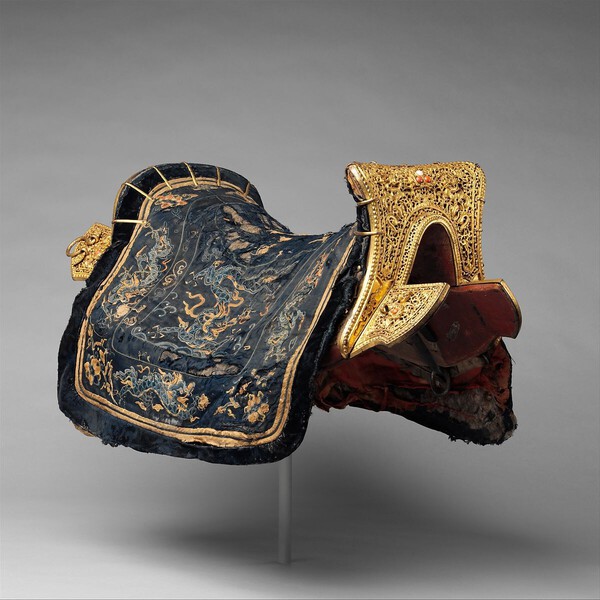
There are other factors relating to this topic that are worth commmenting on. Firstly the design of openwork tendrils seems to have originated as the pommel and cantle decoration that are a feature of Tietan and Chinese saddles, as well as items such as Tibetan pen-cases. Some of the more elaborate saddles have several layers of pierced metal giving the panels of tendrils a considerable 3D effect. It is possible that the Chinese guards were inspired by the same metalworking tradition. Secondly, we are all familiar with the Dutch colony on Dejima in Nagasaki harbour, but there was also a large Chinese enclave there that traded in Chinese imports such as raw silk and brocades, ivory etc. It is quite possible that some of what we think are Japanese namban tsuba were made there by Chinese workers who complied with Japanese instructions, or that details of what the Japanese style namban tsuba should have, such as the shape and size of the seppa dai and the incorporation of hitsu ana, were sent to workers on the mainland. Ian Bottomley
-
I hope members will forgive me from dragging up ideas I I have aired previously, but this topic has a fascination for me. It would seem to me probable that the vogue for namban tsuba really took hold following the ventures into Korea in 1592 and 1598. No doubt Chinese sword guards were known in Japan before that, but it seems reasonable to assume that some would be brought back as 'trophies of war' and proudly displayed on the wearer's sword as an indication they had taken part in the conflicts. These tsuba would be of the type with more or less rectangular 'seppa dai', often decorated in some way, designed for Chinese swords that had no habaki or seppa and hence were exposed to view when the sword was drawn. Some of these were modified by having hitsu ana cut in them, occasionally fitted with added rims , that ignores the layout of the original design. Once the fashion had become established, tsuba makers began to make imitations that eventually incorporated a more standard seppa dai and hitsu ana that were integrated into the design of tendrils. It is interesting that these Japanese versions are made to the size of the Chinese originals, being suitable for wakizashi and were only rarely made larger for katana. Ian Bottomley
-
Long before I had contact with any other nihonto collector and when the only source of information I had access to was Basil Robinson's 'Arts of the Japanese Sword', I was faced with acquiring swords whose fittings ignorant pervious owners had polished bright. I had absolutely no idea how these items were patinated originally, but because I worked in a chemical laboratory at the time, I was in a position to experiment on ways to restore the colouring. I found it relatively easy to re-colour shibuichi and shakudo by de-greasing the part with alcohol and then hanging it on a cotton thread in a cold solution of copper sulphate and bringing it up to the boil. After colouring I would wash the parts in distilled water before drying them. This worked reasonably well on those two alloys but had the unfortunate effect of turning any copper a bright pink! Curiously I also found I had to use a fresh copper sulphate solution each time as it failed to have any effect once it had been boiled. I post this simply as an interesting historic account of the weird and wonderful ways we early collectors resorted to, and certainly do NOT recommend anyone trying it today. Ian Bottomley
-
A few years ago when I was still Curator of Oriental Arms and Armour at the Royal Armouries Museum I was contatcted by a Law Officer for HM Customs and Excise with regard to shipments of Chinese, so-called, katana. They had already cottoned on to printing that they were made by 'traditional methods' on the packaging as well as saying 'Made in China'. I made a point that if a certain M.P. had not interfered in the legal wording there would be no problem in stopping the import of Chinese junk but unfortunately the definition decided upon passed into law. In the end it was the claim that they were genuine 'samurai swords' that was their downfall when I pointed out there were no samurai in China. I'm pleased to say the whole container full was seized and destroyed. Ian Bottomley
-
Piers, The Hirado daimyo involved was if I have it correct, Shigenobu or Hoin, the latter a Buddhist name I assume. For a time the English were also on Hirado and record that Hoin gave Saris the armour he wore in Korea. I have an elaboratly lacquered board with the three disc kamon represented by chrysanthemum flowers but no circle. I am sure it once had a clock attached as there are nail / screw holes and hooks to hang the weights on towards the base. Maybe the Dutch included a clock in the gift. Ian Bottomley
-
I acquired this item from auction to add to the collection of the Royal Armouries Museum in Leeds whilst I was a curator there. Its origins were the result of the Tokugawa Shoguns policy of closing the country. Initially they decided in 1634 to restrict the Portuguese and control the spread of the Catholic faith by isolating them on an artificial island, Deshima or Dejima, in Nagasaki harbour where they could be controlled but still trade. However the Shimabara rebellion persuaded the Shogunate to ban the Catholics all together in 1639. Whilst still wanting some trade with Europe, they moved the Dutch from their base on Hirado to Dejima. In gratitude for the hospitality shown by the Matsura clan of Hirado, the Dutch presented Matsura Hoin with a gift that included at least two pikeman's armours, swords and perhaps guns, although as far as I know they no longer exist. This aikuchi was made from a Solingen sword that formed part of this gift. The maker's name and the words 'Soligen fecit' and the date it was made are inscribed in the fuller. Matsura Hoin had the pikeman's armours made into a Japanese style namban armour,presumably at the same time as he had the Soligen sword made into an aikuchi. Ian Bottomley
- 9 replies
-
- 12
-

-
Aiden, There is an interesting point to be made about the problems in hardening of yari. Like a ken blade, the fact that a yari has a hamon down both sides causes considerable contraction stresses during hardening. When you consider that the stresses generated in hardening a sword are sufficient to cause the blade to curve, the forces generated on both edges of a yari will act so as to cause the point to break off. This could obiously be reduced by quenching from a lower temperature, but I have seen a jumonji blade where the hardening of the central blade terminated about 5cm from the point and then started again about 2cm further down and continued along the side blades. I can only think this technique employed to reduced the stressing on the point itself. Ian Bottomley
-
Prior to the move of the Royal Armouries collection from the Tower of London to Leeds, a yari blade fell behind some boxes in a store room and was not discovered for several years, Being next to te Thames, the room was rather damp and the blade suffered rusting, justifying it being sacrificed for metallurgic analysis. Like that shown above, the blade proved to be made of one homogenous piece of steel. It had however been hardened at the point and down each edge. Ian Bottomley
-
Basil Robinson, formerly of the Victoria and Albert Museum, London had a sword named Sasa no tsuya he acquired during the surrender of Japanese forces. Ian Bottomley
-
Piers, I had a go at making an imitation bohiya for a talk I gave. Essentially they are a wooden rod that fits the bore of the gun fitted with brass or copper fins fastened some distance above the lower end. Above the fins and slightly below the head the wooden rod is reduced in diameter to create a space between it and a paper sleeve around the rod, the space being filled with charred hemp rags and gunpowder. Hanging from the missile is an external fuze. After fitting the lower end into the muzzle of the gun loaded with a blank charge, the fuze is lit and the missile fired over the enemy buildings. If all goes well it either bursts in the air scattering burning rags onto the roofs or penetrates before bursting. Apparently they were considered rather risky to use Ian Bottomley
-
Many years ago I had the pleasure of entertaining a very high ranking iaido sensei who had a considerable collection of swords himself and certainly knew far more than I did. After showing him my humble collection, I took him to see a good friend who had a collection with many fine papered blades. Sitting in his living room, my friend dissapeared and returned with half a dozen or so swords which were duely admired, in some cases out of politeness I suspect, but in most cases in admiration as well. My friend then brought out a second bundle and laid them on the floor. Despite being sat on the opposite side of the room, the iaido sensei stiffened and went totally silent. Eventually after much persuasion, he stated that he did not want to comment on one particular sword. What he had seen about that sword I still do not know. The sword in question is a katana in copper handachi mounts engraved with two kamon and with a kagamishi tsuba in a pale alloy - perfectly normal to my eyes. After being pressed even harder he declared that his reason for not commenting was so as not to insult our host. Intrigued, we pressed him further and he finally stated his reaction was because the sword had belonged to a thief / crook / criminal (exactly what type of villan I couldn't determine). Far from being insulted, our host was over the moon at the idea of owing a sword belonging to a member of the underworld. The sword in question now resides in the Royal Armouries collection in Leeds and so far as I know has caused no problems with the other swords stored in the same storage drawer. Ian Bottomley
-
All, I've seen Bal's work and it is brilliant. If he will take on the job, don't hesitate. Ian Bottomley