sabiji
-
Posts
374 -
Joined
-
Last visited
-
Days Won
2
Content Type
Profiles
Forums
Events
Store
Downloads
Gallery
Everything posted by sabiji
-

1798 Ozaki Gengomon Suketaka
sabiji replied to Frye1001's topic in General Nihonto Related Discussion
It’s not entirely accurate to say that such titles have no significance. I don’t want to dwell on the subject unnecessarily. Especially in highly organized Japan, which remains deeply traditional and conservative in many ways, the worst thing for a Japanese person is to be unaware of the rank and social status of the person they’re communicating with, making it impossible to choose the appropriate behavior and manner of expression. When I think about how incredibly complicated the rules were for drafting a document addressed to specific recipients in Edo-period Japan—and all the things one had to pay attention to—it clearly shows that holding a conferred title had a clear influence on the bearer’s social standing. Even if it only meant bowing 5 centimeters deeper. But I simply don’t know. -
1798 Ozaki Gengomon Suketaka
sabiji replied to Frye1001's topic in General Nihonto Related Discussion
Jared, I don’t know. The big problem is that there are very few detailed biographies of swordsmiths. They are craftsmen. Hardly anyone took the trouble to document the stages of their lives. There is virtually no data on the early Shoami artists, despite their immense influence on the development of sword ornamentation. Some Kodogu collectors consider attributions to Ko-Shoami to be rather absurd, since this area has hardly been researched yet. On the other hand, quite a lot is known about the Goto family. However, the Gotos are also of noble descent. In addition, the reputations of some swordsmiths only gained a certain significance in later periods, so that subsequent generations sat down and wrote something about their family trees. Take, for example, the 3rd generation Ujifusa (Bizen no kami). He compiled a family tree of the Seki-Kaji and wrote extensively about his grandfather Wakasa kami and his father Hida kami. Thus, Shodai Ujifusa received the title Wakasa-no-kami a full three days after being appointed Officer of the Left Honor Guard (Saemon-no-jo). He is not mentioned by name, but it is highly likely that Oda Nobunaga was the advocate for this swift appointment. Nobunaga granted Ujifusa tax-exempt land. He became Nobunaga’s vassal and received a substantial income. In return for following Nobunaga to Azuchi (and presenting him with a sword), he received a horse, a silk kimono, and 200 kanmon of silver from Nobunaga. His son (Hida kami) served as a page to Nobunaga’s son, Nobutaka. After Nobutaka’s seppuku, Hida kami was considered a ronin. As the head of the Seki-Zenjo school, the Kanefusa/Ujifusa smiths bore a family name. The moment Ujifusa became not just an employed craftsman but a vassal of Nobunaga, he likely also attained the status of a samurai. And that is probably also the reason why we know a little more about Ujifusa and his career than we do about other swordsmiths of his time. However, the genealogy does not reveal the significance of the conferral of the title Wakasa-kami for Ujifusa. One can only speculate that the allocation of tax-exempt land in Gifu and later in Azuchi, along with the relatively high income that allowed for the employment of additional swordsmiths under Ujifusa’s leadership, served as a prime example of the settlement of artisans in the castle towns of the Momoyama period. Just as it was a prime example of the extraction of important swordsmiths from the hitherto strong alliance of the 7 Seki schools in Mino. A title such as Wakasa kami would, in this case, have guaranteed Ujifusa a certain hierarchical position within a flourishing sword production center in Azuchi. With a title like that, one would be able to move in different circles. Such a title would likely open doors that remained closed to a simple swordsmith. But history turned out differently... I’m only bringing all this up as an example! You can’t apply this to Suketaka. This is an example from a completely different time with completely different circumstances. -
Bizen Shoami. The Shoami school has many branches.
-
1798 Ozaki Gengomon Suketaka
sabiji replied to Frye1001's topic in General Nihonto Related Discussion
One can only speculate about the meaning and purpose of honorary titles among Japanese swordsmiths. On the one hand, one must likely consider each individual case, and on the other, the broader social context. Fundamentally, it must be noted that a swordsmith primarily belongs to the artisan class. The significance of this status varies from the Muromachi period through the Momoyama period to the early, middle, and late Edo periods. The distinction between artisans and merchants was not yet clear-cut, especially in the early period, as artisans were generally organized into za, which, among other things, managed the procurement of raw materials, customer acquisition, and the distribution of finished products. Although the za system continued to exist in the Edo period, the occupational groups defined their activities more precisely. Thus, the swordsmith was officially ranked below a farmer in status, even though his natural proximity to the sword-wielding nobility meant that the swordsmith stood out from the group of artisans in terms of prestige. For swordsmiths of the Edo period who were fortunate enough to be employed by high-ranking patrons, it was certainly also a certain aspiration and norm—at least in theory—to stand on equal footing with the honorary titles of the samurai class. On the other hand, there were definitely prominent swordsmiths in high-ranking positions who did not hold or use honorary titles. There must be reasons for that as well. In any case, by Suketaka’s time, the traditional titles jo, suke, daijo, and kami were no longer necessarily the standard. It became customary to adorn oneself with creative and artistic, but also morally tinged studio and artist names, such as “Suishinshi,” “Chounsai,” etc. -
1798 Ozaki Gengomon Suketaka
sabiji replied to Frye1001's topic in General Nihonto Related Discussion
Suketaka is considered one of the major smiths of the early Shinshinto period. However, it is difficult to classify Suketaka as a Shinshinto smith in the strict sense of the Shinshinto period. He copied the Osaka Shinto style, particularly that of Tsuda Sukehiro. Accordingly, he also copied the Shinto Sugata, though his Saki-Haba is always slightly wider, as in the works of Osaka Kanbun. He likewise copied the Osaka Kessho and the cursive style of Tsuda Sukehiro or Sukenao. Shinto-Osaka was extremely popular in the late 18th century. In addition to Suketaka, Suishinshi Masahide, Tegarayama Masashige, Kato Tsunahide, and the young (Kato) Chounsai Tsunatoshi were the primary artists working in this style. Since Suketaka died as early as 1805, he did not fully experience the actual Shinshinto Renaissance, which Sushinshi Masahide essentially initiated, marking a shift away from the rather hard-fired Osaka style—which had been popular until then—toward the Ko-Nie and Nioi-Deki styles of the Bizen-Kamakura masters. Shortly before his death, during his Nagato-Kami phase, he abandoned the cursive signature style. He produced mainly wakizashi. Katana are quite rare and relatively short. -
The Samurai Museum Berlin owns a katana attributed to Kinju, on whose tang the katakana “Kusarinawa” is inscribed in silver. This is likely a synonym indicating that the blade cuts with ease, as if through a rotting straw rope.
-
Jacques, everyone is at a different stage of learning, everyone learns differently, and everyone has their own expectations for their goals. After all, you weren't born an expert. Personally, I can only express my opinion from my own perspective. And even that opinion was different 15 years ago and might be different in 15 years – if I'm still alive then. Personally, I currently only buy literature that mentions Oshigata, if at all. The NBTHK publications accompanying museum exhibitions often contain both: excellent photographs and Oshigata. And that's a good thing. The NBTHK's Shijo Kantei, for example, is also interesting. In recent years, blades with different Oshigata designations have appeared there, even with slight differences in the description and sometimes even minimal variations in dimensions. The differences in the description and Oshigata of the same blade are due to the author's perspective. Or, to put it more clearly: Someone who has studied a particular smith or their school over a long period will depict the oshigata of a specific blade differently than someone who has had little to no contact with that smith. The former will emphasize the swordsmith's character more strongly, while the latter will approach the oshigata more technically. I would argue that the situation of a professional oshigata artist is not unlike that of a first-class polisher. They must decide how best to express the essence of a particular swordsmith's work. Some elements can be highlighted and emphasized, while others are better kept subtle. A good oshigata offers the student significant advantages, as it allows them to focus more easily on specific details than when studying an actual blade, where many factors come into play—such as polishing, lighting, and even their own ability to concentrate, which is not always consistent. With an oshigata , a large portion of the information is naturally filtered out—information that, when studying a real blade, more or less consciously floods the viewer. This can quickly overwhelm beginners. Over time, one learns to temporarily block out certain things and retrieve them when needed. This requires a lot of practice and good eye training. Finally, I can't help but chuckle when I read Jussi's comment about viewing blades in a museum. You can immediately tell who's a "regular" and who's a sword-fighting student. And it's not unusual to be surprised to see someone performing the "sword viewing dance" in front of the display case—someone you wouldn't have expected at all.
-
British Museum: A step into the world of Gen Z
sabiji replied to MassiveMoonHeh's topic in General Nihonto Related Discussion
It's funny that the yumi are standing upside down. As a former kyudo practitioner (and still a hunting archer), I'm totally relaxed about the fact that the yumi have been fitted with the tsuru (bowstring) on the wrong side. It would hurt my soul to stress an old yumi in order to string a bowstring. You need someone who knows how to string a powerful combat bow. That's quite different from the light training bows. I wouldn't trust an old, dried-out hemp string either. So you would have to make a synthetic string for a presentation. But that brings us to the next and actually most important problem: modern bows with glass or carbon layers in the bow arms can be left strung. But bows made exclusively from natural materials fatigue considerably when strung and, in the worst case, warp to the point of being unusable. -
New Video from British Museum
sabiji replied to MassiveMoonHeh's topic in General Nihonto Related Discussion
I still have my book from back then in connection with the event and lectures related to the exhibition at the BM. I think that was in the fall of 2004. At that time, you could see some of the newly restored blades at this event. I admit that I basically only remember the Shintogo Kunimitsu. When I buy literature today, it is almost always with meaningful oshigata. However, it is an exhibition catalog in which the blades on display are described and the photos are of relatively good quality. One must not forget how much effort, work, and expense is involved in producing a catalog. In this respect, the catalog is a nice reminder of a special exhibition over 20 years ago, at which (I believe) never again since then have so many blades been presented to the public in a museum outside Japan. -
New Video from British Museum
sabiji replied to MassiveMoonHeh's topic in General Nihonto Related Discussion
Well, it is a “samurai exhibition.” I'm afraid it will be less about the art of sword smithing of the museum's important blades. Regardless, the success of a presentation of important blades at such an exhibition depends on perfect lighting. If this is not taken into account, even the best blades will remain uninteresting. But an experienced curator will surely know this, or at least experienced curatorial staff. I think. I hope... T -
I wouldn't take the dating too seriously. It's more symbolic, meant to bring good luck. Most Sue-Bizen blades were “created” in either the 2nd or 8th month of the year. The number 8 stands for Hachiman, and in Japan, 8 also stands for eternity and infinity.
-
Piers, it was just a well-intentioned criticism on my part. All detailed explanations about blades were exclusively in Japanese. Usually, the name of the blacksmith was written in Latin letters, often along with the era and school. But the next sign could be 100% in Japanese again. This inconsistency annoyed me. I wouldn't write it if it weren't the case. I was very sad that I could hardly study the museum's signed Kinju. The Japanese description rightly pointed out the extreme rarity of signed works by Kinju. But the Tanto/Ko Waki was so poorly positioned and so high up that even with my height of 1.85 m, I could see very little of the blade's characteristics. Of course, the large number of blades on display is impressive. But it is also too large to fight your way through the collection with full concentration and discipline. It is quite exhausting. Less would be more, and then it would be 100% well presented. In return, there could be more temporary exhibitions. But I am also aware that a lot of work, effort, time, and money goes into it. These are just my thoughts.
-
Can't believe I'm stumped on a simple date
sabiji replied to John C's topic in Translation Assistance
The term “Gannen” is commonly used when the new era begins in an existing calendar year. Thus, “Heisei Gannen Ni Gatsu Hi.” -
Google Maps and Google Lens are essential survival tools in Japan. Fortunately, I know a little Japanese and can at least read the hiragana transcriptions quite well if I am unfamiliar with the kanji. However, at some point, one gets tired of holding one's smartphone up to every sign. For smaller museums and exhibitions, this is completely understandable. But for a sword museum of this size and prestige, it's very disappointing, especially since it advertises itself as a new tourist hotspot in Nagoya. But then again, Nagoya isn't really on the list of Western tourists. I only saw Japanese and a few Chinese people at the museum that day. It was pretty empty.
-
I was there on November 4. November 3 (Monday) was Bunka no Hi, a holiday honoring art and culture. Museums are usually open on this day, but I was in Seki. I'm not sure what to think of Token World. The concept behind the presentation of the blades raises questions. Ninety-five percent of the labels are in Japanese, sometimes even 100%. The lighting is like Russian roulette. Some blades can be studied well, others not at all. For some, you need to be 1.85 meters tall or taller, while for others, you shouldn't be taller than 1.30 meters. And what the curators are thinking when they exhibit a blade that can't be seen at all because of the cloth covering the sword stand, or when they put a large sign in front of it, is a complete mystery to me.
.thumb.jpg.4f0669935e53e7e67324acd32db8388f.jpg)
-
Shinshinto- Gendaito periods inaccurate?
sabiji replied to jdawg221's topic in General Nihonto Related Discussion
The matter is much more complex than a blacksmith might think: everything is stupid, from now on we'll make swords like we used to. The Shinshinto marks the beginning of a noticeable social change in the transition from the 18th to the 19th century. Here, too, various factors come into play that cannot be described in a few sentences. But it is remarkable in any case that an emperor, in this case Kokaku, begins to interfere, albeit “gently,” in the politics of the shogunate. Events such as the great Tenmei famine, but also diplomatic incidents with Russian expeditions, reveal the shogunate's inability and inflexibility to respond to such crises in a timely and appropriate manner. However, the prudent and cautious appearance of an emperor in circumstances of public interest at that time inevitably brought with it the idea of placing the emperor at the head of the country as the actual political and social guiding institution. Some philosophers refer back to the time before the introduction of Buddhism in Japan, seeking there the strengths of an original Japanese identity with the emperor as the leading and guiding institution of ALL Japanese people (a role that the Tokugawa shogunate had long since ceased to fulfill) in order to address the problems of the present day. There have been and still are some attempts at reform by the shogunate, but the circumstances mentioned above are forcing an unstoppable spiritual renewal, especially among the simple and middle-class samurai, most of whom are young. The longing for a strong country with strong leadership is leading to a renaissance of the samurai spirit. And in this context, one can also understand the renaissance within the sword-making traditions, which are inevitably affected by this general mood. It may sound crude, but the quest for a strong country, strong leadership, and a strong identity goes hand in hand with the desire for strong blades. In my opinion, this is the essence of Shinshinto. The Meiji Restoration is logically the result of what emerged as a foundation from the Tenmei era onwards. Events such as Perry's arrival only accelerated this development and were milestones in a “more active phase,” even among sword smiths. Shinshinto may have been a short phase, but it was enough to reveal the character of the different generations of swordsmiths. Suishinshi Masahide and Kato Tsunahide were just as much children of their time as Kiyomaro and Munetsugu were later on. But for me, Shinshinto ends with the Haito Edict and the abolition of the samurai caste. In my opinion, this marks the end of a social foundation on which all previous sword traditions existed in the first place. The continuation of craft traditions, or the creation of blades after this point in time, is based on completely different foundations, needs, and goals. -
It is said that swordsmiths of the Mokusa tradition settled in Musashi, but also in Kamakura, before the Soshu-Den was established.
-
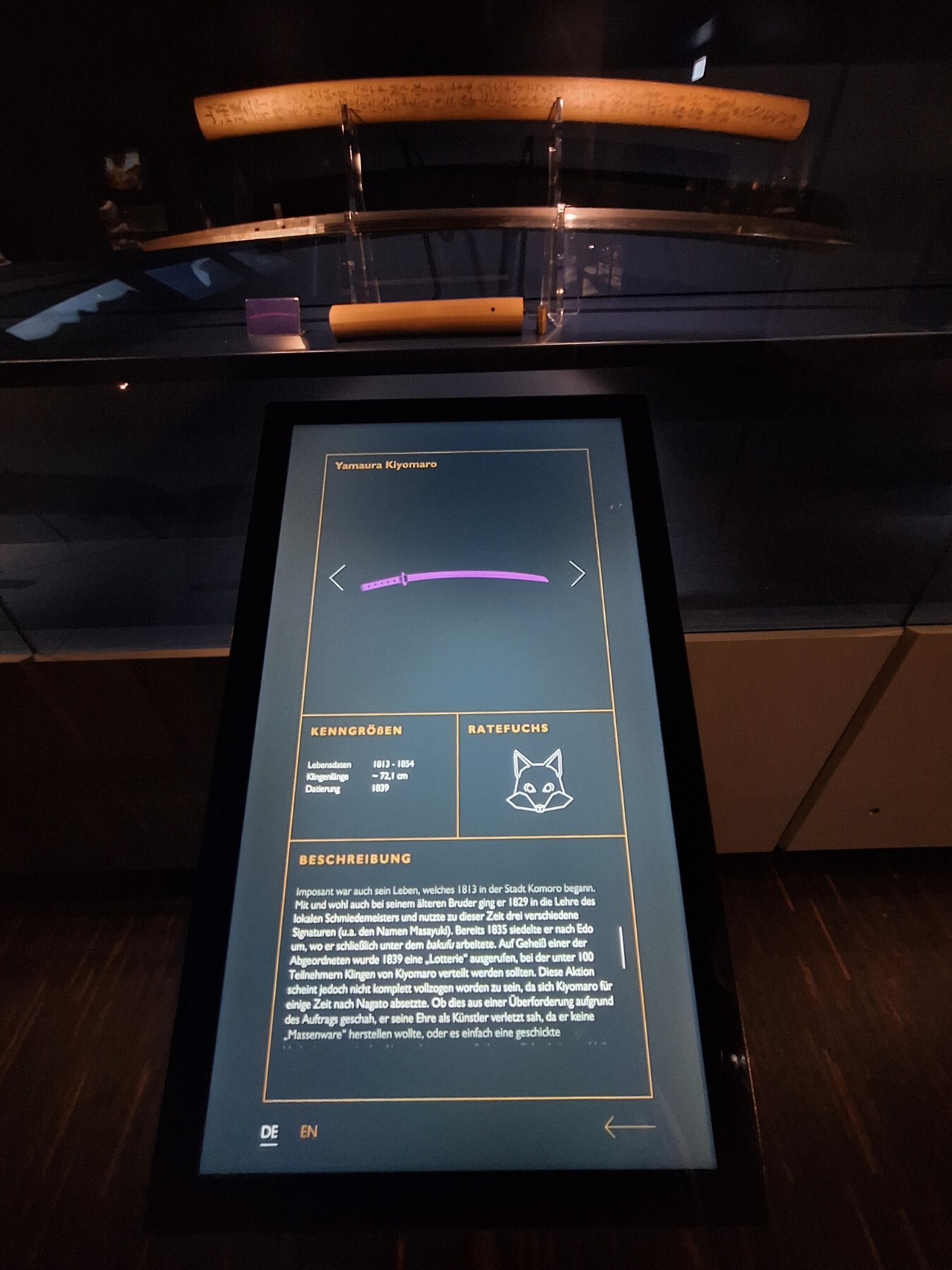
With Georg's (Promo) permission, here is a little reminder of Masayuki (Kiyomaro) exhibited at the Berlin Samurai Museum. The sword will be on display in the museum's blade room until next spring and is probably the only work by Masayuki (Kiyomaro) on public display in Europe. (I'm not sure, but currently Kiyomaro is probably only on display at Touken World in Nagoya. However, I'm happy to be corrected). Next to Masayuki, his great rival Koyama Munetsugu stands peacefully side by side, along with other works from the Shin Shinto period, which “round off” the picture of this last phase of the Edo period in terms of sword smithing. So if you happen to be anywhere near Berlin, Germany, you should take the opportunity to visit Masayuki here.


-
Thoughts on this sword I just picked up
sabiji replied to Eric187's topic in General Nihonto Related Discussion
I will be at the museum on Friday for an event. If the blade is on display, I would love to take a photo. No, the horimono is not centered on the ji, it is centered on the shinogi. -
Thoughts on this sword I just picked up
sabiji replied to Eric187's topic in General Nihonto Related Discussion
The Samurai Museum Berlin has a katana with a 74 cm nagasa, covered in horimono along its entire length. A very large naga-bonji has been added to the monouchi. The blade is by Hizen Iyo no Jo Munetsugu, has TokuHo and a sayagaki by Tanobe-Sensei from 2006. I am not a Hizen expert, but Munetsugu's horimono seem typical of Hizen to me. The horimono are centered on the shinogiji and thus affect the ji and the shinogiji in equal measure. I don't like this type of horimono, but they do exist. And that brings me back to my saying, “there is nothing that does not exist.” However, I find the composition of the horimono on the sword in this thread very strange. Even if it is pure speculation, the figurative horimono are probably much later than the bohi. -
Advice for new collectors from an old dog
sabiji replied to R_P's topic in General Nihonto Related Discussion
Michael, I deliberately used the example of the suriage Kanbun blade without papers. And it was meant to be a dig at what is generally thought about Shinto blades here in the forum. Someone had recommended that I take this particular sword with me because I didn't know any better – and he was right. And even though it was “only” Shinto and even suriage, Micha Hagenbusch didn't tear it apart. Quite the contrary. The workmanship and quality were important to him. I thought that was easy to understand. I still own the sword today. It is a Migi Mutsu Kaneyasu, in the Tegai style with some Kuichigai-ba, Uchinoke, and a pretty Kaen-Boshi. Migi Mutsu, who actually worked until Enpo, is known for his textbook Kanbun Sugata. Little sori, a pronounced taper, and a relatively short tip in relation to the sakihaba. In the original, the blade must have had a motokasane of at least 9 mm, but the Kanbun tapering makes such blades both robust and extremely maneuverable. The koshirae is a toppei koshirae, which leads me to believe that the blade was shortened very late in its history and that the sword was still being carried by an officer in the early Meiji period, well into the 1870s. At some point, I sent it to Japan for a Hozon. But it's simply not worth selling. Interest in the blade, although it's not bad, would be too low for a suriage Shinto. This is also due to the well-intentioned advice given here to the new collector. -
Advice for new collectors from an old dog
sabiji replied to R_P's topic in General Nihonto Related Discussion
Hello Brano, but I'm going to preach now. We just had a discussion on the topic (roughly) “Is the hobby dead?”, which I dispute because I see many good approaches. But there is undeniably a problem with young talent, whether in Japan or elsewhere. It's important to break away from the Japanese ideal that the sensei (or the important collector) is the measure of all things. A good master trains students who will eventually be better than him. Large gaps always arise when there is no one to follow in the footsteps of the good ones. And that is really a problem. And even though I expect a certain amount of enthusiasm from newcomers... if you, as “old hands,” discover someone who has the eye, the talent, and, of course, the virus, then please encourage them. If they then smile (kindly) at your pieces, you've done everything right! -
Advice for new collectors from an old dog
sabiji replied to R_P's topic in General Nihonto Related Discussion
I'll try again, because the last few posts completely missed the point. As a complete beginner, I would think: what's going on here? The problem is that many “old hands” seem to have forgotten their own beginnings. And I can only speak for myself: the problem wasn't the swords I bought when I was starting out. The problem was that I got five different opinions from five “old hands.” Doesn't anyone remember the feeling of going to someone who obviously knew what they were talking about and anxiously awaiting their judgment? And that's because - you were hardly able to assess the quality of your new acquisition yourself, - and you were just as unable to gauge the quality of the judgments. A negative judgment could destroy everything in seconds and effectively render a promising new acquisition worthless to you. Even in my early days at the NBTHK-EB, I observed how members or guests would quietly and secretly take an object to Micha Hagenbusch. Then there were two options: either they would return just as quietly and secretly with a grim expression on their faces and let the piece disappear into their bags. Or they would proudly carry it in front of them and others would then be “allowed” to admire it too. And I experienced the same thing! An old friend warned me during my first participation (I don't know) 25 years ago(?) to take certain blades with me. Instead, he recommended that I take a katana with me that - dated from the Kanbun period, - was suriage but still bore his signature, - had already lost some of its material, - and had no paper. In other words, the worst possible choice imaginable. However, the katana had an en suite koshirae with decorative fittings made of solid silver, typical of the late Edo period. So I tried to focus my questions on the mounting. But Micha Hagenbusch was not interested in the mounting at all. He pulled out the blade, took a quick look at it, removed the tsuka in a matter of seconds, and asked me several times, “...what do you have against the blade, what do you have against the blade??” Very quickly, we were surrounded by curious onlookers, and I was extremely embarrassed! I couldn't come up with a reasonable answer, not with my level of knowledge at the time. But it was a key experience that made me swear to myself that I had to change something! That I had to get to the point where I could form my own useful opinion. The opportunity to see good blades at the meetings was one of the important steps. Incidentally, I already had quite a few books before that. But I often imagined that what I found in the books looked exactly like what I thought I saw on my blades. But it was only when I started studying real blades that I realized there was a world of difference between what I was holding in my hand and what I had at home. That's why books are certainly useful, and they are the best support for the real study of blades in your hand. But they cannot replace practice. And part of practice is having someone experienced to stand by your side. Otherwise, you just stare at the blade like an autistic person. You see a lot and yet nothing. You have to be able to name what you see, but also what you don't see, otherwise you can't be corrected, etc... That was a fundamental insight, and yet many years of learning followed. And it continues to this day. I have no idea what my opinion will be in 10 years. But that's just my story, which I can tell a newcomer here. And a newcomer can draw conclusions from it. But they MUST take the initiative and ask questions. They must also be prepared to “let their guard down.” There's no shame in being completely wrong about a kantei. Micha Hagenbusch always tried to understand why someone gave a certain wrong opinion. And I learned a lot from his corrections. Unfortunately, this type of Kantei was not very popular. Many wanted to know in advance what to expect so they could prepare themselves accordingly. Which is understandable. There are many ways! For me, knowledge is still the most important thing. Acquiring a particular piece is more of a logical side effect. The only problem is that I find it incredibly difficult to acquire anything the longer I continue on my path. That's why owning things is no longer a priority for me. But luckily, not everyone thinks that way, because that would be a real disaster for me! As I said, there are many paths!- 142 replies
-
- 11
-

-

-


.jpg.772b368cefbbd08996b90fffe20333de.jpg)