Toryu2020
-
Posts
2,500 -
Joined
-
Last visited
-
Days Won
21
Content Type
Profiles
Forums
Events
Store
Downloads
Gallery
Everything posted by Toryu2020
-
Peter - since the original tsuba seems to have been greatly altered, I would posit that this was not to preserve the old piece but rather an inexpensive base to build the new tsuba on. In other words, the man was rich in soft metals but not so much iron so converted an old tsuba into the base on which to build his new work. All speculation of course... -t
-
Tips & Warnings * Keep the sword on display in temperature-controlled case and periodically remove the sword from the sheath to allow the blade to "breathe." * You should never use swords to "duel," as blade clashing could severely damage the blade. Also, don't use the swords to strike any equally hard object such as trees. Doing so risks damaging the blade. Not only does my sword have a soul it needs to breathe! :-) -t
-
Steve - we don't want to rob you of one of the pleasures of owning a sword, the search for just who the artist is. There were at least 8 artists working as Kiyoshige in Choshu during the Edo perod. Three that would be considered Shinshinto; Bunka, Tempo and Gen-ji. If you consider that an artists working life is thirty or forty years either side of these dates, you might even say that the man dated to 1781 worked toward the end of the Edo period... -t show us the nakago if you've the chance...
-
You sure thats not a hidden yari!?! :-) -t
-
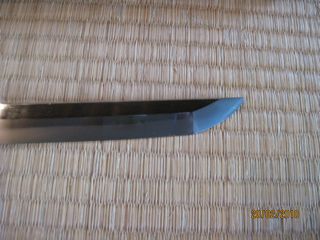
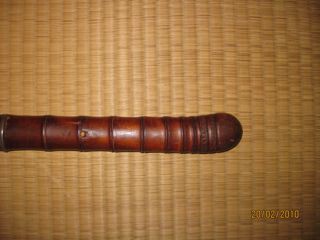
All - Took me a while to figure this out. Here are photos of my Shikomi-zue; a mumei piece papered to Hojoji Masahiro, extremely light wood, not sure if it is honoki which has been carved to look like bamboo and then covered in what appears to be cherry-bark. Hopefully from the photos you can see the seam that runs the length. Also it has an iron tip. FWIW -t



-
Sorry should read (ポカダン) Also I am a little slow catching up on this thread. The pieces are in Western collections yes, but how are we to be sure they were made for export and not just poorly made copies of earlier works? -t
-
Reinhard et al - I should hope that you understand that I for one am not criticizing you but just can't agree with your point. FWIW here is what Fukunaga Suiken Sensei has to say on the subject; "Hama-mono: an all encompassing term for Tôken/tôsogu that were created for foreigners living in Yokohama during the Meiji period. Also known as Pokadan(). Mostly sôken-gu, Gin-goshirae and Makie-zaya, flamboyant saya that foreigners might like by smiths that lost their customers after the haitô-rei. " I am working on scans BTW, -t
-
nihonto, iaido, Tameshigiri ?
Toryu2020 replied to Roarke's topic in General Nihonto Related Discussion
Darren et al - I apologize my comments should have been directed at Marek (the OP) and not you, Darren. On another note; @David, I do hope that folks in Sydney remember to spell Iaido, I-A-I-D-O. I was not at the event described and can hardly be a spokesman for Iaido-ka, but would have to say, yes, most Iai groups do not practice Tameshigiri regularly. I think it is important to do so and a person of any rank should carefully consider where they are "testing" and practice accordingly or be prepared for the audience and the judges to have different standards. For example MJER might impress folks in Kyoto but would hardly win awards in Las Vegas (if you know what I mean). Live blades however are not the be all and end all imho... -t -
Moriyama-san - Wouldn't that be March 18 on the Solar calendar - the year begins on the first day of the lunar new year which was March 18 on the western (solar) calendar just as Chinese new years was Feb 14 this year. So March 18, 1860 for Commodore Perry was January, 1st in the year of Man'en for Ii Naosuke ja nai? -t
-
nihonto, iaido, Tameshigiri ?
Toryu2020 replied to Roarke's topic in General Nihonto Related Discussion
Nihonto, IAIDO, Tameshigiri, Darren - Practice with a live blade, Shinken, Shinsakuto or antique should only be approached under the tutelage of a qualified teacher. As you can see it is not recommended for rank beginners off on their own. Your passion, your desire are are valuable things it would be a shame to lose either because of a stupid accident. Is your teacher aware of your goal? Is he/she driving the search? A proper "fitting" sword for the particular art you seek to study is not that easy to identify I'll wager. There are many factors that go into the choice, any one of which if not studied carefully will have you regretting your investment. You need to be very clear on the style of art you intend to practice and that will dictate the sword you need, and you need your teacher to guide your choices. Using antiques is never a good idea since as has been pointed out we are only caretakers of these items and it is incumbent upon us to see that they are passed down for many more generations to come, -tom AUSKF - Iaido 3 Dan MSJER - Iaido 6 Dan Renshi -
Gentlemen - I would refer you to the 1997 catalog of the Nat Museum exhibit and other books that depict the swords of the Meiji emperor. The tsuba, kodogu and saya makiie are all over the top like the examples above. This was the taste of the times, influenced by the flood of western art and ideas but not imho dictated by it... -t
-
Dan - My immediate reaction was Kaga Kanewaka but I am often way off the mark. Certainly shinto and related to Mino I would look at Kanewaka and perhaps Kanefusa. Can't say I have seen a lot of shinto Seki work, so I couldn't rule them out but would expect to see togari-ba somewhere... -t
-
Dan - What are you seeing in the jigane? Masame above the shinogi? -t
-
nthk San Francisco Shinsa
Toryu2020 replied to bdgrange's topic in Sword Shows, Events, Community News and Legislation Issues
For folks waiting on the registration packets - Still working out the set-up of Paypal account and the website, we are getting close. No packets have been sent out yet and no slots reserved as yet. Stay tuned we should have it all up and running soon. -tom NTHK2010@toryu-mon.com -
Latest aquisition - one kanji eludes me !!!!
Toryu2020 replied to Cuirassier's topic in Translation Assistance
Second that call for Photos... -t -
Need mei help, is the mei "来國俊"?
Toryu2020 replied to majortiger's topic in General Nihonto Related Discussion
George - Perhaps it should be a rule - no one posts a reply until a proper introduction has been made. -t (for tom) -
Another feature that seems to be common is the use of different woods to effect another kind of wood(if that makes sense). For example your is made to look like bamboo. One that I have also looks very much like a dark piece of old bamboo but on close inspection it has a base of honoki but is then covered in Cherry bark... -t
-
In 1877 wearing of the two swords as a badge of rank was outlawed - the class of Bushi (samurai) was dissolved, however certain individuals insisted on carrying a sword. Many old mumei blades and Kanbun blades were refit into Shikomi-zue (cane swords). In general these were not carried by the average stipend-less samurai but by gentlemen who could afford to have a sword custom-made. We find many unsigned and or less than spectacular swords in these koshirae because the folks involved understood what they were working with and generally did not mess with masterworks from an earlier period. However on occasion very fine swords may be found in such koshirae. I should be interested in photos of your sword, nakago, blade, koshirae and all. Because they represent a very brief moment in Japanese history I find them all very intriguing -t
-
Actual photos would be of better use... -t
-
The image shows piles of mallets and stakes and fan shaped frames and triangles, But I guess what I am really asking is why so many mallets? and where does the image come from? Is this from some tale or is it a visual pun like 鎌○ぬ? ートム
-
Stephen, "Rangui-ba" are crooked teeth. As I understand it a rangui is fence or defence like a thorn boma, sticks and what have you piled up to make a barrier. Thus crooked teeth look like a rangui. Moriyama-san, Yes mallets and stakes and triangles and fan shaped frames of some sort, I will try to post photos but this item is in the "hands of another". I checked several references including the Tsuba Gadai Jiten and have done a search in Japanese and like Stephen found that Rangui comes up, but the Kakeya (mallet) motif does not... -t
-
Kakeya Rangui - having just seen a fantastic kozuka and menuki set with a design of "piled up mallets" I wonder if anyone has encountered this theme before and knows its significance? No luck for me so far in the usual references... -t
-
Estrch - I am hardly in a position to argue with Mr Cunningham, wakizashi with extra thick dull blades fits with what I have encountered in my own limited experience. Given the numbers of police personnel over 250 years or so I would think we would see lots of blunted blades around. That not being the case it has to have been pretty rare from someone to have dulled a perfectly good blade for this purpose. mho -tom
-
ESTCRH - I think the problem is with the term "blunted", I think "blunt-swords" is probably a clearer idea. These were made blunt/dull from the get-go not fully made nihonto that then had their edges removed. In Kendo Kata people use "Ha-biki" which are blunted swords but these are nickel replicas that have the edge cut off not fully tempered and forge folded blades... FWIW -tom
-
Jean, maybe you need to ask "How wide is it at the part where the blade begins?" (where the notches are) and "How wide is it at the tip?" (where the yokote line is) and "How thick is it at the base of the blade?" (where the notches in the tang are) and "How thick is it at the tip?" (where the yokote is and the blade flares sightly) Katana-ko sorry if this is putting it too simply, I agree with Jean, the other dimensions will help us get a real idea of the "Monster" status of your wakisashi... -tom