Lewis B
-
Posts
1,889 -
Joined
-
Last visited
-
Days Won
10
Content Type
Profiles
Forums
Events
Store
Downloads
Gallery
Everything posted by Lewis B
-
The figure was lifted from the Token Kantei Hikketsu. But I agree, Norishige was born in Etchu but it's unclear if he started swordmaking there. It seems clear he trained under Shintogo Kunimitsu in Kamakura then encountered and possibly learned from/with Yukimitsu, Go Yoshihiro and Masamune at various phases in his career. After his apprenticeship there, he moved back to Etchu and established a forge. Closer inspection of the Mei in Jussi's informative post, I would put the signature at the Gen'o period 1320 (Kunimitsu died 1319), when Norishige was around 30 years old and supposedly working with/under Go Yoshihiro, who also originated from Etchu and establishes a connection. These various influences could explain the changes in his signature and forging stylistically. The strokes of the kanji seem to be the closest to this era.
-
Accepting Brians challenge. My first choice would be #4.... no contest, but then I'm a sucker for Kamakura/early Nanbokucho era Koto blades. Last pickup #1
-
This is a very timely post. What I have come to understand is that my appreciation for a blade is dictated by how I react to it. The initial aesthetic impact is primarily down to the sugata and everything leads on from that. I have seen Masamune swords I wouldn't glance twice at and blades from lesser makers that have me hypnotised. It starts with the shape, then proportions, then the hamon and the finer forging detail in the jihada. My brain is going through a checklist subconsciously. These are 3 blades I have spent some time studying. I have my favourite even though at first glance all 3 look quite similar.

-
I came across this maker a couple of weeks ago. They are producing a series of honyaki kitchen and chef knives made using Tamahagane steel, that look amazing. You have a very fine piece there.
-
I will be visiting Japan next May and I have your museum on my list of must sees. Do you know if you will have a special exhibition in May 2025? If you can show us some of the English langauge info cards we would be happy to make suggestions. The more information the better IMHO. I didn't attend this exhibition in person but the information provided on the info cards for these Soshu blades was the right amount of detail. I liked that the swordsmith is given some context and his relative importance within the Den and that the features on the sword are described in detail, so that the observer can understand what they are seeing. All this adds to the experience, especially if the number of exhibits are limited.
-
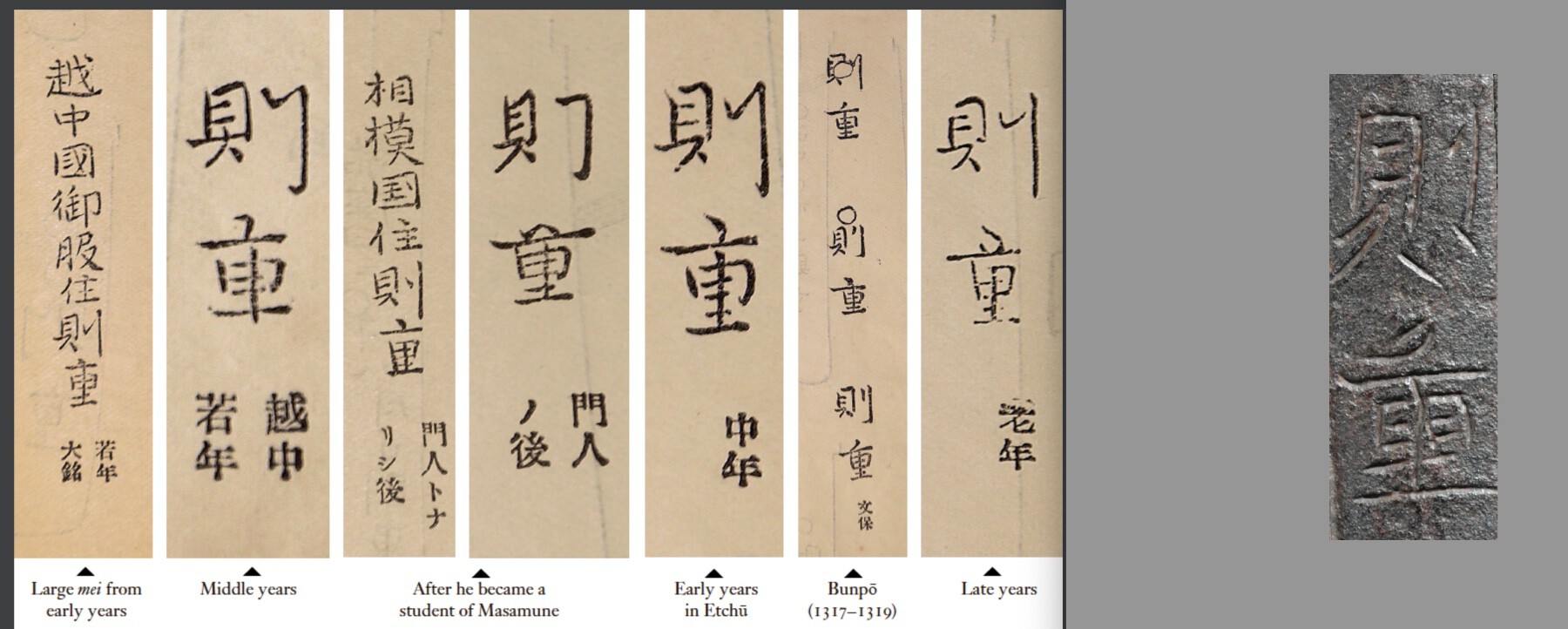
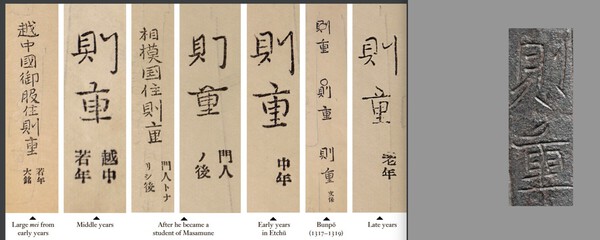
If you haven't noticed I have a massive soft spot for Norishige. My goal is to eventually own one of his blades so in the meantime I'm doing as much study as possible. Part of that is studying the development of the smith through what was a long career. His style changed depending on the influences, location and stylistic preferences predominating at the time. Ko Hoki influences, a phase where his style was similar to his contemporary Masamune and early influences of Shintogo Kunimitsu, with whom he probably had a teacher/student relationship. His Mei changed too throughout the late Kamakura and Nanbokucho eras when Norishige was active. I'm trying to place the style of the Mei on the right. To my uneducated eye it looks most like the large Mei from early years on the far left with one caveat, the oblique chisel mark on the upper kanji, at the end of the righthand vertical element. The crescent mark at the top of the shige kanji, as well as the large horizontal lines seem to be the most indicative.
-

Shirasaya not closing all the way?
Lewis B replied to chinaski's topic in General Nihonto Related Discussion
I tried the whetting seam method to close up a shirasaya split but didn't work in my case, but glad to hear it worked for you. I would make sure the saya is completely dry before you store the blade in it. Any condensation could cause corrosion to start. -
I'm curious if anyone is a crossover collector. Nihonto and kitchen knives. I was into the latter for many more years than I have been into nihonto, primarily because the price of admission is logarithmically lower. I have 5 blades that were made by a certified third generation swordsmith in his late 70's. His swordsmithing name is Kanekuni (Kato Kanekuni) and his kitchen blades are under Yoshiaki Fujiwara. Real name is Kiyoshi Kato. This is the family lineage up to the father Kato Sanehira Kanekuni https://nihontoclub....isplay=image&id=2229
-
Dealer is saying if the bohi was Atobori it would not get Juyo. Personally I don't think this is correct if the blade is from a master smith and in otherwise excellent health. This particlar blade is papered to Norishige. All the evidence suggests it was a later carving possibly when it was shortened for aestheric or balance reasons. I cannot understand any instance whereby the bohi would end so cleanly at the hamachi if it was original. The literature also says horimono was rare for Norishige.
-
Looks like an edged blade strike although not hit with much force. I would expect a much more substantial impression if a sword had made contact even at minimal speed. I would say the impression in the saya suggests an accidental contact.
-
60+....just
-
As a matter of interest how do people organize payment and take possession? I'm guessing no one carries a wad of cash and bank transfers can take a couple of business days to clear. This was my experience when I purchased my Yamato Shikkake. I started the transfer on the Saturday but payment didn't clear until Wed. Luckily I was flying to the UK and was planning to be back in Utrecht the following Friday. I local dealer kindly took possession of the sword and koshirae and we met up when I returned so I could collect it. But this I imagine is not the norm. Paying with credit card may also be difficult, either the dealer isn't able to take that payment or the price exceeds the limit. Do the dealers at the show ship? I assume they would have to return home and ship from there which is less than ideal if international. It wasn't obvious they even bought suitable packaging for shipping. Would really like to have a plan in place before I attend my next show where I might find another blade I can't live without What is the experience of other attendees at these Shows?
-
Did you find anything you liked enough to buy or was it a reconnaissance mission?
-
Thanks I emailed him.
-
Sounds like you're having a good time. Hard to overemphasise the pleasure of being surrounded by other enthusiastic nihonto and Tosogu collectors. Has anyone seen anything by Norishige, Tametsugu or Sanekage or possibly an Ichimonji? Would appreciate a heads up. Continue having fun. Totally jelly typing here in Germany.
-
Without lighting on the tables how are the viewing conditions? Can the finer details in the hada be ascertained. This is one aspect of the Japan Art Expo in Utrecht that I really appreciated.
-
Have yet to see another late Kamakura/Nanbokucho blade by the likes of Norishige, Tametsugu or Sanekage with a horimono that ends so conveniently on a shortened sword. Almost all the ones I can find online are kaki nagashi and extend 1/3 to 2/3 along the nakago.
-
Hope he paid with a credit card.
-
How would you classify a bo-hi like that assuming its o-suriage. But with a single mekugi-ana it could be ubu so the maru-dome hi might be original.
-
Interesting. Is that shigane in the centre of the groove? Certainly doesn't look original in that example.
-
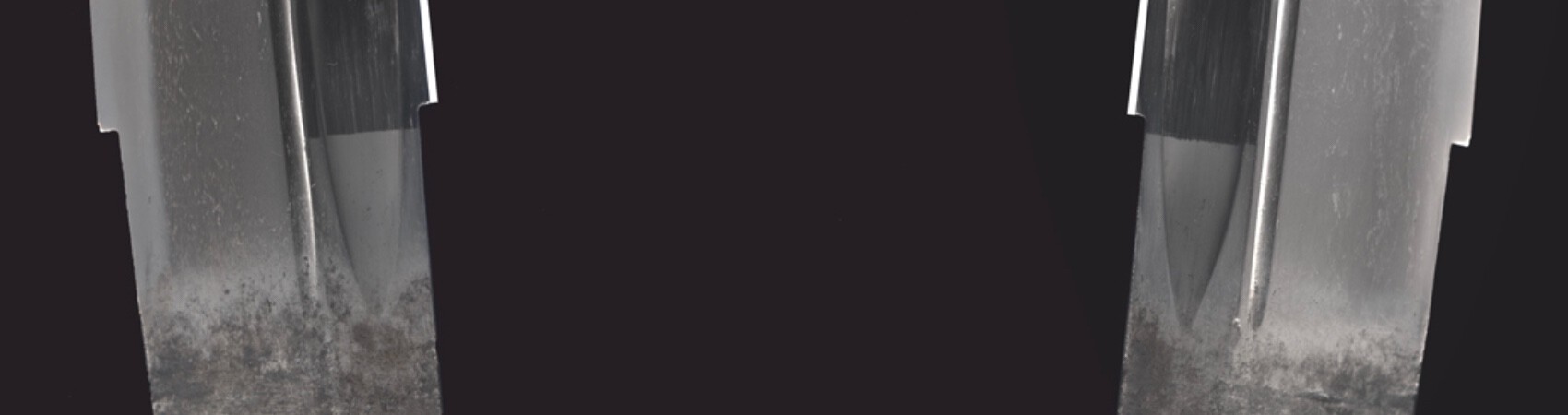
This is the bo-hi in question. Seller calls it kaki-nagashi but that extends much further into nakago according to Nagayama. This looks more like a hybrid Maru-dome bo-hi, conveniently terminating before the yokan-iro. For me this appears to be an ato-bi carving. It passed Juyo shinsa.

-
Is the blade oiled in the photos?
-
Something that has me thinking. I understand the Kaki-toshi style groove extending into and possibly past the end of the nakago when the blade is shortened, as this was originally carved by the sword maker. But what if the blade is o-suriage and the bo-hi only extends as far as the hamachi? Does this occur if the bo-hi was carved later at the time it was shortened or even later? If not original to the blade is this considered a negative either academically and/or financially?
-
One shop on my to visit list next year