Lewis B
-
Posts
1,738 -
Joined
-
Last visited
-
Days Won
7
Content Type
Profiles
Forums
Events
Store
Downloads
Gallery
Everything posted by Lewis B
-
The differences are quite pronounced. Its clear one must choose carefully. Which style was the togishi championing?
-

Odachi on auction. What time period is more likely?
Lewis B replied to JeanEB's topic in Auctions and Online Sales or Sellers
The 'patina' on the shirosaya is not very convincing. The whole setup does look a little engineered to appear older and as for the provenance and backstory.... crazy...as you would expect for Jauce. -
Yes, actually great timing to resurrect this thread. I'm also in a dilemma with regards my tanto. Much of the nioiguchi in the hamon has been worn away through repeated polishes over the centuries. No surprises as the dealer was open about it and I could see what was going on in the photos. Under normal circumstances a sashikomi polish would be the order of the day but I wonder, in this case, if a proper hadori/kesho polish by an expert togishi is the most appropriate. I also need to read this thread to understand the arguments for and against.
-
My first interest as a teenager cutting my teeth on Japanese antiques was Netsuke (like Colin, ivory seemed to be the primary medium at least in the UK) and lots of discussion on how to tell the difference between the natural material and resin copies. These were fairly widely available and while not cheap, attainable.
-
Well it says chin chin cho cho and the style matches Tanobe. There must be additional writing on the reverse side.
-
Please help Wakizashi identification
Lewis B replied to Steven6's topic in General Nihonto Related Discussion
Very nice looking blade and a great memory of your father. I would also say it's a tanto. The only picture missing is of the complete sword preferably against a dark background, without the habaki (metal collar). Does it have a pointed or flat spine (3 facets)? -
I'm reading it slightly different. Less critical rather curious. Certainly there is no question regarding the quality of the forging meeting Shintogo Kunimitsu standards. This is the google translation for the opinion piece. The blade is a shallow furisode, slightly polished, with a small ridge, a small rounded manho, and a bell-like hi-katsu-de. The blade has a fine and thick ji-fure. The blade has a thin and straight blade, a strong ko-fure, and a gold-suji-like edge in the middle of the blade, which is connected to the ji-kei. The blade is deeply turned into a small rounded hat tip. The front has a koshi-hi. For some reason, the date has been written in a way that makes it seem like a bottom inscription, but the two characters for Kagen are also written in cursive script. Is Sei a substitute inscription? The inscription written by Gyokou, which has been looked at, is notable for the fact that the characters are not in the so-called Kita-kanmuri style. However, there is no fake smell at all, and it is rather more dried and relaxed than usual, which is pleasing. As mentioned above, there is a two-character inscription and a date, and the workmanship of the blade can be easily attributed to Shintogo, but Kunimitsu's two characters are closer to cursive writing, and according to his memories, there seems to have been a demand for these characters and men. (We appreciate a glimpse of the beloved works of the late collector Tsushima Sohei.)
-
Be careful with Aoi Art image scans
Lewis B replied to Sukaira's topic in Auctions and Online Sales or Sellers
Would that be considered a hitatsura temper? -
Be careful with Aoi Art image scans
Lewis B replied to Sukaira's topic in Auctions and Online Sales or Sellers
You're not the first and certainly won't be the last to complain that the photos/scans are not representative of the blade received. Those buyers also had to send their blades to a togishi for a full polish, which in Europe is far from ideal. For me this is very dishonest, especially at AOI prices. I will not buy from him unless I see the sword in person. Can you not return the sword to Tsuruta san? There should be an inspection period. You'll be out the return shipping but that may be a worthwhile price to pay for a lesson learned. Can you post some photos and a link to the blade on AOI? -
Fascinating modification whatever the purpose. The conversion to nagamaki sounds highly plausible.
-
Nagasone Okisato Nyudo Kotetsu
Lewis B replied to Sebuh's topic in Auctions and Online Sales or Sellers
Kosher as in legitimate/real -
Nagasone Okisato Nyudo Kotetsu
Lewis B replied to Sebuh's topic in Auctions and Online Sales or Sellers
With a bidder named 'Kotetsu' I wouldn't be surprised if the sale isn't consummated. For big sales like this what procedures does AOI go through to ensure the bidding is kosher? The big auction houses make bidders jump through a lot of hoops to ensure they are genuine and that the bidder has the funds to pay. This one went unsold at least via AOI auction -
There is a Mitsutada tachi in the latest YT video from Paul Martin @8:10
-
Lots to unpack here. I didn’t want the thread to devolve into a guessing game as to why the dealer did this or didn’t do that. I can only talk about my motivations and why I decided to take a punt. Call it an academic endeavour to test the knowledge I’ve gained over the past year, as well as an opportunity to possibly advance the current state of study for an important smith/school. I’ve been lucky to have in hand multiple Juyo and TJ blades and this has given me a modicum of confidence to be able to make some educated guesses. In no way do I consider myself an expert and never claimed has such. But I can read, have access to bodies of knowledge (new and old) and the type of work I do has given me a systematic and investigative approach to a problem. I also trust Ray’s knowledge and experience and if he saw enough in the blade to make an offer, that gives me some sense I wasn’t completely off piste. I didn’t jump in blindly. I even posted a thread last October asking about the Mei and included pictures of the blade. At this point I was still on the fence but at least I had confirmation the sugata was typical for the Kamakura era in accordance with examples in Nagayama's book. It was only after reviewing the kantei Shintogo Kunimitsu tanto’s in Sesko’s Kotozen HC that really convinced me to continue the chase. Ignoring the shape of the nakago and obviously the different style for the Mei (form and carving), the 1306 tanto was, from my perspective, the twin of this blade. The length of nagasa, style of nakago, the mune shape, the koshi-bi horimono, the yakikomi, the finely executed suguha hamon, the style of boshi etc. These are all features found on blades from the Shodei's workshop. Way too much of a coincidence not to take it seriously. It was only the post in this thread showing Tanobe sensei’s discussion of the 1306 blade and his statement that the ‘Mitsu’ kanji was atypical that I wasn’t aware of until now. However it's accepted that daimei-daisaku blades for Kunimitsu exist, as is his sons signing Kunimitsu in an atypical style, in later years, when working independently. The Horyu papers also strengthened my conviction that I should proceed. I saw enough in the blade itself to give it another chance. Many examples of Horyu eventually passing on subsequent submissions and blades getting a different attribution, sometimes a better one, after a sympathetic polish. Obviously the stakes are a lot higher with a name like Kunimitsu but the Shinsa committee can only judge whats in front of them and this tanto is still hiding its secrets. They are not infallible. For example I don’t understand why Tanobe says the 1306 Kunimitsu could not have been made by one of his sons due to their young age, because that year Kunihiro would have been 33. All of these question marks and uncertainties make this an even more exciting project. An ubu Kamakura era tanto is a rarity in and of itself. What is clear is that a window must be opened up to expose the jiba. Once that visual piece of the puzzle is available then I should have a good idea where I stand. I might even get it in front of the NTHK and see what they think before resubmitting to the NBTHK. Tanobe will certainly be consulted. Best case scenario it will test the current Zeitgeist for Kunimitsu and body of production from his workshop. If the quality of the jiba is up to Kunimitsu standard I’m hoping it will be accepted as another example of an atelier (daisaku) piece by an apprentice or daimei. This would connect the 1306 and 1308 tanto’s, both with their atypical Mei. If the quality of the forging points in another direction I will reset and decide what to do next. As Alex said the money has been spent but I paid a low enough price (for me), that I’m happy whatever the outcome. The journey will have made it all the more, a worthwhile academic experience.
-
Why are you posting the same question in multiple threads?
-
Another seminal document from Hoshi and Sesko. Looking forward to the next instalments.
-
The light source is most important for revealing the hamon plus a dark background to increase the contrast. For me a dimmable 250W high intensity metal halide lamp works best for hataraki. To visualise chikei and nie in the jihada I use a cheap LED lamp from IKEA.
-
Found this Senjuin sword on Jussi's list #2419 ex Tsukamoto Museum. Has Tanobe sayagaki now
-
Almost like the nakago was painted black with areas flaking off.
-
Another feature of the kuni kanji that's different to the Masters is the horizontal strike above the mirrored S. I've seen it several times on published Kunihiro Mei but not Shintogo's. I think I can make out a similar strike on my blade.


-
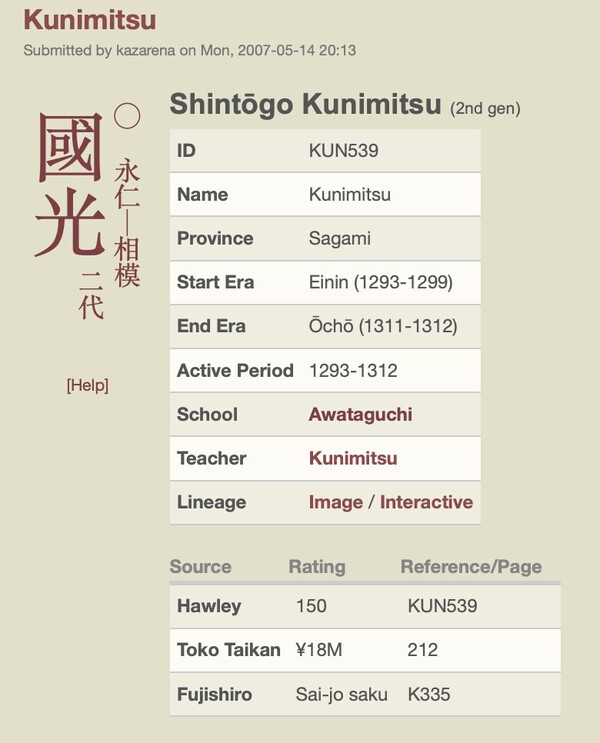
Some very useful points of reference. According the the Nihonto Club Kunimitsu was active 1293-1312. It's interesting that Tanobe gives a longer active life for Shintogo on the basis of the quality of a particular blade ie the 1320 tanto. From the Koto Meizukushi Taizan. Shintogo is said to have been born in 1250 and according to this reference dies in his 63rd year, ie 1313. Question is, which source is the most reliable. Dating works from this period are notoriously difficult with many contradictions even within the old texts. Given photos are even less useful for observing certain features compared to oshigata, this tanto dated 1324 shows many of the signature Shintogo features, such as extensive chikei, fine kinsuji and yakikomi. Signed Shintogo Kunihiro. https://emuseum.nich.go.jp/detail?langId=en&webView=&content_base_id=100486&content_part_id=0&content_pict_id=0 The 1318 Kunihiro signed tanto also has yakikomi. Beyond that the poor quality B&W image gives up little to be able to pass judgement on the jiba. What doesn't make sense is why Kunihiro would be signing in his own right if his father was still alive and working.


-
Yet it has Horyu papers, instead of just calling it gimei and collecting the fees. I guess it will need to be judged on its jiba after a polish. I'm also curious what Tanobe says about it.
-
Another worthy contribution by the forum troll. You're on a roll......keep it up.
-
So to summarise. As Ray suggested this appears to be an apprentice blade made daimei or more likely daimei-daisaku. The more I learn the more this makes sense. I would argue the smith is Norishige at the age of 18 working as an apprentice under Shintogo Kunimitsu. What evidence do I have to support this hypothesis? 1) Its universally accepted now that Norishige initially apprenticed under Shintogo Kunimitsu. 2) He had a long career starting 1308 (exactly the date this blade was made) and in this year he would have been 18. 3) His early Mei was large using a thin chisel, with the 2nd kanji slightly at an oblique angle. And from what I can tell it's quite an angular style too. 4) He dated many of his blades which was unusual for the time. Those that exist from up to 2 years either side of 1308 and also dated were carved by different hands that used a stylised writing style for the date, suggesting he was one of several apprentices in the Shintogo workshop. 5) The fact that the 1306 and 1308 blades are almost identical in sugata, length, identical koshi-bi etc would make sense if a Shintogo wanted to evaluate his students capabilities, by minimising the variables. Apprentice pieces follow this practice even today. 6) If it is an apprentice piece it likely took a lot more time to make thus explaining why there is no reference to a specific month in the date. 7) Norishige continued the Shintogo tradition of carving usual features into his Mei (like the horizontal half-moon on 'shige') throughout his career with only small changes in style. 8. The format of the date is consistent for Norishige who uses phrases like "on this lucky day...." 9) Daimei and Daimei-Daisaku is accepted for Shintogo Kunimitsu towards the end of his life. And in 1308 he only had 4 more years to live. 10) Norishige continued to make tanto in this archetypical Shintogo style for many years after his Master's death. 11) Unlikely to be Yukimitsu or Masamune as their Mei is too different. Kunihiro is a certainly a realistic possibility, but was he old enough if Tanobe says the sons were too young in the preceding Kagen era ( 1303-5) and Shintogo's oldest son Kunishige died in 1303. Here is an example of a dated (1324?) Juyo Bunkazai Kunihiro tanto, but without the adjective kanji Norishige uses. Just "on the 1st month, 3rd day......" Does anyone take exception to any or all of this hypothesising?