Lewis B
-
Posts
1,917 -
Joined
-
Last visited
-
Days Won
11
Content Type
Profiles
Forums
Events
Store
Downloads
Gallery
Everything posted by Lewis B
-
 Don't think I would have the patience.
 -
Bit late now but this show would have been the ideal introduction to nihonto from all eras. Don't under estimate these shows which are held regularly in SF, Chicago and Florida. Attending the DTI as a neophyte might be quite overwhelming. Sometimes these US shows also have Shinsa sessions. NTHK I believe with an appraisal certificate at the end of the process. https://www.ncjsc.org/events/san-francisco-to-ken-taikai
-
If you can extend your trip into first week of November you will be in Japan for the annual DTI expo held in the center of Tokyo. Probably your best opportunity to immerse yourself in everything Nihonto and possibly find your dream sword. Buying from a reputable dealer will ensure a smooth transaction. Just remember it takes up to 6 weeks to get the export permit so the sword would have to be shipped and of course, you'll have to consider the inevitable tariffs that are in effect. To answer your question. Bottomline there is no fast track. Knowledge comes from long study, both books, discussion and most importantly having the swords in hand. The point regarding carefully selecting a dealer is probably your best bet. I would focus time deciding on the era, school, blade type (tachi, katana, wakazashi or tanto) that appeals to you personally, and of course, budget. Your purchase should come with modern NBTHK papers.
-
I thought it was the inside of the forearm but after checking the listing seller says it was the calf. Who handles their blades in bed. Just asking for trouble. tbh he probably got away lightly. Could have got the Bobbit treatment. Not a Muramasa is it?
-
Potential Pawn Shop Purchase - Two Type 97s
Lewis B replied to Kaigunto230's topic in Military Swords of Japan
This is true in Japan too. Rubbing the dealer/seller(consignment piece) the wrong way doubled what I eventually paid using a local buyer to mediate the purchase. So yes, sending someone else a few months later can pay dividends. -
Is this Nanbokucho period Tokubetsu-Hozon Nihoto worth it?
Lewis B replied to MikeIke447's topic in Nihonto
It's seen many polishes, hamon runs off the edge in places and the omote is less impressive than the ura side. The deki is still impressive despite the polishes. Quality papered koshirae and recent TH papers for Yamato Shizu with very early (#17!) 1951 registration number are all plusses. However the blade and koshirae were papered a few decades apart and probably a recent marriage (typical AOI tactic). If the sword speaks to you and you can overlook the deficiencies, it's a fair price. -
Is this Nanbokucho period Tokubetsu-Hozon Nihoto worth it?
Lewis B replied to MikeIke447's topic in Nihonto
The offset hamachi (whats left of it) is odd.
-
Is there a tradition amongst big name Japanese collectors to bequeath their masterpieces to temples, institutions and museums like the Sano and NBTHK? That could certainly reduce the number hitting the open market. Since we like to consider ourselves as custodians for future generations, I would certainly think hard about doing that if I owned such treasures, especially living in the West.
-
Same for the Fine Arts. Not sure if you watch Fake or Fortune but there was an interesting case of 2 Renoir's in the last episode. One was clearly suspicious (as the science uncovered) but the other of the child looked quite convincing. Neither of the 2 authenticating bodies were willing to include either painting in the Catalogue Raissoné. As a result what would have been worth half a million quid is only worth a couple thousand at best. The power of a stamp of approval. I'm pretty sure more significance and importance is placed on NBTHK papers by a Western buyer than a Japanese collector. We tend to value and demand affirmation.
-
I'm sure there are many hundreds if not thousands of big name swords in 'noble' family collections that have been passed down through generations, not to mention important and not so important swords in museum collections, that don't have modern NBTHK papers at any level. Since they are unlikely to be sold the papers are unnecessary. Seems to me it's part academic and part marketing tool for anyone who cares to submit nihonto or tosogu.
-
Totally agree. There have been far too few deep dives into particular smiths and schools in recent years, much to the detriment of the forum. Thank you Dennis for bringing this blade into the NMB arena and being so open for constructive discussion. Since you are based in Germany it would be great to see the blade in person at one of the NBTHK-EB meetings in Solingen. With so many eager and experienced eyes I'm sure you would learn something new about the sword.
-
Beautiful tanto Bobby. You wouldn't happen to have a better photo to show the sugata? From what I can see it I would have put it in the first half of the 14th century.
-
Some interesting thoughts to add to the discussion from the NBTHK in 2015 regarding the relationship between 1st and 2nd gen Norinaga smiths. Clearly its been difficult to arrive at a consensus. There are some important existing reference materials: one tanto in the Boston museum is signed on the omote “ Yamato Shikkake Norinaga 48 saku kore” (he was apparently 48 years old at that time) and the ura side is signed “ Bunpo 3 (1319) Mi Sangatsu to-ka (March 10th)”. Another tanto is signed on the omote “Ya ?? kake ju Norinaga saku”, and on the ura is a date of “Ryakuo 3 (1340) 6 gatsu bi 69“ (he was apparently 69 years old at that time). From these, we can definitely place his active period and his birth date as Bunei 9 (1272). But there are two opinions about these two tanto from experts. One opinion is that these are early works, and the other opinion reflects an old historical opinion that these are the Nidai’s work. If these are the Nidai’s work, the Shodai’s accepted active period is too early, and from the signatures and the styles, it is difficult to see clear defferences from the Shodai’s work. Thus the opinion that these are the Nidai’s work may need to be reconsidered. Concerning the opinion that these are daimei by the Nidai (works by the shodai which were t signed by the nidai), it would be necessary to find and study more new material to address this idea.
-
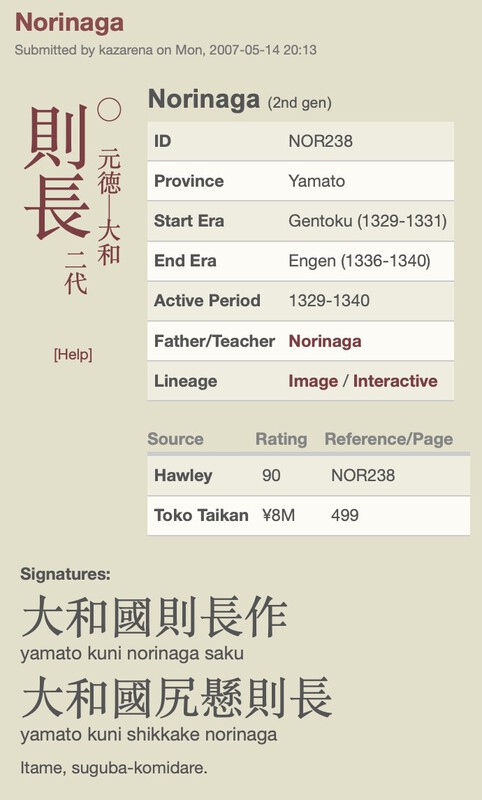
To my mind 1360-1380 for the Nidai (who is supposedly the son of the Shodei) active period seems a little late. According to Nihonto Club NOR238 the start era for 2nd generation Norinaga was right around end of Kamakura. Anyone know when the 1340 signed Norinaga was discovered?
-
I should make a correction. The Tachi in the KotozenHC is signed. However the style of midareba hamon is atypical for Norinaga in that it is almost entirely ko-gunome except for the centre section. Unlike his Yamato contemporaries, this published example shows his adoption of the up and coming Osafune style of hamon. Typically Norinaga features suguha-cho mixed with ko-gunome as featured in Dennis' blade.
-
Thanks. That would make more sense.
-
Methinks the dates are a little messed up. Dated blades up to 1340 for the Shodei with 1272 given as year of birth. Maybe Markus can clarify.
-
I seem to remember Darcy saying that one of his favourite blades was a top tier Senjuin.
-
The original post says this is a Shodei Norinaga Shikkake but neither the Juyo paper you posted nor the sayagaki mention the generation. Does the Zufu clarify this attribution? I ask because the nidei also worked in a similar style. NORINAGA (則長), 1st gen., Shōō (正応, 1288-1293), Yamato – “Yamato Norinaga” (大和則長), “Yamato Norinaga saku” (大和則長作), “Yamato no Kuni Shikkake-jū Norinaga saku” (大和国尻懸住則長作), “Yamato Shikkake-jū Norinaga saku” (大和尻懸住則長作), first name Tarōzaemon (太郎左衛門), Shikkake school, according to tradition the son of Norihiro (則弘), because there are no blades extant by Norihiro – who is considered as ancestor of the Shikkake school – the 1st gen. Norinaga as often regarded as actual founder of the school, he worked according to tradition in the vicinity of the old marketplace of Kishida village (岸田) in the Yamabe district (山辺) of Yamato province, he was active from about Shōō to Ryakuō (暦応, 1338-1342), there exists a tantō with the date signature of the third year of Bunpō (文保, 1319) and the information “made at the age of 48” and a tantō with the date of the third year of Ryakuō (1340) and the age of 69, that means we can calculate his year of birth with Bun´ei nine (文永, 1272), there are tachi, tantō, and naginata are extant whereas tantō can also be in kanmuri-otoshi-zukuri or shōbu-zukuri, tachi have a shallower sori than contemporary blades, the jigane is an itame mixed with masame, ji-nie, chikei, and some yubashiri, and appears as so-called “Shikkake-hada” (mokume along the shinogi and masame along the hamon), the hamon is a suguha or suguha-chō mixed with uniform ko-gunome elements in nie-deki, in addition hotsure, nijūba, kinsuji, and sunagashi appear, the bōshi ist sugu, runs out as yakitsume, and tends with its hakikake often to kaen but can also appear as midare-komi, some hamon interpretations with uniform ko-gunome remind of the Dōei school (道永), this characteristic feature is already mentioned in the Keifun Ki (解紛記) which was published in Keichō twelve (慶長, 1607), ō-wazamono, jō-saku ◎ NORINAGA (則長), 2nd gen., Jōji (貞治, 1362-1368), Yamato – “Yamato no Kuni Norinaga” (大和国則長), “Yamato Sakon no Jō Norinaga saku” (大和左近允則長作), “Yamato no Kuni Shikkake Norinaga” (大和国尻懸 則長), son of the 1st gen., successive generations Norinaga continue to work in the style of the 1st gen. but from the start of the Muromachi period a noticeable decline in quality can be seen, old records of the school say that short signatures of the kind “Yamato Norinaga saku” belong to the 1st gen. and longer naga-mei with the supplement “no Kuni,” “Shikkake,” or “Sakon no Jō” (左近允) to the 2nd gen., but recent comparative studies of extant signatures have disproved this, i.e. no conclusions can be drawn just on the basis of the length of early Norinaga signatures
-
Check out Sesko's Kotozen-HC kantei reference. There are 3 Norinaga swords, a tachi and 2 katana, described in detail with oshigata on p46-51. Very useful to compare with your blade, especially as these are also mumei although two have kinzogan Mei by Hon'ami Koshitsu and Hon'ami Koson.
-
Anything is possible given the quality of those photos
-
Darcy would be my point of reference for this opinion. AI also agrees Yes, NBTHK Juyo is a competition, in the sense that a blade's passing is not solely based on meeting a set of absolute criteria but also on how it compares to other swords submitted in the same session. While the Nihon Bijutsu Token Hozon Kyokai (NBTHK) evaluates swords based on quality and condition, the Juyo Token (Important Sword) designation involves a competitive element where only a limited number of blades can pass each year, meaning a superior sword might be passed over for a better example from the same smith or school. Understanding the "Competition" Aspect of Juyo Shinsa: Relative Quality: Even if a sword meets the minimum requirements for Juyo, it might not pass if other swords in the same submission are considered superior. Limited Passes: The NBTHK only awards Juyo status to a specific number of swords annually, making it a competitive process where blades vie for a limited number of slots. Historical Context and Comparison: Judges consider the historical context and how a blade compares to other examples by the same smith or school, potentially leading to changes in opinion over time. Polish Matters: The condition of the sword's polish is also a factor in the evaluation process, and it must meet the NBTHK's standards. Voluntary Entry: Submitting a sword for Juyo shinsa is voluntary, and by entering, you agree to the NBTHK's rules and evaluation criteria.
-
I wouldn't expect anything less.
-
Tough one. A signed blade is going to have a greater commercial value vs one thats mumei. Yours has quite an early registration number which doesn't do it any harm.
-
Thats interesting. As we all know, Shinsa is a competition. If too many from a school or Gokaden are submitted in a given year the best ones will go through but others, that might have otherwise passed, could pass another year if the competition is weaker. Congratulations on your pass. I might not have been able to afford mine if it had passed.