Kiipu
-
Posts
2,415 -
Joined
-
Last visited
-
Days Won
11
Content Type
Profiles
Forums
Events
Store
Downloads
Gallery
Everything posted by Kiipu
-
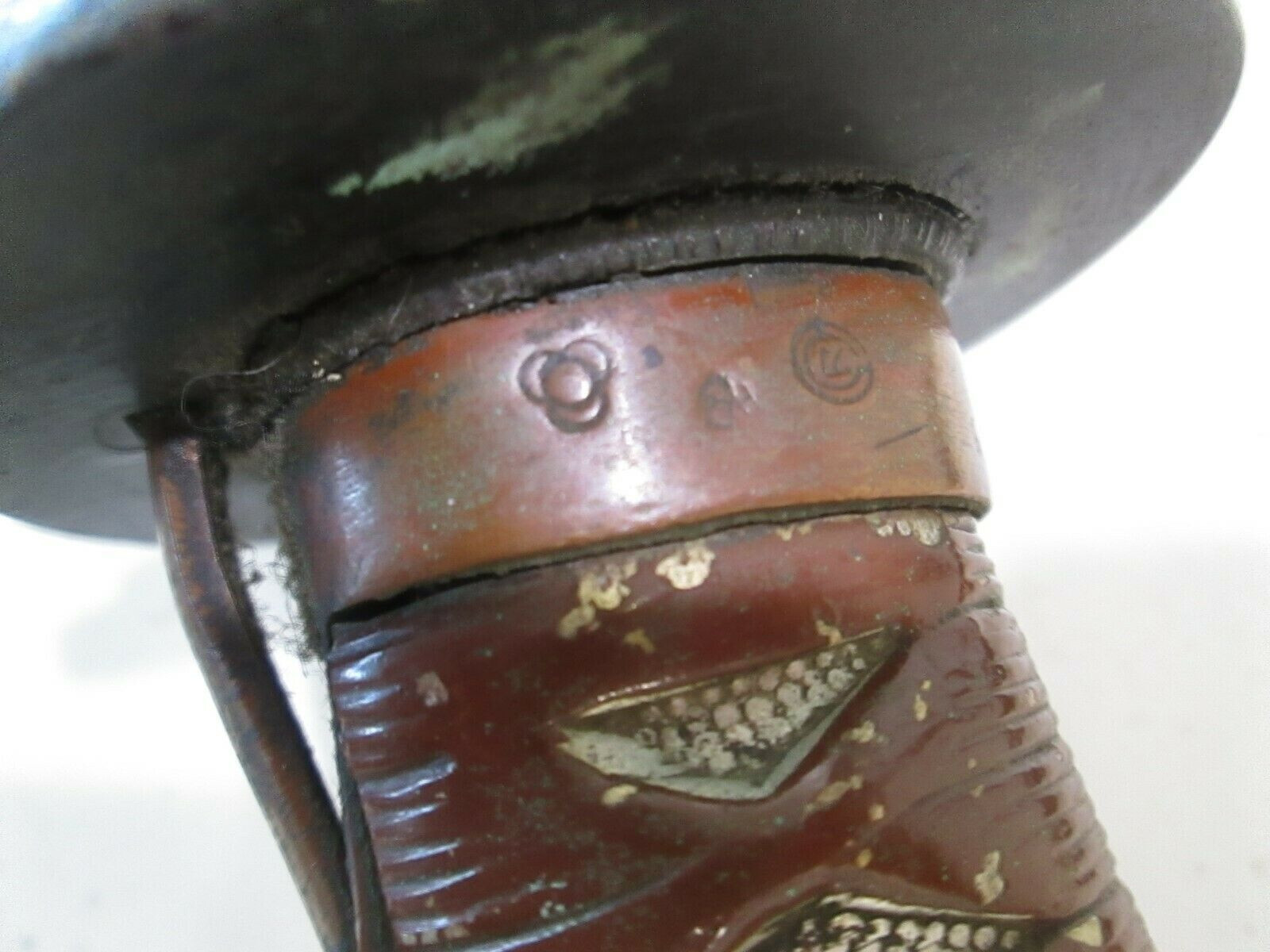
Kabutogane The logo on the right is for Tōkyō 1st Army Arsenal while the logo on the left is for the sword shop. 東 = Tōkyō 1st Army Arsenal Supervisory Section 東京第一陸軍造兵廠監督課.
-

Kanekuni Swordsmiths of Seki Ogawa & Tokyo Kato Families
Kiipu replied to mecox's topic in Military Swords of Japan
As an aside, Katō Jusaburō(?) 加藤・壽三郎 of Meguro-ku 目黒区, Tōkyō 東京, was using the mei of Masamitsu 正盛 in 1937. He could make five blades per month and had 2 apprentices. 壽 = 寿 -
ID Help Please (Type 98, Shin Gunto, Officer's Sword?)
Kiipu replied to EryrWen's topic in Military Swords of Japan
Name of swordsmith: 吉道 Yoshimichi. Date made: 昭和十七年三月 1942 March. -
To clarify, my comments above were about swords made in the early Shōwa 昭和 (1926-1945) era and not older swords repurposed for military use. On this forum, we tend to think more in terms of traditional Japanese sword craftsmanship versus the economical mass production of swords. If one keeps in mind the resurgence of interest in swords in the 1930s and 1940s, one can better understand the need for parts made in quantity (and not quality). I think one is either looking at high end blades and parts made by craftsmen for the wealthy or swords made on an assembly line for the working class with a modest income. In my opinion, these tsuba that are illustrated above and in the links are intended for the working class. Seki stamped Kanemori in handachi mounts on Yahoo Inherited Sword, looking for help Identifying maker.
-
No, gunzoku are civilians working for the military. They wore uniforms but with different rank insignia. Gunzoku Photograph
-
And all those swords depicted are actually civilian samurai-style swords pressed into military service. I would not venture so far as to say these crossguards are for gunzoku use only.
-
I have never seen any Japanese documentation that specified a gunzoku 軍属 pattern crossguard. I just assumed gunzoku used whatever crossguard that was readily available and economical at the sword fittings shops.
-
I think this is an early Shōwa 昭和 (1926-1945) era crossguard for civilian samurai-style swords. Many of which got drafted later on for the war effort.
-
The unidentified company logo on the crossguard consists of the kanji character 内 over 山. It could belong to a sword shop or a uniform store.
-
A more recent reproduction which is better made than some of the older Chinese reproductions. They caused a bit of confusion when first seen via photographs. Nco Shin Gunto - Real Or Rotter?
-
Next on your bucket list will be a leather sword knot, either real or a reproduction. Gotta have one to complete the rig. And once you are settled in and ready to dive into the deep end of the pool, take a look at the following WRF thread. Short Development History of Type 95 Gunto
-
Several different kinds of mekugi were used over time on the Type 95. What you need for your Type 95 is a steel one. Contact Don Schlickman and see if he has a reproduction available for sale. This is the same Don that Conway mentions above.
-
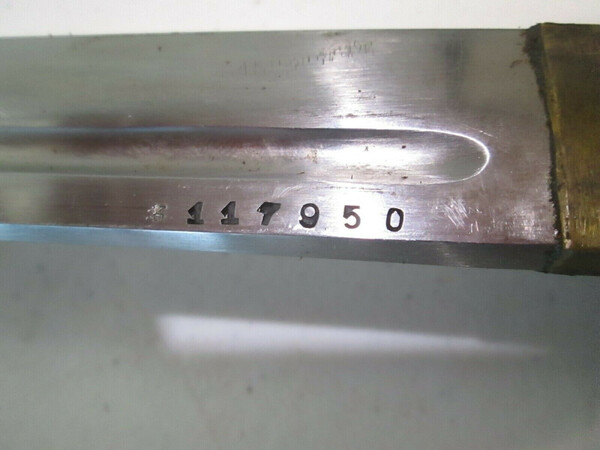
Rob, nothing wrong with your sword. The 115,000 to 117,000 serial number range is intermixed with both Kokura and Nagoya manufactured swords. I have a Nagoya, serial number 名117950, recorded from a 2020 eBay sale. This sword is pretty close to the one you own.

-
Hi Rob, welcome to the forum. As already stated, your sword is a Type 95 Military Sword. Below is a link to some basic information about them. IJA Type 95 NCO Sword Info
-
ARMY MOUNT WAKASASHI- SHIN SHINTO PERIOD ?
Kiipu replied to Dogditcher's topic in Military Swords of Japan
Spartancrest might be able to help with the tsuba (crossguard) identification. -
Is it real or fake - Type 98 WW2 officer sword
Kiipu replied to kogel's topic in Military Swords of Japan
名 昭和十九年一月 [Nagoya Arsenal inspection mark] 1944 January. ☆ 関住兼友作 [Star stamp] Seki-jū Kanetomo saku. -
Another mystery swordsmith. Unable to find a second sword made by him so far. Because it has no date, that rules it out as being made under army contract.
-
Ran across this naval handle that has the same white color in one set of pictures and then a brown color in another set of pictures. I wonder if this could be this case with this sword? Shodai Kawashima Tadayoshi Gendaito Hozon - Kai Gunto for review
-
Handle looks to have been soaked in bleach.
-
That is because of a typographical error in the listing. It is not Katetoshi but Kanetoshi. 兼俊 Kanetoshi
-
紀元二千六百一年 = 1941. 兼道作 Kanemichi saku (with Shō 昭 stamp above).
-
Dale, a very incomplete bibliography can be viewed via the NMB link below. Hope this helps. Bibliography of Early Japanese Firearms
-
Just to clarify, only Sugawa's 1st matchlock book was translated into English. The 2nd book is in Japanese only. Sugawa Shigeo. The Japanese Matchlock: A Story of the Tanegashima. 1991. A translation of Nihon no hinawajū 日本の火縄銃. In addition, are you aware of the Yonezawa book? A New Book-Release!
-
Maybe a name of a forge? Gendaito by Masakuni RJT
-
Carefully look for a "star" stamp and check the nakago mune (top of the tang) for any markings. WW2 star stamp signature help