
Dan tsuba
-
Posts
856 -
Joined
Content Type
Profiles
Forums
Events
Store
Downloads
Gallery
Everything posted by Dan tsuba
-
Hello Alex, Part of your post is quoted below- “Sometimes when you don't know what your talking about you have to stick your neck out and ask what may sound like a stupid question, so here goes Is it possible to cast a really rough overly large sword type thing, re-heat and gently knock it into the shape of a "not for war" small sword ? If so, does that mean we have got to the bottom of this?.” My friend, I do not consider any question “stupid”! Unfortunately, I am not a metallurgist or a person that has done casting of cast iron pieces. The only thing I have cast is lead for making bullets for reloading! But I can tell you that even that is a “science” and almost an “alchemy” type situation in mixing the lead with the tin in just the correct proportions! I can only imagine how the “ancient masters” mixed cast iron! Maybe with the proper mix of metals, they could gently hammer the cast iron? Anyway, about casting a rough overly large sword and re-heating it to gently hammer it into shape, I am certain that the “metallurgists” out there will answer your great question! Onward! With respect, Dan
-
Hello all! So, the videos of the sword casting techniques in the movies are funny and show a humorous part of the individuals that posted them! But let us not forget that casting of iron swords would not be done in the way that the videos show how it was done in the movies! I have included a website to a video on how a cast iron kettle was made (and I am sure there are many other videos “out there”). Of course, cast iron tea kettle casting uses a complete mold; and it is not as “thrilling” as the videos show about casting iron swords in the movies! https://www.youtube.com/watch?v=pqrJC8D3eEs Now, whether a cast iron sword was to be used in battle (highly unlikely) or to be used as a “ceremonial” piece (much more likely according to the previous posts on this thread) the way it was cast would be much more like the cast iron tea kettle casting. Using a complete mold of sand, sand and clay, or whatever method the “ancient masters” used and whatever cast iron metal “formula” they came up with! With respect, Dan
-
Hello all, So, some interesting stuff. As David stated in his post- “Perhaps of interest, there is evidence for China continuing to produce and use "bronze" swords for quite some time after they could cast iron. This I thinks says a lot about their opinion of cast iron swords.” From my previous posts we know that- “Also, cast iron and bronze foundry workers were not segregated; they often worked side by side at the same foundry. Very likely, the cast iron foundry workers adopted and adjusted the original bronze production techniques and, consequently, maintained the preexisting organization.” And also- “Some molds used for casting weapons, coins, and belt hooks also have been found at the two foundries. It is highly likely that the last two types of molds were used for casting bronze objects.” So, unfortunately, the article does not state what type of cast iron weapons molds were found. They could have been arrow heads or a “ji” (polearm) type weapon? Then I did some more research and found the reference below- “Ironworkers in China About 300 BCE ironworkers in China discovered that burning iron ore mixed with charcoal produces a thick metallic liquid instead of a bloom. We now know that carbon from the charcoal mixes with the iron to produce an iron alloy with a melting point that can be as low as 1130°C (2066°F). This temperature is exceeded by the hot-burning charcoal. The hot liquid can be poured into a mold where it cools into hard, durable (but brittle) cast iron. Produce cast iron with different qualities Although they did not know that the new method worked largely because charcoal is almost pure carbon, the Chinese quickly appreciated the advantages of cast iron over wrought iron. They also soon learned to vary the recipe to produce cast iron with different qualities, such as forms that were less brittle when cooled. The ability to cast the new alloy meant that all of the techniques previously developed for casting bronze or gold could be adapted. Complex shapes could be made in one operation. With wrought iron much working was required for even simple shapes.” From this website= https://about-history.com/the-usage-of-cast-iron-in-ancient-china-and-its-importance/ Not to say that they made “cast iron” swords (although the sword that “captured” my attention for this thread is stated to be a “cast iron” sword that is 2000-years-old). But this is some interesting research that does raise possible questions about cast iron swords. The adventure continues! With respect, Dan
-
Jean, my friend- Thanks for the great information! So, when you state "hot punched". Could that mean that the tang was reheated to punch the new tang hole for the new tsuka? So, what was the "abrasive" used on a drill during the Edo period (for "slow" drilling) to drill a hole in the tang, and did they use water or oil to lubricate the drill? And of course your knowledge of modern drill bits is appreciated! I was just referring to some drill bits I saw described on "Harbor Freight" tools! Onward! With respect, Dan
-
Thanks, Ed and Jacques, for your valuable knowledge, I have another question pertaining to the holes in the tang of the blade. Now I am fairly certain that the Japanese sword craftsman (at the time) did not have electric drills with titanium bits (hey, but what do I know, I could be wrong – just a little humor!). And drilling through cold steel, I imagine, could be quite a challenge in the “old days”. Is it possible that the craftsman could have reheated the tang of the blade to drill the hole for fitting a new tsuka? With respect, Dan
-
Hello all! So, I have a question about sometimes seeing several holes (mekugi-ana) drilled in the nakago of a blade. If the blade was cut down from a katana to a wakizashi I can see where a new hole had to be drilled to accommodate a new tsuka. That is probably why some blades have a mekugi-ana that appears at the top of the nakago. Also, I don’t think the “old blades” were mounted using two mekugi? But what about the blades that were not cut down that still have several holes in the nakago? I can only figure out that instead of mounting a new tsuka and drilling the hole in the tsuka to match the previous hole in the nakago; it must have been easier to mount the new tsuka un-drilled and then drill through the tsuka and the nakago of the blade at the same time to mount the new tsuka? That seems like a lot more work than just using the same mekugi-ana in the nakago to mount the new tsuka. Is there another reason for more than one hole in the nakago? With respect, Dan
-
Hello again Kirill, Sir, as you can tell I know nothing about the development of cast iron swords. I was just very interested in the fact that there is a 2000-year-old cast iron sword that was found in Japan. I really enjoy the “learning process”! I have re-researched (is that a word?) the article titled “Everything Old is New Again” stated in my previous post and found (on page 528) the below quote about a cast iron weapon mold found at an archaeological site- “Some molds used for casting weapons, coins, and belt hooks also have been found at the two foundries. It is highly likely that the last two types of molds were used for casting bronze objects.” So, let’s say a sword was cast in iron. Would it then be “hammered” to further flatten and shape it? Would that be considered “cast iron” or “hand worked” or both? The adventure continues, With respect, Dan
-
Yabbie! That is correct, sharp side up when carried in the saya (scabbard). I use to train in iaido (the drawing of the sword). That is why most of us (except the very high ranked black belts) trained with an iaito sword (dull bladed sword). So we don't cut off any fingers or anything else when we practice! The adventure continues! With respect, Dan
-
Hello Matthew! And welcome to the forum. You are really going to enjoy this wonderful hobby! Anyway I have learned that in reference to the picture of your tsuba (from Spartancrest - Dale) and also from the other great detailed information he sent you: Your tsuba should be mounted with the more round hole (kozuka hitsu-ana) being closer to the wearer's body (sword carried on left side of body). So in relation to the picture Dale sent you, the handle (tsuka) would be placed on the front (omote) and the tang of the blade going through the back (ura) of the tsuba and attaching to the handle. Well, I hope I got that right! Here is a good website for tsuba terminology. https://tosogucollection.wordpress.com/2013/05/16/787/ Onward, With respect, Dan
-
My apologies Jacques, I guess I was not clear on the first abstract I quoted. I cited too much of the abstract! I was just showing interest in a 2000-year-old cast iron sword that was found in Japan. That was the first time I encountered or read something like that And I was very interested! With respect, Dan
-
Hello all! So, I was “looking around” the internet (again!) and found another interesting abstract of an article (in the Journal of Anthropological Research, vol. 70, 2014,Copyright © by The University of New Mexico). I think it is neat in that it deals with bronze and cast iron production at the same sites in ancient China (and somewhere in the article it states about molds for cast iron weapons – but I don’t want to read it again to find the exact quote!). It is a lengthy article and I have included the weblink below the abstract. EVERYTHING OLD IS NEW AGAIN? (Abstract of article) Rethinking the Transition to Cast Iron Production in the Central Plains of China Wengcheong Lam Department of Anthropology, Harvard University, 11 Divinity Avenue, Peabody Museum, Cambridge, MA 02138, USA. Email: wlam@fas.harvard.edu "The transition to a cast iron industry was essential to the development of ancient China. Previous studies, however, did not address precisely how this process occurred and how the preexisting bronze industry could have served as the foundation for the transition. This paper develops a framework focusing on three parameters—techniques, assemblages of final products, and production organization—to investigate the mechanism of the transition to cast iron. Results of two case studies indicate that the three parameters do not demonstrate dramatic changes between the two industries. Also, cast iron and bronze foundry workers were not segregated; they often worked side by side at the same foundry. Very likely, the cast iron foundry workers adopted and adjusted the original bronze production techniques and, consequently, maintained the preexisting organization. This study illustrates how cast iron manufacturing developed based on the indigenous bronze production in the Central Plains of China, and aims more broadly to contribute to the discussion of technological transitions in archaeological contexts." The entire paper can be found at this website- (well Brian stated I linked to the file with my own p.c. (thanks Brian , so I took that link out of the post), I don't know how else to do it - Maybe you can access the "Journal of Anthropological Research, vol. 70, 2014,Copyright © by The University of New Mexico" and it can be downloaded-the specific pages are p. 511 to p. 542 -- or this may be another way to access the article- https://www.journals.uchicago.edu/doi/epdf/10.3998/jar.0521004.0070.402 Anyway, I am trying! Computers are still "new" to me. I would rather use an old "land line" phone than a "smart phone" that keeps dropping my calls!). Another adventure continues! With respect, Dan
-
Hello Kirill R., I quote your previous post below- “The article's title I am afraid suggests its unprofessional in everything except the corrosion. You can't date an excavated sword with a given precision and its unlikely to be that old. Cast swords are (mostly) nonsense. There are old swords made from pure iron though. Next thing we'll see photographs comparing the sword's size to a pack of cigarettes.” So, you can always contact the authors of the abstract to ascertain how “unprofessional” the article is. And what are your references to verify your statements. Without references you are just “bullying” and stating rhetoric. I have seen too much of this style of posts on the forum. With respect, Dan
-
Hello my friend, Jean! So you found me here on the "Nihonto" forum! As you are well aware, I always appreciate your "challenges". You keep me researching! Unfortunately (or not), I will have to take the "abstract" of the article at "face value" (cast iron sword). Unless you or I can find the original article and have it "retranslated"! I will await your "retranslation" of the article, since I have no idea how to do it or have it done! The adventure continues, With respect, Dan
-
Hello all! So, I am a tsuba guy! But I was doing research on the possibility of cast iron tsuba (long story!) and I stumbled across this “abstract of an article” about a 2000-year-old cast iron Japanese sword. I don’t know, I thought maybe some of you may find it of interest (or maybe not!). Oh well, here is the abstract of the article- From the website- https://link.springer.com/article/10.1557/opl.2012.630 “Long-Term Corrosion of 2,000-Year-Old Ancient Iron Sword Seiichiro Mitsui, Atsuhiro Fujii, Megumi Higuchi & Kohsuke Nishimura MRS Online Proceedings Library volume 1475, pages545–550 (2012)Cite this article Abstract An ancient iron sword (ca 2,000 year old) excavated from Ohtake-nishi archaeological site in Osaka Prefecture, is one of the oldest cast iron swords in Japan. Because of a good state of preservation, such as the sharply-defined “Shinogi” (the longitudinal ridge) on the surface, we studied relationship between the burial environment and corrosion behavior. As environmental conditions, we investigated groundwater chemistry and corrosion rate with iron probe monitor, etc. Regarding corrosion state, we analyzed corrosion depths with an X-ray computed tomography and corrosion products with a portable X-ray diffractometer equipped with X-ray fluorescence spectrometer. As results, we found that the redox potential and dissolved oxygen level as environmental conditions were very low, and that the corrosion rate (7.5×10⁻⁴ mm/y) evaluated from measured corrosion depths was smaller than the probe corrosion rate (3.2–5.2×10⁻² mm/y) by two orders of magnitude. The results suggested that the corrosion layer of siderite formed on the iron sword surface inhibited corrosion reaction.” Well, I thought it was interesting (maybe I should just stick with tsuba!). Onward! With respect, Dan
-
Ed, Thank you so much for your quick reply and making the comparison! Much appreciated! That is a really interesting tsuba you have there, I wonder if it did come from a museum collection? I have nothing like that! The adventure continues! With respect, Dan
-
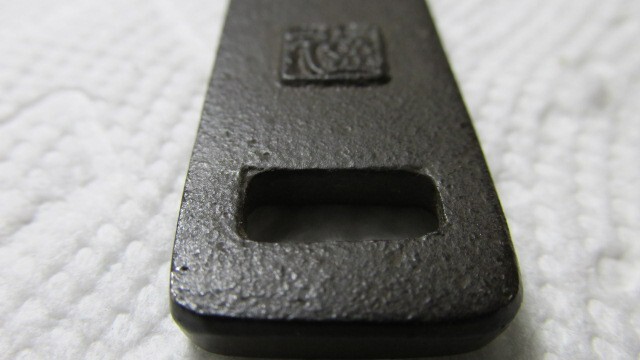
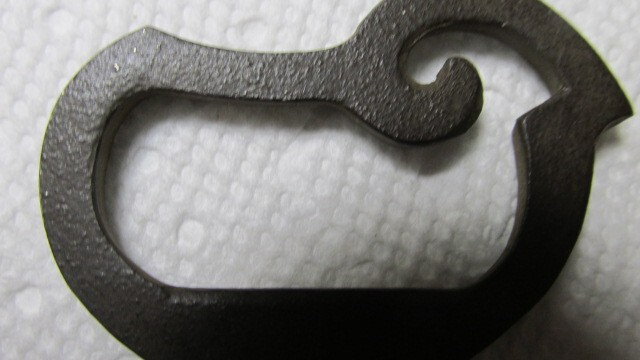
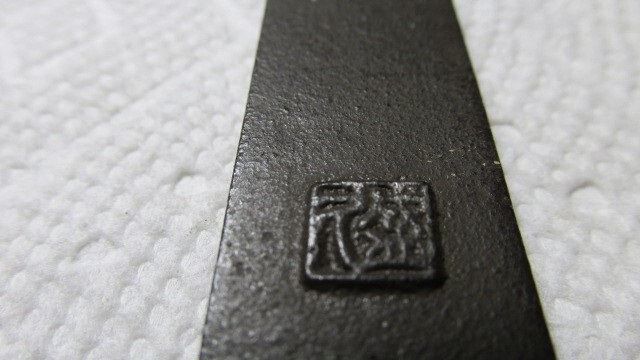
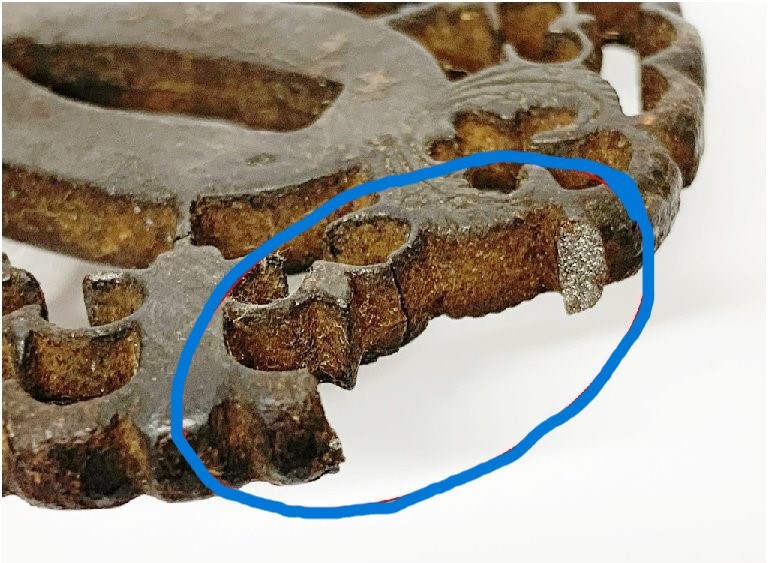
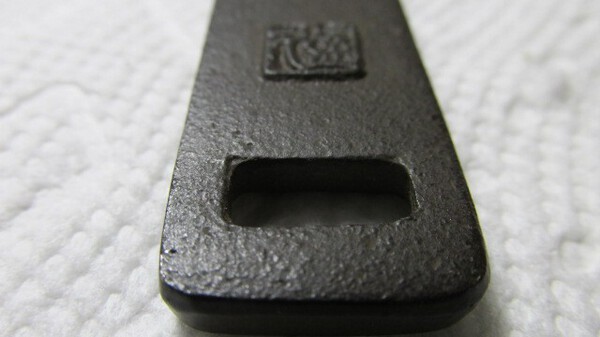
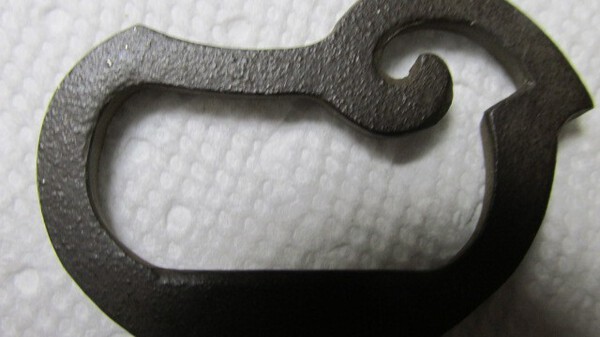
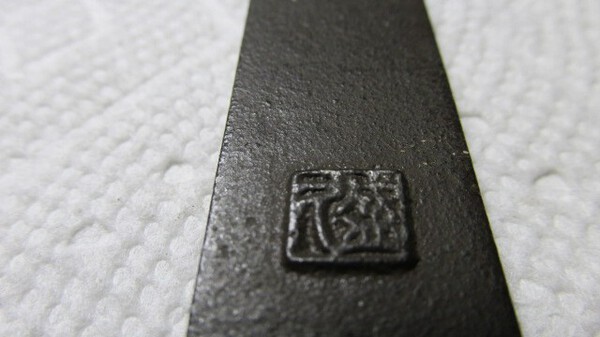
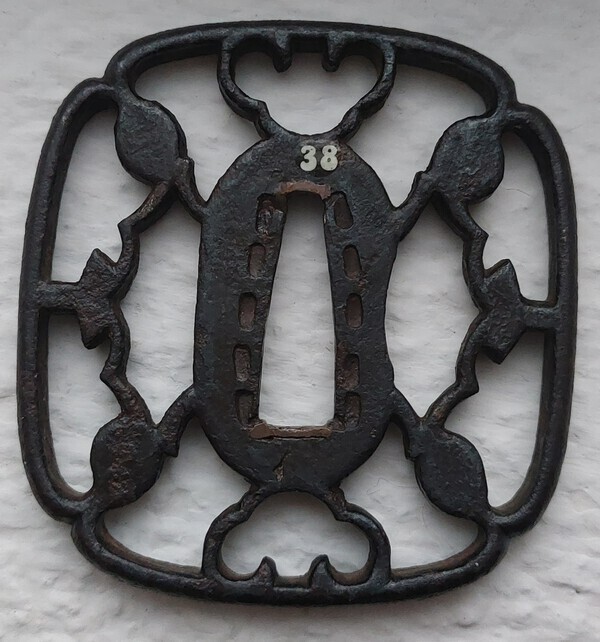
Hello Ed, nice meeting you for the first time! So, that is a really great picture you took of your tsuba! I just couldn’t keep from looking at it and noticing certain items. Now, I don’t want this post to become another “can of worms” (for others that may happen to read this!) on the forum, but I had to comment on your tsuba. Now, there is another thread on this forum titled “Tsuba casting molds”. I (and others) have done extensive research on the subject. One of the hypothesis stated is that some Edo period tsuba were made out of cast iron and sand cast. Although there are no extant (or not yet translated?) documents attesting to that fact. My personal opinion is that your tsuba looks sand cast. I purchased a Japanese made sand cast cast-iron bottle opener (cast in the old traditional way-if you wish you can find that information on page 8 of the above-mentioned thread) that I use now to compare the texture of what tsuba I think are sand cast to the texture of the bottle opener (have included 3 pictures below of my bottle opener and the picture of your tsuba for a (sight only!) comparison of textures. Your tsuba looks old, and as stated by Spartancrest in part of his post “The numbers are very neatly done, it is possible they may have been from a prominent collection or even from a museum sale”. So, not only is the texture of your tsuba interesting but also what appears to be a “crack” at the bottom of the seppa-dai in your picture. I can’t tell if that is a crack due to improper “annealing” of the cast iron (to make it less brittle) or if that is some sort of “left over” casting mark? Anyway, I would be interested in your thoughts and if you think the texture of the sand cast (cast iron) bottle opener looks similar to the texture of your tsuba. Not that this would prove or disprove anything, as your tsuba may have been made after the Edo period and if made during the Edo period it may not be cast (unfortunately there was no provenance that came with it, and there is no way to tell for sure without metallurgical testing). This is just for my own knowledge and my own inquisitiveness. Thanks, and I hope to read what you think of the comparison! With respect, Dan
-
Hello all! Is it known how many tsuba did the “average” samurai have for his swords? I tried researching it on the forum, but couldn't find anything (or maybe I missed it!). I assume that not all tsuba were made for combat. I have read (can’t quote the reference where I read it) that many samurai had 3 or 4 tsuba for each of their daisho. Maybe a “combat” tsuba. A tsuba for “everyday carry”. A tsuba for “royal and court functions”. And maybe a tsuba to reflect their “clan” with a kamon symbol. Did they always have the same design tsuba for each of their swords? Or could they have one motif on the tsuba of the katana and another motif on the tsuba of the wakizashi? Although that would not be considered a “daisho”, but it would still be a long and short sword that would meet the “two swords” requirement that a samurai would have to carry. With respect, Dan
-
Hello all! So, let’s imagine. The year was 1573 at the Battle of Mikatagahara. “At around four in the afternoon as snow began to fall, Tokugawa arquebusiers accompanied by a number of peasant stone-throwers opened fire upon the Takeda formation. Firearms, still somewhat new to Japanese warfare, were a known deterrent to cavalry assaults. Ieyasu had expected his superior weaponry to overcome Shingen's overwhelming forces and formation, but this assumption was quickly dispelled as Naitō Masatoyo's vanguard cavalry attacked and rapidly overran Honda Tadakatsu's segment of the Tokugawa right.” (https://en.wikipedia.org/wiki/Battle_of_Mikatagahara) A samurai in the Takeda force draws his sword. As he does a musket ball fired from the Tokugawa forces hits his tsuba and saves his life. After the battle, the samurai must replace his shot and cracked tsuba with a new one. However, he keeps the musket ball shot tsuba as a memento of the moment. As the years go by the tsuba that saved the samurai’s life is passed down from generation to generation. Someone along the way tries to repair the tsuba with some type of gold colored metal. Anyway, just a fun sequence of events. Did it happen that way? If that tsuba “could talk” it may have a very interesting story to tell! Onward! With respect, Dan
-
Hello all! Well, over the 10 months that this thread has been on the forum I (and others) have done some serious time-consuming and painstaking research! I now feel that I have pretty much exhausted all the references and research that I can do on the subject of cast iron tsuba being made in the Edo period (or before). Now, as mentioned in part of my previous post (of November 7, 2022) – “Now, I know from trying to find research relating to this thread over the last several months that there is very little (almost none!) historical evidence written about “cast iron” tsuba possibly being produced in the Edo period. Maybe the “16th generation iron casting family” has some “family written” old historical documents on the subject. Or, at least, some knowledge of it that was passed down by “oral tradition”? Not that I am going to fly to Japan and interview the family! But it would be an interesting way to find out if more (or any) historical information about the possibility of “cast iron” tsuba being produced in the Edo period is still in existence. “That may finally conclude this very interesting thread. Either way: “If cast iron tsuba were produced during the Edo period” or “if cast iron tsuba were not produced during the Edo period” I consider this thread to have been (and still is!) fun!” And just so the question of ‘written documents” by Edo period craftsman does not come up again (as it did before) let me add a quote from another post of mine also dated November 7th, 2022- “When the Tokugawa period began, few common people in Japan could read or write.” Anyway, that is why Edo period craftsman passed down their knowledge by “word of mouth” or what is known as “oral tradition”. Although my personal opinion is that if this thread is read in its entirety (if someone can get through it all!), an interested individual has enough referenced and researched material on hand to make an informed decision on the subject (one way or the other!). So, until I can find more research that I can reference or save up my money for a roundtrip plane ticket to Japan! -- I guess the adventure (or “crusade” – as Jean likes to call it!) will continue in one form or another! With respect, Dan
-
Hello Arnaud, About the “Edo period” tsuba on my iaito. Well yes, they looked completely different than the “new” tsuba I replaced them with on the iaito. But about “feeling different”. My personal opinion is that with an “actual piece of history” attached to the iaito, the sword carried a different “spirit” (in a good way!). Some may know what I mean, others may not. With respect, Dan
-
Hello Arnaud, So, I used to train in Iaido. I mounted an actual "Edo period" tsuba on two of my iaito swords. It was really neat to train with an actual "piece of history" attached to my iaito. I had to add some metal filler in the nakago-ana, but they worked great! With respect, Dan
-
Hello all! So (as Jean referred to it below) the “crusade” continues! Hurrah! Jean asked a question in his latest post about "for the masses". I quote it below- “But if someone is on a mission (or should I say 'crusade'?) to "prove" that cast TSUBA must have been made in EDO JIDAI in large quantity 'for the masses' (who were they? who would have bought inferior TSUBA, and for which purpose?) only because the technical possibility was given, then there is the danger to use any related information (be it correct or not) as a saving straw.” Now, this is a very long thread. I have often noticed that questions that are asked in current posts have already been answered in a previous post. I have noticed that GRC (Glen) has addressed the above issue in more than one of his posts. I include quotes from part of those posts. If the reader is interested, they can read the entire post for themselves. (part of a post from GRC 11/13/22)- “I found it interesting that he also stated: "I do not think that the majority of these “forgeries” were made for the European market." *Caveat for this quote: this was specifically referring to "gimei tsuba" (tuba with fake signatures), but was placed in a passage that was addressing shiiremono more broadly. In reading Joly's text, it seems clear to me that he is including cast-iron tsuba in with the broader group of "shiiremono". So according to Joly, most of the Edo period productions that were "made for the masses" so to speak, were of lesser quality or were deliberate attempts at deceit, and were mostly being purchased by the Japanese themselves.” (part of a post from GRC 11/14/22) “It's interesting that cast-iron Choshu and Bushu tsuba (among others) were deliberately called out, despite there not being any specific examples in this collection. It speaks to how common they were, such that the author (Joly) would call attention to the fact. In a period of relative decadence and opulence of the mid to late Edo period, it shouldn't be surprising that some members of society would opt to purchase the much less expensive cast-iron version of a famous tsuba, or one with a culturally significant or popular motif. To compare it to a modern day equivalent, it's like people who would buy and wear a fake Rolex. The real ones are widely available, but not everyone can afford one. “ (part of a post from GRC 11/17/22) “The inherent problem there is that you are talking about samurai again, not the target market for cast fittings... refocus your attention on the general populous who would have had a far more varied buying potential. It is well documented that during the peaceful Edo period, some merchants had exceeded the wealth of many samurai, while the masses were still much less affluent. Yet the samurai were still the "cultural elite", and the general masses were not as "cultivated" or as educated as the samurai themselves. So, it doesn't take much of a leap to envision the general populous admiring the cast tsuba copies that have a lot more "obvious" designs with 3D depth to them, like "the frog" and "the rat", or any of the heavily carved "Choshu and Bushu" tsuba, as noted by Joly. Now throw into the mix, many of the lower quality nanban tsuba that were so popular among the masses during the mid to late Edo period, as well as the multitude of cast copies of the Kinai dragon tsuba, or the myriad of examples in the Shachi tsuba thread. These surely would have appealed to those who were NOT the exalted aesthetes that Ford seems to think were the only people who were purchasing tsuba during the Edo period. People also need to stop viewing these things as defensive tools during the Edo period. The idea is absolute folly and is completely irrelevant in terms of determining whether or not cast-iron tsuba were produced in the Edo period. Yet it remains one of cornerstones of the "post-Edo believers". What war, what battle was anyone getting into? And that goes for both the samurai and the general populous. The defensive potential or function of the tsuba, during the Edo period, is completely irrelevant to this whole topic.” The “crusade” continues (and remember that in one of my previous posts this “crusade” question about cast iron tsuba was initially undertaken 133 years ago by Mr. Huish!). With respect, Dan
-
Jean, My friend, your thoughts, opinions, and valuable knowledge are always appreciated by me. Although, it seems to me (my personal opinion) that sometimes you miss the entire point of the subject being presented in the post. As an example, in your recent post you stated “Did Mr. Huish have some competence in metallurgy? When he reports about "hard wrought iron", I have my doubts.” Now, after the entire post, that is all what you derived from it? Well, the only way to find out the answer about his knowledge of metallurgy is to ask him. But oh wait, he is dead!! Unless you can do research to ascertain his knowledge on the subject, you really don’t know for sure. So, what is your point in presenting your opinion about his knowledge? What are you trying to say? I just wish to understand your point of view. With respect, Dan
-
Hello all! So, some may consider this a “minor point” but I nonetheless find it very interesting. Here is a quote from Mr. Huish (referred to in my previous post) from his book published in 1889- “The decoration of the sword furniture showed symptoms of decline early in the present century. Working in hard wrought iron was first of all shirked, and similar effects were endeavoured to be produced by castings ; then the decoration ran riot and transgressed all limits, so that many of the pieces made between 1840 — 1870 could never have been used for the purposes for which they were professedly intended ; such pro- ducts are remarkable in a way, as showing the lengths to which elaboration may be carried, but they can never stand for a day beside the dignified workmanship of an earlier date.” P.182 The longer quote was previously posted on this thread by Spartancrest (Dale) on February 17th 2022 and came from this reference- “JAPAN AND ITS ART” MARCUS B. HUISH, LL.B., EDITOR. OF "THE ART JOURNAL" LONDON THE FINE ART SOCIETY Limited, 148, NEW BOND STREET 1889” (So, when Mr.Huish is referring to the “present century” above, he is referring to the 19th century or the 1800’s, since the book was printed in 1889). Below is a weblink to his book- https://archive.org/details/cu31924072968286/page/n199/mode/2up?view=theater Now, an interesting point to consider. In my previous post, I included part of a letter that Mr. Huish wrote to the “Japan Weekly Mail” in Yokohama Japan. He asked a specific question about cast iron tsuba in that letter (please refer to that specific post). He sent that letter on May 17th, 1889. Mr. Huish wrote the preface to his book in November of 1888. So, I would think that his book was completed by that date, and then sent out for publishing. It was then published in 1889. So, it appears that Mr. Huish had completed his book (and the above quote taken from his book) before sending his question about cast iron tsuba to the “Japan Weekly Mail”. Evidently, he still wanted further research done on the production of cast iron tsuba. Whether he ever received a response from the “Japan Weekly Mail” is unknown to me. Onward! With respect, Dan
-
Hello all- Upon doing further research about cast iron tusba I “stumbled” across “The Japan Weekly Mail”. “The Japan Weekly Mail: a review of Japanese Commerce, Politics, Literature, and Art, Yokohama”. The below article was found in the July 6th, 1889, issue on page 14, under “Japanese Sword Blades and Furniture”. Which was found at the below website: https://archive.org/details/jwm-bound-1889/page/13/mode/2up?view=theater The article is very interesting, but I just attached what I thought were the important points below. It was written from an editor of an art journal in London to the editor of the Japan Weekly Mail in Yokohama on May 17th, 1889. So, it seems that some of the same questions about tsuba have been asked for about 133 years! He asks several questions that are listed in the article under his "Appendix Desiderata", but I only included the question about cast iron tsuba. Also, this is the earliest date on research that I could find (so far!). It predates the other research I found and posted that was found in the “Transactions and Proceedings of the Japan Society, London” (1914-1915) by 25 years! The quote from the article follows below; “It is in the hope that an interest does exist of which we are unaware, or that the matter may be ventilated, that I take the liberty of asking you to give publicity to my letter. It would be an immense benefit to collectors here if they could get into touch with collectors in Japan. ‘There are many points as to which we get hopelessly entangled here but which might easily be unraveled on the spot. I append only a few on which we seek information. Then again there are Japanese textbooks we would willingly contribute to the translation of. The interchange of photographs, which perhaps the Asiatic Society might kindly assist in, would be a real benefit. I will not trouble you further but, apologizing for the length of my letter, beg to subscribe myself Yours obediently, MARCUS B. HUISH, Editor of The Art Journal. London, May 17th, 1889. APPENDIX.— DESIDERATA. Old iron tsuba; whether often cast and decarbonized for chasing or damascening ;...…". Now , as stated above, there were many more questions asked under the above heading, but I only included the question about cast iron tsuba. If you wish to see the complete article and all the other questions asked, I have provided the link above for your reference. The adventure continues onward! With respect, Dan