
Dan tsuba
-
Posts
899 -
Joined
Content Type
Profiles
Forums
Events
Store
Downloads
Gallery
Everything posted by Dan tsuba
-
Hello all, So, Ford brought up some excellent points in his last post regarding the reference titled “Casting Sites of Bronze Bell and Iron Kettle in Ancient and Medieval Japan” paper written by Shinya Isogawa in 2014 (that paper was referenced to in one of my earlier posts – but here is the website where it can be found at https://www.jstage.jst.go.jp/article/isijinternational/54/5/54_1123/_html/-char/ja Ford’s first point (and it is well taken) is that “There seems to be no mention of Edo period casting in this paper” I find that to be correct (although I may have missed that because I need new glasses!). The only reference I could find stated “Kettles in Medieval Japan (12–16 century)”. So, the 16th century are the years in the 1500’s. So that pre-dates the Edo period by about 100 years. Now I know from research that there is a kettle maker in Japan who is a 16th generation kettle maker, and they started producing cast iron kettles in 1625. That information can be found here- https://www.architonic.com/en/story/25portraits-Japan-stories-suzuki-morihisa-studio/7001664 On to the next point. Ford states that there is no mention of what was referred to as “The article outlined that the foundrymen were using widely available, distributed cast-iron ingots”. Well, what I did find in the article is that “Thus division of production has considerably developed in medieval period, and metal material was circulated all over Japan as item for sale, and using this metal, casting craftsman made a production of kettles.” So, unless the tradesmen that were selling this “metal material” were just pieces of cast iron in loose form, I don’t think it is impossible to imagine that they were sold as “ingots”. The next point is the quote “and would have poured this into multiple pre-made sand molds.” What I did find in the article was “It melted a large-quantity of metal at a time and furnished many molds of kettles with molten metal one after another.” That statement is found at the end of this paragraph “In order to melt metal material, cast iron is charged with charcoal into melting furnace and is burned with sending air. Molten metal is poured into sprue by ladle. In case of large-sized object, casting craftsman let molten metal flow through gutter (shallow channel for molten metal) into sprue. Melting furnace clearly resembles Japanese traditional melting furnace (Koshikiro). Its shape is cylinder, and it has 60–70 cm inner diameter, and is about 1.5 m in height. And it has one tuyer (mouth for blast) through the middle of its body. Inner diameter of tuyer is about 20 cm. This melting furnace has the almost same shape and structure with the melting furnace for Buddhist bell. It melted a large-quantity of metal at a time and furnished many molds of kettles with molten metal one after another.” And the next bit of contested research from Ford. “Cast iron goods were commonplace during the Edo period, and foundrymen were supplying all sorts of small sized consumer goods in large quantities. They even pointed out that a certain point in the Edo period, household ceramic bowls had been largely replaced by cast iron bowls.” Now the statement I found in the article states - “In ancient period, cast iron kettles were rare objects. In Japan, production of the oldest cast iron object was made in the end of 7 century. It is a large-sized Hagama for particular use. And in 9–10 century, in ancient smelting factories of Tohoku, Kanto, Hokuriku, Kinki district, cast iron objects were made. In those days, most of kettles for cooking were made from clay, and these casting kettles could not supply a demand for cooking vessel on the whole, and were in circulation as particularly luxury utensils among a small number of people. In 12 century, production and supply of cast iron kettle increased to high level, and then iron kettles became to be daily necessaries for people.” Now the 12th century (or the 1100’s) is way before the Edo period. And the final point from Ford- “I'd also add that melting cast iron is impossible "at a relatively low temperature" . Typically 1200 degrees C is needed to do the job, this is really at about the limits of a bellows fed charcoal fire.” The type of furnace used for cast iron was described in one of the paragraphs above. So, whatever the temperature needed to melt cast iron, we know that it was done, and they had the furnace to do it. Now in the article the author refers to an “annual report” noted below- “From 2000 on, the annual report, Data book on Casting site Study has been published, and it contains not only data of annual meeting, but also recent achievements on study of casting sites, and discussion of the last year and so on.” Now, wouldn’t that be something interesting to study! I have searched the internet but couldn’t find anything about it. Wow, that research was super fun and kept me busy! I may have missed something along the way. Like I stated above “I need new glasses”! Now, it is time for me to use that Japanese cast iron bottle opener I bought (described in one of my previous posts) and see if it opens a bottle of beer! Anyway, the adventure continues! With respect, Dan
-
Roger, Thank your for your advise. Although, since I am old I am "kind of slow"! I don't understand? What do you mean in referring me to the posts by Bob Morrison? It appears to me that several (if not all !!) of those tsuba would be well "beyond my means" in cash outlay. Although the information provided on the motifs are interesting. Could you please explain why it is "worth my while". Thank you very much, With respect, Dan
-
Hello all, Jean stated in his last post- “Training your eyes and understanding traditional techniques will help you to decide what is good work and what is not. Buy what you like, and look at it also from the artistical and aesthetical side. Buying a cheap TSUBA like that "JAKUSHI" does not teach you anything, and it is not a pleasure to look at. It may well be a genuine Japanese TSUBA, but it is nothing one should collect. Lastly, there are really good TSUBA at reasonable prices available, so there is no need to hunt for bargains.” Well, the only tsuba I can afford are cheap type tsuba (it is the only tsuba I can afford to collect, I hunt for bargains, and they are a pleasure to look at). I never spend over $250.00 U.S. dollars for a tsuba (the tsuba I have purchased cost me anywhere from $40.00 U.S. dollars to $250.00). Why? Because that is all I can afford. But also, if I get “bit”, if what turns out to be a fake or reproduction tsuba, I don’t lose a lot of money! I really enjoy my collection of tsuba (over 120 and counting!). They are a pleasure to look at, hanging on my walls. I learn a lot from these “cheaper” tsuba. The techniques used in making them, the Japanese legends that are sometimes depicted on the piece, the different materials used on the piece, and the intricate designs (yes, even on a “cheap” tsuba), and other learning experiences. Now, maybe unlike others, I will never be able to afford a beautiful museum piece type tsuba. Maybe others can, and that is great for them! But I still look at books of tsuba collections at museums and just “drool”! Anyway, I feel that someone must give these lower quality and lower priced tsuba a “good home”. Hey, that is what I do!! Hurrah! With respect, Dan
-
Hello all, (I present the below information only as a support for the “cannibalized metal” theory, and not to distract from this thread or “impress” anyone with what I collect!) So, Glen in one of his latest posts stated- “He also concluded that the rarity of extant examples of older cast-iron products strongly suggested that older items would have been "cannibalized" and remelted to make new items once they were damaged through use, transport, or fire damage. So, looking at it from a reverse perspective, we can perhaps infer that newer items will have had a greater chance of surviving, and older items will be harder to come by.” Now, that “cannibalized” use of metal has been done over centuries. I am referring to something else I collect. I collect antique “kukris” (oldest from about 1840), the fighting weapon of the “Gurkha” of Nepal. “The oldest kukri known to exist is the one on display at the National Museum in Kathmandu which belonged to Drabya Shah, the King of Gorkha in 1627 AD. It is, however, certain that the origins of the knife stretch further back, way back to 2500 years." And also- “Although the oldest known surviving example (currently) of a kukri is in a museum at Kathmandu in Nepal. It has been approximately dated as having been made in 1559. Although that kukri survived because it was owned by a king of the Gorkha people. Unlike the Japanese swords of old which were handed down from generation to generation; the kukris that may have been owned by the common Gorkha before that period could be lost to history through being buried with their deceased owners (which is a religious custom in Nepal) or having been reheated and reforged time after time.” (The above is a quote from my own article on kukri that I have been working on for over a year!) But below is some further research- “While kukri-like weapons have been carved in temple reliefs and are occasionally seen in ancient art throughout northern India, it is critical to remember that modern Nepal is a very ethnically and linguistically diverse place. Most of these groups did not use the kukri as a tool or weapon prior to the end of the 18th century.” (Above from- https://chinesemartialstudies.com/2012/11/05/identifying-and-collecting-the-nepalese-military-kukri/ Also- “……… museum samples practically do not differ from those made now. Earlier samples were not preserved due to the low-quality metal used in them.” (Above from- https://ezoteriker.ru/en/nepalskii-mech-nazvanie-nepalskii-nozh-kukri-mify-i/ So, perhaps with cast iron tsuba (as with kukri) there may be no early examples because the metal was “cannibalized” for re-use or they just “rusted away” because of the low quality of metal used. Just another thought for consideration. The adventure continues! With respect, Dan
-
Hello Arnaud! And welcome to this super great forum! Thanks for all the valuable information and resources on "Techniques of colouring for goldsmith" and "tsuba making" and where to find them. Very much appreciated! With respect, Dan
-
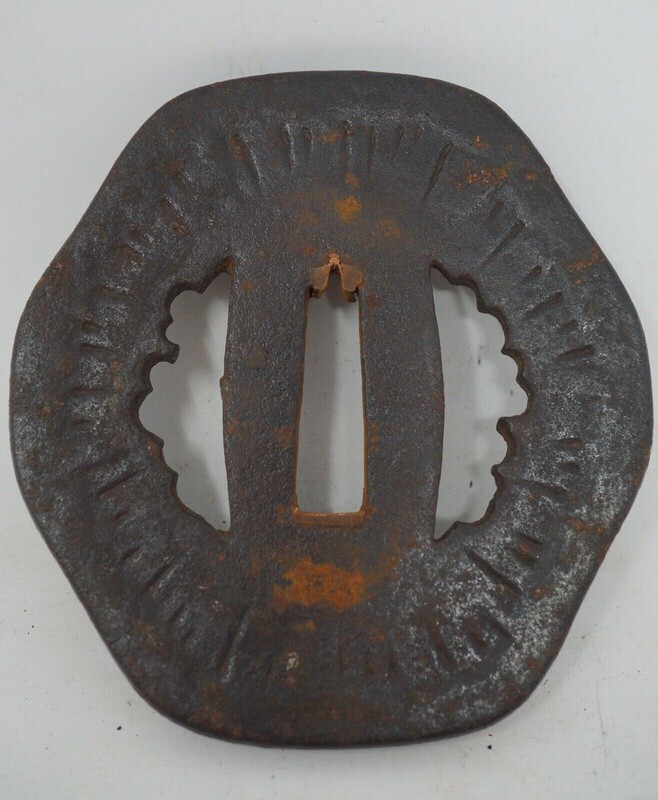
Hello all (and I am still playing the video Dale sent – “oh no, not you again”- he has a great sense of humor, and it is appreciated as this thread can sometimes become “heated”. And I don’t mean in a “cast iron" furnace way!) Anyway, I have read on this thread where now there appears to be a discussion on “cast iron tsuba carving”. And that is great! Please continue so that I may learn more about this great hobby! But Darrel stated in one of his posts shortly after my post of the “bottle opener” - “OK, so now you’ll have to see if you can chisel it and do an inlay like Glen said would be so easy. Maybe try a file first?” I (personally) have no doubt that cast iron tsuba could have been chiseled and possibly inlaid. Hey, but that is just me! Anyway, what I think is more relevant is that the motif in cast iron tsuba (if not cast with the piece) was cut (which must be easier than chiseling) to add their design. This would keep the entire tsuba flat, with no outstanding concave or convex areas in the design (and in some examples the mimi could have been filed somewhat round). I have included some pictures of what I have described above. Remember, I am not saying that these are cast iron tsuba. I just wish to describe “the flat” appearance of a “cut motif” tsuba (that may have been done with cast iron tsuba to save time and effort). Onward! With respect, Dan


-
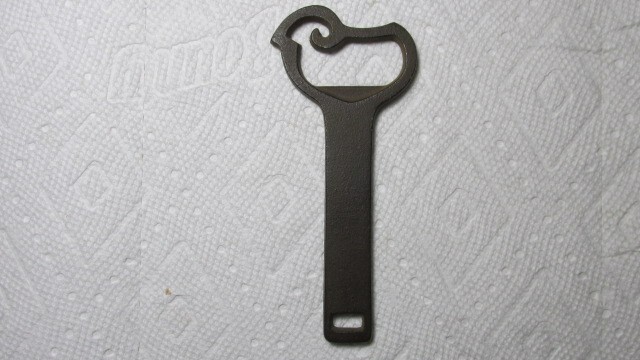
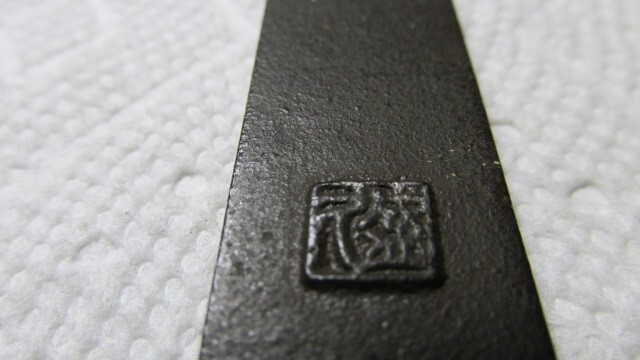
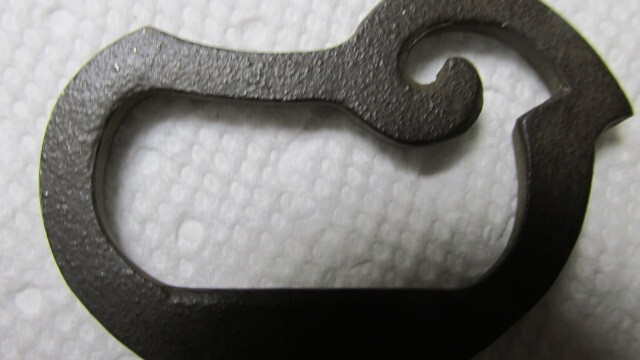
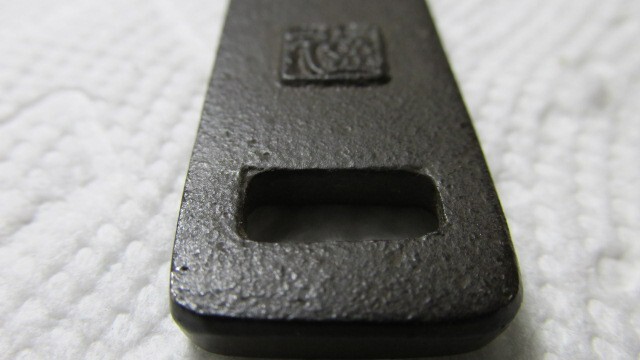
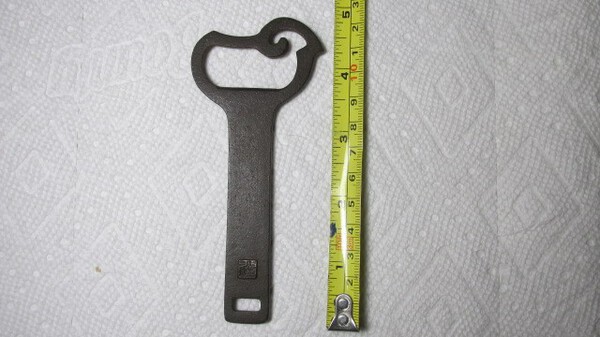
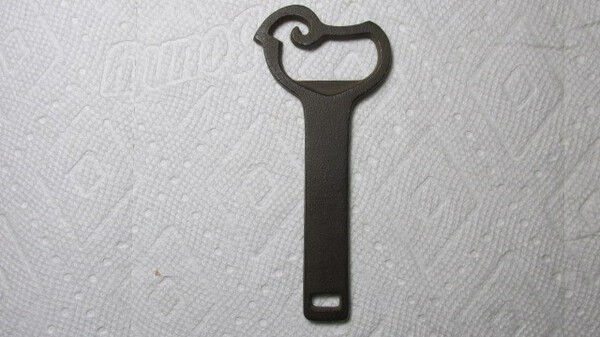
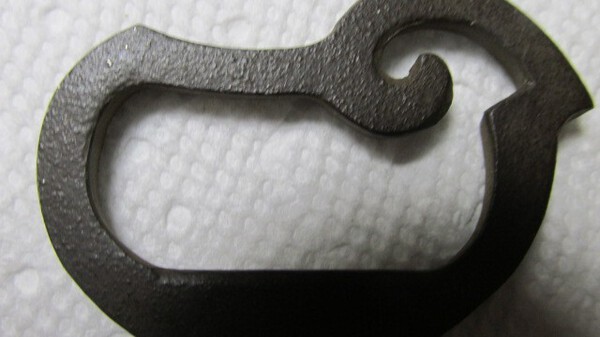
Hello all, So, where to start! I had a fun experiment all planned out (and I am not a scientist or metallurgist!). I figured the experiment would take 4 or 5 days to complete. The hypothesis was that a sand-cast cast-iron tsuba could be abraded (using an actual sharpening stone) to appear as if it was “hand forged”. What I was going to use for this experiment was a sand-cast cast-iron bottle opener, and an actual stone sharpening stone (using water instead of oil as a lubricant – like the Japanese craftsman of old did). Then “flash rust” it and steel wool the rust off of the piece so that there might appear a dark patina on the cast iron. So, I received the sand-cast cast-iron bottle opener today that I was going to abrade. I quote the dealer’s description of the piece- “Suzuki Morihisa Cast Iron Bottle Openers $42.00 Since 1625, The Suzuki Morihisa Iron Studio has produced the finest iron products in Japan. It was designated a Japanese National Treasure in 1974. They have created cast iron fittings, bells and teapots for Buddhist temples and royalty. We are happy to carry a modern extension on their historical craft - bottle opener representations of the Chinese Zodiac. Each is solid and feels perfect in hand. Sheep, Rooster and Monkey currently available. All are exclusive to Made Solid in the USA” Also, they go on to state- “About Suzuki Morihisa Studios Established in 1625, The Suzuki Morihisa Studio is now in it's 15th generation of family operation. Known for traditional Nanbu Tekki iron work, the studio has created Buddhist altar fittings, temple bells and teapots for the highest levels of Japanese culture and society. The Studio was designated a Japanese Cultural Treasure in 1974. Made Solid is the exclusive US retailer of Suzuki Morihisa Studio work.” Here is the link to the studio- https://www.madesolidinla.com/home-1/suzuki-morihisa-cast-iron-bottle-openers?utm_medium=email&utm_source=customer_notification Now, when I received the bottle opener I was amazed! There was no need to abrade it to appear as if it was “hand forged” (although that option is still available!). It was obvious (to me at least) that the piece could be easily abraded to make it appear “smoother” in texture (but it is smooth already!). And I didn’t really want to “ruin” a 50 dollar (including shipping) artistic bottle opener (after I post this I am going to see if it works on a couple bottles of beer!). So, what is my conclusion (remembering that this is all personal opinion!)? I think that a sand-cast cast-iron tsuba could have easily been made. Remembering that the only way to tell the difference between a sand-cast cast-iron tusba (that perhaps was hand finished and hand worked) and between a hand forged tsuba (that has not obviously been “folded”) is to subject them both to invasive or non-invasive metallurgical testing. Otherwise, it is just a “guess”! Also, I have included several pictures of the bottle opener. Dimensions of the piece are 4 ¾ in long (about 120.7 mm), weight is 65 grams, thickness varies from about 4.25 mm at the bottom to about 4.48 mm at the top of the motif. The adventure continues! With respect, Dan

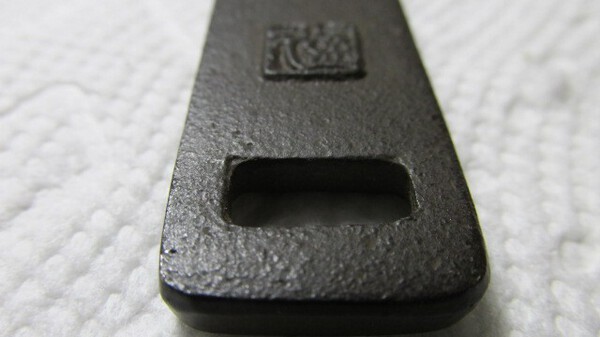
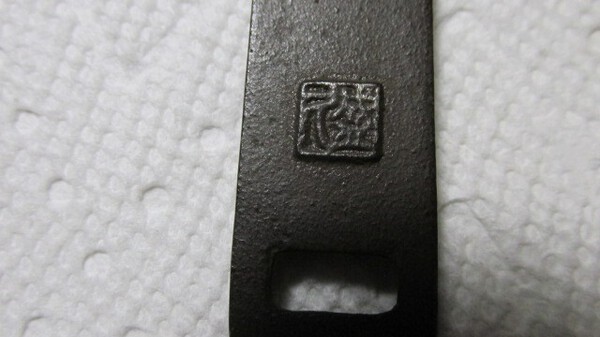
-
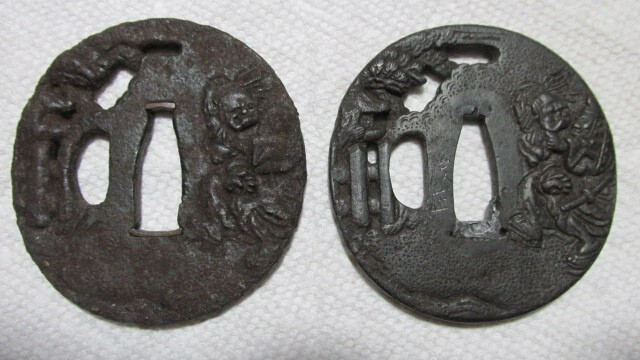
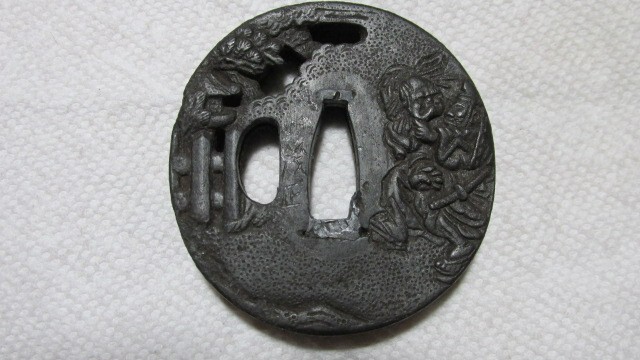
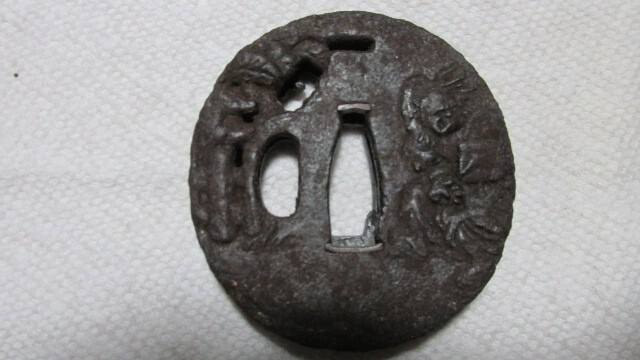
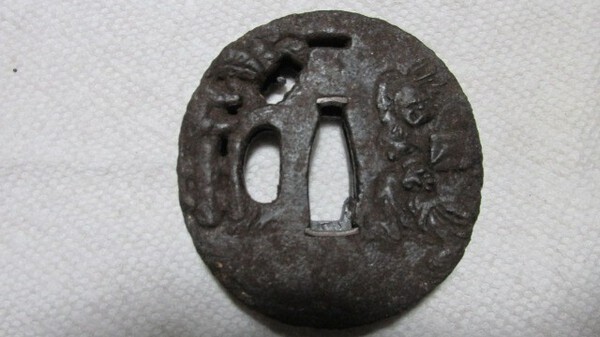
Hello all, (don’t mean to interrupt this fantastic thread – so perhaps read this and carry on!). Brian, I didn't understand what you were referring to in your last post about “Satsuma Rebellion” tsuba? Did you mean that the tsuba found on those swords would be cast or not cast? But since the "Satsuma Rebellion" was mentioned I thought that the following information may be of interest. Now, I thought this would be interesting (although kind of “off topic”). About 4 years ago, I purchased a tsuba from one of my “trusted sellers” in Japan. This was the only tsuba that I purchased from him that included a “story”. I quote what he stated in his story (remembering that this is an unverifiable piece of provenance). “This tsuba is made of iron. The story behind this tsuba is that it came from an imperial soldier, taken as spoils of war during the Satsuma Rebellion of 1877. There were two swords and other things among the items that came out of a kura, or old store house. The former owner came from the same lineage as the imperial soldier. I was only able to get this tsuba. Now, while the previous owner believed the story, his father might have made it up, or his father before him. There is no guarantee that this tsuba came from a fallen samurai after the clashes during the satsuma rebellion, but it is an interesting story. The tsuba has been ‘sleeping’ for a long time and it had a lot of active rust. I have cleaned it with a deer antler, but the damage from being stored for so long is still visible in the lack of details”. Then, as luck would have it, a year or two after buying the so called “Satsuma Rebellion” tsuba I came upon a tsuba with the exact same motif. The seller states it was signed “Shigemasa”. Could cast iron tsuba have been signed (or could that only be done on hand forged iron?). Anyway, I have included pictures of both tsuba (and have tried to highlight the Mei on the one tsuba with chalk). When placed one on top of the other, they are exactly the same, except for the filler (sakigane) in the bottom of the nakago-ana of the less rusted tsuba (pictures also attached of both tsuba placed one on top of the other). So, could these have been “sand cast iron and hand cut pieces (or hand enhanced)”? Now without metallurgical analysis it will never be known for sure, but still interesting! The tsuba (less rusted one) is thick at about 5.16mm and it is about 66mm x 68mm in size and the weight is 106 grams (less rusted tsuba) and 96 grams (rusted tsuba). Yes, the Satsuma Rebellion was in 1877 (10 years after the Edo period) but still interesting stuff to consider! With respect, Dan
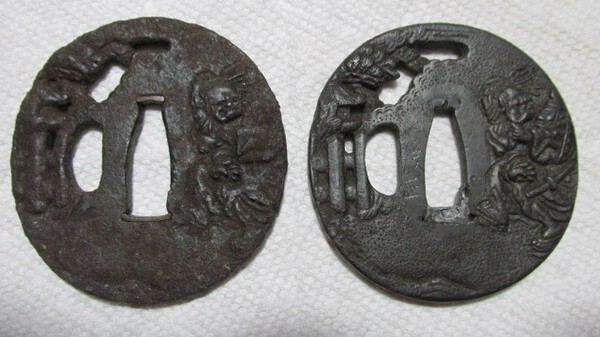

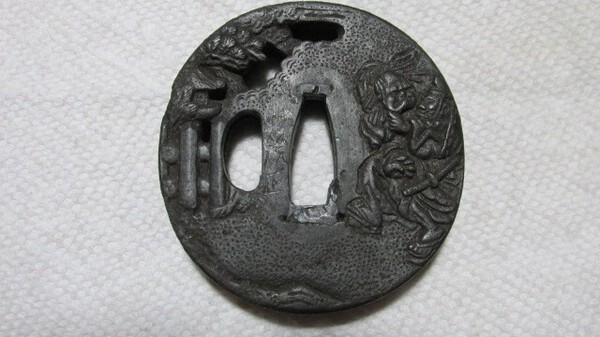
-
Vlatko, First, welcome to this fantastic forum! I have practiced iaido. The koshirae I used is “MINOSAKA HIGO KOSHIRAE” from Tozando International. I am ambidextrous. The iaito works well for me right or left-handed, although I do prefer my right hand as the “dominant hand”. All I can tell you is that the ura and omote knots don’t bother me with either hand used. With respect, Dan
-
Hello all, Thanks Darrel, for the information in your post! I researched the sabitsuke patinas and what that means. I found the below website that shows the sabitsuke technique (controlled rusting) for a tsuba- http://www.jimkelso.com/tutorials/ironpatina.htm Very interesting! With respect, Dan
-
Hello all! Now, after looking at the “tsuba rust” video again the young man states something like “you will understand why rust can protect tsuba”. Maybe that is something he will show in his next video? So, there I was, minding my own business not looking for anything! I was researching some tsuba information and came upon this statement: found on page 40 of "Japanese Sword-Mounts"- “Contemporaneous, if not of earlier date, are the tsuba reproduced in Plates V and VI. They are of iron and covered with a patina of fine smoothness. While age has undoubtedly done much to produce this "skin," it is more than likely that one of the several methods known as sabi-dashikata ("rust-summoning process") was applied to some of these tsuba. The old iron workers had recipes for producing patina, which they guarded with great secrecy and kept among their hiden ("secret processes") handed down from generation to generation. Some of these methods have been outlined in published accounts, but almost all serious searchers after authentic information on tsuba agree that these same accounts are intended to deceive rather than instruct. The one quoted by F. Brinkley 1 is typical and full of quaint fancies. Once the patina has become scratched or rubbed, the tsuba loses much of its value ; for it is the color and "feel" of the iron, as well as the handling and design, which combine to make the artistic appeal of these tsuba. It is very difficult to restore a patina that has become harmed. From a personal letter of Joly, who spent much of his time on the study of Japanese sword-mounts, and who left the most valuable information which we have concerning them, is quoted the following paragraph: — , "The problem of patinating iron and Japanese alloys is far from simple ; I have worked at it for more years than I care to remember, and have collected many recipes, some of which do work. — In years gone by I can still remember a dozen or so bottles of pickling solutions gathering dust on the shelves of my laboratory, some of which worked on shakudo, others on shibuichi, which one day were all turned into a larger bottle, and the resulting mess, the composition of which is wholly unknown, does patinate anything it is applied to. — Thank goodness I have enough of it to last as long as I shall, unless the bottle gets broken !" The "resulting mess" was never analyzed, and unfortunately Mr. Joly's valuable researches were brought to a close by his premature death in 1920.” The above information was found in “Japanese Sword Mounts in the Collections of Field Museum”, by Helen Cowen Gunsaulus - first published in 1923. A downloadable copy can be found at the below link- https://archive.org/details/japaneseswordmou16guns/page/40/mode/1up So, I was thinking what the above stated “rust-summoning process” was (and if that was what the young man in the “rust” video was alluding to?) Well, more research led to finding out that there is a rusting process called “flash rusting”. The resource I found the information in is listed below, and it was written in 2014. https://www.canada.ca/en/conservation-institute/services/training-learning/in-person-workshops/understanding-flash-rusting.html The specific section is “Immersion of carbon steel coupon in tap water”. Although there are interesting areas for study in other parts of the article. I have included the specific section of the article below- (I couldn't download the pictures associated with the article - so if you want to see the pictures just click on the above link!) “Immersion of carbon steel coupon in tap water When a carbon steel coupon is first immersed in tap water, the surface is bright and shiny, as shown in Figure 10. Before immersion, this coupon had been cleaned with acetone, then abraded with 220 grit sandpaper. Within 5 minutes, there is evidence of corrosion as orange rust starts to form. Figure 11 shows the surface after it has been immersed for 30 minutes in tap water. The surface of the coupon gradually becomes more orange over the next few hours. Figure 12 shows the carbon steel coupon after 5 hours of immersion.” © Government of Canada, Canadian Conservation Institute. CCI 127992-0014 Figure 10. A carbon steel coupon just after it has been immersed in tap water. © Government of Canada, Canadian Conservation Institute. CCI 127992-0016 Figure 11. A carbon steel coupon 30 minutes after it has been immersed in tap water. © Government of Canada, Canadian Conservation Institute. CCI 127992-0017 Figure 12. A carbon steel coupon 5 hours after it has been immersed in tap water. After several days, the surface of the coupon becomes bright orange. Figure 13 shows the carbon steel coupon after 72 hours (3 days) of immersion in tap water. When the coupon is removed from the solution and the orange residue wiped off, the surface beneath should be darkened, as shown in Figure 14. © Government of Canada, Canadian Conservation Institute. CCI 127992-0019 Figure 13. A carbon steel coupon 72 hours (3 days) after it has been immersed in tap water. © Government of Canada, Canadian Conservation Institute. CCI 127992-0020 Figure 14. The carbon steel coupon after the orange corrosion has been gently wiped off. The underlying surface has darkened in areas. So, in summary, is it possible that “flash rusting” was used in the patina process, and also to protect the tsuba from further rusting? I don’t know, just some more interesting research in the quest for tsuba knowledge! The adventure continues! With respect, Dan
-
Hello all, As an interesting addition to the post by Thomas about the findings from ancient Japanese casting sites (and parts of the below article deal with cast iron kettle making) I would like to add the following information: “4.2. Kettles in Ancient Japan (7–11 century) The oldest production of cast iron object in Japan was pursued at casting factory of the north region of Kawaharadera Temple of Asuka, Nara Prefecture, in the end of 7 century. This is a large-sized Hagama, and was casted in the casting pit. In those days the bathroom for priests was annexed to Buddhist temples, and iron Hagama for boiling water were prepared there. This Hagama is not a kettle which is used as a cooking vessel, but a particular religious tool, and it was maybe made by the special technology which was imported from foreign country along with popularity of Buddhism in Nara period. From many smelting sites which were located on gently sloping hill of Souma (Fukushima Prefecture), Kashiwazaki (Niigata Prefecture), Imizu (Toyama Prefecture), Kanto Plain, and Konan (Shiga Prefecture), many molds of kettles of 9–10 century were excavated. Recently in Kawatodai site (Ibaraki Prefecture), a large-sized site of casting factory in Kanto district was discovered, and a great many molds of kettles were excavated.21) Common point in kettle casting sites of 9–10 century is that cast iron production was pursued in the smelting factory or in the surrounding area. From excavated molds, products are Nabe and Hagama, and they have three legs under their bottom. They need not be put on kitchen range, but independently used. They belong to small-sized object, and so casting pit for large-sized objects has never found. Although these casting sites of cast iron kettle broadly spread from Tohoku to Kinki, there is no regional difference of form of vessel. Precisely examining these ancient molds of cast iron, core print by which fix mold and core is not clear. This is a different from medieval mold of kettle. As ancient casting sites are located considerably in north-east Japan, ancient casting production was influenced by Bohai or Liao which ruled north east district of China, Y. Kojima thinks.22) But it was influenced by Korean casting production.23)” And there is more interesting information to be found in the article. The above information was found at the below listed website- https://www.jstage.jst.go.jp/article/isijinternational/54/5/54_1123/_html/-char/ja The paper appears to have been written in Japan in 2014. Although it states nothing about tsuba, I find it a very interesting read about cast iron production in Japan and decided to “pass it on” to others. With respect, Dan
-
Hello all, I think I recall a post to a thread on the NMB forum (cannot remember which thread it was or if I read it somewhere else) where someone described Ford Hallem “as considered the West’s leading expert on tsuba” (or words to that effect). Now, that is a great honor! I believe if this entire thread is read from beginning to end, it will clearly be seen that many contributors have verified their research by stating references where they located the information. They are not stating opinions, but rather statements backed by (sometimes) painstaking research. It is also my belief that many of those contributors are “university educated” individuals (as I am). Their research methodology was learned over several years of formal education. Now, as stated above, Ford Hallem may have been described “as considered the West’s leading expert on tsuba”. Again, that is a great honor. And congratulations, Ford! But “who is considered the East’s leading expert on tsuba”? Or more specifically “who is considered East Asia’s leading expert on tsuba? And why haven’t we heard from him? Now, Ford, in one of his latest posts to the thread stated a very humorous fact- “I'll end by sharing this, sent to me by Greg Irvine, recently retired Senior curator at the V&A, so a serious scholar, The Samurai, as a class, were dissolved in 1867 The 'printing telegraph', the first fax, was invented in 1843 Abraham Lincoln was assassinated in 1865 so There was a 20 year window in which a Samurai could have faxed Abraham Lincoln.” That is indeed very funny! And although the information is from a “serious scholar” I believe it is flawed. That is because there were no direct telegraph lines installed between the United States and Japan until 1901. “The Commercial Pacific Cable Company Founded in 1901, the company provided the first direct telegraph route from America to the Philippines, China, and Japan. Prior to this, messages had to travel across the Atlantic to the Far East via Capetown and the Indian Ocean, or via London to Russia, then across the Russian landline to Vladivostock, then by submarine cable to Japan and the Philippines.” Found at the below website- https://atlantic-cable.com/CableCos/ComPacCable/index.htm Now, in the paragraph stated above there is mention of a “land line”. A “land line” is defined as a telephone. The telephone was not invented until 1876. So, although the “serious scholar” statement is funny, it is incorrect! Anyway- Gentleman, we are not trying to discover a cure for cancer here! Tsuba collecting is extremely educational, interesting, and sometimes exciting. But most of all it is “fun”! I have found that, oftentimes, people take themselves much too seriously. When tsuba collecting stops being fun for me, then that will signal the time for me to “exit” the hobby! This forum is a fine place to ask questions and share ideas and thoughts. In several of the threads a “lively discourse” of varying opinions often takes place. However, I believe there is still much “out there” to be discovered and learned about tsuba. I am reminded of a quote from a famous Zen master in his book- “Zen Mind, Beginner's Mind: Informal Talks on Zen Meditation and Practice” by Shunryu Suzuki “In the beginner’s mind there are many possibilities; in the expert’s mind there are few…. In the beginner’s mind there is no thought, ‘I have attained something.’ All self-centered thoughts limit our vast mind. When we have no thought of achievement, no thought of self, we are true beginners. We can really learn something.” ~ Shunryu Suzuki Also, I would like to repeat something I previously stated on a post to this thread- “I never underestimate the innate quality of man’s ingenuity. To do so would be a mistake.” If this thread is read in its entirety I am personally convinced (from all the excellent research presented in the thread) that cast iron tusba were produced during the Edo period (even maybe as early as the 1600’s). But that is just my thought on the subject! As for the multitude of other tsuba collectors out there, they will have their own opinions. Thank you all very much! With respect, Dan
-
Roger, You are too kind! Your input into the progression of this "amazing" (in my opinion) thread is much appreciated!! Yes, my friend, you are correct. There is still "maybe a little way to go yet". We will see what happens! With respect, Dan
-
“Tsuba- The tsuba (鍔, or 鐔) is usually a round (or occasionally squarish) guard at the end of the grip of bladed Japanese weapons, like the katana and its variations, tachi, wakizashi, tantō, naginata etc. They contribute to the balance of the weapon and to the protection of the hand. The tsuba was mostly meant to be used to prevent the hand from sliding onto the blade during thrusts as opposed to protecting from an opponent's blade.” The above was found at this website- https://en.wikipedia.org/wiki/Japanese_sword_mountings So, Jean- There you go again, making me do more research!! Thank you!! Onward! With respect, Dan
-
Jean, Throughout about the 10 months that this thread has appeared on the forum you have been a great and valuable help. Your insights, thoughts and opinions are of excellent value; and they are much appreciated! You always seem to “challenge” me. That is much appreciated, since it forces this “old man” to continue his research. In so doing I am constantly learning. Thank you! Now, in your most recent post you again “challenged” me with your below statement which refers to a quote from my previous post-- “.... there is very little (almost none!) historical evidence written about “cast iron” tsuba possibly being produced in the Edo period..... Dan, do you have a suspicion what that might mean?” A very legitimate and valid question, Jean. Thank you. But I am sending that question back to you Jean, “do you have a suspicion what that might mean?” As you notice I used the term “oral tradition” in my last post. That is defined as- “a community's cultural and historical traditions passed down by word of mouth or example from one generation to another without written instruction.” That definition is found here - https://www.dictionary.com/browse/oral-tradition Now, Jean, I make reference to the following- Below is from this link- https://en.wikipedia.org/wiki/History_of_education_in_Japan “Japan was very unified by the Tokugawa regime (1600–1867); and the Neo-Confucian academy, the Yushima Seidō in Edo was the chief educational institution of the state. Its administrative head was called Daigaku-no-kami as head of the Tokugawa training school for shogunate bureaucrats. When the Tokugawa period began, few common people in Japan could read or write.” And more information was continued on that site, that I did not consider relevant to the issue. Also, I would like to refer you to this “hierarchal” scale on the “Edo” period (notice where “artisans” fall on the lower end of the scale). Which was found at this website- https://factsanddetails.com/Japan/cat16/sub107/item502.html So, my conclusion is that there are very few (or none at all) written records of early Edo period cast iron tsuba casters because those artisans did not know how to read or write (as verified by the above research). If anything, they would have communicated their methods by “oral tradition. That is why I stated “oral tradition” in my last post! Anyway, my friend, the adventure continues!! With respect, Dan

-
Hello all - (and yes, and I am playing the music video that Dale posted “oh no, not you again”!!). Anyway, enough with the humor and onto the subject at hand- First off, I would like to very much thank all the forum members that continue to show an interest in this thread of “Tsuba casting molds?”. And I would also like to thank all the members that have contributed (and continue to contribute) their valuable research, thoughts, insights, and information to this thread. Onward!! So, as stated in my previous post “13th generation iron casting family in Iwate, Japan using traditional techniques...” Upon further research I found it is now a 16th generation family of iron casters going back to 1625. That information can be found at the link listed below (which in itself is a very interesting “read”)- https://www.architonic.com/en/story/25portraits-Japan-stories-suzuki-morihisa-studio/7001664 Now, I know from trying to find research relating to this thread over the last several months that there is very little (almost none!) historical evidence written about “cast iron” tsuba possibly being produced in the Edo period. Maybe the “16th generation iron casting family” has some “family written” old historical documents on the subject. Or, at least, some knowledge of it that was passed down by “oral tradition”? Not that I am going to fly to Japan and interview the family! But it would be an interesting way to find out if more (or any) historical information about the possibility of “cast iron” tsuba being produced in the Edo period is still in existence. That may finally conclude this very interesting thread. Either way: “If cast iron tsuba were produced during the Edo period” or “if cast iron tsuba were not produced during the Edo period” I consider this thread to have been (and still is!) fun! Although, personally (and just my opinion), it would not surprise me one bit if those people of Japanese descent who collect tsuba in Japan (and thus have easier access to possible cast iron tsuba documentation and cast iron artisans) already know the answer about “cast iron” tsuba being made in the Edo period (and have probably known the answer for some time!). Just more “food for thought”. Thank you all! With respect, Dan
-
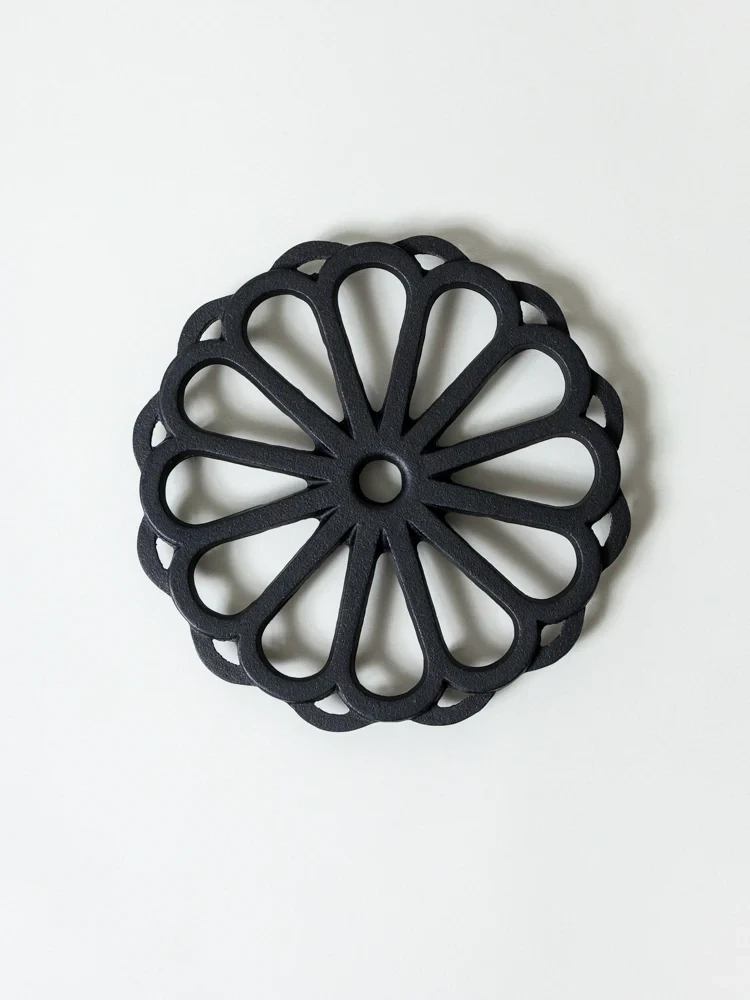
Hello all! Thank you, Dale, for the great music video! Very funny and well done! It had me dancing with a “sand cast” cast iron tsuba held in each hand!! But now back to research! I found this description on one of the “trivets” pictured in my last post- “Handmade cast iron rest made by a 13th generation iron casting family in Iwate, Japan using traditional techniques to create amazing shapes and beautiful weathering effects. Each piece will deepen in color with use and develop a one of a kind patina. Perfect for placing your hot kettle or even in your kitchen for hot pans or pots! Origin: Made in Iwate, Japan Size: 13 x 13 x 2cm (LWH)” The above quote was found on the following website (which also shows a picture of the “very tsuba looking” cast iron “trivet”)- https://www.teadealers.com/products/circles-cast-iron-trivet?variant=32265054257217¤cy=USD&utm_medium=product_sync&utm_source=google&utm_content=sag_organic&utm_campaign=sag_organic&gclid=EAIaIQobChMIxIirptyQ-wIVUg6tBh0G_wsHEAQYASABEgLCzfD_BwE So, “13th generation iron casting family”. So, considering a “generation” is 20 to 30 years that would mean that this family has been casting ironware for 260 to 390 years! Which would be from about 1632 or 1762 to the present (depending on the number of years you define a “generation” as- and if my calculations are correct!). Just another interesting fact for consideration! The adventure continues! With respect, Dan
-
Thank you, Piers, for your translation of "Tsubaology"! Although, since I am not familiar with the Japanese language is "Tsuba-gaku, Tsuba no Kenkyū." one term or is it an "either or" type choice?? Thanks again! With respect, Dan
-
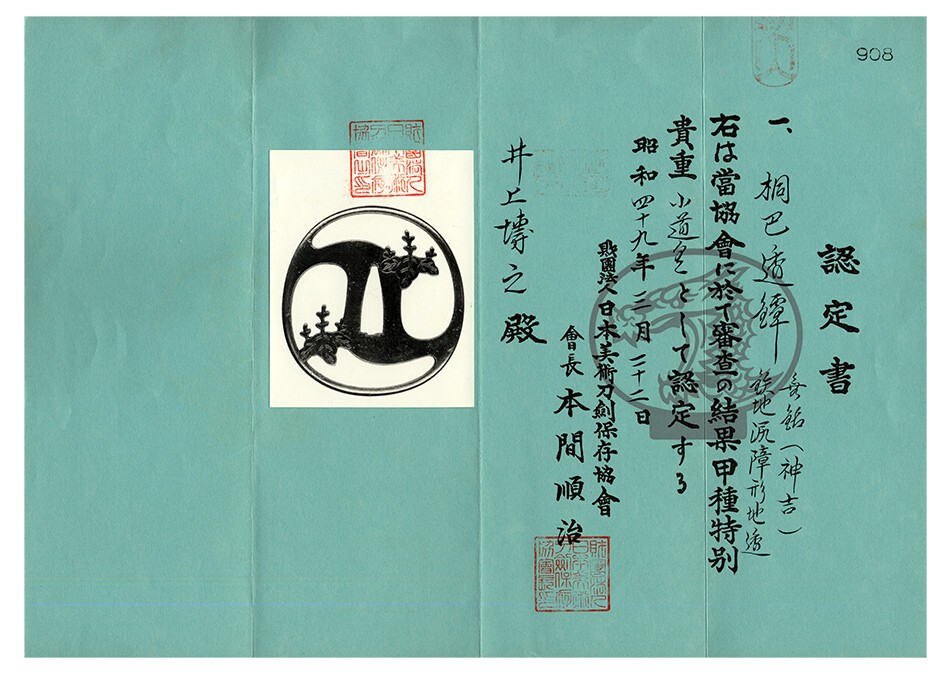
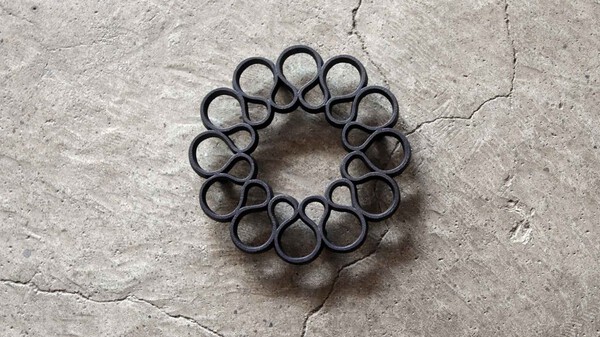
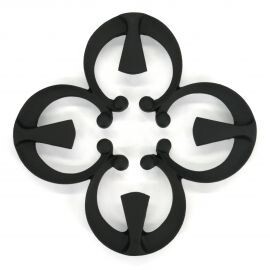
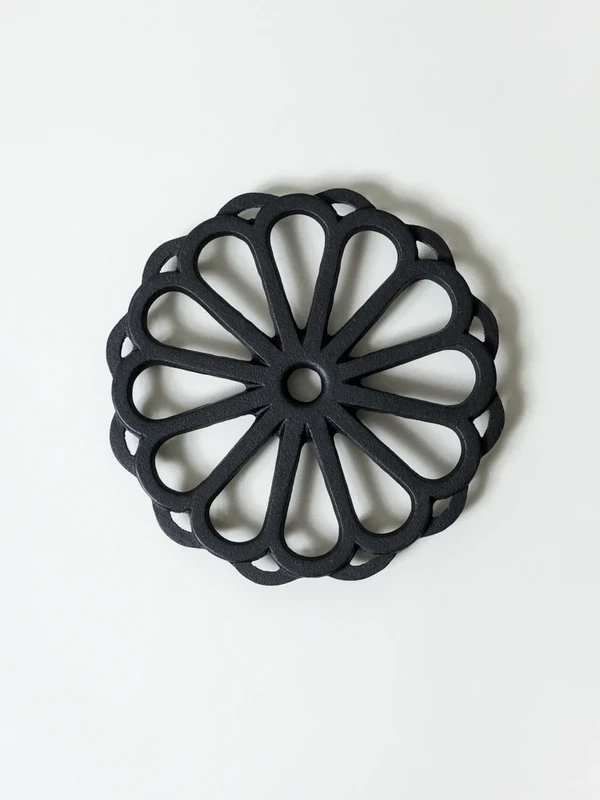
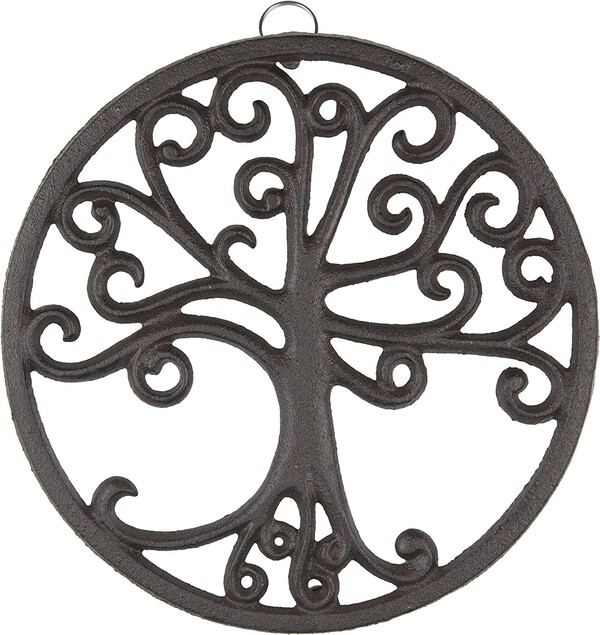
Hello all, it’s me (I know what most of you are thinking – “oh no, not him again”!!) Later in this post I will bring up the subject of “cast tsuba” again, but I would like to preface this subject with Curran’s helpful post. Thank you, Curran, for your post and insights into the “micro texturing” of tsuba. Although really the only way to know anything for sure has already been discussed on this thread. I refer you to my quote from a previous post- (I know- kind of long, but hang in there this post gets better, I think it does!!). And remember, this is just my opinion! “Now, if this subject of Edo period cast iron tsuba is to be resolved, may I suggest the following (and I would like to inform the reader that I have no vested interest in the outcome one way or the other – I just find it a fascinating subject for exploration)- I suggest gathering at least 20 tsuba from different "reputable" dealers (I consider that number of tusba a relatively fair sampling - although others may think that fewer or more would be better). In the dealers listings of these tsuba they would be listed as Edo period and would appear that they could be made from cast iron (perhaps including a few Nanban types). Then have a metallurgist cut (or maybe it can be done by chemical or other less invasive means?) and analyze each tsuba. If a "cast iron" tsuba is found, then the examination can stop at that point. The conclusion that can be drawn is that if there is one cast iron tsuba, there are probably many others "out there". If no cast iron tsuba are found in the sampling of those 20 tsuba (or more or less), then there is an extremely high probability that Edo period and earlier tsuba were not made from cast iron Unfortunately, there is really no solid definitive historical written proof (that I can find) that states that cast iron tsuba were “not” being made in the Edo period (I refer the reader to my earlier post that includes reference to the Transactions and Proceedings of the Japan Society, London 1893-5, and to the reference of the Professor A.H. Church collection). I believe that the above-mentioned scientific way of discerning the metal used in Edo (and possibly earlier) tsuba would be the only way to finally “bring to a close” the “cast iron” tsuba debate.” Also, a quote from a post from Darrel- “There are a number of closely related non-destructive methods of elemental analysis of metals and alloys, but the basic method is XRF or EDX. So, if you have a large enough sample size you could describe the elemental components of different tsuba. Some years ago I did this for Marcus Chambers and someone did this for Ford at V and A. Normally this is quite expensive although the analysis takes little time and the calculations are done with internal software. But you might find someone who has access to an instrument that shares your interest. The steel industry does this routinely. The data could be separated into like groups statistically. Perhaps a good chemistry/metallurgy BS thesis subject.” Anyway, just some more stuff to “ponder” follows!!!---- “Trivets”, as explained in my previous post, are “sand cast” (or “clay cast”) cast iron pieces to place a teapot upon. Some of these pieces are very intricate in design, and if cast in a smaller size they could easily be made into tsuba. I have included some pictures of these intricately designed trivets that appear somewhat like very large tsuba (the size of these trivets is anywhere from 8 to 13 inches or 20 to 33 cm). Also, “Cast iron tea kettles are particularly common tea vessels in Japanese and other Asian cultures. In Japan, cast iron kettles are known as tetsubin. They originated during the late 17th century and early 18th century and became integral to the Japanese tea ceremony". This information was found at this link- https://senchateabar.com/blogs/blog/cast-iron-teapot#:~:text=In%20Japan%2C%20cast%20iron%20kettles,with%20any%20loose%20leaf%20teas. And another great link that explains the history of a “kettle casting” family in Japan. https://www.sunday.de/en/nanbu-tekki-suzuki-morihisa-square-trivet.html So, my opinion is that Japanese cast iron kettle makers could have made tsuba. And since the kettle makers originated in the 17th century, maybe there are “sand cast” or “clay cast” tsuba that could have been produced as early as the 1600’s!!! If that is the case, how many “sand cast” or “clay cast” tsuba have been purchased as “hand forged” and “hand cut” pieces (myself included!)??? When in actuality they could have been “sand cast” (or “clay cast”) and “hand worked”!! Also, I still am of the belief that the pictures I posted on my latest previous thread is a “sand cast” (or “clay cast”) tsuba, that was filed or abraded to show a smoother appearance. Which brings up another interesting point. As shown in one of my posts, that particular tsuba has been papered (twice!). Now (also in my previous post) if that tsuba was made for “display” only (due to the fact that the motif is a big part of the seppa-dia and the seppa would “cover up” part of the motif) then did the “authenticators” of the tsuba miss this point and authenticated a “display” piece (twice!)??? Anyway, just “food for thought”! And thanks for reading the entire post!! Onward!! With respect, Dan


-
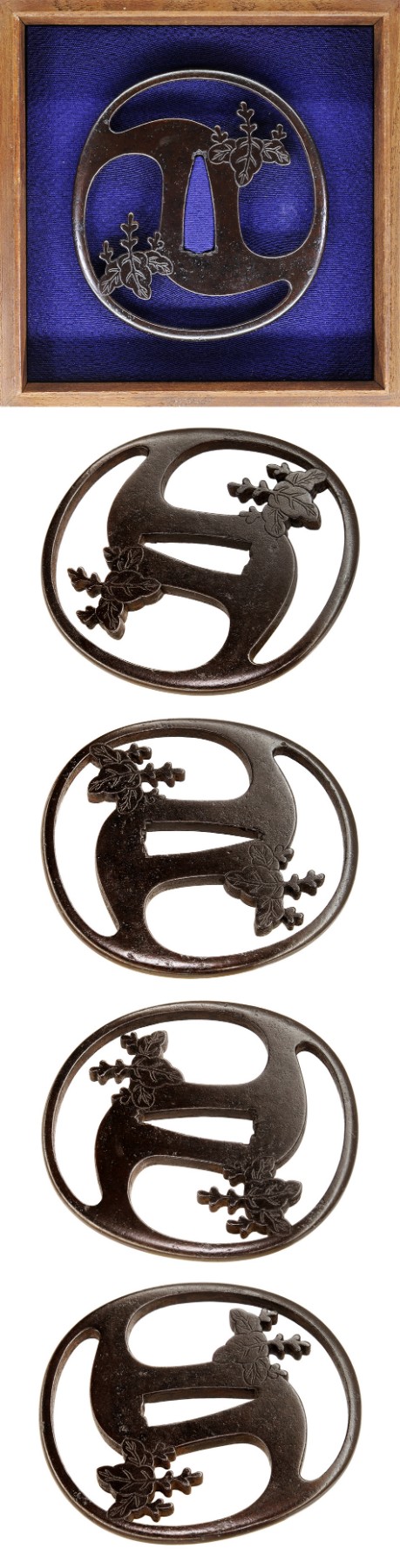
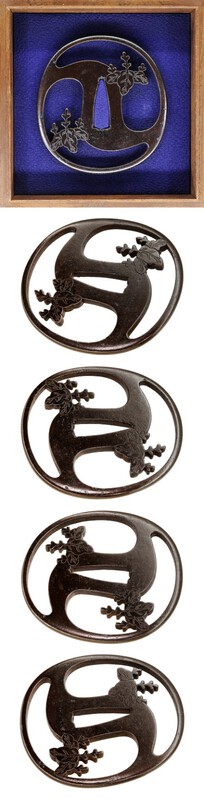
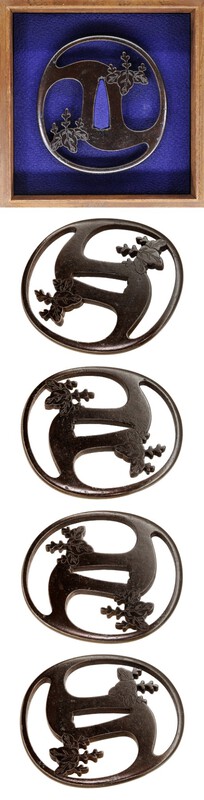
Thank you, Roger, for your kind words. Yes, the NMB at its best! So: Onward! Looking very carefully at the pictures of the latest tsuba I posted. I noticed that on the omote and ura sides there are several tiny “pin type” marks and tiny depressions. Now, the possibility of cast iron kettle makers that also possibly could have made tsuba has been discussed previously on this thread. Also, the possibility of “annealing” cast iron to make it less brittle has also been discussed. Kettle makers use a technique to make cast iron kettles called “sand casting” (the molds used are either clay or sand). Perhaps the tsuba that was pictured could have been “sand cast. So, one thing led to another and I noticed that the Japanese artisans also make items called “trivets”. These are sand cast metal pieces to place a hot tea kettle upon, and some look very intricate. At a size of 8 to 13 inches (about 20 to 33 cm) in diameter, they look very much like tsuba (except much larger). But that is a discussion for later. Right now, I would like to point out another item about the tsuba that is “off topic” to the thread. If you look at picture number 1 (attached) you will see that the motif extends onto the seppa-dai. Now, when the seppa are placed on the seppa-dai it appears that part of the motif would be covered up. I looked at all my 100 + tsuba to see if this occurs on any of them, it does not!! So, was this tsuba made to be used or was it just for display?? Anyway, the adventure continues! With respect, Dan
-
Thanks for the posts and opinions!! Much appreciated! I thought I noticed possible casting marks on the side of the “large leaves” in pictures number 2, 3, 4 and 5. When I enlarged the pictures, in the middle of the “large leaves” motif, there appears to be a “line” (casting mold line?) in the center. But, maybe like Mauro stated, “All can be explained with layering during hand forging, IMO.” So, maybe that is what I was seeing?? Oh well, Onward!! With respect, Dan
-
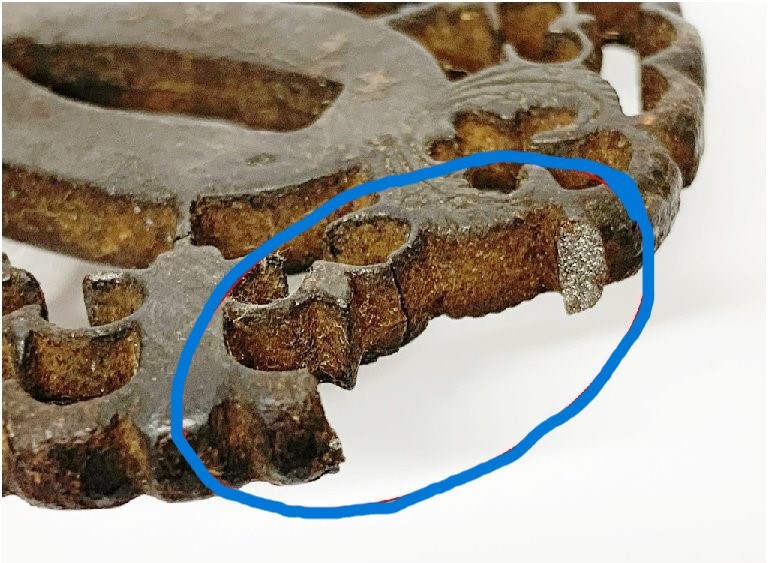
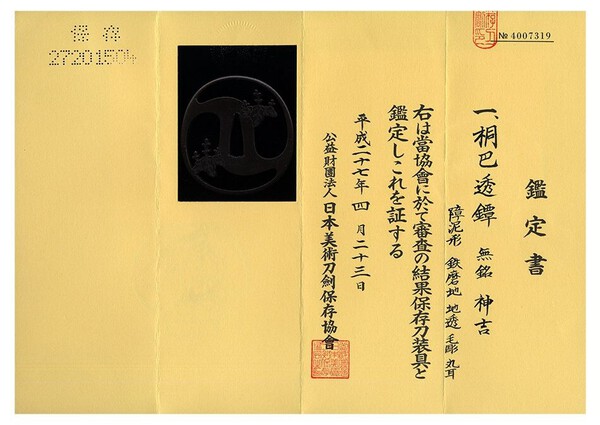
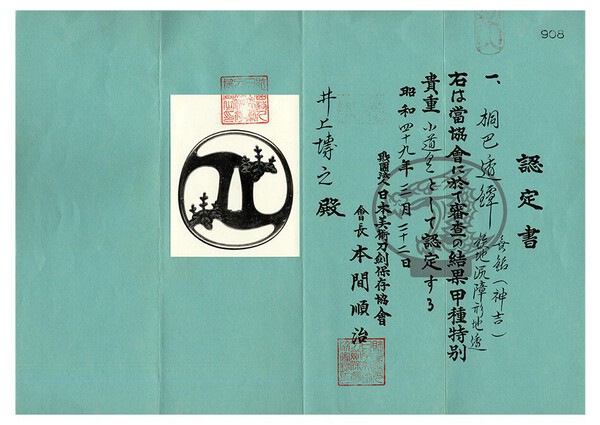
Hello all (again!), So, I thought this was interesting. And should be added to this thread. I was doing (my almost daily!) online tsuba looking (and of course looking at pieces I could never afford!). And I “stumbled” on this tsuba. What first caught my eye was how delicate looking it is. Also, that the motif did not appear as if it was “hand carved”. The tsuba was listed as Edo period and is papered (with two different papers?). When I looked at the close-up pictures of the tsuba, I saw what appeared to be casting marks along the sides of the motif. I have included pictures and the web site where I found it posted. http://world.seiyudo.com/product/tu-030517/ Any thoughts or opinions would be greatly appreciated. With respect, Dan
-
John, Thank you so much for your research and knowledge about "However, you can’t use another language to form a new word". And also the about “The Latin for sword guard is gladium custodiam, so a study of sword guards would be something like 'custodiology' “. My thought is that maybe it should be “gladium custodiamology”.?? Hey, I think that either of these is a great “new term”! However, my research suggests that “sword hilt” in latin is “capulo gladius” (I don’t know if that is correct, or if your research is the correct translation). Whatever! “custodiology” “gladium custodiamology” or maybe “capulo gladiusology”. I like them all! So, there you have it, a new term that will be used from now on!! Maybe we can ask forum members which term they would prefer?? Just kidding!! And having some more fun! Again, thanks for having some fun with this along with me and other members! Much appreciated! With respect, Dan
-
Malcolm, well done! Very funny! "You get an 'ology' and your a scientist". I am still laughing! With respect, Dan