
Dan tsuba
-
Posts
861 -
Joined
Content Type
Profiles
Forums
Events
Store
Downloads
Gallery
Everything posted by Dan tsuba
-
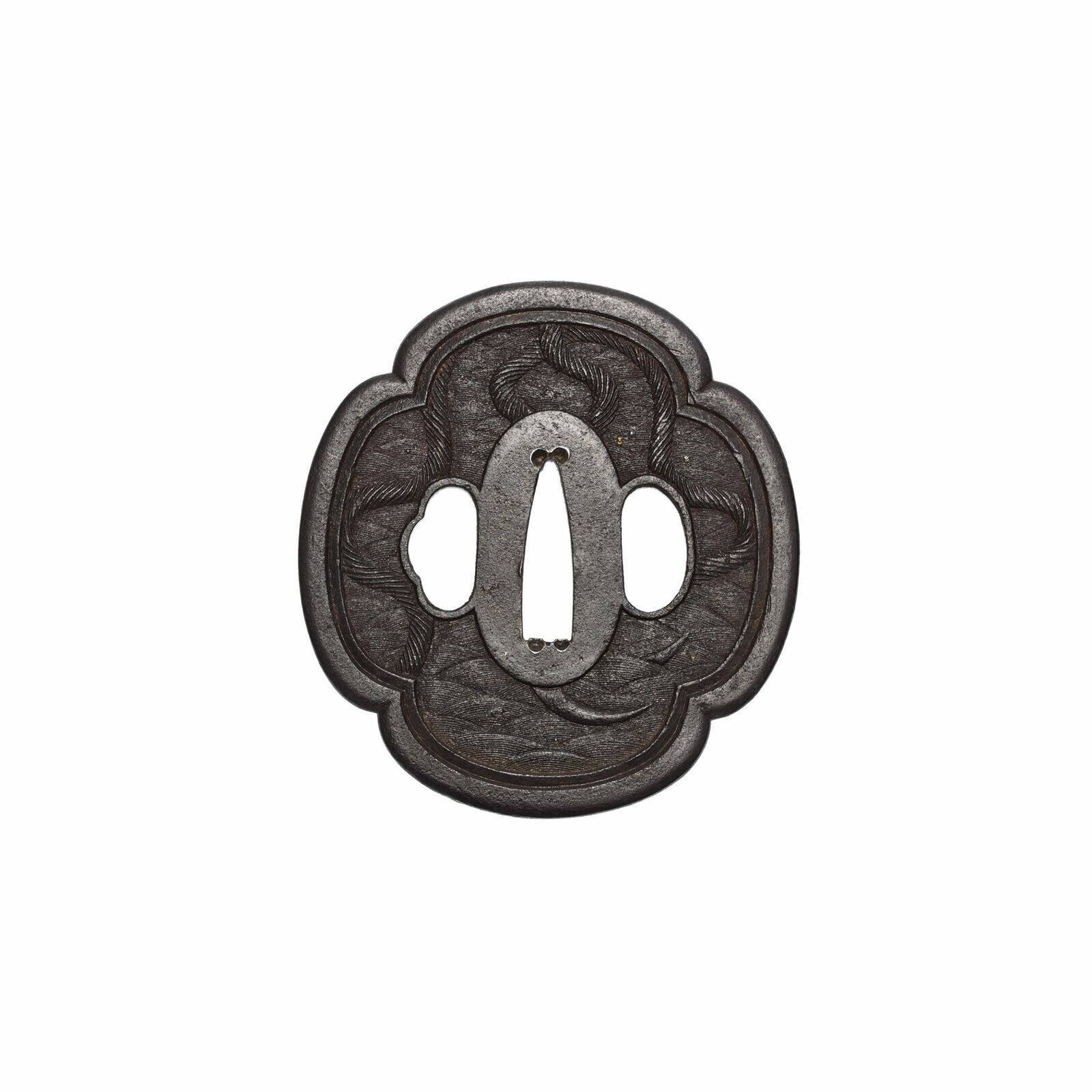
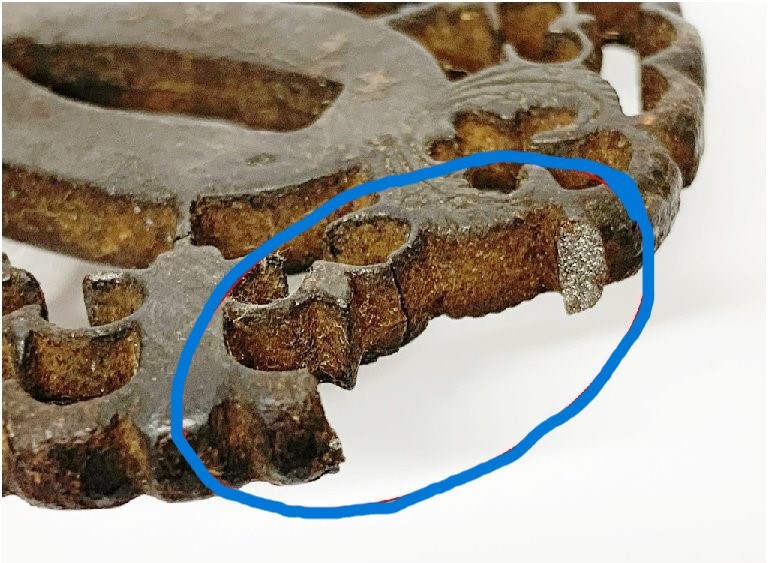
Hi! Thanks, Glen, for your evaluation of the tsuba. I looked at many more pictures of Heianjo-style since you let me know that “there's a whole group of Heianjo plates that have purposefully rough-textured surfaces that were worked by hand (and possibly some sort of chemical treatment as well to create all the pitting and "flaked"-look... just a hypothesis). So this one should not be counted as "cast-iron". They are recognized as being proper forged plates.” What I saw was as you stated. There are vary many of the Heianjo group that have a rough texture to them. But from what I can tell (just by looking at pictures) is that although they have a rough textured plate, the kozuka hitsu ana and kogai hitsu ana are pretty much smooth, clean, and appear to have been “worked”. On the “Heianjo style” tsuba in my previous post, the kozuka hitsu ana defiantly appears to have a “lumpy” type surface inside of it. Also, the Nakago ana appears to have an unfinished look to it. That is what I observed (but hey I wear glasses, so my eyesight is not that great)! But as you stated in your post (and thanks for researching that area) we can’t rely on carbon dating to find out how old tsuba are, so I will just have to wait until someone finds a cheap way to do non-invasive testing to determine the metal used. And since that may take several years to develop (and I may not even “be around” anymore to see that done!!) I will just move forward with checking out pictures of papered possible cast iron tsuba and seeing what turns up! The research continues! Onward! With respect, Dan
-
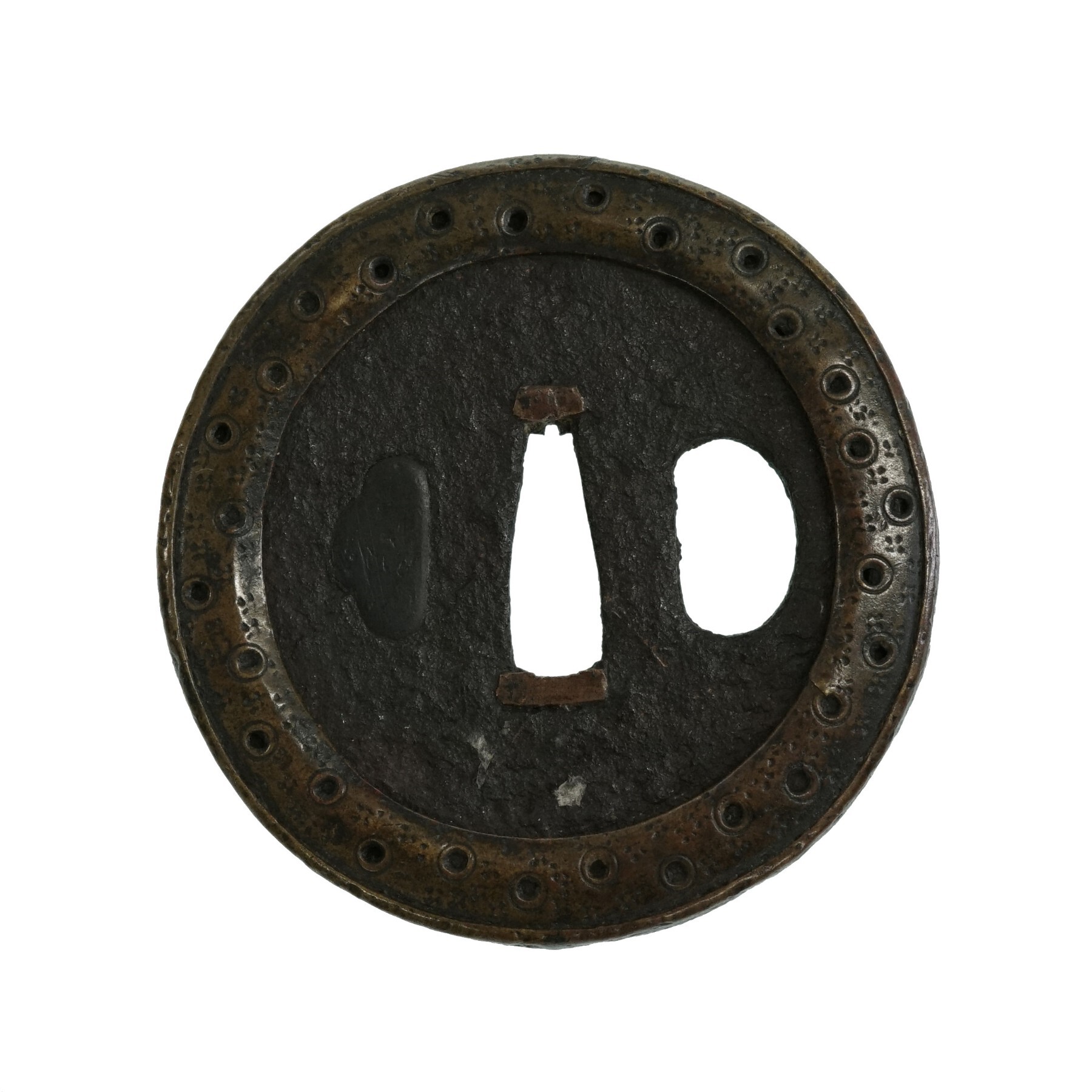
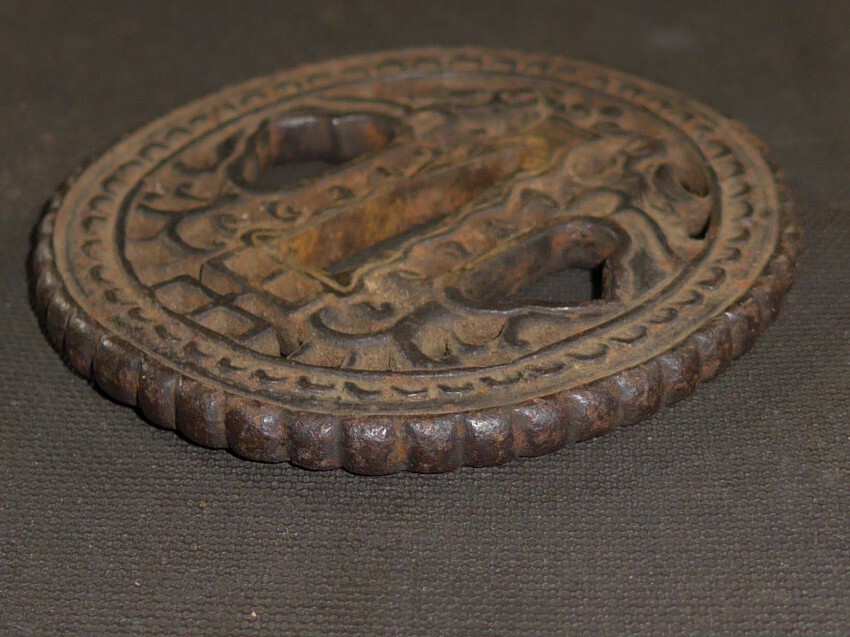
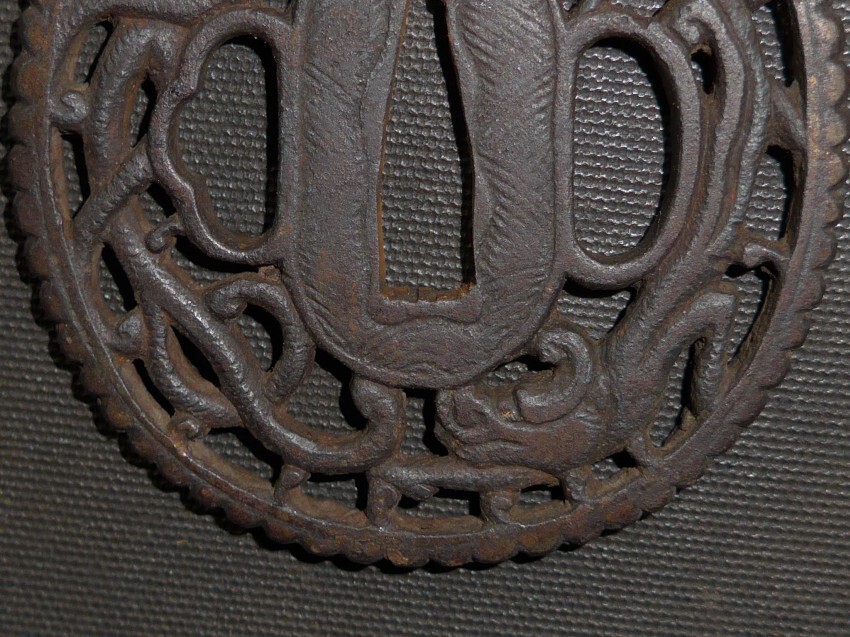
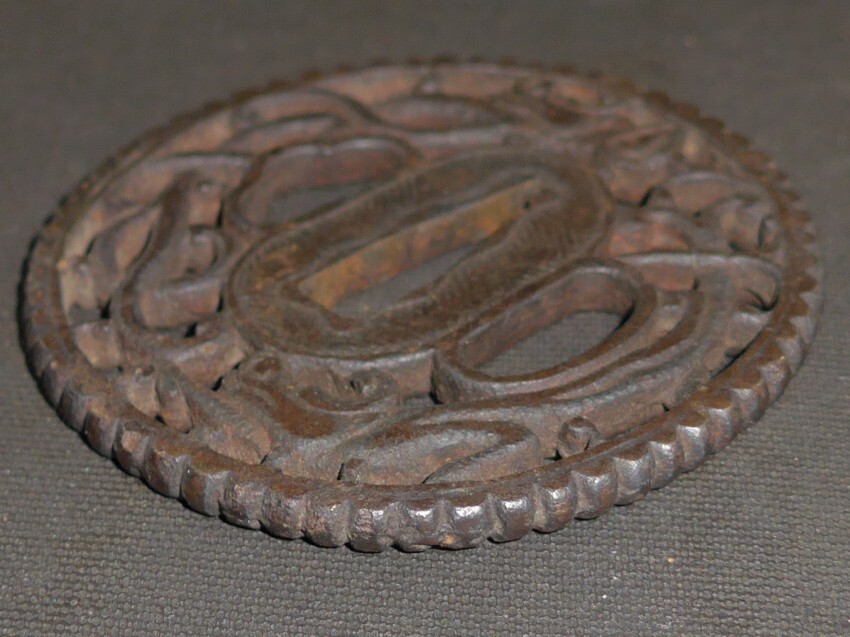
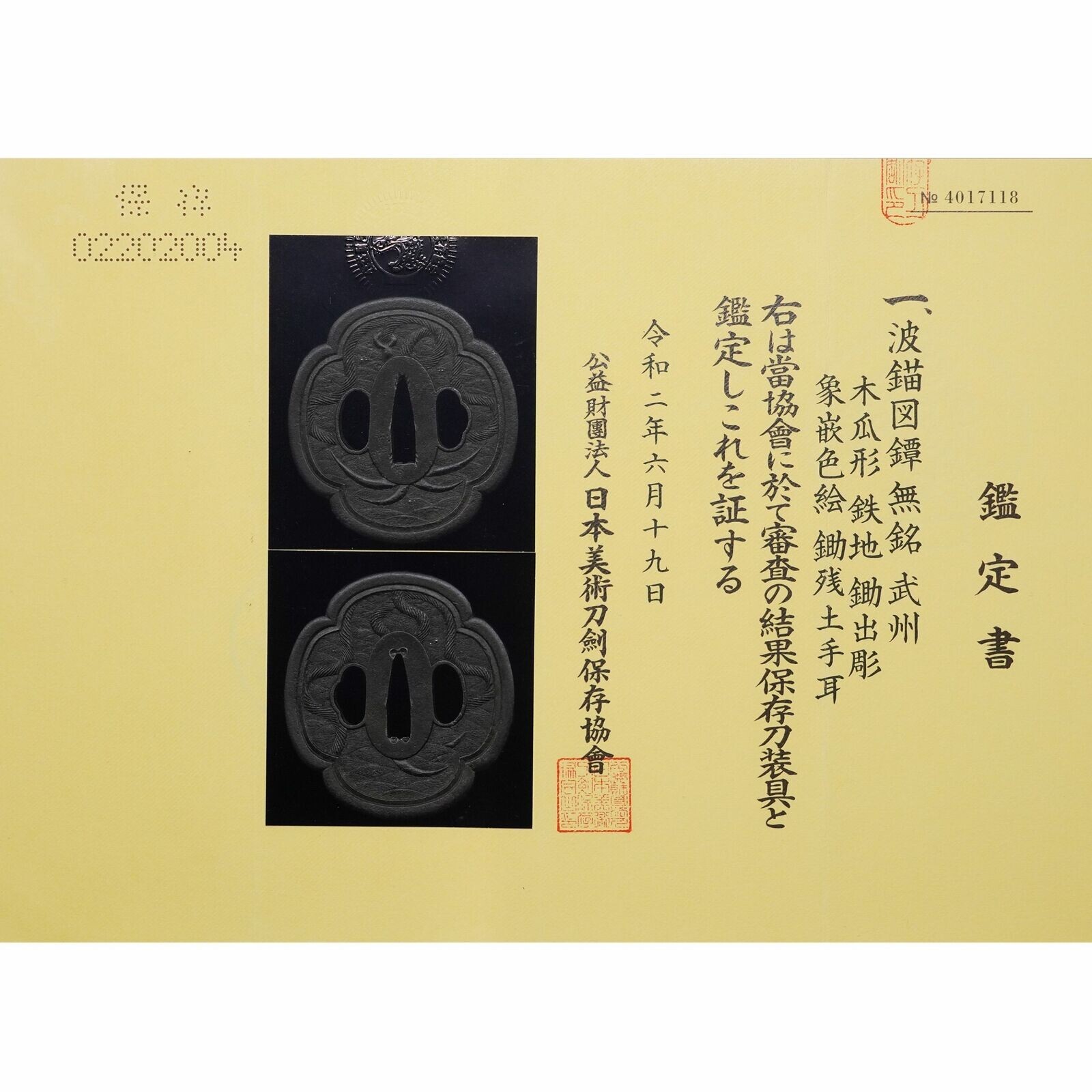
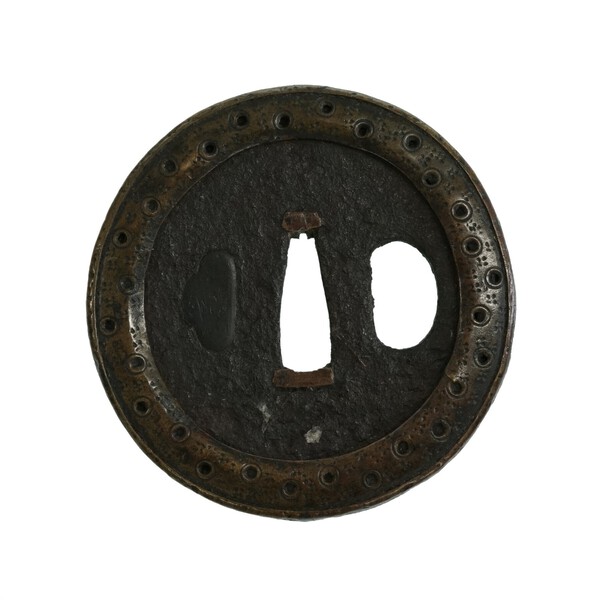
Hello again, As I said before, I am endeavoring to find possible cast iron tsuba that are papered. I believe that doing this adds some extra validity to this thread. And it is also fun and keeps me busy! So, I have included a picture of my latest “find”. It appears to be cast iron with an added metal mimi . But then again it could have been very rusted, pitted and cleaned. I don’t know. So, once again (as always!) I am asking for opinions and thoughts. From the following website - https://www.samuraimuseum.jp/shop/product/antique-Japanese-tsuba-with-nbthk-certificatet-12/ And excerpts: “Title: Heianjo-style, Small Holls Signature: NO SIGNED Age: Edo period Material: Iron” “Description” “An Iron Tsuba circle shape with Kozuka & Kougai holes Its rim is covered with the sheet metal; therefore, it is a bit thick. This type of edge decoration is called “Hukurin” in Japanese. Heianjo-style was established in Yamashiro (Kyoto Pref.). It is mainly made of iron with brass inlay. Its design was simply family crest or arabesque patterns in the beginning. However, after that, they made different shapes of Tsuba and started using gold, silver, or copper for inlaying. This Tsuba is recognized by The Society for Preservation of Japanese Art Swords, which is known as NBTHK.” “Authentication Paper:NBTHK Hozon Certificate” “NBTHK, also known as Nihon Bijutsu Touken Hozon Kyokai (the Society for the Preservation of the Japan Art Sword), is one of the oldest Japanese sword appraising organizations in modern-day Japan. They authenticated the Tsuba on Aug 27th in the first year of Reiwa (2019). They appraised it as Hozon Tousougu, the Tsuba worth preserving for Japanese society.” With respect, Dan


-
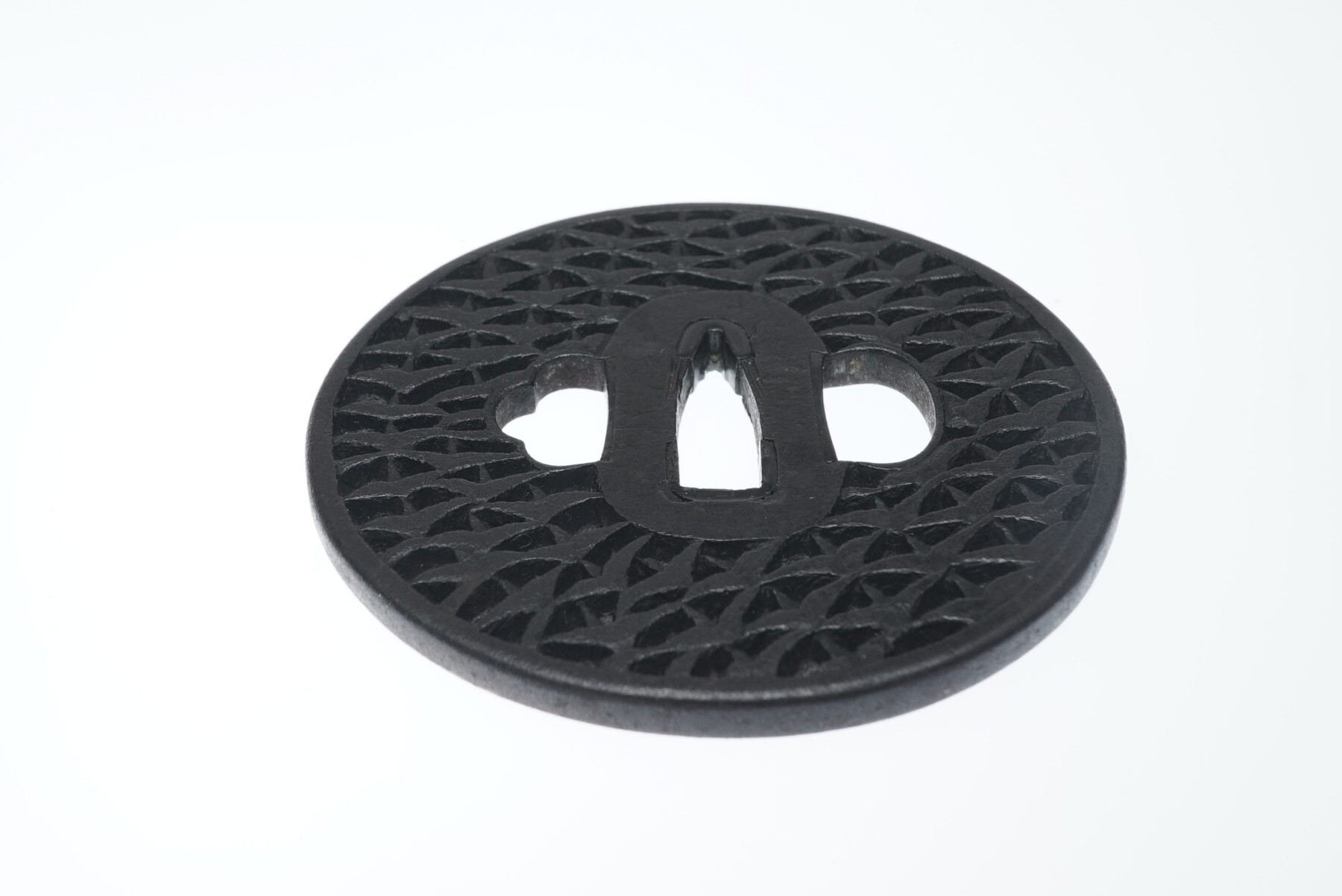
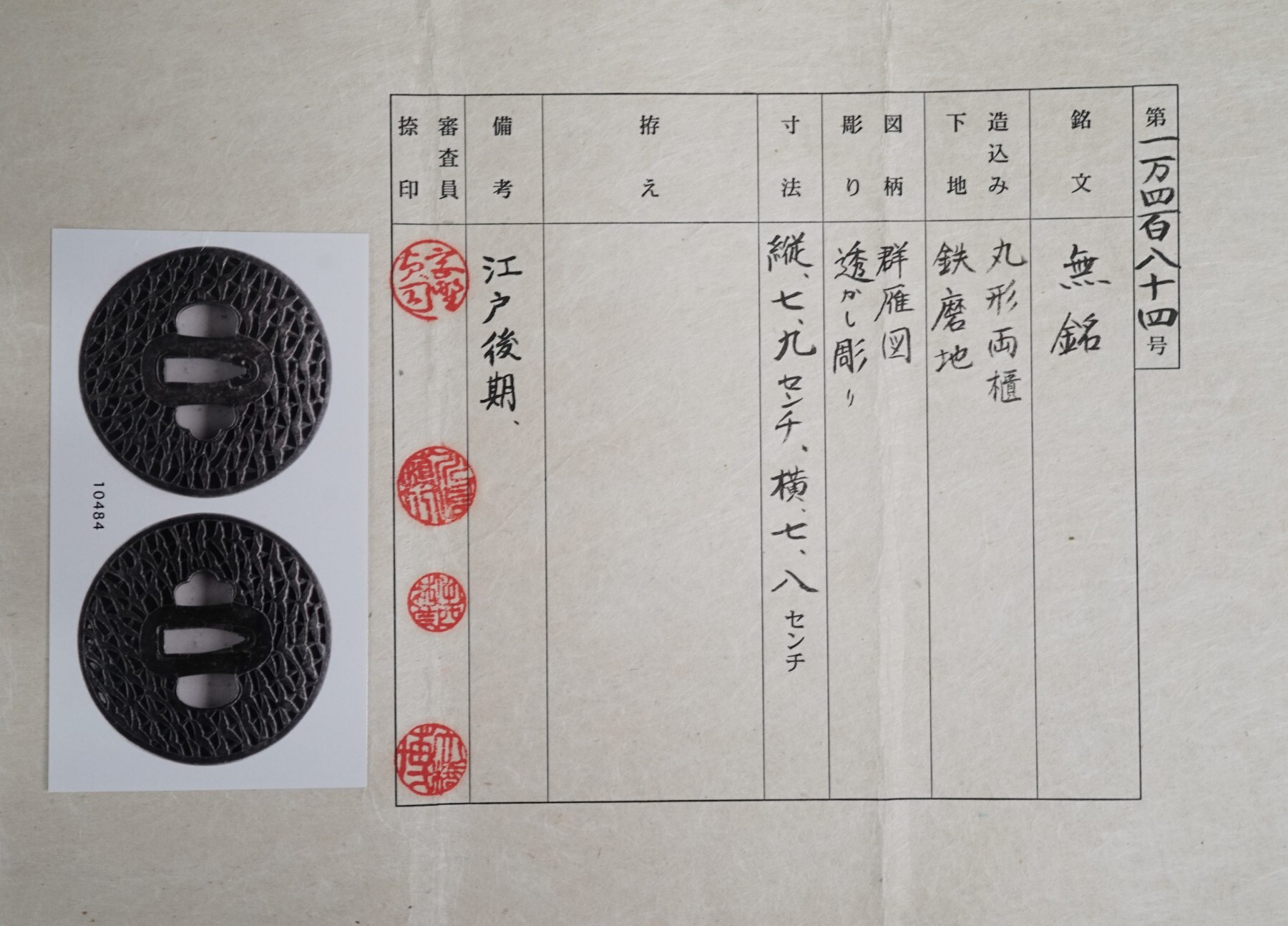
Hi all! So, personally, I think I have pretty much exhausted all the resources I could find on anything to do with cast iron tsuba. I am now down to finding possible examples of NBTHK papered tsuba that could appear to be made from cast iron. I understand that the only way to actually determine if tsuba are made from cast iron is to subject them to a modern technological non-invasive metallurgical analysis procedure. But lacking the money to buy this tsuba, let alone having the analysis done, I am asking for your opinions and thoughts on this tsuba. I chose this tsuba for a couple of reasons. On close inspection of the photograph, I noticed possible metal debris and “uncleaned cuts” between the bird figures (a possible indication that this tsuba could have been cast). If the design was cut out of forged metal, I would expect much more “clean” cuts and filing. Next, not only is the tsuba papered but the school of tsuba makers is described. And upon researching the school, I found that this school is described as having survived until the middle of the 19th century (so maybe this school tried its hand at cast iron – which would agree with previous posts of cast iron tsuba possibly starting to be made as early as 1840 – or even earlier). Also, I am not discussing (at this time) how it was cast or if it was even possible to cast something like this in about 1840 (maybe that is another topic to bring up later). I am just interested in what others think about this particular tsuba. “Title: Akasaka-style, The Flock of Wild Goose Certificate: NTHK Title: Akasaka-style, The Flock of Wild Goose Signature: NO SIGNED Age: late Edo period (1781-1867) Material: Iron Description An Iron Tsuba circle shape with Kozuka & Kougai holes The big flock of wild goose is engraved by openwork. The wild goose is a migratory bird that represents fall. According to the certificate, its creator is Tadatoki Akasaka. It is said this school was named Akasaka school because they moved to Edo (Tokyo Pref.) from Kyoto and lived in the Akasaka area after the Edo government was established. This Tsuba is recognized by NTHK Certificate.” From-- https://www.samuraimuseum.jp/shop/product/antique-tsuba-for-samurai-sword-t-109/ Also, “Akasaka schools of Yedo and Kiōto (17th-19th century) Early in the 17th century, tradition says, a dealer of Kiōto, named Kariganeya Hikobei, practised the designing of openwork iron guards in a new and refined style and had them made by a group of skilled craftsmen. From among these men he selected one Shōgunal capital, and settled with him at Kurokawa-dani in the Akasaka [Japanese text] district. Shōzayemon took the name of Tadamasa and continued his work on Kariganeya’s designs, dying in 1657. His son (or younger brother) Shōyemon, who succeeded him, calling himself Tadamasa II and adopting Akasaka as a surname, died in 1677 and was in turn succeeded by his son Masatora (d. 1707), by Masatora’s son Tadamune, and thence by four generations all called Tadatoki, the last living on into the middle of the 19th century. The first Tadatoki seems to have removed to Kiōto with his father’s pupil Tadashige and there to have founded a western branch of the school. Besides these a number of pupils, all called Tada-…, are recorded.” From- http://jameelcentre.ashmolean.org/collection/7/10237/10356 With respect, Dan


-
Thank you, Geraint and Glen. I now realize that many tsuba were swapped out, or mixed and matched!! And that samurai had more than one set of tsuba. Now this is kind of “off subject” to this thread but I have included the link so that you can check out the sword. It appears to my “untrained eyes” (untrained is the key word!!) that the koshirae have been with that sword for quite a while. No big deal either way. https://www.ebay.com/itm/353862933835?hash=item5263dfdd4b:g:Yg4AAOSwWKVh5jgq The tsuba (again to my untrained eyes) does appear to be cast iron. With respect, Dan
-
Hello all! So, some quotes from Glen’s fine research- “Shiiremono are essentially "mass produced" and generally regarded as lesser quality. However, there was also a full range of quality and prices of shiiremono of all types (not just Nanban-style tsuba).” Also- “Although there is no specific mention of "cast-iron" in either of these quotes, they both provide the "need" and the "market" for less expensive, mass produced tsuba in the late Edo period, prior to the Meiji period. And that fits with the late Edo time frame in Dale's most recent quote of cast-iron tsuba going back to at least the 1840s…..” So, in looking at listings of Edo period swords for sale it seems fairly easy to find what appears to be a cast iron tsuba mounted on the blade (and I have included pictures – but again I am not certain that the tsuba is cast iron – but it looks to be). Can I infer from this that many people wore a sword with this type of tsuba? This type of tsuba may have been easy to come by, inexpensive, yet somewhat artistic and more utilitarian. The below pictured sword with tsuba was listed as Edo period. No NBTHK papers. With respect, Dan


-
Hi all! Just interesting to see a possibly cast iron namban type tsuba mounted on a blade. It was listed as Edo period, no NBTHK papers. With respect, Dan


-
Hello! Jean, thanks for the information on smelting. I will keep that in mind when I get around to reading the book (maybe something referring to a chemical process will be mentioned - I will look for that). And also thanks for the information on the years of sword making. You always add valuable information on metal working techniques and history. Much appreciated! With respect, Dan
-
Hi! Glen your points are very well stated, thanks!! And thank you for those "thoughts to consider". The research continues!! Onward!! With respect, Dan
-
Hello! So, I did find an interesting resource that seems to be unique. I found it by my usual “bumping” around the internet. It is titled “The Pirotechnia of Vannoccio Biringuccio (or the book is better known as “De la Pirotechnia”). I include a Wikipedia statement below (and the website) – “De la Pirotechnia is considered to be one of the first printed books on metallurgy to have been published in Europe. It was written in Italian and first published in Venice in 1540. The author was Vannoccio Biringuccio, a citizen of Siena, Italy, who died before it was published.” https://en.wikipedia.org/wiki/De_la_pirotechnia and this website will give you the chapter and woodblocks listings (from pages 29 to 37) in the book. https://www.tms.org/pubs/books/pdfs/09-1002-e/09-1002-0.pdf I just received it today, so haven’t had the time to read it through. But I did find a few areas of interest and I have quickly “skimmed” over them. It seems to be very in-depth on several areas. From the mining of different metals, to including many woodblocks prints of differing bellows arrangements on forges, to making molds, to the sands and liquids used in making the mold, to the smelting of ores, and many other areas that may be of interest (check out the complete chapter list in the website above for a better understanding of what this book has to offer). But like I said, I haven’t read it yet. And this European book was published in 1540, what would coincide with the later Muromachi period in Japan. I can only infer that the Japanese may have developed these metal techniques much earlier. Anyway, it looks like an interesting read and will definitely give me some insights into early metallurgy. I thought that others may be interested in reading it (probably many have done that already!). Just wanted to share!!! With respect, Dan
-
Hello! Thank you, Glen, for the post. I quote some information that you stated: “These are copies of tsuba produced by the Yagami school that started in the late 18th century. This one looks like it has enough patina to be from sometime in the 1800s. But again, we just don't know exactly when, and with Nanban tsuba, we can't always be certain from where (within Japan or from outside Japan). This one is certainly made specifically for the Japanese market, and likely made in Japan.” Also, “Here's his main quote that pushes Japanese iron casting well back into the 1800s:” So, it seems possible then that cast iron tsuba could have been made in the earlier part of the 1800’s (1800 to 1840)???? And Jean, thanks again for your vast knowledge of metal working and your correction of the process. I also found something interesting relating to the possible study of cast (iron) tsuba – “I then discuss, in general, the APPLICATION OF CASTING METHODS TO TSUBA — this is a subject that is almost a taboo for scholars of tsuba in general……” A quote from the Dr. Lissenden’s thesis (p.ix) written in 2002. With respect, Dan
-
Hi all! Thank you, Glen, for your assessment of the tsuba that I posted. Much appreciated. Well, it looks (for now) that you and I are the only ones that are researching this cast iron tusba question. And that is fine by me! So, as an addition to your in-depth analysis of the tsuba, can the tsuba be further classified as a Namban type tsuba? I make this determination based on the prevalent “seigaiha diaper” design found on the tsuba (as described in Dr. Lissenden’s thesis paper page 76-78). I am fairly certain that many individuals (including me and you!) have also read his thesis paper, maybe even several times! I include the below link for those that haven’t read this “great read” on Namban tsuba” and may be interested in reading it (he discusses a lot about casting possibilities of Namban tsuba ). http://etheses.dur.ac.uk/4129/1/4129_1648.pdf Whether that makes this tsuba of Chinese or Japanese origin is unknown. But if it is a Namban type then I can reference some of Dr. Lissenden’s thesis paper (and if it is not a Namban type – then these references can still be used for a Namban tsuba). On page 137 of the above referenced thesis, it states “The examination -with a light and with powerful magnification- of a corpus of Namban tsuba leads one to the surprising conclusion that a very high proportion of them are the result of a casting process.” Dr. Lissenden goes on to state (on the bottom of page 137 and the top of page 138) “……, the subsequent examination by the author of his own collection, comprising a wide range of qualities within assorted groups of tsuba, also indicated a surprisingly high proportion of moulded tsuba therein”. Now in all fairness, I cannot find in the thesis where it specifically states, “cast iron” (it only states “moulded tsuba”). Maybe I missed that part! But on page IX he refers to “Namban iron”, and (starting on page 5) of his thesis he refers to “foreign iron”. So, I think at the least, that “moulded foreign iron” can be inferred, but I could be wrong. But what is fairly certain that Dr. Lissenden’s collection of tsuba (“examination by the author of his own collection” – as stated above) contained iron tsuba. But again, I am not sure. Although some of the pictures of Namban type tsuba contained on pages 154 to 169 appear to be made from iron. What is very interesting is that he states further (top of page 138) “It is therefore suggested that the high incidence of moulded tsuba in the Namban group should, perhaps, rather be considered to be an indication for the similar examination of other groups of tsuba as a comparative study.” Also he goes on to state that “Such a study would be strictly non-invasive, but one of its limitations would be the need for it to be carried out on museum artefacts of a recognized high quality in order to obviate the accusation that any pieces found to be cast were, a priori, of an inferior quality.” That possibility of a non-invasive type of tsuba study has been presented in this thread. And Dr. Lissenden submitted his thesis in 2002 !! Quite the forward-thinking individual, especially since the non-invasive technique discussed previously in this thread was probably developed several years after publication of his thesis. With respect, Dan
-
Hello everyone (again) !! So, without purposely looking for a possible "cast iron" tsuba I happened to "bump into" this NBTHK papered one. It may be cast iron. The listng states that it is "Edo" period. Thoughts and opinions would be greatly appreciated. With respect, Dan


-
Hello again ! Great pictures and I am certain you will get the answers you seek. Just wanted to let you know (as found out on the other thread) that just because this tsuba may be cast, it does not necessarily mean that it is not genuine. It could have been made in the Edo period after 1840. Just again, my opinion !! With respect, Dan
-
Hello Tony !! I really like your tsuba ! So, I am realitvely new to tsuba collecting (only about 3 years into it). But on another thread on the forum we have talked about cast tsuba. Now I am not sure, but from what was discussed on that thread, this looks to me like it could be cast. I don't know, just saying in my opinion. Maybe others can tell you more about it. With respect, Dan
-
Hello all! Some great and informative posts!!! Now, I am not saying that cast iron tsuba were produced before about 1840 (as the date of some cast iron tsuba “……. does push the casting dates back before 1840….” as found in Dale’s post above). But it appears that the Japanese craftsman were very familiar with cast iron techniques for at least 800 years! The below excerpt also “begs the question” why did a warlord have cast iron metal casters in his army? “Yamagata cast iron - History The origin of Yamagata cast iron is thought to date back to the late Heian period (794-1185) when the warlord Minamoto no Yoriyoshi was involved in a military campaign to suppress uprisings in the Yamagata region. Metal casters who were in his army entourage found that the sand in the Mamigasaki River (located in present day city of Yamagata) as well as the soil quality of the surrounding area was ideal for making casting molds. Some of these men stayed in the area, and about one hundred eighty years or so later, historical records state that between the years 1336 and 1392, cast iron artisans made metal fittings. During the Edo period (1603-1868) the cast iron industry fully began to develop. Yoshiaki MOGAMI, the lord of Yamagata Castle, reorganized the castle town, and in order to develop commerce and industry, established two manufacturing towns on the north of the Mamigasaki River, thus laying the foundations for generations of metal casters. ‘ From – (the website is primarily used to describe cast iron kettles, but the above historical information is interesting). https://kogeijapan.com/locale/en_US/yamagataimono/ With respect, Dan
-
Glen (thank you for your latest 2 posts) what a great article! I have included a piece of it below, so others do not have to link up to the website. Well, that is definitely a “plus” for the “forged iron (and not cast iron)” side of this discussion. And that the analysis was done on a Namban type tsuba is also a “plus” for the “forged iron” side of this debate. The research paper referred to was written in 2014 – “First published on 5th November 2014 “(a year before the Nara site tsuba casting molds were found), thanks for searching and finding it!! Although (and I agree with you that this would be the best method of determination) I would still like to see this type of research done on a wider sampling of iron tsuba (as I stated in a previous post of mine– about 20 tsuba that appear to be cast iron). But hey, I don’t have the cash to have that research conducted. I would much rather spend my money on widening my tsuba collection!! And to Jean, Thank you, once again, for your post and your in-depth knowledge and research into this subject. I present a part of the article of “Neutron computed laminography on ancient metal artefacts” below for review: “The white beam laminography revealed a homogeneous body for the iron tsuba, probably filed starting from a single piece of iron (Fig. 4). As a matter of fact, starting from the Muromachi period, the sukashi technique evolved over time. The iron plate prepared as the ground metal was very uniformly forged and relatively soft in order to cut out the fine designs successfully but hard enough to avoid breakage during use. Any void or significant irregularity in the iron body would have made the shaping of continuous decorative lines impossible. Extra effort in the preparation of the plate would have been necessary, as observed in the inner volume of the samples which was free from any cracks, pores and inclusions.23 Evidence of forge-welding was not identified in the design motifs involving plant and animal figures, apart from the gilded ring outlining the profile of the kozuka hitsu. While the inner brighter areas are reconstruction artefacts, the ones detected on the surface were probably due to the application of a patina or to the early formation of products of alteration.24” With respect, Dan
-
Hello all, So, could you all please just disregard the last 2 posts to this thread. The one post of the picture that stated, “I have a proof of a cast iron pre-EDO KO-KACHUSHI TSUBA” and my reply to that post. I now realize that the picture that was posted probably is not an actual pre-Edo tsuba and was just a diversion by someone trying to be “funny” or diverting an otherwise serious conversation and forum thread. Like I stated before in one of my previous posts “I am a relatively new beginner” (so it is very easy to mislead me if someone wanted to!). I hope that this thread continues to produce a “lively” debate on the “cast iron tsuba” subject. With respect, Dan
-
So, thank you Rokujuro (Jean) for posting the picture of the cast iron tsuba with the statement “I have a proof of a cast iron pre-EDO KO-KACHUSHI TSUBA”. I don’t know. So, from what I can discern it looks like some tsuba were made from cast iron (if there is one “out there” I can only assume that there must be more). Also, perhaps over the years (or hundreds of years?) the tsuba craftsman learned how to “up their game” in casting methods and got much better at it. With respect, Dan
-
Hello all! First, thank you Rokujuro for your excellent post and a breakdown of the misleading statements found in the wikipedia sites!! Much appreciated. I was wondering, Rokujuro, is there any way that you could add that information to the wikipedia sites so that others are not “misled”? Now, what is of interest, I have found 4 former threads on the NMB site that deals with some kind of cast iron questions. And I believe there are more threads on the subject on NMB-(the 4 threads are listed below)- NMB thread of 2010--- https://www.militaria.co.za/nmb/topic/5697-what-do-you-make-of-this/ NMB thread of 2012- https://www.militaria.co.za/nmb/topic/9339-beware-of-torigoes-temper/ and the other is – from a NMB 2014 thread- https://www.militaria.co.za/nmb/topic/15302-casting-vs-carving/ And the last is the NMB thread– from 2016- (I find the 2nd, 3rd, and 4th posts on this thread very interesting) https://www.militaria.co.za/nmb/topic/18598-cast-sword-fittings-by-markus-sesko/ Three of these threads were started 5 years (first thread listed), 3 years (second thread listed), and 1 year (third thread listed) before the discovery of the Nara site tsuba mold finds (in 2015). And in previous posts to this (current thread) there was mention of metallurgical examination of iron tsuba. However, as stated in one of my posts, that examination was only conducted on 2 tsuba (and they were discerned not to be made from cast iron). Now, if this subject of Edo period cast iron tsuba is to be resolved, may I suggest the following (and I would like to inform the reader that I have no vested interest in the outcome one way or the other – I just find it a fascinating subject for exploration)- I suggest gathering at least 20 tsuba from different "reputable" dealers (I consider that number of tusba a relatively fair sampling - although others may think that fewer or more would be better). In the dealers listings of these tsuba they would be listed as Edo period and would appear that they could be made from cast iron (perhaps including a few Nanban types). Then have a metallurgist cut (or maybe it can be done by chemical or other less invasive means?) and analyze each tsuba. If a "cast iron" tsuba is found, then the examination can stop at that point. The conclusion that can be drawn is that if there is one cast iron tsuba, there are probably many others "out there". If no cast iron tsuba are found in the sampling of those 20 tsuba (or more or less), then there is an extremely high probability that Edo period and earlier tsuba were not made from cast iron. Unfortunately, there is really no solid definitive historical written proof (that I can find) that states that cast iron tsuba were “not” being made in the Edo period (I refer the reader to my earlier post that includes reference to the Transactions and Proceedings of the Japan Society, London 1893-5, and to the reference of the Professor A.H. Church collection). I believe that the above-mentioned scientific way of discerning the metal used in Edo (and possibly earlier) tsuba would be the only way to finally “bring to a close” the “cast iron” tsuba debate. The expense for this test, and the results, could be offset by the individual if the research obtained was used for that person's masters or doctoral thesis project (as was Dr. Lissenden's paper on “The Namban Group of Japanese Sword Guards: A Reappraisal” used for his thesis project for his Master of Arts degree in East Asian Studies, in 2002). I do apologize to the readers of my posts on this thread for being a relatively new beginner to this vast and complicated subject of tsuba. I am certain that the below Zen quote is applicable to my naïve state of mind on this subject- “If your mind is empty, it is always ready for anything, it is open to everything. In the beginner's mind there are many possibilities, but in the expert's mind there are few.” ― Shunryu Suzuki With respect, Dan
-
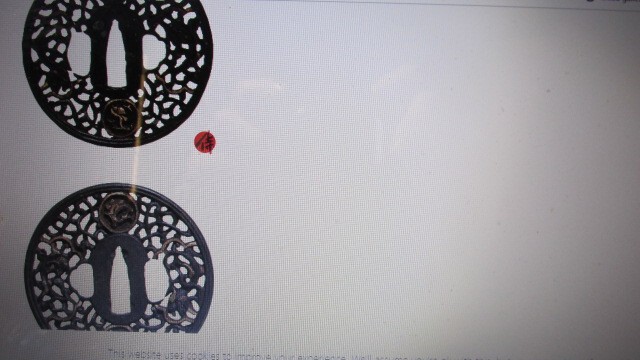
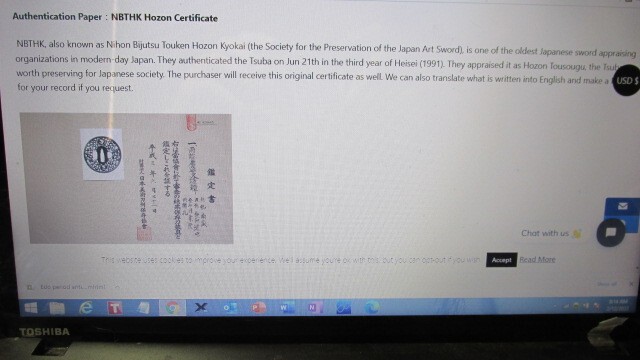
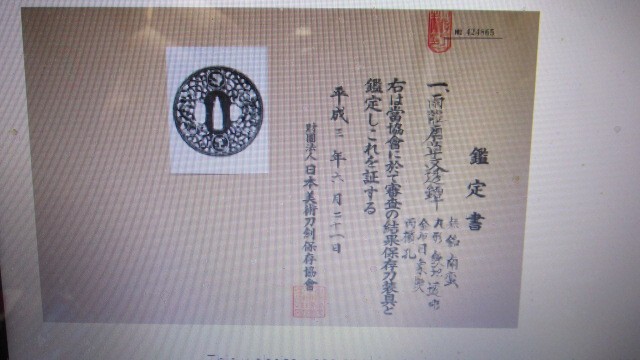
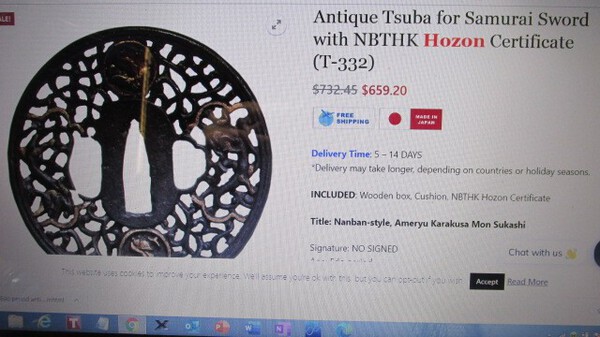
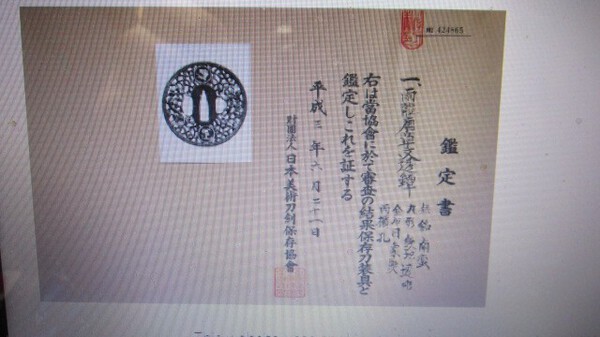
So, I had to take pictures of the website referred to in my above post (in case it ever disappears!) and that's the only way I know of how to post these pictures of a possible cast iron Nanban tsuba (with papers).


-
Hello all, So, there I was on the internet thinking about purchasing another Nanban type tsuba. Minding my own business. Then I happened to “bump into” the below listed web link and a papered Nanban type tsuba that may be cast iron just kind of “jumped out” at me!! I needed to post it so that others could check it out and help me discern if it could be cast iron. If you scroll down on the link, it will show the NBTHK papers. I don’t know how to copy the pictures to post them – so I apologize for that). Thanks for the assist! With respect, Dan https://www.samuraimuseum.jp/shop/product/antique-tsuba-for-samurai-sword-with-nbthk-hozon-certificate-t-332/
-
Glen (and others), Thank you so much for your excellent posts! I know nothing about metallurgy or the process of making cast iron. I do agree with Glen that this thread “has been fun”. Not only fun, but (for me) extremely educational, intense, and complicated. And I guess I am not entirely “ready to let it go”! I also agree with him on his suggestion that if anybody finds examples of any papered tsuba that they think are cast iron, that they should take the time to post them. I don't have enough expierience with tsuba to discern a well-made cast iron tsuba from a regular iron plate tsuba. However, I know for certain that there are others that have that experience, and your thouhts and insights would be very helpful and much appreciated. I don’t want to belabor the point but want to include the below information as possible “food for thought”: In one of my previous posts to this thread I referred to this website- I include only parts of the wiki site entry- https://en.wikipedia.org/wiki/Ferrous_metallurgy “The earliest iron artifacts made from bloomeries in China date to end of the 9th century BC.[40] Cast iron was used in ancient China for warfare, agriculture and architecture.[9] Around 500 BC, metalworkers in the southern state of Wu achieved a temperature of 1130 °C. At this temperature, iron combines with 4.3% carbon and melts. The liquid iron can be cast into molds, a method far less laborious than individually forging each piece of iron from a bloom. Cast iron is rather brittle and unsuitable for striking implements. It can, however, be decarburized to steel or wrought iron by heating it in air for several days. In China, these iron working methods spread northward, and by 300 BC, iron was the material of choice throughout China for most tools and weapons.[9] A mass grave in Hebei province, dated to the early 3rd century BC, contains several soldiers buried with their weapons and other equipment. The artifacts recovered from this grave are variously made of wrought iron, cast iron, malleabilized cast iron, and quench-hardened steel, with only a few, probably ornamental, bronze weapons.” “By the 11th century, there was a large amount of deforestation in China due to the iron industry's demands for charcoal.[49] By this time however, the Chinese had learned to use bituminous coke to replace charcoal, and with this switch in resources many acres of prime timberland in China were spared.” I have referenced Chinese metallurgy methods because I find it very believable that Japan could have learned some of their metal working techniques from China. I also found another wiki site that deals with the Japanese tatara. https://en.wikipedia.org/wiki/Early_Japanese_iron-working_techniques I also only include parts of that wiki site entry- “The traditional Japanese furnace, known as a tatara, was a hybrid type of furnace. It incorporated bellows, like the European blast furnace, but was constructed of clay; these furnaces would be destroyed after the first use.[1] According to existing archeological records, the first tataras were built during the middle part of the sixth century A.D.[2] Due to the large scale of the tatara, as compared to its European, Indian and Chinese counterparts, the temperature at a given point would vary based on the height in the furnace. Therefore, different types of iron could be found at different heights inside the furnace, ranging from wrought iron at the top of the tatara (furthest from the heat, lowest temperature), to cast iron towards the middle, and finally steel towards the bottom (with varying degrees of carbon content.)[3] Importantly, tataras did not exceed 1500 C, so they did not completely melt the iron.” (also) “The metal-workers clearly had an understanding of the differences between the various types of iron found in the tatara, and they separated out and selected different portions of the “bloom” accordingly.” With respect, Dan
-
Hello SG and welcome to the forum !! I don't know enough about tsuba to help you out. I am certain that others will tell you exactly what you want to know about the tsuba. The only thing I can tell you is that I really like it and great pictures!!! With respect, Dan
-
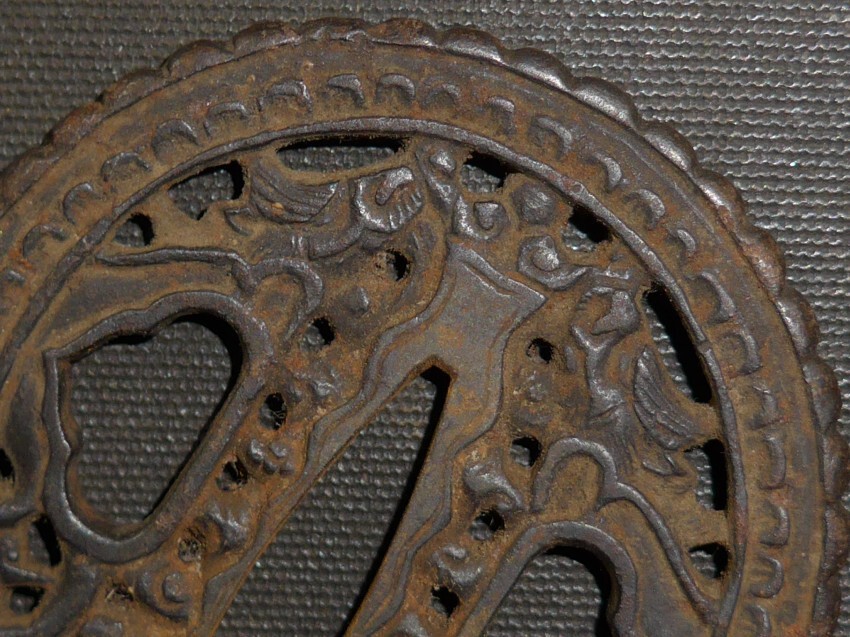
I know in my quest to find information on Edo period cast iron tsuba that I can present the reader with many pictures and examples of tsuba that are listed as Edo, are listed by reputable dealers, and appear to be made from cast iron. However, presently that is not my research goal. I am now endeavoring to find legitimate records or historical notes that give some insights into the possibility of Edo period cast tsuba. This is not an “easy” thing to do, but I have tried. So far, I have gleaned some insights. A couple of months ago a friend gave me a book entitled “Transactions and Proceedings of the Japan Society, London (which is stated on the cover). Inside the book is stated as “Transactions and Proceedings of The Japan Society, London, Volume III The Third and Fourth Sessions 1893-5”. Then it states publishing information which is: London, 1897. Published for the Society by Kegan Paul, Trench, Trubner and Co., Limited Paternoster House, Charing Cross Road, W.C.. He stated he bought this reprint of the original on the internet. He also said that there are several sites that sell it. I found that it is also available for the public domain in PDF format, but I couldn’t get those exact pages I listed below to download. I find that it is a valuable resource for many different subjects about Japan. One subject they touch upon is that of tsuba. So, on page 83 (starting from the front of the book, because if you start from the back of the book you will end up on the wrong page because this book contains a couple of individually paged and numbered volumes) in the bottom paragraph it states “The tsuba………are of greatest interest to the metallurgist.” Also, it goes on to state “………...skilfully dealt with by Professor Church in the introduction to the catalogue of the late exhibition at the Burlington Club”. So, let’s hold onto that thought about “Professor Church”. Now on the bottom of P.91 and going to the top of P.92 it states “The Hamano school was founded by Hamano Shozui, a pupil of Ju Toshinaga, and who died in 1769. ………. He worked both in iron and bronze, and as in the case of Toshinaga, there is sometimes a strange contrast between his work in the two metals, one of his iron tsubas in my collection having a very singular surface, like a fragment of cast iron (Plate X. I), while his bronze is often highly finished.” So, I have included that picture stated in the above text on the bottom of this posting. The picture that is referred to is the first tsuba on the bottom of the picture. Now, let’s move on to Professor Church. His name was Arthur Herbert Church (1834-1915) and he was evidently a very knowledgeable collector of tsuba. Refer to the website below to see his collection –(scroll through the areas located on the left side of the site to view the different schools represented in his collection). http://jameelcentre.ashmolean.org/collection/7/10237/10338 Now when I went to the above website and put in a search for cast iron tsuba I got this. - http://jameelcentre.ashmolean.org/collection/8/object/21614 The results of that search are shown below : ? Aori-shaped tsuba with tea ceremony cauldron and poem Associated place Japan (place of creation) Date 19th century (1801 - 1900) Material and technique obverse and reverse: iron, with gold; tang-hole plugged with soft metal, probably copper, and partly gilded obverse: with cast iron and shibuichi; central silver ground, with punched ishime decoration Dimensions 6.5 x 5.6 cm (height x width) Material index iron, gold, shibuichi, shibuichi, silver, more Technique index forged, cast, punched, punched, plugged, more Object type index tsuba No. of items 1 Credit line Bequeathed by Sir Arthur H. Church, 1915. Accession no. EAX.11077 Well, that’s it for what I could come up with for Edo cast iron tsuba that seems to be from credible sources. This has been fun and extremely educational. But I am know going to “let it go” and maybe there is someone out there willing to “take up the torch”! With respect, Dan

-
So, in doing research for my post on “Tsuba casting molds” I came across some interesting information regarding the two holes in the tsuba. I found this information in the “Transactions and Proceedings of The Japan Society, London, Volume III, the third and fourh sessions, 1893-5.” On page 95 at the top, it states: “In some tsubas we find two circular holes, often lined with gold or some other metal. These are called “kinuki” tsubas, the holes being for the passage of a cord, tying the tsuba to the scabbard. They were used it is said by old men whose age and military service exempted them from having to draw the sword, either for public or private purposes. I have tsubas on which is a small stud pierced with a fine hole, as if to pass a wire through it, the use of which I cannot learn” Thought that this is another interesting view of why the holes were there. With respect, Dan