

Curran
-
Posts
4,775 -
Joined
-
Last visited
-
Days Won
25
Content Type
Profiles
Forums
Events
Store
Downloads
Gallery
Everything posted by Curran
-
John- I'd have to agree on Nobody's expert reading of the 1st and 4th character. I think he is probably right on the 3rd character, but not sure what to make of the 2nd character. I looked up 'Motoaki' (and other variations) in Haynes and didn't get a match. I think we will hafta wait until you receive it and post a better image. Then we will help as best as we can. Let me know when you have a better picture.
-
John, If possible, provide a better image. We will translate it, try and confirm the signature as authentic (or not?), and give you some history on the guy. Curran
-
Hamon: Ultimately, it is your call. On pre-1500s stuff, if it runs near or touches the edge, but is of true artistic merit... very few Japanese seem to mind. Even if it looks like it is at the very edge of the blade in a few spots, a good polisher can still do wonders. I have seen many a thin to microscope thin hamon on many a nice old Yamato, Yamashiro, and Bizen piece. I have seen Juyo and even a Toku Juyo with small areas (1.5 inches or less) of what I would call 'no hamon'. I don't fully understand it, as some of the blades' artistic appeal escaped me. Then, one of the nicest blades I have ever had the chance to study for a while was a nice Bizen blade where the hamon got very thin in one or two small spots. It bothered me for the first few days I got to look at, but the more I studied and held it and considered it both as art & a weapon; I thought it had lost nothing and was one of the most elegantly balanced (in art and function) Nihonto I'd gotten to study. Those fingernail wide areas thin hamon points were quickly eclipsed in my mind. Retemper: Extremely complex issue. Mizu-kage on both sides of the blade with loss of activity is a sign of the retemper have spoken about. But there are other signs that some call retemper. The one I most often mention is when something (usually pre-Edo blades that were probably used in the warring states period) and had the hamachi moved up- it has been shown to me how it was often done with a heated copper block to soften the metal structure in the edge and not split/hagire when cutting the new hamachi. Creates a bit of what looks like mizukage on one side, but doesn't seem to have much other affect on the blade. I DO NOT consider this a retemper. I've seen dealers claim these blades are 'retempers' to get a seller down, then try and buy and paper them. I'm thinking of a nice Bizen blade where the owner decided not to believe one of our self proclaimed "foremost experts"- and it papered very well. Absolutely beautiful blade. The sort of retemper you mention is very hard to do well. It leaves lots of clues, and if those clues are inconsistent with the school from which the blade originates- then you do (highly likely) have a retemper different from its original form and now mostly a weapon- not so much a piece of original form artwork. But then sometimes these clues are misleading. I know of 4 blades, all Oei period Bizen or Yamashiro-Bizen that were called retempers by many experts because of "the clues". All of these 4 blades (2 swords and 2 O-tanto) now have Tokubetsu Hozon papers. One of the O-tanto belongs to me. That one won't leave me until I am in my coffin. But yes, a true retemper puts a lot of stress on a blade already under stress. It changes the shape and creates havoc in some areas leaving 'clues'- especially along the mune in those I've been able to study. The retemper issue can be a very complex one.
-
Moses has good stuff. Over the years, there are probably only 3 or 4 swords in memory that I kick myself for not having bought. 2 of them were ones Moses offered up. He has a good eye and brings some good blades "out of the woodwork". He also is selective in what he allows to be ~consigned~ and is negotiable. Highly recommend him as being better and easier to deal with than even the majority of Japanese dealers.
-
John, I do not think I could add anything. What more sort of information where you seeking? I assume you have been through Nagayama, Malcom Cox's book and through the Mino Taikan.
-
If it were, this would be a fair bargain. They are not Tanaka school. I sold a nice Tanaka school tsuba last year for $3000 without papers. I owned it for all of 6 days. Within 24 hours of posting it, it was gone. The signature was certainly authentic, but the tsuba had some small damage- so I priced. it accordingly. With Hozon papers, it swould have been closer to $4500 USD. The other two I knew about went for between $5000 and $6500 via Bob Benson. They both went fairly fast out there, and one fellow has shared with me that he collects them. ex: http://www.cgfinearts.com/gallery_outpu ... alleryID=2 I am a wee bit surprised the one on Colin's website has not gone at $3850. The ones up for auction look more like Aizu Shoami / Mito. See the tsuba that Colin has next to the Tanaka school one for an example. Aizu Shoami certainly gets a bad rap for some decent work. I believe to paraphrase the wording in the Nihon to Koza, "they produced diamonds and duds", so their diamonds suffer the valuation of the duds. To say "Probably Tanaka-school" is quite a wink and nudge from an auctioneer.
-
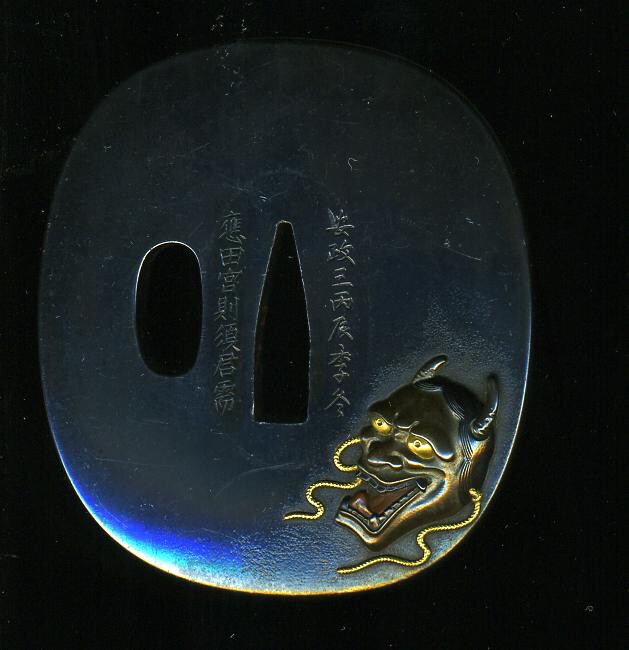
I took a scanner version too. It has come out a little discolored, but you get the idea. Mr. Nobody- thank you very much for the Translation help
-
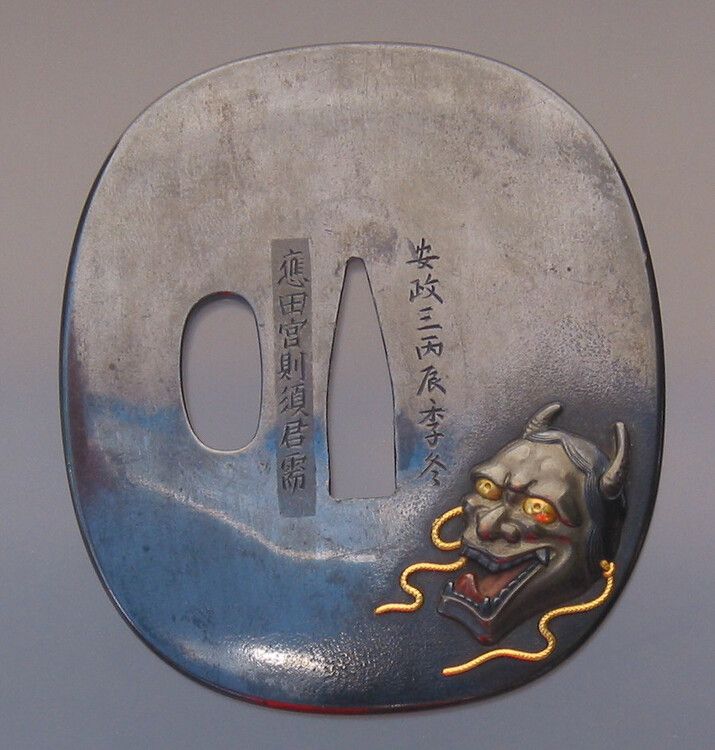
This is a 6th Gen Yasuchika. It is signed on the back, though I don't have a photo of the back yet. I'm hoping the photo will upload. This tsuba is hard to capture. Even with a light hood on, it was highly reflective (as John stated). It is not the best shakudo I have ever seen, but in the 9 out of 10 range. Jim Gilbert had one which reminded me of gas floating on black-blue water. It does make most people pause who see it in hand. Anyway, I like the tsuba. In a moment of absentmindedness- I thought it came in the box that started this thread...
-
Of course, -you are right Milt. It was very late and I was not thinking correctly. This box came with a different tsuba- but that tsuba was iron and it is not signed. So I think this box has long since lost its original tsuba. The tsuba that came with the box is currently in Japan for papers, and I have been keeping the Yasuchika in this box. My very bad mistake. I will post the Yasuchika tonight, so perhaps I can get a correct read on the signature. Curran
-
Thank you very much. That would describe the tsuba inside very well. I must learn the kanji for the various metals. I will upload a photo tomorrow. The tsuba has some of the best shakudo I have seen, but is very highly reflective. It is a nice Yasuchika tsuba dated 1853 and commissioned for a Mr. ??? Curran
-
Darcy, If Peter couldn't direct you to a more detailed materia, I doubt that I can add much. Your best bet may be Harry's Nihon To Koza- Kodogu translation looking up the Sano Ke. It is just a verbal flowrecord of how the various late Edo schools formed. There is also further mention of Naoyoshi on page 398 (or so), when discussing the height/depth factor of quality in some of the better/best late Edo kinko workers. I'll try finding something in the Haynes Catalogs later, as there he wrote many a paragraph on various kinko schools. It would be useful if someone cataloged all the names relative to volume & page, as I am surprised the Haynes Index did not refer back to this his own work. The Haynes having been commercial in nature are not infalable- but Mr. Haynes work is far and away some of the best stuff published in English. Ah, if there were more time- I would gladly cross index the Catalogs. Anyone know of this already having been done? Some Volumes have an index in the back. Some don't.
-
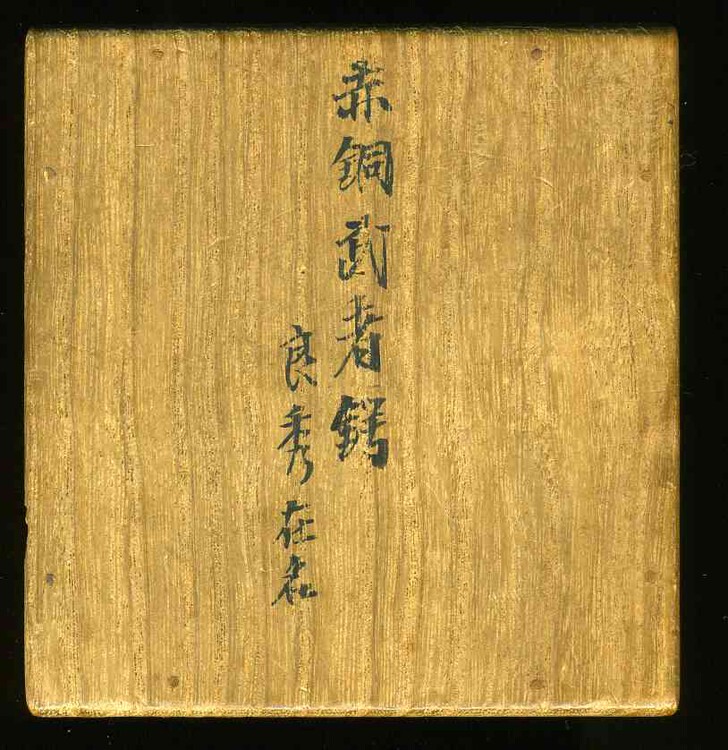
Could someone help translate the gaki on the tsuba box pictured below. The box itself is interesting. I have never seen a tsuba box constructed this way, and the box seems very old. Perhaps the oldest non lacquer tsuba box I have ever seen. Constructed with many little wooden pegs, so despite its age it is still fairly airtight.
-
Brian, Pardon my language- but... "Damn-it". I am sad to hear this. It was only Thursday that I thought about Jim and hoped his website was still operating. Beyond the Nihonto knowledge, I thought I might re-read some of his "Veteran's Hospital Rants". Ole White Lung was someone many of us greatly appreciated, and a few hated. I appreciated him, and never had (forgive the irony Jim) the heart to tell him my mother-in-law is a Veterans' Hospital Doctor. I never met him face to face, but enjoyed quite a few emails with him. Quite a character, and I'm sorry that his website is gone. If you find a backed up copy, please let me know. Curran
-
It seems I missed a lot in a few days away from the board. I recommended Jim G's list because it is very good and most of what I would recommend would not improve on the list- but just be redundant. Also, given that so many of the texts are in Japanese-- I confess I cannot remember the name of many of them unless I am at home looking at my shelves. Even then... there are a few I have to get down and out of their protective boxes to read on the inside flap the name. For instance, I can never remember the correct name of "the blue Owari-den tsuba book" which may or may not be on Jim's list. And even after 8 years of active collecting, I am still finding there are books out there I did not know existed. It was only a few months ago that I became aware of a book dedicated specifically to Norisuke tsuba. Some books took me years to track down. Until this year, my library expense eclipsed the value of my collection. And several people here have much larger libraries. Also, tastes change. There are certain schools I have no more interest in- although I have books on them. For instance: I personally don't care much for Soten tsuba, but know I am in the minority. Do I NOT recommend such a book, even if the book itself is very good? And I have some books that I get a lot from, but I know others consider to be a borderline waste of paper. To recommend or not to recommend? I've never completed a proper bibliography of my books, and I don't know who has other than Jim G. It is considerably easier to tell you what we think of specific books or tell what migh help with a specific interest. Assembling a bibliography can be considerable work. Give respect to those who have done it. I tried once to properly catalog mine using Excel and confess I didn't get very far. Curran Ps. Milt- Your Ono is an odd one- but probably a good call. I said I thought maybe Yagyu. I don't know if I agree with the Ono call 100%. I need better Yagyu references. In your reference that shows a similar piece and says "Kanayama", I'd question the text or the attempt to jump from the 2-D reference text to your tsuba where so much of the evidence is in the mimi and the construction.
-
I suppose the theme to be the annual sawing off of the deer's horns in Nara (is it Nara?). Nice festival/seasonal reference. The first tsuba looks legit. I am not too sure about the second. Looks too crude.
-
See Jim Gilbert's website for a very good list.
-
Milt, Same for NBTHK. Blade doesn't have to be inside the koshirae. A tsunagi or partial tsunagi that holds it all together is fine. Curran
-
Bonsai knife, that is? It interested me more than the Akasaka tsuba. I have seen many "bonsai" tanto and even considered buying one, but this is one of the most interesting. Curran
-
For those of you not familiar with the catalog, it is softback but extremely well done and the pictures much nicer than those from the website. The man assembled quite a phenomenal collection of tsuba. I thought it well worth the price, with many unique tsuba not seen in other books. Curran
-

for those that collect only juyo level thingies
Curran replied to Bungo's topic in Auctions and Online Sales or Sellers
Ah yes... that fellow. I never had a problem with him, but I seem to have been the lucky one. "Hageyama" is a big boy and can protect his interests, so maybe he gets a Juyo on the cheap side here. -
Rich, that is a good example from Jinsoo's site. To date I've never much been wowed by Kaneiye, put I look at the iron of that example and observe Kaneiye's subtle obsessive compulsive perfectionist work... you'd think it would be easy to copy- but is actually fairly difficult. I understand his appeal. It isn't what grabs me, but I get it. You'd think it would be an easy thing to copy, like Van Gogh's "Irises", but once you've seen it in person and almost touched it... well, any hopes I migh have ever had of painting myself a decent copy just died then. How many of the Kaneiye copyartists got to handle one and then try and make one? Nice example. I doubt I will ever own a Kaneiye, but who knows. I've always like the Daruma one.
-
Ken- It is much about the iron plate. Imagine low grade iron that is produced in sheets or somehow else in quanity. Then hockey puck sized round ones are punched out with cookie cutter or other technique that produces the nearly identical plate. The rough edges from the punching are quickly file finished, but on some sloppy ones the edges still have a bit of nasty hangnail that has worn down with time/age- but is still not exactly perfectionist. The "hockey pucks" are taken in a bucket to a workshop where trained individuals do a wee bit of carving and building up of base designs onto the iron plate. Usually the base design is on the lower right quadrant- in this case the fisherman w/hat. Then using various (and often poisonous) techniques, a minimal amount of precious gold and silver is placed over the copper. It is an assembly line production that might have inspired Henry Ford. "You can have the Model T in any color you like, as long as its black." Kaneiye was one of the most famous prone to copies. Off the top of my head , the Saga Kaneiye guys would continue his designs and make variations on his designs- and sign with their own names. Saga Kaneiye tsuba aren't KANEIYE (the originals), but still more revival style pieces than copies or gimei. Some of them are quite nice. I cannot comment much on "the original" Kaneiye tsuba. I've had little chance to study them in hand, as most of what I've seen is in books...and a calendar sent to me by one of the Japan sword shops (A Kaneiye tsuba for each month of the year!). Curran
-
mark, Seperate out into 2 boxes: box1: Copy and box2: Gimei. Rich T is bullseye perfect with his opinion. I second it. But copies are common all through Edo and thereafter. They are to be appreciated for what they are. Posters of Van Gogh and Renoir hang on many a person's wall. Only the biggest chucklehead will try and tell you they are (as a Jamaican friend says...) "Au-then-TIC!". They are still legit hand guards and art, not intended as deception. Gimei are another category. Curran
-
Nobody-san, Your English is excellent and perfectly understood. We are lucky to have you with us as part of this forum. Thank you for the recent -shinsa standard- from the NBTHK. I would point out that I have seen saiba (or saiha ? -which is correct these days?) Muromachi with NBTHK Hozon papers. Usually they are tanto. The last one I saw was Bizen and for sale by Aoi Arts. Many organizations are overly quick to declare blades "retempered". There are debates over such topics as the use of heated copper blocks to make the hardened and edge more pliable when moving the machi up the blade. It creates the appearance of what looks like mizukage on one side. Yet utsuri can remain and the blade will otherwise seem perfectly normal in all the other places that retemper is usually evident. Is this retemper? You decide! I have seen this many times in blades of the Muromachi period and wonder if this wasn't something done often as acceptable during the demands of the warring period state. I have seen very good and very functional Muromachi blades with this hallmark, but I have never seen a great blade with it. I cannot recall having seen a Shinto or Shinshinto with this trait, although I must have at some point. There are other variations of odd things seen on some blades. When there is any doubt, it gets declared 'retemper'. I have known the NTHK and NBTHK both to declare blades 'retemper', and the other organization disagree and paper them. I have an o-tanto that I like very much with the NTHK declared 'saiha' and the NBTHK gave Hozon in one shinsa, then Tokubetsu Hozon papers in another years later (Oei period, early muromachi, o-suriage...so not signed, if it ever was! - so it does not meet the criteria Nobody shared with us). As to which organization is tougher on this, I cannot say- though I think you could fill a rainbarrel with the number of blades that came out of the 2002 NTHK shinsa with 'retemper'. Minister Amos, to answer your question: "yes". But don't get your hopes up. The large majority of retempers *are* retempers. None of the better organizations will pass them. Curran
-
If possible, please show us close-ups of the rest of the fittings- especially the junction between the scabbard collar and the fuchi. Initial thought is "higo" or "heian-jo", as some iron and gold (yes gold- not brass, sentoku, etc) "heian-jo" items were made very similar to Higo stuff. It could also be Satsuma work, akin to Higo- but some things like the saya loop will be the only pointers there. Most likely it is Higo. From the initial photos it looks that the wrap has been removed from the handle and I also suspect the tsuba & menuki have been removed. I do not think it was originally an aikuchi mount job. More photos would help firm up the opinion. Curran


