Curran
-
Posts
4,820 -
Joined
-
Last visited
-
Days Won
25
Content Type
Profiles
Forums
Events
Store
Downloads
Gallery
Everything posted by Curran
-

Tampa Show Feb. 9-11
Curran replied to b.hennick's topic in Sword Shows, Events, Community News and Legislation Issues
Where were you Milt? We missed yah, but I figured you were more set on Chicago. -
Tsuba for Sale & Tsuba wanted
Curran replied to Curran's topic in Auctions and Online Sales or Sellers
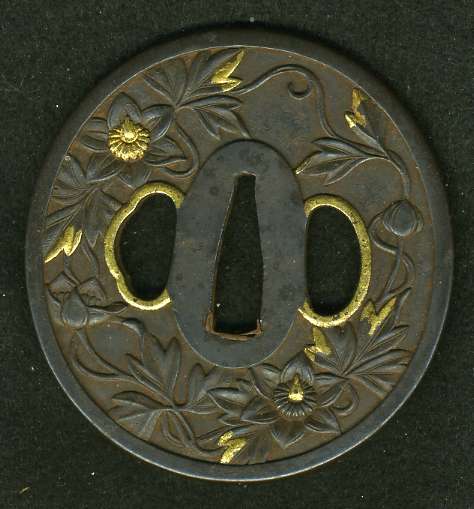
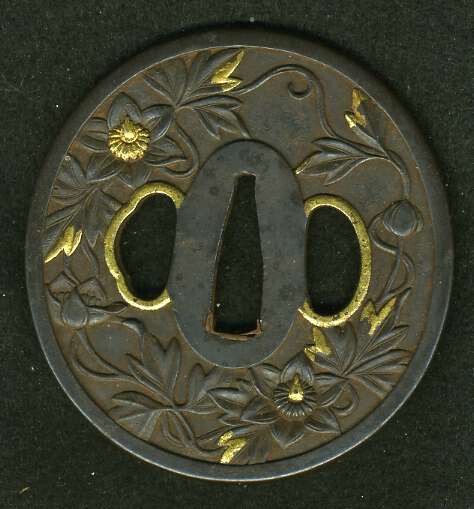
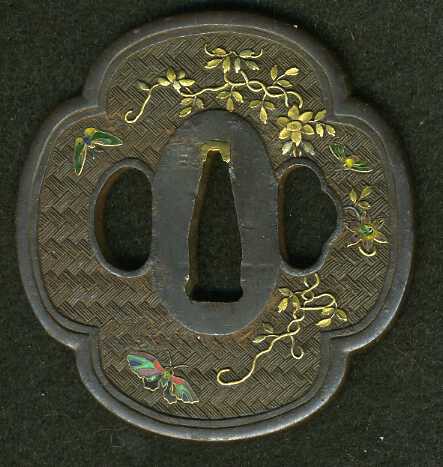
Next one: Tsuba #2: Bushu-Ito ---------SOLD-------- Very good condition. I believe the flower is called "Clematis" vine. Thank you Mr. Moriyama for helping me to learn to recognize it on tsuba.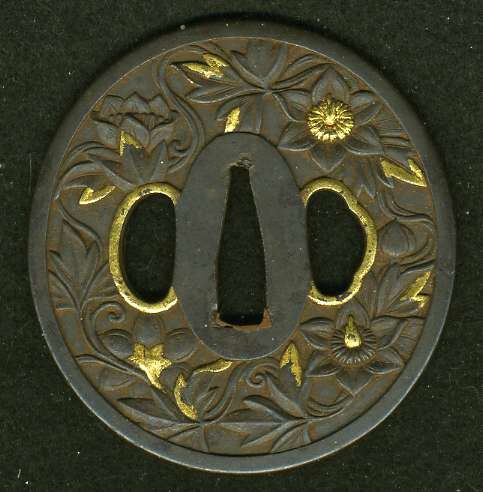
-
Tsuba for Sale & Tsuba wanted
Curran replied to Curran's topic in Auctions and Online Sales or Sellers
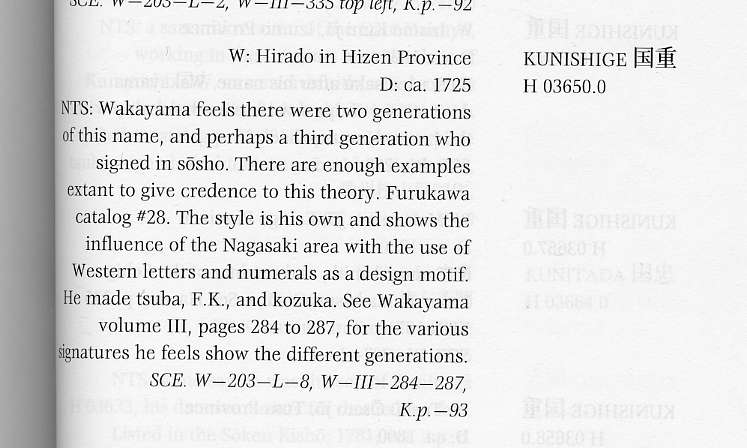
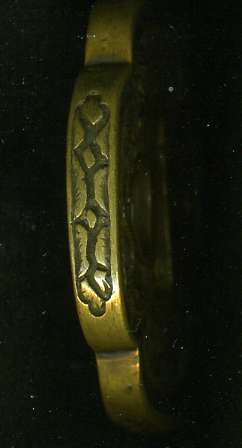
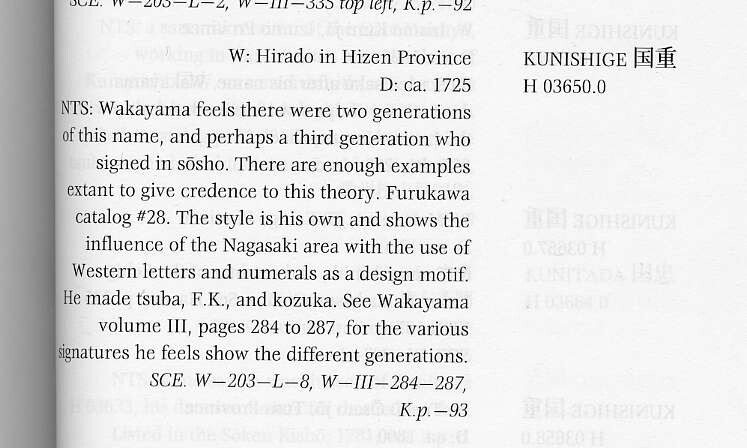
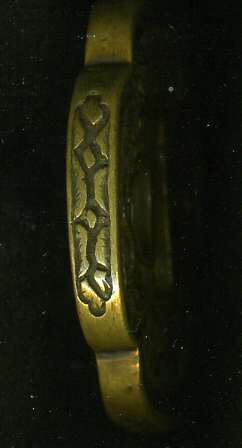
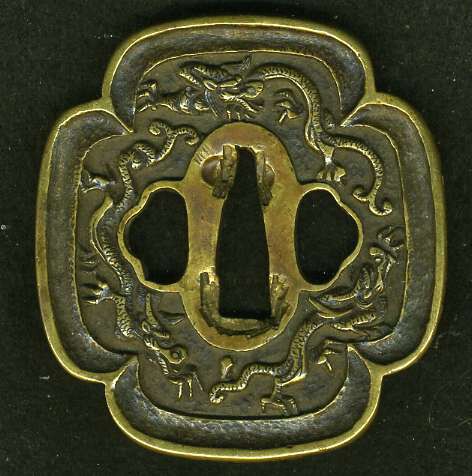
Feel free to openly discuss or ask questions, as we might as well make an academic lesson out of this. This tsuba in typical Kunishige fashion is very thick: 9mm -
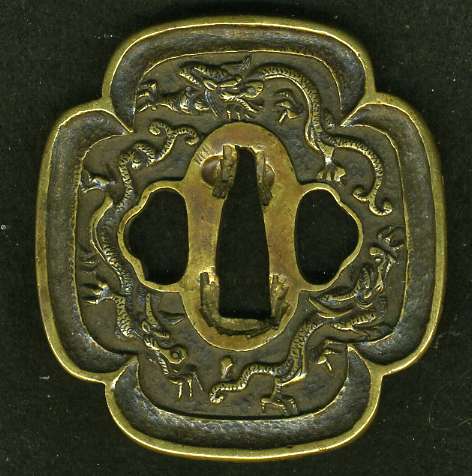
I'm trying to focus more on sukashi tsuba- with greatest interest in ko-akasaka, early owari, kaneyama, Ono and early Higo. I will be selling the majority of the non-sukashi part of my collection. Figured I'd post them here before considering evil eBay. If interested in one, shoot me an email or post here. I'd also be interested in most papered ko-akasaka (or Tadashige) for sale or trade. Curran C. Tsuba 1: Hirato Kunishige --SOLD--
-
Tampa Show Feb. 9-11
Curran replied to b.hennick's topic in Sword Shows, Events, Community News and Legislation Issues
-No, that would be a mistake- Bad karma It adds up. I had a wealthy guest/friend drop in and visit the show on Saturday. Hands on guy who likes to see things before he buys. He could buy anything in the room fairly easy. He didn't see anything that quite fit the bill, and I wasn't going to go forcibly digging under people's tables. So he left with a few thousand worth of various fittings. Pocket stuff to him. As a hedge fund manager, I deal with more and more of these people as we grow. Nihonto is small potatoes to them. I don't mind the dealers being offish towards me, as I focus more on fittings and rarely buy big, but then why should I bring someone over to them and make introductions? The karma adds up. -
Tampa Show Feb. 9-11
Curran replied to b.hennick's topic in Sword Shows, Events, Community News and Legislation Issues
The Tampa show was good, though Chicago Show+Shinsa being only 2 months away seems to have had a number of people opt out in favor of that. Volume over the last few years has been consistent, but then a drop this year. Certain regulars were absent. There were many good fittings to be seen, but many good swords were kept under the tables and you had to know to ask for them. I've never liked this, but that is the business practice for some. For everyone I know about, there must be one that I do not. I sold a good number of tsuba. Even mix of sub $500, $1000+, and $2500+ tsuba graduated to new owners. I had a very scant few blades for sale, most on behalf of a friend. 2 offers of cash+trade for the higher end ones. I was very tempted by a nearby dealer's tanto w/ koshirae. It too had been under the table, and I did not know about it until very late in the show. All in all, there were some good items around. I came with cash and left with more cash than I intended. One tsuba I wanted was "not for sale, but I'll leave it to you when I die" and my distant 2nd favorite- the very hung over owner changed his mind. With family obligations in Tampa, I only spent 2/3rds of the time at the show. I would have liked to been able to hang out more, buy and sell more. Just never enough time. -
Kyo-sukashi. 1725 to 1800 is my call. Rich is da king. Not much to add. If the plate is (probably) thinner, I'd probably put it later (1750 to 1800). Ps. Your Umetada plate patina is entirely consistent with that of other Umetada tsuba I have seen from that period. A few years ago I owned a similar style Umetada by Yoshitsugu. Distinct patina. Gray black, and somewhat slick as if it had somehow been burnished. Curran
-
Left hand side is: Umetada Shige______ (I cannot see the last one) Just off the top of my head from memory- Probably later Edo Umetada work. If you pop open Harry Watson's Nihonto Koza Kodogu Volume- I suspect he will prove to be one of the Umetada Shige_____ listed there. I'd thought such guys very unlikely to be gimei, but the NTHK bounced a fellow listmember's signed later Edo Umetada at the NTHK shinsa. So always a chance it is gimei. If you can produce a better image of the last character under the 'Shige', I will look it up for you.
-
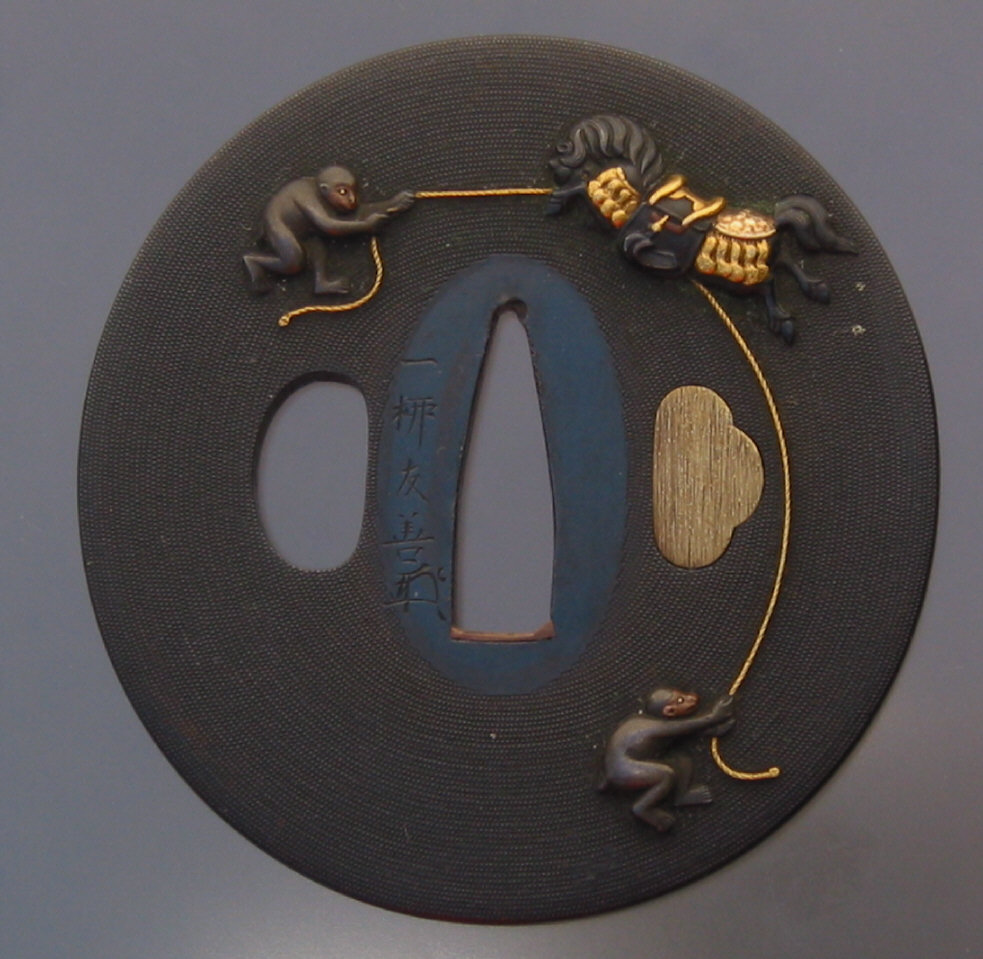
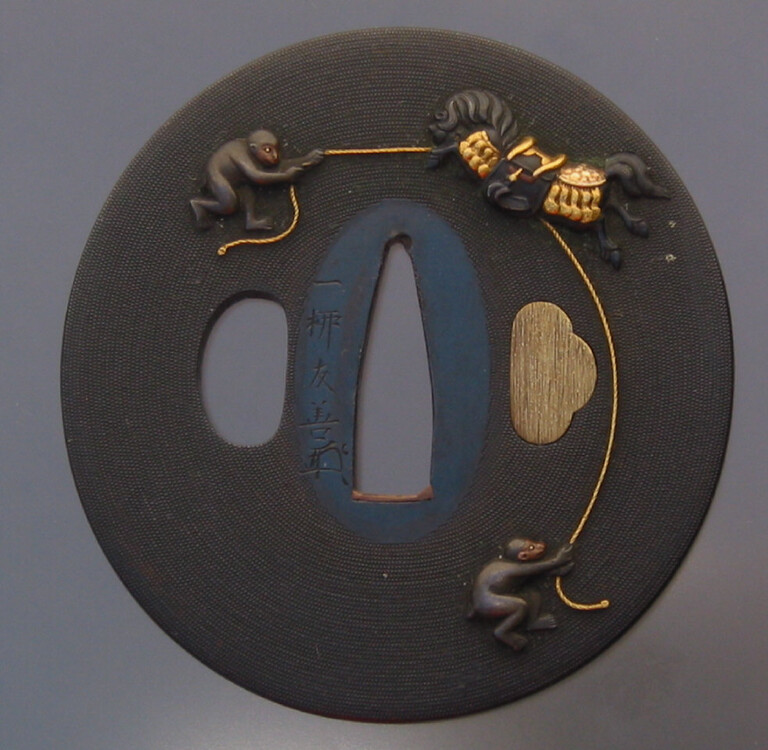
Milt, Sorry but I do not have a photo of the back. The back has a money with a hat carrying a banner and another baby monkey eatting a peach or such. Look it up in Japanese Myths and Legends. I believe it talks about the theme in there. The deer tsuba image was too large to post. I'll send it to you offline.
-
Milt and Moriyama-san, I should have known that said 'kao'. Sometimes I miss the easy ones. Yes, my wife has her anniversary, her birthday, and Valentine's Day within a 9 day stretch. We call it Holy Week, perhaps because I must be Angelic :D during this time. So of course there is the Tampa show right in the middle of Holy Week. It should be interesting. She gets a Hermes purse, and maybe I have to sell a tsuba or two to pay for it. Thank you gentleman. Best regards to you.
-
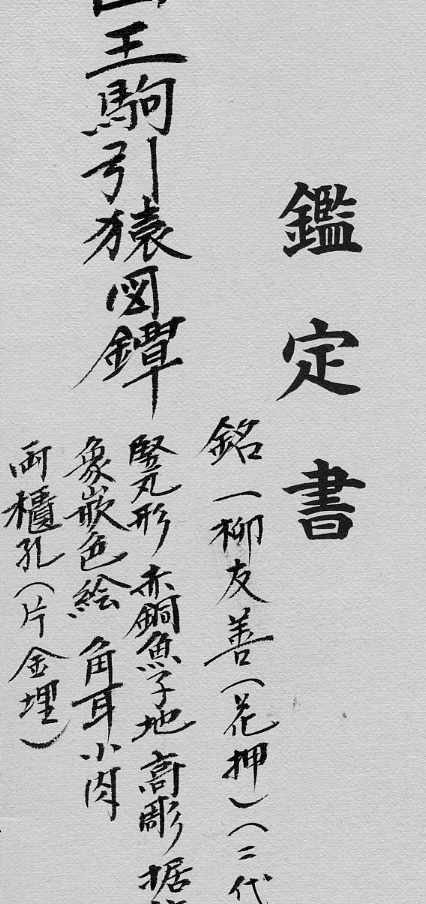
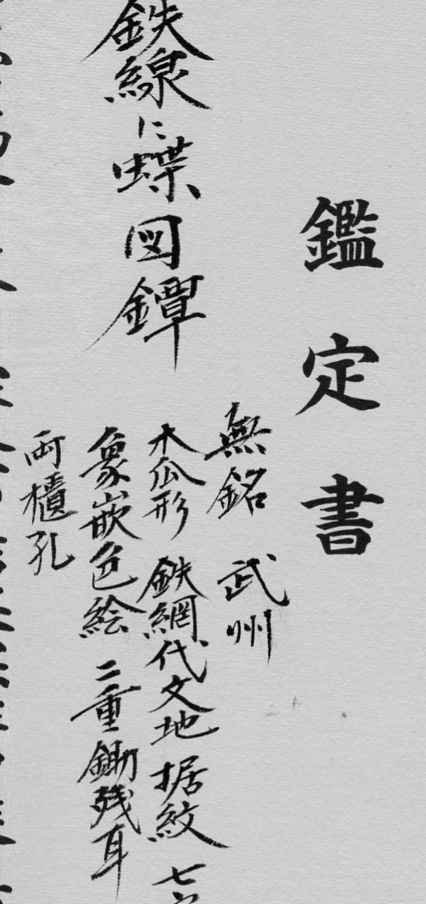
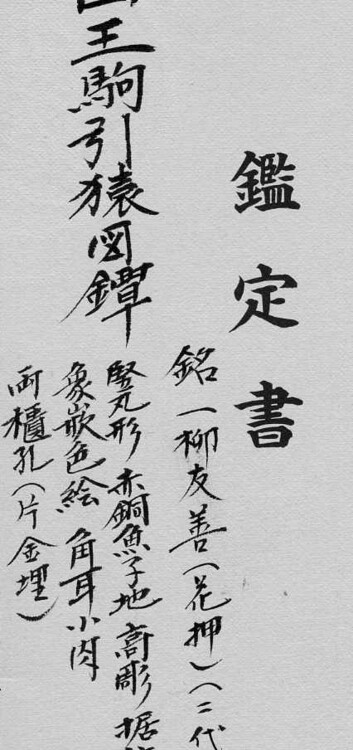
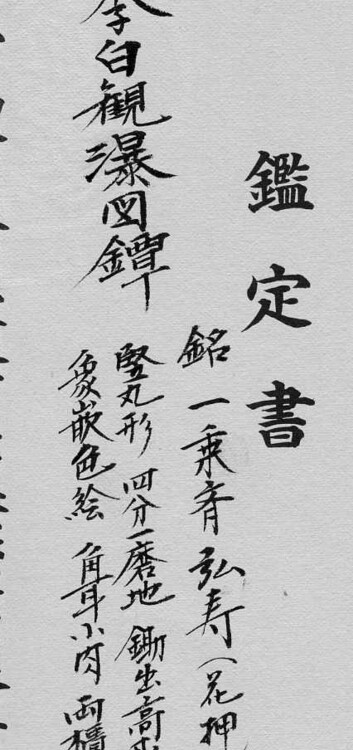
Milt, Yes I remember your tsuba quite well. I thought it was a fair call by the NTHK, though I too think they may have shafted you on the kozuka. That is the drawback with the NTHK these days.... if they paper a signed fitting- then it is darn certain. But on so many bigger names, they hesitate. I owned a nice Umetada tsuba where the vine flowers ( I now know they were clematis) were rendered in gold and silver. They were executed exactly as on your Bushu Ito tsuba. This supports for me... as I've read a bit more, and I understand the Umetada <-> Bushu Ito connections- but it is still hard for me to accept that I was so far off. I've seen a near identical basketweave cloissone tsuba that was NBTHK papered to Hirata. I am learning. Maybe I have another 50 years to learn a bit more. I've attached scans of two other tsuba I sent. I do not recognize the characters inside parenthesis after the verification of the mei. Yes... I know the one set says "the nidai", but what is that in that other set of parenthesis on both papers? Let me guess... it says "This space for rent".
-
They enjoy a good reputation according to some. I've seen their stuff in SF, and but not yet been tempted by their swords. They get in some good fittings now and then and are knowledgable, but can be difficult to deal with. I tried to buy a set of menuki off them, but ran into such trouble like you are currently experiencing. Then I tried to buy those same menuki in San Fran, but there was further difficulty between 'website' price and 'see them in person on first day of the San Fran show' price. The menuki have been there on the website at least 4 or 5 years now. I gave up trying to buy them. As I've said, they get good stuff (fittings at least), but dealing with them has never been easy for me. You would probably do best to deal with Moses at Nihontoantiques.com , Fred W. of Nihonto.com , and Andy Q of Nihonto.us . I've had some excellent buys from Moses and Fred.
-
Moriyama-san, Thank you so very much for the in-depth translation. I truly appreciate it. I purchased the cloissone tsuba for my wife a while back, because she liked it. She tells me that clematis grows very well here in Florida, and she thinks it must also grow in southern Japan. We did not realize the flower on the tsuba was clematis, but you (or the NBTHK) are very correct. I have never seen a cloissone Bushu tsuba before, so my mind is still trying to absorb the idea (accept or reject ?). I will post more tsuba and their papers later. Most of the others are signed, and I understand the papers, though there are some kanji I do not understand. Thank you again.
-
Milt, Okay, here's a photo. The coloration of the butterflies and flowers is translucent like stained glass. Study with a magnifier shows the apperance of what I think are little bubbles trapped like that in amber. The wire used to shape the butterflies is of varying weights. Both gold and silver wire have been used. (silver for the antennae of the butterflies). Inspecting it closer, I now realize two types of gold were used on the vines- a yellow gold and a red gold, so that the vines contrast more as they twist around one another. This tsuba has some minor issue with rust in the basketweave. A jeweler (or dentist) with an attention to detail could clean this up and make it a truely beautiful tsuba.
-
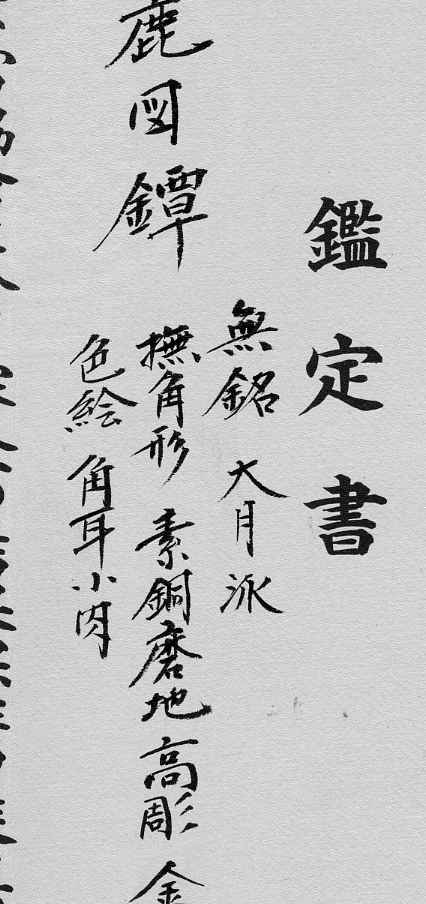
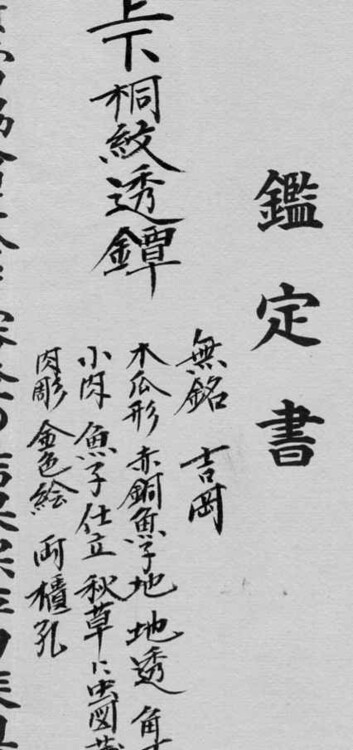
I've had a little more time to try and figure it out. Tsuab #1 (deer tsuba) is: Otsuki ( ?? ) I assume it is Otsuki Den or something similar. I could kick myself as I read up on Otsuki a while back and Peter sent me a related article. I knew it should be easy, but was wandering off trying to make sense of 'O-gatsu' or 'Dai-gatsu'. Nice tsuba, but I'll probably sell it in Tampa. Tsuba #2 is: Yoshioka The name rang a bell in my head, but wasn't in the Koza that I saw. Supposedly there were 12 generations (according to small blurb by Haynes. Catalog #9), but I would greatly appreciate the sharing of knowledge others might have about this school. 'Yoshioka' seems a very general attribution if this family was 12 generations long. Beautiful tsuba. I assumed it was Goto. Most likely one of the side branches. I'd very much like to better understand the reasoning for a 'Yoshioka' call. I wish I could see the koshirae that went with this one. Tsuba #3: Well... that one still says Bushu. I know that other schools worked in cloissone- but I would have thought the work to be Hirata or Umetada. Anyone else have an example of Bushu Cloissone work? Curran
-
John, Yes, I didn't give you any of the easy ones! :D I work fairly hard to ID a tsuba before I send any tsuba to the NBTHK or NTHK. Of the many I sent, I was only uncertain about the deer tsuba and the cricket tsuba. Now that they are back, I still do not know what they are... oh the curiosity is killing me. I've been more and more hesitant about sending to the NBTHK for fittings. Sometimes their calls are very good, but then I've seen some odd things. As Ford noted, he's had some of his moderns pass. I just had a big-name pass that I was more than 1/2 sure would not pass. But then I have a Hirata tsuba come back with Bushu papers? Maybe the Bushu group worked in fine cloissone, with the sort of iron I usually see with Hirata tsuba? Hell, I don't know! What is up? I've never run across anything like that in the books, so I must hope Peter K. or Rich T. can explain. Maybe Jim Gilbert will pop out of the woods for a bit and point me at a reference? Mr. Nobody, I need your bilingual expertise! Anybody think they can beat him to the translation? Peter K.? Rich T.?
-
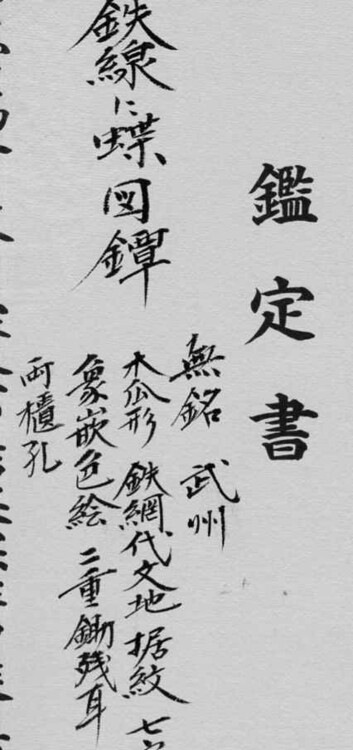
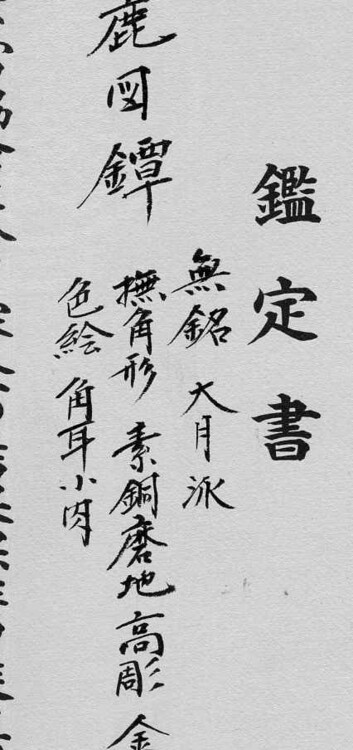
Paper 1: (deer tsuba) Ogatsu___? Daigatsu___? Paper 2: (cricket tsuba) (Yoshi Oka?) Paper 3: (cloissone tsuba) Bushu? ? ? Thank you for all help.
-
Dear Gents and Dames, I just received a large crop of tsubas back from Japan NTBHK. Ironically they failed the only one I knew to be 99% correct, and passed with flying colors the one I thought most dubious. I cannot complain, though still scratching my head about that and some of the other papers. Three of papers are giving me trouble for various reasons. Tanslation help please? Paper 1: (Translation) ? Paper 2: (Yoshi oka ???) Paper 3: This one is confusing to me. The papers say "Bushu", but it is a fine Hirata cloissone tsuba. Maybe I miss something in the context? Any translation help is most welcome!! It is my anniversary this weekend, and I do not think the wife will let me stay home to work on these. Curran
-
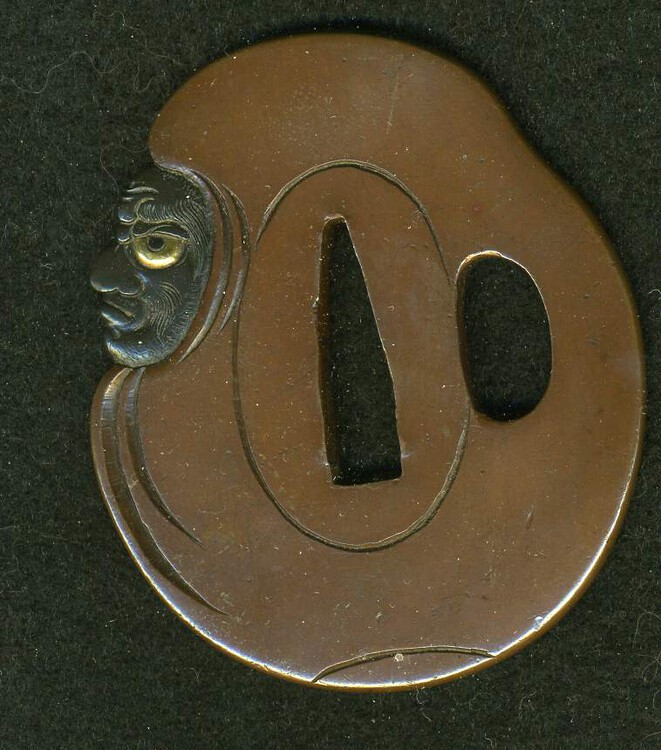
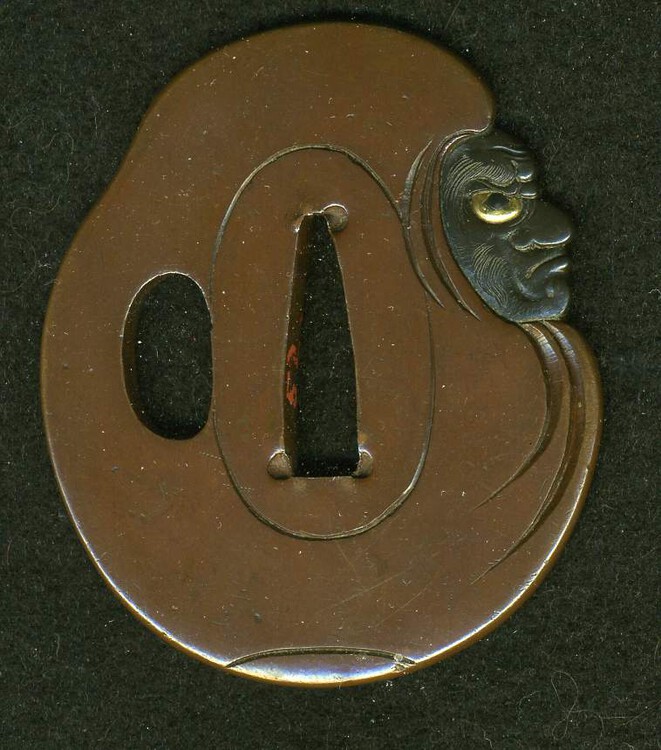
And now the fairly identical otherside. Been curious what this one was, but have not bothered shinsa'ing it yet, as I get the feeling they will scratch their heads and call it 'Hamano'. Doesn't feel Hamano to me. Some sort of derivative of Hamano- maybe Otsuki or maybe something else. Opinions welcome.
-
Ok, second try to post the photo.
-
Mike, Nope- the wife and I let the Jersey City apartment go a while back. We are now in the Sarasota, FL area. I love where we live half the year, and hate it the other half (hurricanes and all). We'll see what we are doing in the long run. Both wife and I miss the NY area, so we will probably either move back there or "snowbird" back and forth. Small chance we may move to Scotland, but most likely just some FL <-> NY life. Oddly enough, we mostly miss certain types of food. Who would believe you cannot find Jamaican food on this coast, and we hafta drive over 1 hour to the nearest mediocre Korean resteraunt. Yes, I miss living about 2 blocks from Kodama and being to see him. Not a whole lot of Nihonto down here. I've pruned my collection back a bit too. Mostly tsuba and books. Not as much fun without other collectors around.
-
Mr. Ford, You may be the best person to ask about a tsuba I've owned for a while. A photo/scan should be attached. I've wondered if it might be Otsuki school? Yes/No/Maybe The tsuba is identical on both sides, and the face seems to be more shibuichi-esque in a dark grey with nice lustre. Eye is gold, with a shakudo pupil. My logic is only that I have seen two very similar Daruma school tsuba from the Otsuki school. I do not know much about the school and would appreciate any references in English. (Hmmm... photo isn't attaching. Need to resize it. Will post later.)
-
Mike, At the meeting, show it to Kodama. Hopefully he will show up to the meeting. I miss attending the New York club. If I may ask, from whom did you buy the sword? You can contact me offline if you want. I'm mostly just curious. Your description of the seller reminded me an awful lot of a gentleman from New Jersey.
-
Nice looking sword. I know little about the smith, so cannot comment other than that at least one excellent gimei of his is floating around (last in Japan I believe?). I cannot agree with that papers comment. I just don't much believe in Toku Hozon anymore, and some others feel that way. There is Hozon, and then there is Juyo. Toku Hozon is often a waste of money. Once... only once... I got a specific smith and generation attribution whereas the Hozon had given it just to the school and time period. Ironically... that sword came from Japan originally. Last 11 items I submitted to the NBTHK, only 1 did I bother with Toku Hozon. Looking at that Toku Hozon paper now, I wonder... why did I spend the money? As for the sword coming out of Japan without papers, thats a tough one. There have been others with no papers that came out and have gone as high as Juyo. Sometimes they come out of Japan with respected 3rd party opinions. Sometimes not. One of my favorites.... the 3rd party opinion was wrong and so were some smart people here in the US. I saw the sword and it needled at me as something special. I was close with my attribution, but off. Still wish I could have bought it (I wanted it for the koshirae nearly as much as the blade). One year later, the blade is Juyo. Great blade. Great attribution (one of the more impressive calls by the NBTHK, where once it was made I read-up and said... D@*N how did none of us get that). But for a signed blade coming out of Japan without papers... a bit more questionable. Very sincere "Good luck!". Hope it papers.
-
I remember seeing a tsuba at one time that was signed something like "this was made with namban tetsu by _____". The signature was more interesting than the tsuba, but I made mental note of it. That was a while ago. Not sure which, but I believe it was on a Japanese website.