Bugyotsuji
-
Posts
14,912 -
Joined
-
Last visited
-
Days Won
314
Content Type
Profiles
Forums
Events
Store
Downloads
Gallery
Everything posted by Bugyotsuji
-
This Week's Edo Period Corner
Bugyotsuji replied to Bugyotsuji's topic in General Nihonto Related Discussion
Recently I had to re-register two guns after returning from Japan Week in Portugal. Now it seemed to me that the old gentlemen who were noting down the special features of each gun, also consulted their books. I could be wrong, and the books were simply primers for registration, or there for the swords that day. I have since asked some knowledgable friends and they assured me that such a volume does not exist. My secret plan is to phone or visit the Cultural Section in the Prefectural Education Committee and try to double-check this. I have heard rumours/rumors that despite their serious faces they actually know less about old firearms than we give them credit. On the other hand, there is/was a two volume private printing in a cardboard cover which records all the known Tanegashima Mei (at the time of printing 10 odd years ago). I do not recall that the registration officials had this volume. This is a) long out of print b) almost impossible to get as no-one wants to part with theirs, c) in need of more addenda as many more J matchlocks have come to light since then and therefore d) in desperate need of an updated reprint. There were rumors/rumours of an imminent reprint and I have been eagerly awaiting such for several years. Content. There is no information or comment regarding the recorded Mei therein. No dates or ages. It's a straight list, in Japanese only. One of the volumes lists by area, and includes maps of the gunsmithing areas. The other is an a-i-u-e-o national alphabetical listing of smiths. (Kunitomo alone covers 70 pages.) Some of the smiths' Mei, but not many、 include a date and perhaps a smith's chiselled word on the method of manufacture, which can be useful on occasion if you can cross-reference two corresponding names. Very much the exception though. -
What a great thread. So much food for thought. Henry, how much does Togi-beri feature in the difference in feel between a Kamakura and a Kanbun blade? (Better declare an interest in this question. You have just called my Shinto blade a "poker")
-
This Week's Edo Period Corner
Bugyotsuji replied to Bugyotsuji's topic in General Nihonto Related Discussion
Mmmm... great story Chris. Hoping that you still have it and photos will be in the pipeline! -
This Week's Edo Period Corner
Bugyotsuji replied to Bugyotsuji's topic in General Nihonto Related Discussion
How's your translation machine? In this article... http://www.asahi.com/kansai/news/OSK201106060007.html ...it says that on the 5th of this month (June) at Azuchi Castle a group of four had dressed up in armour to do a live firing display. During the reloading of his 30 Monme O-zutsu one bloke accidentally set off his hand-cannon and sustained very serious burns to his face. (The grim details have not been published.) Well, this has had a very negative affect on the Police and authorities regarding the holding of such events. It was already hard enough. We had to apply in triplicate back in February for the big display in Akashi tomorrow. Suddenly they withdrew the permits and asked us what extra guarantees we could give to justify going ahead with the event, the centrepiece of so-called 'Time Week'. Our leader was quite displeased with the bloke who had thought he was a real expert, but never considered that his actions might reflect on all matchlock companies throughout Japan. He wasn't even a proper member of a Teppo-tai, but simply someone who enjoyed shooting guns (5 modern guns in his cabinet) and made an elementary mistake. Luckily the police accepted our supporting paperwork and reassurances that we are not a bunch of looney gun collectors or amateur shooters, but we do this properly and responsibly as a Martial Art. Anyway I will be up at 3:00 am tomorrow (Sunday) to leave at 4. They have asked me to help dress the present Daimyo of Akashi who will be joining our procession (his very first return for his family to Akashi) and wants to wear full armor/armour once in his life, as do his present-day Karo and retainers. The Mayor of Hagi also will be coming from Yamaguchi to observe, because I believe they are considering setting up a Choshu teppo-tai and want to see an example of what can be done. -
Another what is it called?
Bugyotsuji replied to estcrh's topic in General Nihonto Related Discussion
Eric, the Kanji on the front, says, wait for it, ... 前 front! Most Yoroi-bitsu have this character on them. The Mon is a 16-petal Chrysanthemum, with a leaf design in the center/centre. Ura-giku? 裏菊? -
My very first gun was a baby Hazama from Awa. The quality of the steel was not good, but the wood of the stock was wonderful. Most Awa guns have tiger stripes burnt into them artificially, but mine had natural tiger's eye Mokume patterns in the wood, polished up rather like a sword blade. I never fired that gun, but it was such a pleasure to bring it out and hold it, the long dead-straight smooth stock taking me straight back to the original craftsman who fashioned it. The woodwork alone engendered something like love in my heart! The barrel was created in the Awa style by Yamada Gohei, a Settsu gunsmith, probably in Awa, considering the quality of the iron.
-
This Week's Edo Period Corner
Bugyotsuji replied to Bugyotsuji's topic in General Nihonto Related Discussion
Lorenzo, your wife looks at what you write!!! How can that be? Eric, maybe you were not meant to own it. I have a list of excuses in my brain for self-preservation, without which I would buy everything that came my way, selling the wife and the house in the process. In this case, however, not one of them worked and the gun ended up sliding into my hands. Rules of self-preservation. 1. Don't get up and go to that early antiques market. Enjoy the lie-in. 2. Get up and get dressed and go, but take all the money out of your wallet, except for say 50 bucks. Hide your cash card somewhere in the car where you are highly likely to forget it. 3. Go with someone who also has strong will-power, and vow to help each other buy nothing. 4. Look at an object, fine, but bite your tongue and do NOT ask the price. 5. Feel no pity for the antiques dealer, and marvel at how you can say "I am just doing a circuit first." 6. Vow not to go back to that stall. 7. Think of sex. 8. When you come back to the stall, don't catch the holder's eye. If he/she is with a customer, take that as a sign from Allah/Jehovah. Fervently hope and pray he has sold it to someone else, completely, finally and irrevocably removing the temptation to break all your vows and buy the damn thing. 9. Do not make friends with any of the dealers, or they might allow you to take it and pay later. 10. Tell the dealer that you want it, but your wife came too, and you can feel her eyes boring into the nape of your neck... -
Yari kake, teppou kake, generally tend to have strings on them and I have always thought it was for safety in earthquakes. More than one usage. But I do like your example, Eric.
-
This Week's Edo Period Corner
Bugyotsuji replied to Bugyotsuji's topic in General Nihonto Related Discussion
Eric, there is such a mass of detail there that you are wise to keep it for future reference! Ian, your observations are spot on. With the increasing appearance of Western ships off the shores of Japan the Tokugawa started to increase their orders for more guns. Bunsei/Bunka period, 1800-1830. In order to rearm the whole country, it took time to increase numbers though, where the industry had been seriously wound down. Your catalogue sounds fascinating. Ron, yes, it is a Samurai gun, Shizutsu, expressly designed for the battlefield. I bought it for practical use in our displays here. You startled me with the bit about the wife. I did follow the Three Golden Rules. 1. What the eye doesn't see, the heart doesn't grieve over. I replaced it in the gun case and moved old trusty to my place of work, hoping she won't notice the subtle difference in appearance. 2. If she does say something I have some clever back-up plans. An old lady left it to me in her will. Years ago, don't you remember? 3. I sold the other one and bought this one out of the profits, with enough left over to fix that broken guttering. Besides, where does she think I got the money for her airfare from? -
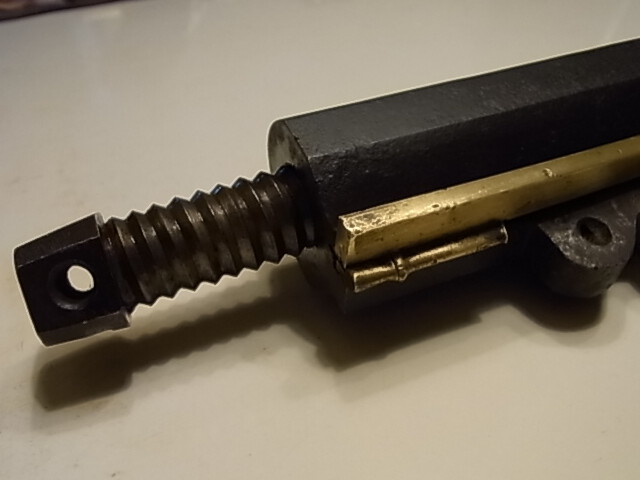
Cannot recall having seen a 'rivet' like that. Always a first time, though! Does it look the same on both sides?
-
Andrew, my books only deal with 'old' smiths. There is a 'Shinto' (?) Yoshisada with those Kanji in the Toko Soran, p.723 but he is 宮野義定 Meiji 34 (国不明)
-
This Week's Edo Period Corner
Bugyotsuji replied to Bugyotsuji's topic in General Nihonto Related Discussion
Oh, and two of the first things to check when you consider purchasing one of these.
-
This Week's Edo Period Corner
Bugyotsuji replied to Bugyotsuji's topic in General Nihonto Related Discussion
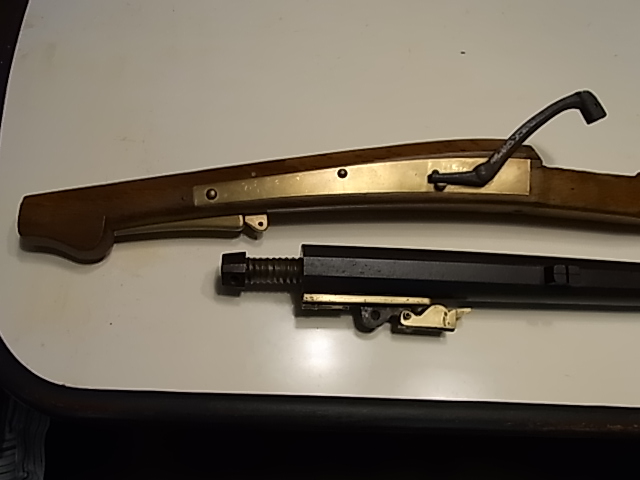
Overall shot, and the plainness of the reverse.


-
This Week's Edo Period Corner
Bugyotsuji replied to Bugyotsuji's topic in General Nihonto Related Discussion
The previous owner polished up all the brasswork so it will take a while to settle down to a good ole patina.


-
This Week's Edo Period Corner
Bugyotsuji replied to Bugyotsuji's topic in General Nihonto Related Discussion
Not quite sure where to post this. I bought another Tanegashima Matchlock the other day. The gun is in pristine condition and looks to have been used very little. The barrel bears the Mei 国友林右衛門 重当 Kunitomo Rin (Hayashi) Uemon Juto/Shigeto, and the number 四 can be seen inside the Dogane brass band. Inside the belly of the stock is written in brush ink the stock maker's name 伴 治平斎(?)基重 and the number 四. It appears to be a 6 Monme, 1.6, 1.7 cm caliber. (The authorities made a mistake on the Torokusho 1.3 cm, LOL, so I will have to have it reregistered next week.) The gun 'feels' to be about the same age as my 1.7 cm Kumamoto Castle Hosokawa long gun, which is dated 1847. Whereas that one is a military gun through and through and bears the shape of the manufacturing area, Higo in Kyushu, this 'new' Kunitomo gun is typical of the Ogino-Ryu school of gunnery and, typical for Kunitomo, lacks any defining Kunitomo regional characteristic. Two back sights and one forward, inner lock mechanism and iron serpentine. What is interesting is that despite this gun having no decoration on it at all (the plain drilled Mekugi-ana having no surrounds, and there is no decorative non-functional brasswork on it anywhere) my gun collector friends have been drooling over it and congratulating me on a very wise purchase. What are they seeing? Beauty in simplicity of function? Lack of ostentation? Singularity of purpose? -
Unless someone pulls me up short, :lol: I would say that is definitely a different Yoshisada.
-
Nice. I like the ishidzuki. Can we see a piccie of the rivet, Eric? Are you sure it is not a screw that has been damaged? You know the threads traditionally went the 'wrong' way and people often screw them up! :lol:
-
Sawada Sensei uses the word 'distance' shooting when describing long guns for sharp shooting, or target practice. (Just been doing some reading up.) Perhaps the effective range was 'the width of a moat' ? How long is a piece of string and how wide is a moat? It must also depend partly on the quality and amount of powder you pour in before the ball.... 狭間筒Hazama-zutsu is the usual word to describe these guns, and although the loop hole in the castle wall is usually described as 狭間 Hazama, in the blurb for Hikone Castle they call them simply Sama さま. The mini long guns are about 130 cm long, bigger ones go up to 2 meters in length. I also read an explanation that the size of a ricefield stretching from the castle walls was called a Hazama. (Think feudal serfs' fields.) Sawada Sensei is puzzled by the weight of these guns, and the large quantity of iron needed to create one, and then by the very small caliber. He says none of it makes sense, but there are surprisingly large numbers of Awa-zutsu Hazama guns in existence. Was it a fashion? My private theory which has not been tested or thrown around yet, and may be way off the mark, is that the Lord Hachizuka (said to have loved guns) called all his best gunners into the castle to be aware of who was good, and keep potential enemies close at hand. Large unwieldy guns could not be easily or rapidly swung round to cause trouble or to assassinate him, and even if they had managed such, the caliber would ensure no-one was killed. (Think fairground guns...) (Please ignore this last paragraph as necessary, but I will be testing this idea on some of my fellow 'experts' very shortly, and report back.)
-
This Week's Edo Period Corner
Bugyotsuji replied to Bugyotsuji's topic in General Nihonto Related Discussion
Ah, but has it left you any the wiser? :lol: -
This Week's Edo Period Corner
Bugyotsuji replied to Bugyotsuji's topic in General Nihonto Related Discussion
Eric, have a gander at these! http://www.onmarkproductions.com/html/fukurokuju.shtml http://www.onmarkproductions.com/html/jurojin.shtml -
Thomas, it has also been said that Hazama zutsu, (guns fired from the Sama, or Ha-zama) were trained on attacking troops massed on the opposite shore of the castle moat. The idea was that, at that range, you cannot guarantee to kill any one person but you can seriously wound someone within the mass. Four or five of those around the wounded ashigaru would then be removed from the fight as they carried him back and out of the fighting. Ron, thanks for the technical back-up. I was aware that increased length of a smoothbore barrel does not really improve accuracy, but in those days it was the received wisdom and the driving force behind longer gun barrels, I believe.
-
This Week's Edo Period Corner
Bugyotsuji replied to Bugyotsuji's topic in General Nihonto Related Discussion
Eric, quoting myself from the previous page, that is what is written on the bag. The two elegant figures... (Trolls, grrrrrrrrrrrrrrrr ) are two versions of an ancient Chinese scholar/god. Often confused with each other, they are called either Fukurokuju or Jurojin in Japanese, and are usually depicted with high foreheads. The short one is a two-hundred-yr-old 'Netsuke' that I bought about two months ago. Originally worn decoratively on the top edge of the Obi to hang Sagemono from, now worth several hundred dollars. The taller one is a fairly modern 'Okimono' (standing object) and the moment I saw it I wanted it for addition to the family. (No, not trolls, or gnomes or eggheads!) -
Yes, Thomas, the 'Hazama-zutsu', or castle/ship slit/port guns, were mostly found in the the country of Awa in Shikoku, so when one thinks of Awa-ju, the image is of a long and heavy Hazama-zutsu, with a rather small bore. They tend to have sights that can be adjusted, but most have lost these, with only the sight base remaining. The Lord Hachisuka of that Tokushima area is said to have set up targets and gathered up the people to have regular shooting exhibitions within the castle, (accuracy being considered better achieved with a longer gun). As to statistics, I will go and have a look. Thanks for the information about the Korean Cheonbochong. Look forward to the pics!
-
This Week's Edo Period Corner
Bugyotsuji replied to Bugyotsuji's topic in General Nihonto Related Discussion
Eric, have a play around with this page, but go down below the stones. You will find some of the Sanskrit letters that were popular and the meanings and associations that they carried for the Japanese in the middle ages. http://kuubokumon.com/bonji.html -
This Week's Edo Period Corner
Bugyotsuji replied to Bugyotsuji's topic in General Nihonto Related Discussion
Gnomes, you say??? Come here and say that!