Bugyotsuji
-
Posts
14,654 -
Joined
-
Last visited
-
Days Won
297
Content Type
Profiles
Forums
Events
Store
Downloads
Gallery
Everything posted by Bugyotsuji
-
Justin, while following your brave attempts to make a suitable brass ring to slip over and fasten the barrel to the stock, I decided to go back to the literature to find out what the 'correct' word might be in Japanese. Do/dou/doh (like in donut) 胴 means body, and Kane/gane 金 means metalwork; these together seem to be short for the proper term 台締金 Dai-shime-gane. (Dai 台 is stock) Sawada Taira seems to be the most authoritative in this area, but trawling through his book I came up with no less than five different expressions. These can be explained in different ways, but the easiest way out I noticed was for him to use the imported word バンド (band) which has a multitude of convenient uses in Japanese today, including belt to hold up one's pants/slacks/trousers. He uses the word Do-rin 胴輪 several times, which has a Buddhist 'ring' (pun intended, the pun works in Japanese too) to it. He often uses the word Kantai 環帯 but my electronic dictionary and Google searches fail to come up with such a meaning to this compound word. In conversation you will hear people refer to it as Wakka ワッカ 輪っか which is a convenient slang word for something ring-shaped. In an illustration on p. 103 of his book of the 'correct' terminology for the parts of a Seki-Ryu gun, these bands are referred to as Do-rin, and in brackets "Dai-shime-gane, made of copper".
-
Wow, that is special. To make it stand up to numerous openings and closings without becoming loose, he chose to make that piece out of very hard walnut.
-
Could it have been in a fire?
-
IMPORTANT FURTHER RESEARCH INTO TANEGASHIMA PISTOL
Bugyotsuji replied to watsonmil's topic in Tanegashima / Teppo / Hinawajū
A rather unusual gunmetal (Hokin) barrel with iron Bisen screw. Pan and barrel in nice condition. May I add that I was surprised by the shop's elaborate line about why the gun was Mumei. Many guns are, and being unsigned is not particularly unusual or even detrimental. Just nicer to have a Mei. Giving an excuse like that suggests that they feel it really should have been signed and perhaps when asked by a customer they came up with some nonsense about prohibition in order to make the sale. On the other hand there may be something behind what they say, or it may be something to do with the bronze material and the ability to cast extras. I will make a point to ask around. -
Moriyama San, is it possible that the blade was ordered by somebody else, and that Nishimura Masamichi made it? (There are three smiths signing 正路 listed in the 日本刀銘鑑 for example.)
-
Gilles, let me en-courage you! Please post them!
-
Too right! Birds of a feather flock together? :lol: Thank you for your comments, Brian. Comments do add something really special to the act of writing, photographing and posting and somehow make it all worthwhile.
-
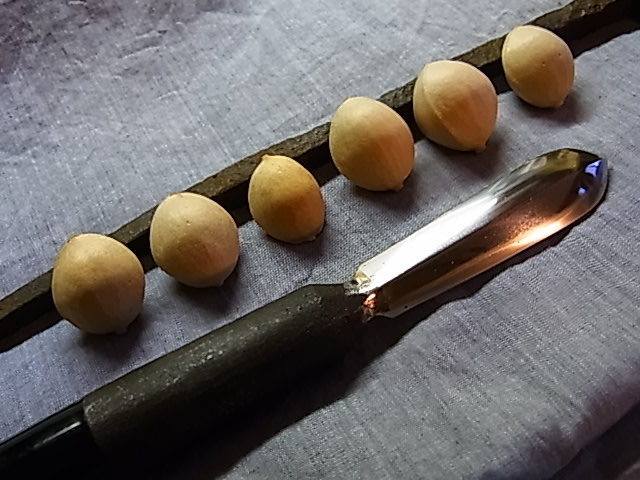
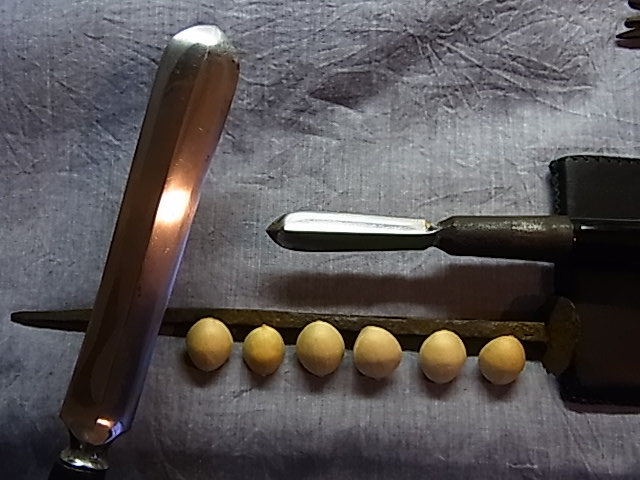
PS Special thanks go for the support of the iron nail from Himeji Castle. (Under the Gingko nuts)
-
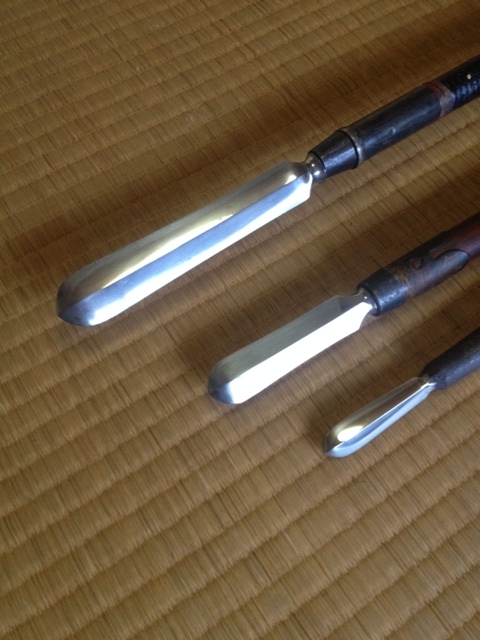
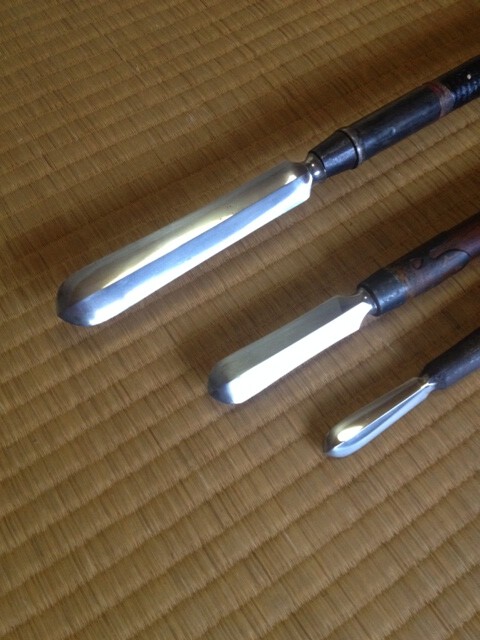
And from me here (anyone else have examples?) one final shot showing all three Ginnan-Po/Ho together. Blade length, measured from base of kerakubi to tip. Large, 15.5 cm Medium, 9.6 cm Short, 6.5 cm
-
None of them quite have the right strokes, but while we are thinking creatively, just as likely as 申 神 must surely be the two-water-stroke hen version of 沖 with the missing stroke brought over to the right?
-
Sasa-ho, Sasa-no-ho Yari
Bugyotsuji replied to Bugyotsuji's topic in General Nihonto Related Discussion
At your service, kind Doctor. -
The Mi? Oh, yes. The first is a tiny fukuro yari. Both yari are Ryo-shinogi.



-
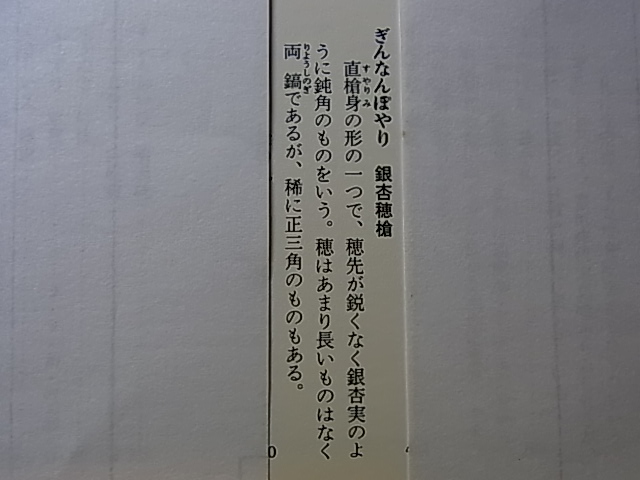
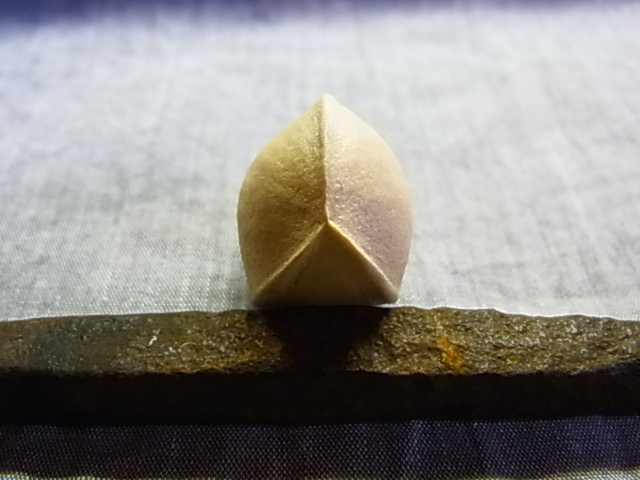
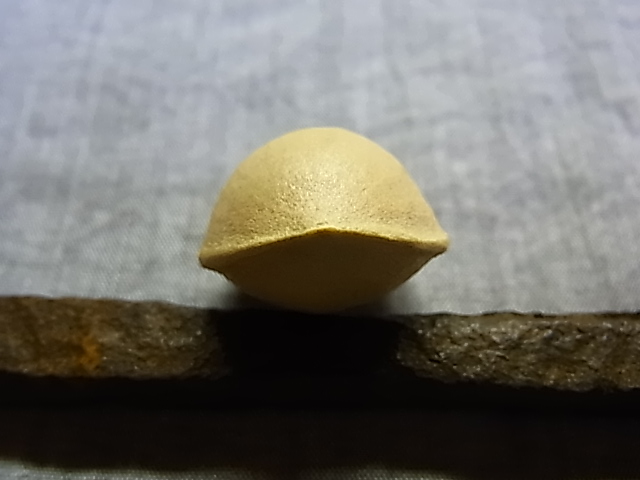
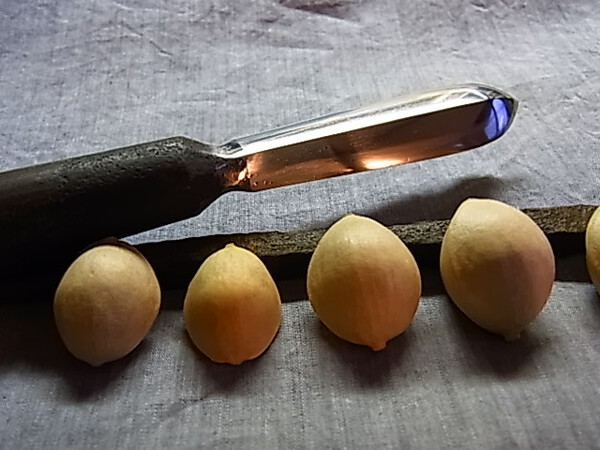
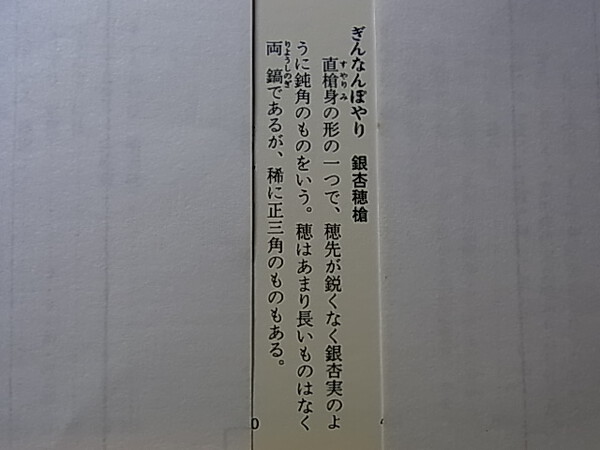
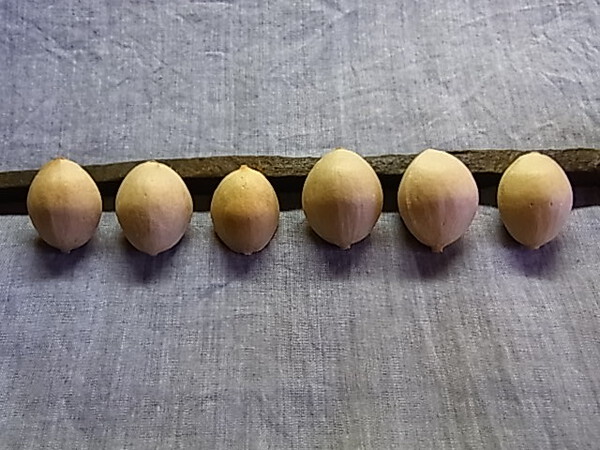
Just out of curiosity, I asked the wife if she had any Gingko/Ginkgo nuts in their shells and not only did she have some, but they were in good condition, and even better still, there was a surprising variety among them. What I discovered while taking the following shots was that the nut shells have a rim on them, which could equate to the edge of a spear blade, I suppose. The second discovery was that the end-on/cross-section profiles can be quite different as you may see in the illustrations. Sasama says in his encyclopedia of J arms that Gingko nut spears do not have a sharp tip but are 'donkaku' 鈍角 ie, they end at an 'obtuse' angle. He also says they tend to be Ryo-shinogi, though you do occasionally get a triangular, true Sankaku 正三角. Now one of the nuts below approaches Sankaku! Those yari kaji must have been very aware of the shapes of Gingko nuts when fashioning their blades. I dragged out two more Yari that have been around for several years here which seem to fit the 'Gin-nan-po/ho' pattern, one very small, the other quite large, indeed testing the upper limits I would guess. Both Mumei, the longer one registered in Kyoto.
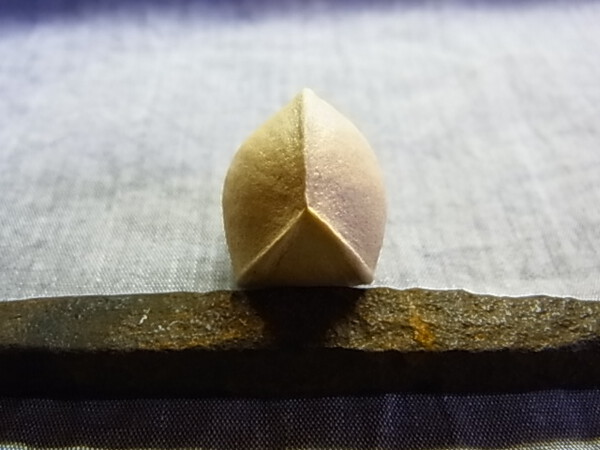
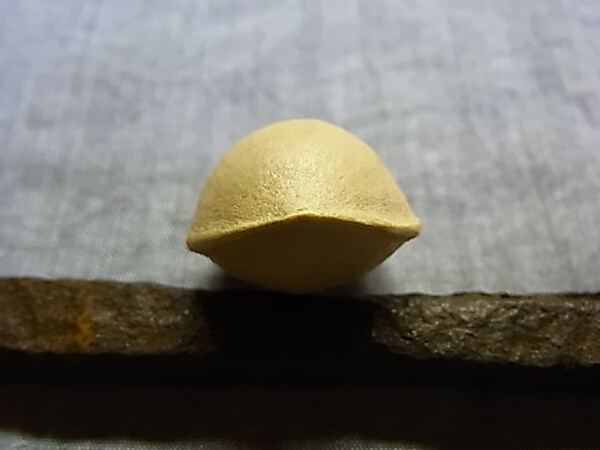

-
Sasa-ho, Sasa-no-ho Yari
Bugyotsuji replied to Bugyotsuji's topic in General Nihonto Related Discussion
Good, Hoanh, I am glad you enjoyed it. The leaf caught my eye and gave me a flash of insipiration. Something here to amuse the NMB members, I thought. :lol: -
Sasa-ho, Sasa-no-ho Yari
Bugyotsuji replied to Bugyotsuji's topic in General Nihonto Related Discussion
Oh, and the Yari itself is Mumei, but papered to Munemitsu of Sue Bizen. Reunited after 400 years, neither has changed much. -
Sasa-ho, Sasa-no-ho Yari
Bugyotsuji replied to Bugyotsuji's topic in General Nihonto Related Discussion
Oops, somehow they loaded in the wrong order. Here is Sasama San's description in Japanese clarifying the difference between the usage of SasaHo and Sasa no Ha. Ho is often used to describe the Yari-Mi or blade of a Yari.
-
Just sitting here idly watching the wind through the bamboos when I saw a single Sasa leaf caught trembling. It reminded me of a spear I have had for many years, and it was as if nature itself was waving the leaf at an unseen enemy. Talk about themes from Japanese Nature! The Ho in Sasaho 笹穂 means pointed head or ear as in a cereal, but in the description of Sasaho, Sasama says the word indicates a spear like a Sasa-no-Ha 笹の葉, or the leaf of a low-lying bamboo grass. Pic 1, second from left. Pic 2, (see following post) how Sasama San describes SasaHo Yari. Pics 3~ the leaves and the spear in the garden.


-
Not as clearly defined as recent Western auction houses Malcolm, but it leaves open the possibility that the Mei may have been added later for whatever reason. It simply notes that it bears a signature reading "Nishijin Ju Umetada", without wishing to get into any authentication process. Which, come to think about it, is a little surprising, considering that swords will fail automatically if there is any doubt regarding authenticity of Mei, regardless of what should be the most important thing, the blade itself.
-
Renato, the thick writing above simply describes the koshirae saya. The three lines below describe the Fuchi/kashira, the Menuki, and the Tsuba. Are you wanting to see if the writing corresponds exactly to the article?
-
How to Make : Tanegashima Pan Cover Hollow Pin
Bugyotsuji replied to watsonmil's topic in Tanegashima / Teppo / Hinawajū
Full of admiration. I know from experience how satisfying it is to create such things by hand. To write it up must have been another labor/labour of love, though. Such a small thing, but so important in my mind too. I remember buying my second Tanegashima, a lovely 6 Monme Hino gun, and feeling disappointed that the pan hinge-pin looked wrong. Almost as an afterthought I asked the Banto of the shop about it. He pulled an old one out of a different HInawa Ju he had for sale and stuck it in mine, perhaps hoping that the next customer would not mind. Regardless of his motivation, I felt such relief that a seemingly impossible hurdle had just been removed so easily. Only for the purist! -
Theories of Funny - Mei
Bugyotsuji replied to ancientnoob's topic in General Nihonto Related Discussion
Guido, the Meikan on p. 1202 at the bottom appears to list all of those ways of signing Yoshihiro, although it does not suggest any order to the changes.. -
Seeing Brian's shot from overhead two things strike me. One is that the amaooi does appear to be a little thick. How flat is it against the barrel? Completely flush? It seems to creep towards the edge of the vent hollow, taking up too much of the edge. The serpentine head should fall just surrounding the bowl, but not necessarily touching it. The amaooi should not approach the bowl too much. Just checked my guns and found that their amaooi vary in thickness, but although the thickest one is similar to yours, there is still plenty of room between it and the edge of the bowl. The second thing is that the top of the serpentine neck seems to have wandered a little too far to the left, and someone has then tried to move the head out to the right. In an ideal world, the whole neck should be straighter or bent more to the right, so that the head can be moved left a little in order to fall straight down, if that makes sense. Many serpentines do have slight play in them which can often be adjusted in the way that Ron suggests. Of course, ultimately we do not want the brass serpentine whacking the iron bowl. The burning cord should be protruding enough to act as a cushion every time it falls. May I just add that from those shots your gun looks to be in seriously good condition, Brian. Good clean-up on your part, I am guessing, but also good choice of working weapon. (Although I do not need to tell you this!!!) :lol:
-
My first inclination is to agree with Ron. Often these guns have been dropped and the serpentine more often than not takes a hit. Iron ones can snap, but brass generally bends. Go gently...
-
IMPORTANT FURTHER RESEARCH INTO TANEGASHIMA PISTOL
Bugyotsuji replied to watsonmil's topic in Tanegashima / Teppo / Hinawajū
Congratulations on a fiddly job well done, Ron. Many thanks for the update, and for saving and restoring a once-fine example. Now I was discussing your project with a friend on Wednesday and he alleges that an acquaintance of his has one of these guns. Whether it is in working order or not, I do not know. The problem is a very Japanese one in that the guy 'Hideyoshi' left our matchlock group under false pretenses and is now seriously persona non grata. Personally I have no issues with him, and might be able to sneak a visit to his house in exile, but if the rumor/rumours got around I would be tarred with the same brush. I am tempted to risk it, being Gulliver here... but those silken cords... -
Any help for ura side of tanto would be appreciated
Bugyotsuji replied to templar44's topic in Translation Assistance
Many thanks for the pics, Tony. (My PM box is always full) Sorry, I should have said that he was talking only about the characters and had no complaints about the blade itself!