Jussi Ekholm
-
Posts
2,333 -
Joined
-
Last visited
-
Days Won
45
Content Type
Profiles
Forums
Events
Store
Downloads
Gallery
Everything posted by Jussi Ekholm
-
Your sword is signed 豊後住藤原輝行 - Bungo jū Fujiwara Teruyuki. I believe few generations of Bungo Teruyuki worked from c. 1650 to 1750.
-

What could have happened to this kissaki?
Jussi Ekholm replied to Rokkit's topic in General Nihonto Related Discussion
I believe the signature would be 相州住神氣 - Sōshū jū Shinki. As I stated in other thread I don't unfortunately have access to my references for a long time and I think I have never heard about this smith from memory. Regardless the sword seems to be an interesting one at least to me, and will warrant more research. -
Unfortunately I am away from all my references for a month. I might dare to guess it could be. 大和守氏命作 - Ujinaga. Unfortunately I couldn't find any reference examples to this particular Ujinaga smith online. But sometimes Uji 氏 & Naga 命 might look bit similar in execution to kanji on this sword when done by various smiths. Of course it is very difficult one as there are only specific amount of Yamato no Kami smiths.
-
I wouldn't think there is specific mm or percentage that would make the classification. If you can see a noticeable difference with eye I would say it is a high shinogi. The very thick kasane measurements are not too often seen in normal sized Kotō blades but with very large ōdachi or naginata in original form the kasane can be large. And massive kasane for some that I personally see as unusable sized.
-
Another entry level Waki
Jussi Ekholm replied to marivo's topic in General Nihonto Related Discussion
There are guys in the forum that are very good in finer details on the blade. The Sue-Seki and late Muromachi to Early Edo could be a reasonable guess. -
I think it is legitimate sword, just the condition seems rough even for me (and I can close my eyes on lot of stuff). I feel NBTHK sees this as Early - Middle Kamakura tachi. The NBTHK expert panel seems to have put Ko-Aoe as the attribution for this one. Unfortunately this Yahoo JP dealer always has small sized pictures. Would have been nice to see high quality pictures at the end of the nakago where there might be remnants of signature. This sword has also appeared at Yahoo JP in late 2022 (as I do backups on my files I could check it). Here is for comparison what I personally see as quite nice Ko-Aoe attributed mumei tachi: https://web.archive.org/web/20240921040517/https://www.samurai-nippon.net/SHOP/P-452.html Of course the price will be very different on the one for Yahoo JP one but I felt the nice one was also surprisingly "affordable". The term used in "" as the sword was still fairly expensive but I feel it was well priced for what it was and sold quite fast in 2024.
-
There is a huge variation between the "quality ladder" of the two attributions Hasebe is often seen as high level attribution while Esshū Mitsuyuki is very low tier Nanbokuchō attribution. I know they do need to attribute the sword to someone but these very less known smiths are pretty much as bucket where items can be thrown when there is not much to identify on. I have so far only found one signed short sword by Esshū Mitsuyuki. Now as I am bit obsessive in tracking down items, here is a fun fact. Actually the sword appraised just before this one got the same attribution towards Esshū Mitsuyuki.

-
Great News from the NBTHK Japan
Jussi Ekholm replied to R_P's topic in General Nihonto Related Discussion
Wonderful Rayhan and your contribution to the community is amazing! Huge thanks for NBTHK for allowing the old magazines to be shared. I think the English magazine ran for c. 15 years so within these magazines you will find many of the best Japanese swords as feature items. -
Wonderful article
-
NBTHK Study Swords 1998–2024
Jussi Ekholm replied to Markus's topic in General Nihonto Related Discussion
Absolutely amazing stuff again Markus I have tried to locate the ownership of blades as well as I can from publications. So far I have not found Sadamune or Gō that would be owned by NBTHK (where ownership would be written in book or on display text). I mistakenly thought that 太鼓鐘貞宗 was owned by NBTHK but it is owned by private person. It has just been displayed at NBTHK recently where I saw it last year and will see it again in their next exhibition when I visit next month. NBTHK owns at least 2 Masamune, Musashi Masamune and Ashiya Masamune as I have seen both in their exhibitions, and it is written that they own the item. NBTHK has also exhibited one Masamune that I saw last year that is privately owned, and that has been also featured on the viewing sessions. I believe many of the items brought in for viewing sessions are privately owned by NBTHK members and they share the great items as study material for the group. Then there are of course extreme rarity items like Ko-Hoki Sanekage tachi and Bungo Sadahide tachi that are both owned by NBTHK. They are very often used as reference items as I seem to have both in 15+ different references. I feel the NBTHK viewing sessions have a focus on high level items by great makers. Focus on items like these and you will get high level knowledge and will train your eye for details. There is extremely rarely obscure and weird stuff used in these sessions (at least written down). I personally like obscure weapons from less known smiths as that makes me tick but NBTHK does not appreciate that type of items highly which is of course understandable. -
?Legit JuBi at auction
Jussi Ekholm replied to JeanEB's topic in Auctions and Online Sales or Sellers
Some of the top end Japanese dealers do occasionally have real Jūyō Bijutsuhin blades in their inventory. However I think often they are not advertised that much in public, they buyers might respect privacy and the shops know their clients. I don't really visit swords shops in Japan as I can't buy anything at the moment. I still remember first time going into Iida Koendo many years ago and they had JūBi at their shop that they hadn't even listed on their website. -
I think Moriyama-san is referring that normally when era changes in Japan, the month count do not reset. And he explained that Lunar year in Japan at that time was already at 12th month. I believe what Moriyama-san is referring that Kōka 1st year was only 1 month long period. For example when Reiwa started in May 2019 the first month of 1st year of Reiwa was 令和元年五月. I am not into these newer swords but I have legitimate signature examples of Kōka 2, 2nd month. In similar way when Kōka changed into Kaei mid year at the end of 2nd month the earliest Kaei date on swords I have is Kaei 1, 3rd month.
-
I think the signature is 尾崎長門守藤原助隆 - Ozaki Nagato no Kami Fujiwara Suketaka
-
?Legit JuBi at auction
Jussi Ekholm replied to JeanEB's topic in Auctions and Online Sales or Sellers
I own the Jūyō Bijutsuhin Book collection. This Masatsune tachi is not among the 1094 items in the books. Also I think they made an error on the paper that is fairly easy to check. The paper of Yahoo Auction sword seems to have Shōwa date 昭和十六年八月二十一日. However when you check all the items in the book, the Shōwa 16 dates were 四月九日 & 九月二十四日 There are actually 11 signed tachi by Ko-Bizen Masatsune that are Jūyō Bijutsuhin. 2 of them actually passed on Shōwa 16 but they are completely different tachi to one being sold. -
Here are the amount of swords NBTHK has had passing through each phase of their shinsa. The numbers are not 100% correct but in the quite close neighbourhood and they will hopefully give you lot of insight. Starting from highest tier to lowest Tokubetsu Jūyō - c. 1,200 swords Jūyō - c. 12,000 swords Tokubetsu Hozon - c. 80,000 swords Hozon - c. 125,000 swords I am quite sure there are 2,000,000+ swords in Japan. I made a post about license numbers as it is a running system and you can see it here: https://www.militaria.co.za/nmb/topic/52155-naginata-naoshi/page/4/#comment-545277 The problem with running systems is that if the sword leaves the system (for example advances to tier above in NBTHK system) it just remains in the system as number even though the actual sword would not be Hozon papered anymore. Similarily if the sword returns to the system it gets issued a new number (sword gets a new license number when it returns to Japanese system, or for NBTHK shinsa the sword gets resent for Hozon and it gets a new paper and different attribution). Unfortunately these are the closest numbers that I can get. About the pass factor, I chose 2 sessions slightly randomly as they have pretty much the same number of swords sent in. And I do own books for both of the sessions so I have data on every sword passed. Jūyō 68 shinsa had 817 swords sent in to the evaluation. Out of them 66 swords passed. With my math that would be 8,1% pass rate Jūyō 25 shinsa had 819 swords sent in to the evaluation. Out of them 341 swords passed. Using the same math it would be 41,6% pass rate Pretty big difference... In the 2000's I think the pass rate has mostly fluctuated between 10-20%. There are some below that and some above that. It seems like the most recent ones 68,69,70 have all have been judged very stricly with very small amount of swords passing through.
- 25 replies
-
- 10
-

-

-
Rayhans Hirotsugu story is amazing one and it highlights many things that go into submission and collecting at high level. Things that I and I suspect many others have not even thought about. I would have been perfectly happy with the sword in the original polish but more experienced eye saw how it would benefit from top class polish and the end result is most likely wonderful. I hate the business side talk about monetary values etc. but as this hobby is so connected to dealing items and various papering tiers it is unfortunate part of it. To me it just makes wonderful historical items feel bit commecialized like they are more common goods that are just traded over and over. However the talk and discussion about Jūyō items is relevant in the sense that it gives bit of "common ground" for everyone to the discussion. Of course we all have varying understanding about them. Many might have never seen one in hand, some might get to occasionally view them in hand (I admit for me even after 20+years in the hobby it is always a rare and exciting chance whenever I get to hold a Jūyō level sword in my own hands [and a fun fact they have all been wonderful swords, even though we might talk bit negatively about some Jūyō swords to a very average collector like me they are always very good quality swords]), and yes we do have collectors in the forum that are at the top level and for them these are the types of swords they are accustomed to. I think the best fact in NBTHK Jūyō is that the swords get documented to be used as a reference. Of course limited number of people will have access to the information but it is still one of the best resources towards high end items. It is also a good way to get the discussion going as people will at least have some experience of them. Trying to build up discussion about some shrine swords would prove most likely much more difficult as maybe only an handful of members would be aware of those particular swords. Still online access to Japanese dealer sites, lots of international people visiting DTI, many things like that make Jūyō swords appear to be more common than they actually are. I know I have done some calculations lately about total number of swords in Japan, as well as I should have fairly accurate guess on the number of Hozon and Tokubetsu Hozon passed items. Jūyō and Tokubetsu Jūyō you can just actually count as they are in the references. Jūyō item % is very tiny when you compare it to the number of Japanese swords in Japan. When thinking about Jūyō sessions one thing to look at is also the pass factor. I know few forum members excel in stuff like this, and have made amazing research on this. There is huge variance between the sessions in percentage of submitted items that pass. NBTHK does not hide this information at all, numbers of sent items and passed items are published in their Tōken Bijutsu magazines. Of course magazine is only sent to members, however recently NBTHK has published the results on their website too so everyone interested could have viewed them there. Like Franco and Colin wrote above it is extremely complicated with so many factors it goes way over my head. I have only fairly recently understood how important historical provenance also is. Of course it makes sense in the way that swords owned by high ranking people and families back in the day were quite often very high quality items.
-
Rayhan has made so many interesting topics lately. I have spent a lot of time going through the Jūyō items and I quite recently started what is my probably 4th time going through all the books that I have. With the amount spent I think I should be able to make some guesses what would pass but to be honest I am pretty much clueless. Part of it is my own mentality for sword appreciation being different and huge part of course is not seeing the items in person. There are of course some what I would think as "slam dunk" items yet I have heard that some of the amazing Tokubetsu Hozon items have been sent to Jūyō and they failed, and that I cannot understand as you get so many X ō-suriage mumei swords passing while genuinely rare item would be failed. As a long time NBTHK member I am still not a fan of their tiered shinsa system but it is what it is. For ō-suriage mumei items I would think the most important thing at Tokubetsu Hozon would be the attribution it gets from NBTHK. It is bit sad to say but rather than item quality itself I would be more focused on the attribution if I would think about Jūyō submission (now I have to state I have never sent an item to NBTHK shinsa at any level and not sure if I will). So as a mind game you have a nice ō-suriage mumei sword that you think is from Nanbokuchō period and you send to shinsa - then it returns as Echizen Rai (越前来). You are bit unlucky as there is only 1 mumei Echizen Rai that has passed Jūyō shinsa, so I would think you could try Hozon & Tokubetsu Hozon again and see if you will get a better attribution next time. Now lets say you will get Nakajima Rai (中島来) as an attribution, then there are 64 that have passed Jūyō. There is even one Nakajima Rai that has passed the prestigeous Tokubetsu Jūyō, Nagoya Tōken World has it in their collection, I saw it there last year and it seemed to be a fine sword. https://www.touken-world.jp/search-noted-sword/tokubetsujuyotoken-meito/17432/ Then as 3rd spot in the game you might get Rai Kunimitsu (来国光) attribution you can give a big thumbs up, there are 114 ō-suriage mumei katana with attribution to Rai Kunimitsu that have passed Jūyō (yes few of them have kinzōgan etc. but that is often a form of attribution too and I don't see that relevant to prove the point). And 21 of them have went on to pass Tokubetsu Jūyō. I have been very lucky to see in hand the amazing Tokubetsu Jūyō Kunimitsu of Samurai Museum Berlin and also a very stunning Jūyō Kunimitsu last summer in Kawagoe sword meet where multiple NMB members were attending. Yet I have seen few in museums that to me don't seem all that impressive. Now those specialized in fine details in swords might say that there is no way that attributions would vary so much. I think yes and no, as the fine details are not really my thing. Sometimes I just find myself wondering why something gets an attribution it gets, and wondering if trying the process again would change the outcome. I also believe that people in Japan and even internationally who are "in the circle" for Jūyō and Tokubetsu Jūyō swords know if certain items have been sent for example Tokubetsu Jūyō before. Unfortunately I am not and will not be as those swords are beyond my means and also not often the main type of swords I try to focus my research on. The fact is that once the sword has passed Jūyō shinsa it is a Jūyō sword. Of course all of them are not equal. I would personally think that the only Jūyō sword of a smith Y would be more important piece than 1 out of 100 mumei attributed swords to smith X. However I think the vast majority will think the opposite way, and people want to get more and more items by these same prestigeous smiths. As some may know I have tendency to track swords at bit obsessive level. Now I looked and I have documented 19 swords for sale at Hozon & Tokubetsu Hozon level that have since passed Jūyō (one has also passed Tokubetsu Jūyō). Here is one example by Kanemitsu. I personally like the shape and size but that is my thing. I remember discussing this back then with several people and nobody was that impressed about the sword. https://web.archive.org/web/20201031200433/https://www.nipponto.co.jp/swords6/KT332646.htm https://www.nipponto.co.jp/swords6/KT332646.htm Here is pretty nice one, rare Bungo smith and dated to 1451. It passed in Jūyō 67, I just don't feel like taking out books and taking pictures of them as it has already taken so much time to think and type this post. https://www.sanmei.com/contents/media/A21591_S1283_PUP_E.html This Uda Kunifusa attributed one also passed session 67. https://web.archive.org/web/20210621170603/https://www.samurai-nippon.net/SHOP/N-564.html This Hatakeda Sanemori attributed one passed Jūyō session 65 and Tokubetsu Jūyō 26 https://www.aoijapan.net/katana:kinpun-mei-gold-powder-hatakeda-sanemori/
-
Can this two considering Daisho ?
Jussi Ekholm replied to Bosco's topic in General Nihonto Related Discussion
Unfortunately Shintō swords and smiths fall outside my personal interest as I don't gather info on them. However I am lucky to have huge collection of books and after looking into it for a while there is a lot of bit conflicting information. Nihontō Meikan has 2nd gen working c. 1650 and having the buddhist title 法橋. 3rd gen is listed c. 1675. Sesko Index has 2nd gen working c. 1630 and having the buddhist title 法橋, it is mentioned that he got the title Izumi no Kami in 1616. 3rd gen is listed c. 1665 with active range from c. 1650 to 1680 mentioned. Fujishiro has 2 gen working c. 1650 and mentions a sword signed with buddhist title dated 1636 (if I understood it correctly). In Jūyō 25 book the 1684 dated sword is seen as joint work by 2nd and 3rd generation. I happen to own 2018 book of Kyōto National Museum Special Exhibition - Swords of Kyōto In there is massive naginata made by Rai Kinmichi signed with the long mei and dated 1675. Now I am just getting the machine translation as I am not that invested into starting to type in the Japanese text to computer by myself and figuring out the translation as for me that takes a long time. In short it goes bit like, at first this could be seen as joint work by two smiths but it is actually work by 3rd generation Rai Kinmichi. In the text it is mentioned that Eisen and Hokkyō were titles/names used by 3rd generation Rai Kinmichi. Of course a lot of other info in the text too. As you can see the information is bit conflicting. However I would see the 2018 Kyōto National Museum book as most up to date and correct information. Jūyō 25 was in 1977, so the Kyōto Museum book has 42 years more modern information. There would be Rai Kinmichi swords in Jūyō 60 & 61 books from NBTHK but so far I am still missing both of those books. Also by time frame it would seem to make the most sense that 3rd generation smith is the one making these swords. If the info on 2nd gen getting the title in 1616 you can see that 1684 for example would be 68 years after receiving the title. -
Can this two considering Daisho ?
Jussi Ekholm replied to Bosco's topic in General Nihonto Related Discussion
Do you have clear image of the katana signature? Wakizashi seems to be signed - 大法師法橋来栄泉 / 和泉守藤原来金道 / 天和元年土月吉日 - Daihōshi Hokkyō Rai Eisen / Izumi no Kami Fujiwara Rai Kinmichi / 1681 The katana signature is so blurry I cannot really make out the year but I would guess 貞享元 - 1684 based on that picture. -
Fujiwara Yukinaga: Why no info?
Jussi Ekholm replied to jdawg221's topic in General Nihonto Related Discussion
I have the "Bungo book" and this is the lineage from the Kaimoto smiths. There are few pages of text about them, as well as maybe 10 different swords by Yukinaga smiths in the book. Sorens post had excellent graph that I think was probably made by Markus Sesko as it seems to have similar format that he uses, and to me it seems great. I would trust Markus over myself on these things. My personal feeling is that Japanese top level sword appreciation is actually quite narrow minded. Of course I at least like to say I understand a bit why it is like that but I personally follow different view when it comes to swords. You'll just see the top and good level smiths featured in every publication and to me it gets bit boring. I like to find interesting and unknown stuff. But in traditional appreciation I think Takada smiths are seen as quite unimportant. There is Tomoyuki (友行) during Nanbokuchō that is seen as a good smith. Unfortunately In person I have only seen one work attributed to him, National Treasure ōdachi of Ōyamazumi-jinja. It is absolutely spectacular supermassive sword but I have no opinion nor skill to say if the attribution would be correct. After that Nagamori (長盛) during Muromachi and Sadamori (定盛) are pretty much the only better regarded Takada smiths I know on top of my mind. I do think the appreciation gap between Tomoyuki and everyone else in the school is massive. You can search 藤原行長 to find some reference work. There is actually a lot of variation in work.
-
It actually is the same one. It is the only Jūyō Bunkazai long sword by Yoshikage, the other Jūyō Bunkazai item by him is a 1374 dated wakizashi that is owned by Tanzan jinja. Bunkachō website just has an error on their sori measurement, as that is incorrect. Correct sori for this sword is somewhere around 0,9 - 1,0 cm. It is actually surprisingly common that Japanese references have measurements that differ slightly from book to book. While practically few mm in length does not matter at all but when documenting items it drives me crazy if 3 books all have different length or curvature for the item... Of course occasionally there are just incorrect measurements like the one in question here.
-
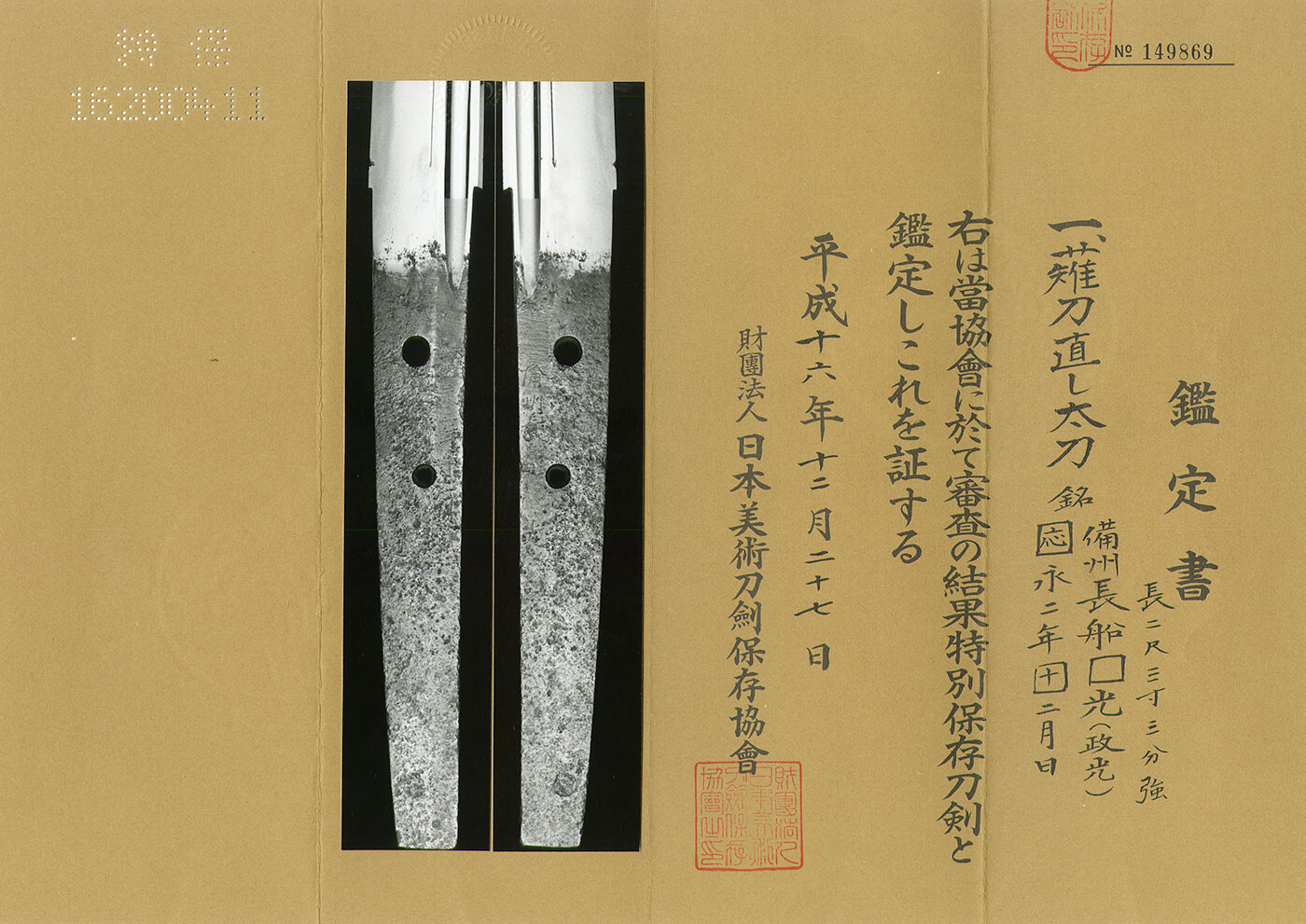
It was just my mishap that I forgot to mention that most commonly the length is added afterwards by NBTHK, depending on if it is currently wakizashi sized or katana sized 薙刀直し刀 薙刀直し脇指 薙刀直し太刀 Now there is also very rare naginata-naoshi-tachi classification. I can actually show an example of this. Unfortunately I don't own any copyrights to the pictures but I don't think I will be eliminated by ninjas even if I post them. This particular blade was one that I was saving up for for over a year but it got sold. Then years later it reappeared on another Japanese dealers site but didn't have a chance to buy it then either. One character of smith is illegible and at first it was judged as tachi by Hidemitsu (秀光) but later revised as naginata-naoshi-tachi by Masamitsu (政光).

-
As I have spent already so much time on this I decided I would look into all naginata-naoshi form descriptions in Jūyō 31 and they are bit all over place. Rai Kunitoshi - Kanmuri-otoshi-zukuri Rai Kunimitsu - Naginata-zukuri Shikkake - Naginata-zukuri Unji - Naginata-zukuri Unji - Naginata-zukuri Unji - Naginata-zukuri Motoshige - Shōbu-zukuri Hōjōji - Shinogi-zukuri Hōjōji - Naginata-naoshi in shōbu-zukuri Nobuhide - Naginata-naoshi-zukuri (the one 1864 dated few posts up) I admit I have never really looked that particular part of Jūyō books as I can visually see the image of the blade and check for myself. However I am extremely disappointed at the naginata-zukuri description. I would have thought they would have written the actual blade form like in some cases. Now to make the continuity a lot worse. I do own very recent Jūyō 68 and 67 books. In 68 den Chōgi - Naginata-naoshi-zukuri Yoshikage - Naginata-naoshi-zukuri Sanemitsu - Naginata-naoshi-zukuri In 67 Hoshō - Naginata-naoshi-zukuri So as you can see NBTHK has changed their terminology over the years, and that does make things bit difficult to evaluate.
-
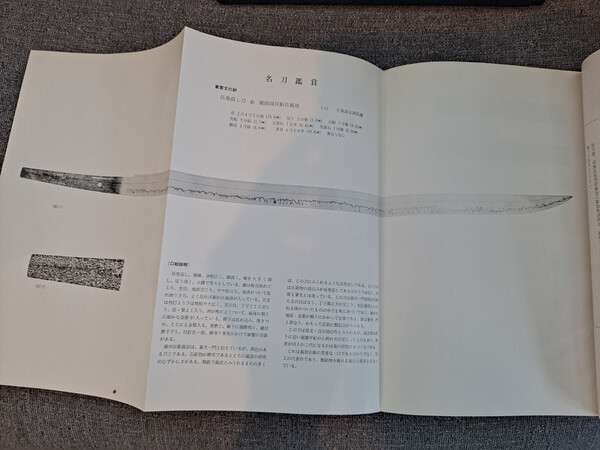
The Yoshikage Jūyō Bunkazai can be found in the cultural database where every Kokuhō and Jūyō Bunkazai item is listed, here is the entry for it: https://kunishitei.bunka.go.jp/heritage/detail/201/6524 I was about to write that it is privately owned in Fukuoka prefecture, however looks like the location has changed since I last looked through every sword in database (maybe 2021-22?). The sword now resides in private collection in Aichi prefecture. For these very famous swords their location can be tracked as in my oldest books it has been owned in Kanagawa prefecture, seems like from there it went to Fukuoka prefecture and now it is in Aichi prefecture. Unfortunately I couldn't find it fast in Aichi Prefecture database for their National level Bunkazai items. Digging through the prefecture and city bunkazai has been bit exhausting as I needed a long pause trying to get through all of the cities. Personally I most often go by Bunkachō designations, I just feel in general as if they would have the most prestige, usually followed by NBTHK. However Bunkachō still classifies this as tachi for some reason, even though it is a shortened former polearm. First two pages are from Shōwa Daimeitō Zufu (昭和大名刀図譜), the Japanese page for the item and the partial English translation from the original bonus translation book. This one is by NBTHK, the sword was feature item of Tōken Bijutsu 213. They see it as nagamaki-naoshi. Of course I think modern NBTHK does not use nagamaki-naoshi for blades as a term anymore. What is very interesting in these NBTHK feature items that you get all the measurements, as you can see the motokasane and sakikasane measurements too, 0,45 to 0,35 cm.


-
I know that people like to take jabs at Jacques as his blunt style can be bit unforgiving, however he knows a lot in general. I admit that I was wrong and like Jacques said NBTHK do indeed use naginata-naoshi even for ubu swords just made in style of real naginata-naoshi. I had previously thought it would be just reserved for actual former polearms. Here is what I would call just katana but NBTHK calls it naginata-naoshi in Jūyō 31. I was trying to find latest reworked polearm as was asked by Michael on the last page. I was doing quick browse of my Jūyō list and thought I hit a quite modern reworked polearm with this Nobuhide that was made in 1863. I was very puzzled as to me this is just an ubu katana, not a former polearm, and in the nakago description NBTHK even just states this for it: 茎 - 生ふ, 先栗尻, 鑢目浅い勝手下り, 目釘孔一, 指表目釘孔から一字上げて, 棟寄りにやや大振りの三字銘があり, 裏は目釘孔から三字上げて, 棟寄りに同じく年紀がある. This terminology thing is bit fundamental problem as there are not that clear guidelines anywhere. Some organizations use some terms while others use other ones. That is one of the reason I personally just use naginata as the general term for all polearm blade types. However various organizations, museums, shrines, temples etc. can use these terms. Naginata - 薙刀 Naginata-naoshi - 薙刀直し Nagamaki - 長巻 Nagamaki-naoshi - 長巻直し Nagatō - 長刀 Ōdachi - 大太刀 Some organizations use some terms almost exclusively for koshirae and some for blades, while other organizations can do both ways. The actual lines for these are at least to me somewhat blurred. Mounting type will of course matter in combination but there are items that do not have original mountings left anymore. So to me it is better not to stress too much. Even though I mentioned the term nagatō I would not think using it is good thing. It is extremely rarely used, I have mostly seen few shrines use that term. As far as NBTHK i regarded I have pretty much only seen them use it in relation to koshirae, and then it seems to me almost interchangeable with nagamaki koshirae. So far I have only seen 1 Tokubetsu Hozon feature this classification on top of my head. Jacques also posted another extremely interesting Yoshikage blade, I will need to write another post about it. I checked and I currently have that particular blade featured in 13 different refences (that is good and bad thing with high level items that they appear in so many places while I would want to uncover new unknown items).