Bruce Pennington
-
Posts
14,022 -
Joined
-
Last visited
-
Days Won
169
Content Type
Profiles
Forums
Events
Store
Downloads
Gallery
Everything posted by Bruce Pennington
-
That's quite a unique habaki! Too bad it's not in better shape. Still would enjoy a clear shot, or two, of it.
-

Mei translation help
Bruce Pennington replied to Richard K's topic in General Nihonto Related Discussion
Richard, I really enjoy my Takayama-to. Short, but surprisingly heavy. I can see how the design would fit Masayoshi Takayama's idea of "One strike, one kill." -
Vincent, The bolt through the tsuka is unusual. Looks like the ito (cloth wrap) around it is worn? Does the wear look old? My first thought was that it was something added later by a collector (and still could be), until I noticed the worn ito around it.
-
Confirming My Translations I
Bruce Pennington replied to George KN's topic in Translation Assistance
Perfect, thanks George! -
Grandpas Other Sword WWII
Bruce Pennington replied to BourbonGuy's topic in Military Swords of Japan
Chris, Any small stamps up above the mei (signature)? No date on the other side, I presume? The file marks are called yasurime. You can see the different styles on this site: Sword Blade Terminology - Japaneseswordindex.com -
Thanks for the update, Joey! Hey, it looks like the saya has the patented, Wakase-made, extended drag. Can you give us a shot of that? You can see a couple variations on this thread:
-
Anything is possible, but we just don't know. The notches often, but not always, match numbers on fittings. But the dots don't do that.
-
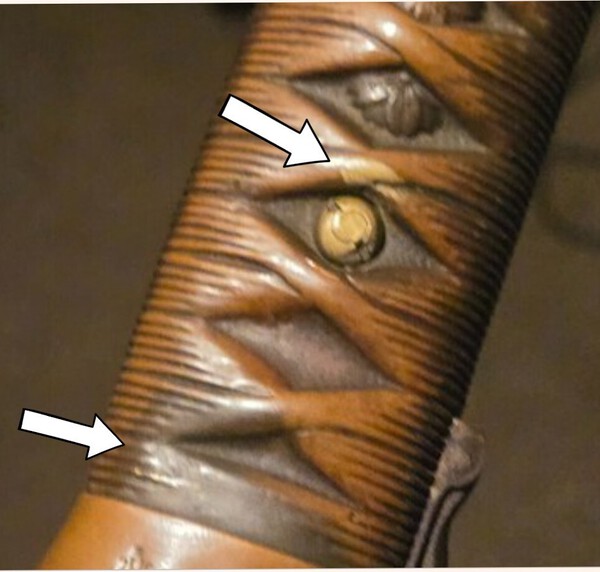
Just noticed this: The brown paint/coating had come off in two places, so it's not copper but a paint. I contemplated that it was a Nagoya sword, but with all the other issues, not to mention that I'm pretty sure Suya Shoten never made blades for Nagoya, I don't think it was a Nagoya.
-
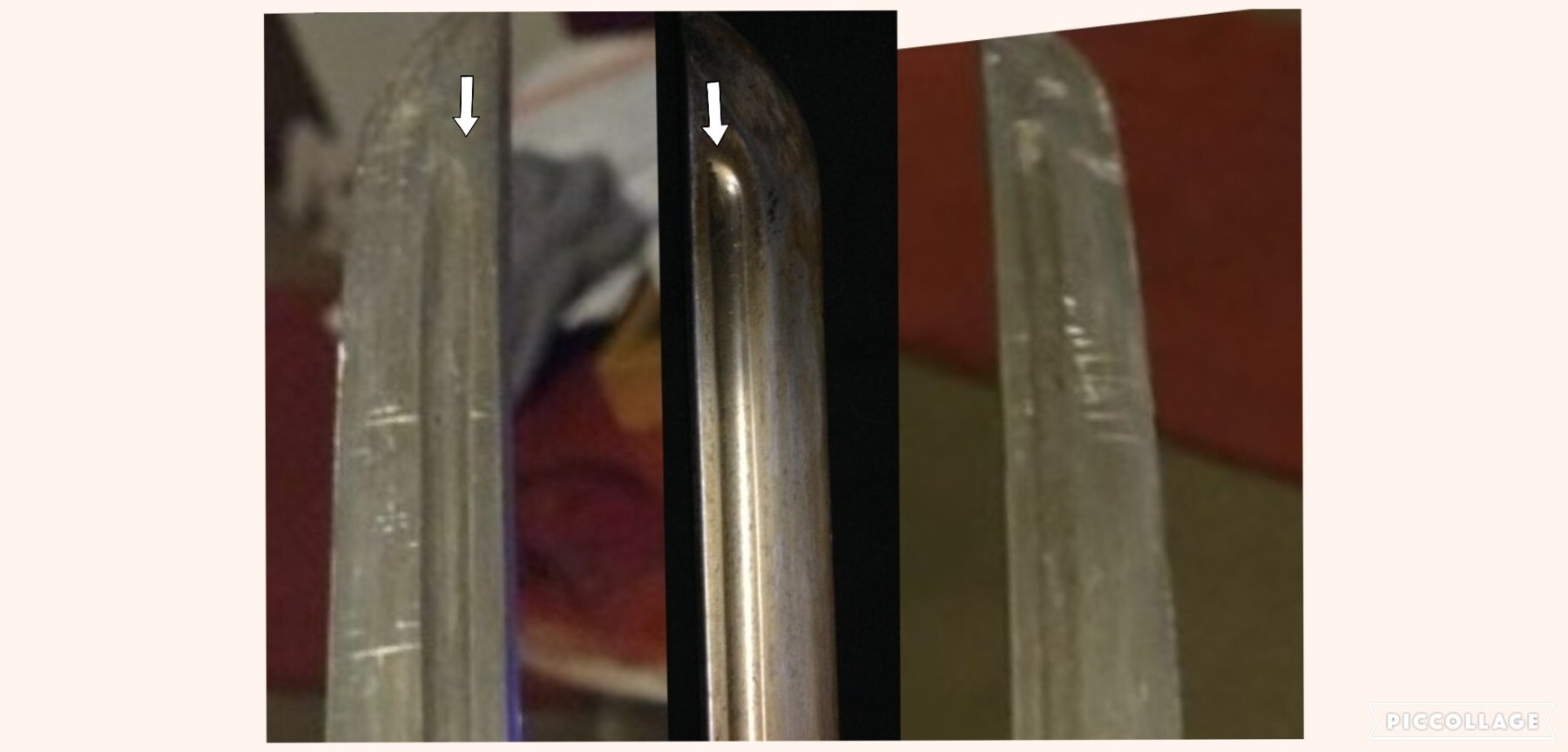
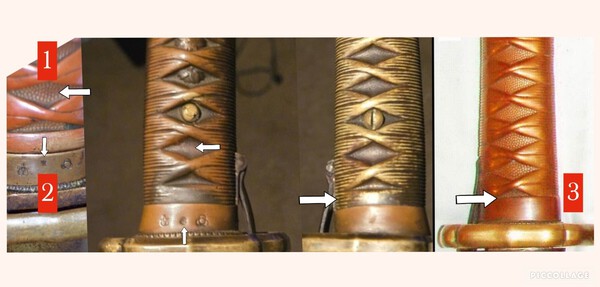
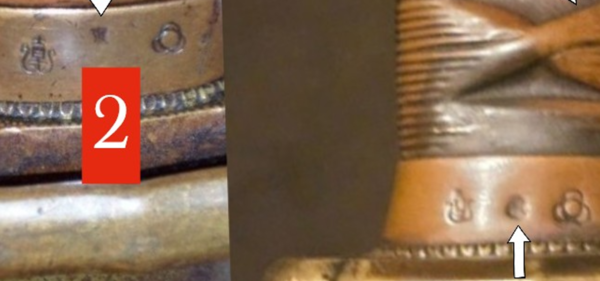
Joseph, I understand the mixed signals you are getting on this one, as many things about it seem legit, yet just as many are off. Maybe you can describe the different colors of the tsuka (handle) from one side to the other? Can you post a shot of the back edge of the tsuka showing the transition of the two colors? The side showing the stamps seems to be realistic copper color, where the other side appears brass. Here are some observations of the things that are off: 1. The dimples in the diamond areas should be distinct, whereas those on your sword are almost not visible. 2. The center inspector stamp on yours seems to be a "Na" of Nagoya, where it should be a "To" of Tokyo. Plus the left stamp, Suya, is close but not accurate. 3. Copper handles had the imitation wrap on the stamped side, but not of the other side, where yours shows the wrap going all the way around the base of the handle. The drag 1. It is a fine distinction, but the curvature of your drag is a bit flat for a Tokyo drag 2. The end of the scabbard is rough, and too curved for a Tokyo 3. The dip in the long edge of the drag is almost not there, compared to a Tokyo edge. The bohi (fuller groove) Hard to see in your photos, but it appears the end of the groove is rounded/tapered. Tokyo bohi end in a point that mirrors the shape of the actual blade tip. All said, I thing this is likely a really well done reproduction. But still curious about the two colors of the handle and how they transition on the edges.


-
Have a number of smiths with dots on nakago, and the number varies over quite a range, but have not found out the purpose of them.
-
Thoughts on authenticity and Mei translation
Bruce Pennington replied to Ronald Aguirre's topic in Translation Assistance
Photos of the fittings are not clear enough to judge, but with the information presented, it appears to be legit. I'm no expert on the blade age, and there are a number of Kuniyasu with that mei, including 2 during WWII. My guess is it's a WWII blade, but I could be wrong on that. -
Opinions about straightening a bent blade (UPDATE)
Bruce Pennington replied to John C's topic in Military Swords of Japan
That's really good news, John! Glad it worked. A little surprised no heat was needed. You got me to searching, because I'm pretty sure someone else was wanting to try this. Could find the one tickling my memory, but found a good one where a Type 95 blade had be straightened. When the moderator situation gets straightened out (ha! pun not intended), I think this should get pinned for future reference. -
Attention Mantetsu Owners: A Survey
Bruce Pennington replied to Bruce Pennington's topic in Military Swords of Japan
Somebody get that serial number! HA! Nice find, Thomas. Does anyone know anything about LtGen Okada? Searches online line have scarce info on him. Looked to have been in mainland Japan jobs mostly. He commanded 2 tank divisions in '42, but none of the job titles I can find say where. -
How to value/rank Showato?
Bruce Pennington replied to George KN's topic in Military Swords of Japan
All five, as listed, seem to fall into the same 'class' of swords assuming they are all equally in the same condition. So, like said already, photos would be necessary for us to pick, Kaigunto, in general, are more "pretty" than army gunto, and more expensive, but the missing ashi takes it down a notch or two. Field grade tassels cost much more, around $500 USD, so that's a plus. As stated already, it would have to be a "what does my gut say?" approach. -
Jumyo
-
Thanks Thomas! They both look to be in late-war fittings, although that kai has an upgraded saya. Can't imagine paying for saya upgrade, yet still having that icky tsuka.
-
Another type 98 showato for review
Bruce Pennington replied to Jimny's topic in Military Swords of Japan
I am out of town for a few weeks, and don't have my books. Maybe someone with a Hawley list can answer about his rating. I haven't intentionally noted which blades were in gunto with mon, but I suspect you will find everything in them. Maybe @PNSSHOGUN has experience with that question. -
Amazing, @Jimny posted a gunto by the exact same smith, today: The stamp was used by the Seki Cutlery Manufacturers Association on inspected/approved showato. It was a civilian organization doing the inspections at the request of area shops and forges to maintain quality blades. "KATSUMASA (勝正), Shōwa (昭和, 1926-1989), Gifu – “Katsumasa” (勝正), real name Kojima Shichi´emon (小島七右衛門), born October 20th 1892, he studied under Kaneyoshi (兼吉), worked as a guntō smith and died September 22nd 1947" Likely no date on the other side, with that large Seki stamp, but most of those were made in 1942, plus or minus a year.
-
Another type 98 showato for review
Bruce Pennington replied to Jimny's topic in Military Swords of Japan
Nice find, Perry! Don't know how much you know about it. Smith was Katsumasa: "KATSUMASA (勝正), Shōwa (昭和, 1926-1989), Gifu – “Katsumasa” (勝正), real name Kojima Shichi´emon (小島七右衛門), born October 20th 1892, he studied under Kaneyoshi (兼吉), worked as a guntō smith and died September 22nd 1947" Likely no date on the other side, with that large Seki stamp, but most of those were made in 1942, plus or minus a year. Faded blue/brown tassel was for Capt's & Lt's. -
Noob with sword needs help
Bruce Pennington replied to 2FixandRepair's topic in Military Swords of Japan
Hi Robert, For clarification, blades with the Showa stamp, like yours, were not "arsenal blades." The stamp was an inspection stamp of the Seki Cutlery Manufacturers Association. The Association began inspecting blades made by the industry at the request of sword makers and sellers. The demand for Japanese blades exploded in the mid 1930s as Japan transitioned away from Western styled swords, back to Japanese, Samurai, styled swords. There were low-quality blades hitting the market and hurting the industry's reputation. So, they approached the Cutlery Association asking them to do Quality Control by inspecting all blades (more likely all non-traditionally made) made in the area. The stamp showed up in 1935, but most blades with the stamp were made in 1940-41. After logging yours into my files, it was surprising to see how many of them were in civilian fittings. I'll run a count to see the percentages, but it seems higher than blades with other stamps. My point being, that they were not "arsenal" blades. The majority were sold to the Army and fitted out that way, but many of these blades were being initially bought by civilians or civil shops, later donated to the war effort and refitted, sometimes with just a leather cover, like yours. On another note, I'm glad to hear you had success recovering the leather cover. I have read many time of guys trying to preserve their leather covers, but had never heard of such success as you've had. The blade does have a temper line, hamon in Japanese. It is the straight pattern called suguha. Here is a care guide: Japanese Sword Care Guide - Japaneseswordindex.com -
This white-painted leather covered Type 98 with white ito, posted by @kanemotows6 here:
-
Dang, Matt! I just realized what I was looking at with that crumbing saya (scabbard). It's a leather cover that was painted white, and even the ito (cloth handle wrap) is white! There are a couple of threads discussing legit WWII swords, often NCO Type 95s, but some officer swords. Read these: Winter Is Coming - White Type 95s Greetings From AZ .... Type 98, white
-
Thanks Matt. That's "NA" "HO"; Na of the Nagoya Army Arsenal that likely processed the blade, then HO of Kokura Army Arsenal that had supervisory authority over them at the time.
-
Oh, and the sword was a Type 98 Japanese officer sword. You can see examples on Ohmura's site here: Army Officer Type 98 - Ohmura Care and cleaning guide: Japanese Sword Care - JSI
-
Matt, In spite of the condition of the fittings, you've likely got a really nice blade there. Sukenobu, from Noshu (Modern day Gifu, If I have that right) and was an RJT rated smith that made blades traditionally. I don't know when he got RJT qualified, maybe @mecox or @vajo might know. Check a litter higher above the smith name to see if there was a star stamped up there. The earliest I have on file from him is Oct '42, so far, with a star.