Bruce Pennington
-
Posts
13,928 -
Joined
-
Last visited
-
Days Won
169
Content Type
Profiles
Forums
Events
Store
Downloads
Gallery
Everything posted by Bruce Pennington
-

Very Unusual "konan Essei" Mantetsu
Bruce Pennington replied to Bruce Pennington's topic in Military Swords of Japan
I don't know John. In the intro page, he says he's sold some of his watch collection, but he didn't mention swords being sold. 208 Japanese swords and 2 dirks!!! -
Very Unusual "konan Essei" Mantetsu
Bruce Pennington replied to Bruce Pennington's topic in Military Swords of Japan
Just got confirmation that the slogan was in use in Japan, culturally. He thinks it was more around 1942. Hopefully the owner will respond to my request for a date and serial number. -
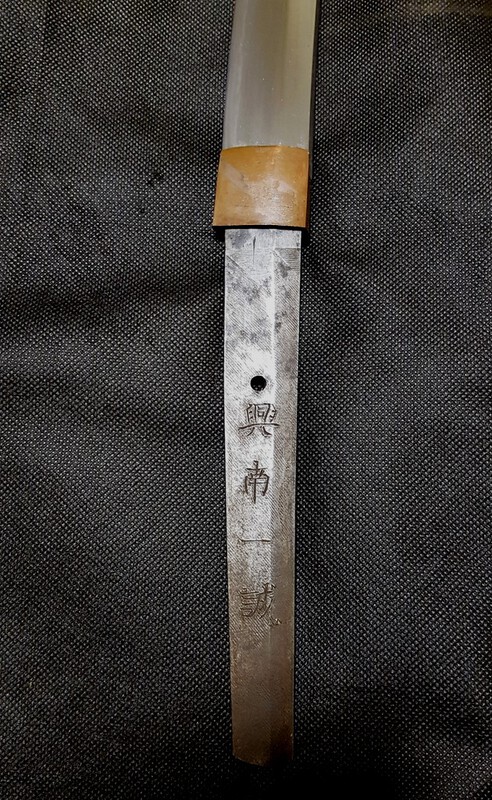
Came across this quite unusual gunto on the Kinghouse.sg, sword collection site. I tried copying the particular page, but the link takes you to page 1 of 27. The sword is on page 7. http://www.kinghouse.sg/collections_frame.asp?cat=8 He claims, and it does appear to be made by Mantetsu, but it simply "Konan Essei" stamped on the nakago (picture attached). According to the collector: "Extremely Rare Mantetsu sword signed "Konan Issei This is an extremely rare blade specially made by Mantetsu, South Manchurian Railway Company for the senior Officers at South Pacific War zone during the last stage of the War in 1945. very few were made and very hard to find. It's so rare that no literature on "Konan Issei" can be found. During 1944 and 1945 the Japanese suffered major reverses in mainland Asia in South Central China and Burma, while the Allies crippled the Japanese Navy and captured key Western Pacific islands. "Konan Issei" swords were created hastily from readily Mantetsu blades in very small quantity at Seki in 1945 at the final phase of WW2 to rush to the senior commanders fighting in the South Pacific War. "Konan Issei" was meant "to win the South Pacific War with determination" a "WAR CRY" to boost the morale of the very weary troops after loss of many battles. To the best of my knowledge, this sword, is so far, the only one with "Konan Issei" inscription that has surfaced unlike other swords made by Mantetsu. The hamon is suguha and except with the wordings" Konan Isshin, otherwise, it's very much a Mantetsu sword" It's the first I've ever heard of this, but it appears legit. He's got 3 other standard Mantetsu Koa's, and I've emailed them for the serial numbers. Hopefully they reply!
-
Interesting point Peter. Even from this standpoint, though, it is the scammers of the world that latch onto these, regardless of their reason to exit, and market them as something other than what they are in order to make a quick buck. Heck, from a pessimistic point of view, even Tibet has scammers in their midst (if there are humans present, there are crooks among them) and who knows what the innocent buyers are being told about those product! Maybe they are being sold as "WWII Japanese ....".
-
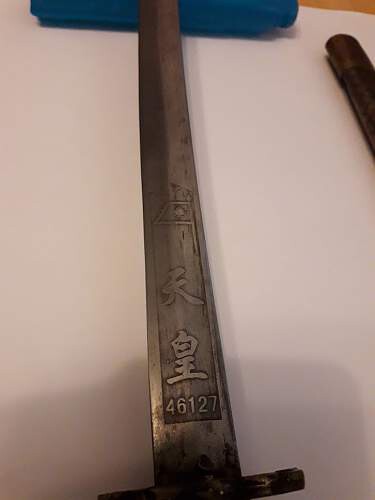
Interesting read on a Warrelics thread about a commonly seen style of fake sword. Guy and Nick go into the accurately written Japanese, and that a slogan normally wishing good fortune in war is rearranged to wish for continued war (against the Japanese!). The kanji and serial number on the blades are all identical as if stenciled and etched, and are obviously made by the same shop. http://www.warrelics.eu/forum/Japanese-militaria/help-fake-sword-712996-2/


-
Has a “Gifu” stamp, so showato.
-
Attention Mantetsu Owners: A Survey
Bruce Pennington replied to Bruce Pennington's topic in Military Swords of Japan
Excellent one Mark! Thanks a lot! -
Interesting. I just came across another post on Warrelics of another fake sword with the same blade etchings and serial number. Clearly a different sword with different koshirae, but obviously the same blade maker using maybe a template for the blade etchings.


-
Attention Mantetsu Owners: A Survey
Bruce Pennington replied to Bruce Pennington's topic in Military Swords of Japan
Many thanks to Jon (PNSSHOGUN), for a great link that had 4 Mantetsu for sale ( Japanese site, double USA prices). One of them had the assembly numbers matching the seppa, stamped on the nakago! “278” “W”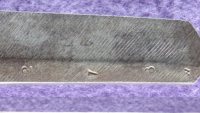
-
Thanks John! That put me at 73 Mantetsu blades on the list! (I found 3, and DRDave found 1 more, so if there are more than 4 let me know).
-
The sword shortage began early as Japan realized the need to reject the cavalry styled blades and return to the samurai style. There were at least 2 big government efforts, 1938 and 1942, but I suspect it was throughout the war. Here is a section of Nick Komiya’s discussion of it on Warrelics: The 1942 program that relates to that leaflet is strictly an army program, managed under the Chief of Army Weapons HQ and evolved from the earlier 1938 program which was indeed a army/navy joint program. This appraisal organization was established on 19th February by Army Regular Ordinance 990. It was a program supported by the local Veterans Association as well as the Taiseiyokusankai Political Party. Municipalities would announce the dates and venues of the appraisal sessions and the army sent its appraisers to do preliminary screening. Only the swords that passed this screening were sent further to the HQ of the Officer Gunto Appraisal Committee 将校軍刀監査委員会 for a full screening to determine a fair price. Owners of swords that passed got a notice of appraised value through their local municipal office and the money was remitted by the Gunjinkaikan. Those swords were polished and set into proper new Koshirae and sold to Army officers. Yes, the maximum blade quality for this program was 500 Yen, which meant that they would sell at much higher prices than the Rinjiseishiki specials. If there were swords that got dropped in the second appraisal, they got returned to owners with detailed explanations as to why. The program only required the blades, but owners who wished to sell the swords complete with Koshirae was paid for the Koshirae as well. “I just checked the original army/navy joint buy-up program rules announced in the fall of 1938 and discovered that the blade length criteria of minimum 54.5 cm was already in effect from that time. The 1942 rules are more streamlined and easier for the public to follow and contribute, but otherwise it is the same program, just without the involvement of the navy. Last edited by nick komiya; 12-23-2017 at 01:59 PM.” The thread is here: http://www.warrelics.eu/forum/Japanese-militaria/family-short-blades-gunto-688110/
-
Attention Mantetsu Owners: A Survey
Bruce Pennington replied to Bruce Pennington's topic in Military Swords of Japan
I see, but it still doesn’t jive with the claims that the factory was cranking out 400 blades per month. -
Attention Mantetsu Owners: A Survey
Bruce Pennington replied to Bruce Pennington's topic in Military Swords of Japan
Stephen, my FB is shut down for a while. Do you think you could ask the guy for the full date and serial number? -
I have recently seen 2 different Mantetsu gunto being sold on Japanese websites. Both were (forgive me if I'm using the wrong term) officially registered and had papers. I've seen Type 95s being sold as well. Does anyone know if something new has changed regarding showato in Japan? Here's a link to one. I can't remember where I saw the other. http://www.Japanese-sword-katana.jp/katana/1710-1042.htm
-
Attention Mantetsu Owners: A Survey
Bruce Pennington replied to Bruce Pennington's topic in Military Swords of Japan
A quick update on the tabulations. I've added tracking for seasons on the dates - Spring, Summer, Autumn, and Winter. Amazingly, out of 70 blades, 60 are "Spring"!!! I have NO speculation as to the reason. More than half of the years are in the '41-'43 range (44 of them). One might expect that as the USA entered the war Dec '41. Blades made before that could have a higher chance of serving in China/Asia and ending up in Chinese hands. Still puzzled by the total absence of '45 blades. I greatly appreciate the tips coming in from you guys on blades I haven't seen yet! Updated charts attached. Mantetsu Serial Numbers.docx -
Didier, I assume by "army gunto" you mean wartime showato? as opposed to an old blade retr-fitted for army use? Because gunto simply means "army sword" (gun - army; to - sword), so any blade, old or new, fitted for army use would be called a gunto.
-
First Japanese Sword 1883 Navel Sword
Bruce Pennington replied to Martin P's topic in Military Swords of Japan
That's quite gorgeous Martin! Seems custom made. Dawson points out that there was a multitude of variations of this model. What is that on the guard, that I circled? Is it a stamp or just a smudge? If stamp - is it something you can clean so we can see what it is? Grant, didn't the Germans stamp their blades with "Solengen" or something similar?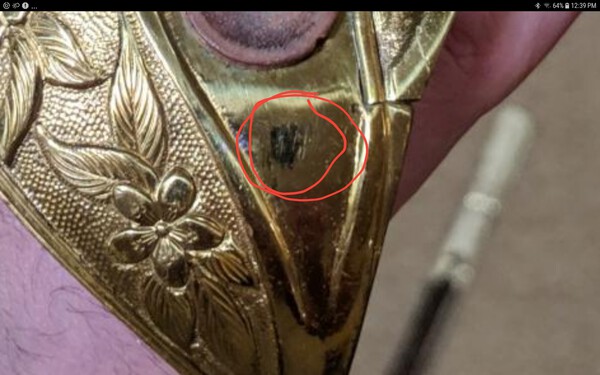
-
Yes “shingunto”. But their effort truly was a “sin!”
-
Could Anyone Identify This Signature Please
Bruce Pennington replied to matthew's topic in Military Swords of Japan
Bingo! Nice work Ray! -
The serial numbers in the blade are a sure mark of a fake. Without the numbers and kanji on the blade, they might have tried to pass it off as an island sword.
-
Could Anyone Identify This Signature Please
Bruce Pennington replied to matthew's topic in Military Swords of Japan
Right side up: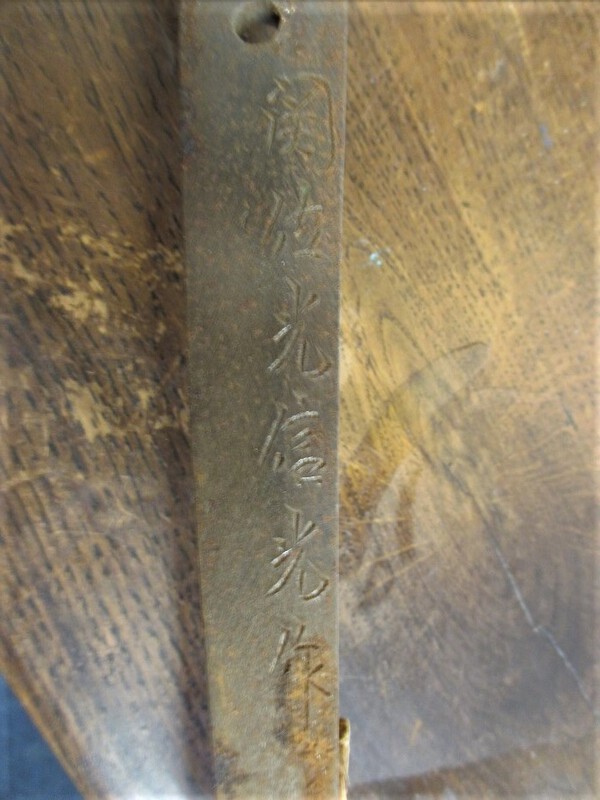
-
Great example. Hey am I seeing black same’ on that army Guntō?
-
You might be referring to the painted on assembly numbers? Not uncommon. My theory is that contract swords bought directly from a sword shop wouldn’t have those numbers. The painted ones are likely from the Arsenal factories and larger companies that cranked out larger numbers at a time. Just speculation though.
-
And after all that, it's not signed! Well, standard Type 98 WWII gunto. The officer obviously paid for the sharkskin upgraded tsuka, but it's odd that the seppa are seemingly plain (though, someone, post-war, may have stripped them). Closeups of the blade and hamon (temper line) would confirm whether oil quenched showato, but it probably is. Decent pattern, though.
-
Tom, After seeing everything in better focus, I agree with Steve that this gunto probably had a full leather cover originally. I couldn't comprehend them missing ashi (suspension ring). They don't come off. But if this were covered in leather, the ashi for that style are different and probably did slip off once the leather cover went missing. I wouldn't call this "late-war" at all. It could have been made at any point in the war. I don't know if I'm communicating clearly about the mekugi peg. It comes completely out of the handle. Sometimes they are fatter on one end (the end inside the handle) and must be pushed out that way. Sometimes, and yours seems to be one, the mekugi is short, and inserted at an angle. These can be fussy to get out, as you might have to poke a toothpic or something pointy in the open hole to guide the peg out as you push it from the other side. It's an important step to most of us collectors because the smith name, and sometimes a date, are stamped on the tang (nakago).