Bruce Pennington
-
Posts
14,510 -
Joined
-
Last visited
-
Days Won
175
Content Type
Profiles
Forums
Events
Store
Downloads
Gallery
Everything posted by Bruce Pennington
-

Rain in the Face with samurai sword???
Bruce Pennington replied to Peter Bleed's topic in General Nihonto Related Discussion
YES! I remember that! Very fascinating article! Sorry I forgot that it was you who wrote, dude! -
The Mysterious W stamp Officers sword
Bruce Pennington replied to Pippo's topic in Military Swords of Japan
We're pretty settled on the fact that it is a double chevron, or yamagata, used by the Army indicating a "halfway or midway" inspection. It would be "M" from this chart (we thank Thomas, aka Kiipu, for this!)
-
Here's something you don't see everyday! A kyugunto from the Russo-Japanese war! Posted by Delibes on this Warrelics thread.
-
Show us your nice Gendai blades
Bruce Pennington replied to IJASWORDS's topic in Military Swords of Japan
Thanks Steve! So 1879. @Kiipu - is it possible that this is a traditional sword then? And how about the smith name? -
Show us your nice Gendai blades
Bruce Pennington replied to IJASWORDS's topic in Military Swords of Japan
Will someone translate please? The date is strange looking, and appears to be Showa 30, which would be 1955 -
Rain in the Face with samurai sword???
Bruce Pennington replied to Peter Bleed's topic in General Nihonto Related Discussion
Posting the pic for posterity. I can't see it as a Japanese sword, Peter. Completely straight. Looks more like a cane sword, or a cavalry sword? There is an older post, which I cannot find, discussing Japanese swords in the Old West owned by Native American Indians, though.
-
Help with sword surrender tag please
Bruce Pennington replied to Pippo's topic in Translation Assistance
I second that request, @Pippo! Wow! This seems to answer the age-old question as to whether there were private swords re-fitted for the navy! I have seen old blades re-fitted in fully standard kaigunto koshirae, but I don't recall seeing one in it's civil fittings with the wartime leather covered saya. -
need translation help on mei
Bruce Pennington replied to texanmarauder's topic in Translation Assistance
No. They made blades a variety of ways all throughout the war, and there was no known law or order requiring stamping. The military took control of sword production late-'41 to early '42 and we see a huge increase in arsenal inspector stamps after that. Prior, the Seki Cutlery Manufacturers Association was inspecting blades for quality and would stamp those that passed. -
Show us your nice Gendai blades
Bruce Pennington replied to IJASWORDS's topic in Military Swords of Japan
Left-facing sauwastika: " In Hinduism, the right-facing symbol (clockwise) (卐) is called swastika, symbolizing surya ("sun"), prosperity and good luck, while the left-facing symbol (counter-clockwise) (卍) is called sauwastika, symbolising night or tantric aspects of Kali.[1] In Jain symbolism, it represents Suparshvanatha – the seventh of 24 Tirthankaras (spiritual teachers and saviours), while in Buddhist symbolism it represents the auspicious footprints of the Buddha." -
The Mysterious W stamp Officers sword
Bruce Pennington replied to Pippo's topic in Military Swords of Japan
Thanks @Pippo, I still track them. I have one other zoheito with the W/M stamp on file. Can you post a photo of the number please? -
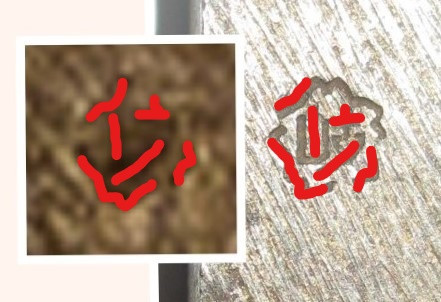
John, I'm with the other guys on this, in that it's most likely an older blade brought to the war. I my knowledge, arsenals didn't stamp older blades. "Hi" was used by the Mantetsu operation, but I don't know of an arsenal that used it. These marks are likely from the original smith. I have seen all sorts of marks on blade nakago mune of old blades, some pretty elaborate! I suspect your original thought about the top item being "Dai" is likely correct. The intent of the bottom mark is obscured enough by time and pock-marks that we may not be able to decipher it. Here's what I see as possible marks:


-
John, I admit, many inspector stamps are poorly struck, but with this mark, I can't see how it would be a "Na". Here's the Na:

-
Arsenal Mark on RJT sword Fittings
Bruce Pennington replied to george trotter's topic in Military Swords of Japan
This may be true, but it's a little messy with the Yamagami brothers, Akimitsu and Munetoshi being from Niigata. Their blades have the circled Matsu and are dated from Feb '42 (松 542) with 2 blades earlier (no dates available, but likely Aug/Sep '41). My earliest Nagano blades are dated Feb '43. As Niigata sits geographically right on top of Nagano, maybe the Army started the system with the Yamagami brothers in Niigata, as a trial, or the Nagano brothers invented the system, and the Army absconded with it (like they did with the Seki stamp!) and launched their use of it in Nagano?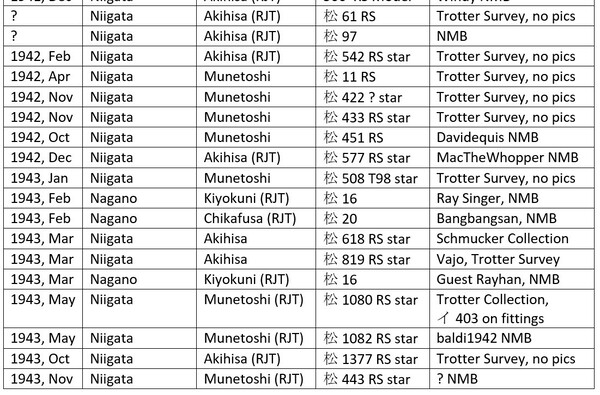
-
Hi, Like Jean said, please update your profile with a real first name. The blade is stamped with the "Gifu" stamp, which I believe was used by the Seki Cutlery Manufacturers Asssociation after the Nagoya Arsenal inpectors absconded with their Seki stamp. It signifies that the blade passed their inspection for quality. Currently, the source material is conflicting as to whether it signifies a non-traditionally made blade, so have to go by the blade, itself, for that determination. Non-traditionally made Rinji seishiki (type 3; type 100; type 44; etc), like you said are going for a variety of prices. A reasonable range is $900-1,200 USD. Start high and take offers!
-
WW2 Japanese sword (Fukumoto AMAHIDE)
Bruce Pennington replied to Swords's topic in General Nihonto Related Discussion
No one knows why some blades were hotstamped and some were not. As to this blade, I'm a REALLY bad guy to make such judgements, but I'd say it was at least oil-quenched by the dark areas inside the peaks of each 'tooth'. Clearly, a lot of quality workmanship by beauty of the blade, but probably non-traditionally made. -
need translation help on mei
Bruce Pennington replied to texanmarauder's topic in Translation Assistance
Hi John! These blades went through a lot from the war and the years after the war. Hard to know the causes of such stains. Your saya (scabbard) originally would have had a leather cover. They quite often are missing. You can find guys that do re-wraps for tsuka (handles) with a search on NMB. Any small stamps or numbers on the nakago (tang)? -
3 NMB pages of multiple discussions about Komonjo here.
-
WW2 Japanese sword (Fukumoto AMAHIDE)
Bruce Pennington replied to Swords's topic in General Nihonto Related Discussion
Steve, The hotstamp is of his forge/shop. It is also found on blades of the other smiths that worked for him - Kanemune, Kunimoto, Hidetoshi, and Masafusa. It is a personalized variant of one used by the Shinshinto era Amahide (Masahide). Discussed on page 33 of the Stamps of the Japanese Sword document, and in Mal Cox's article Ichimonji Minamoto Amahide. As to the Mantetsu discussion, histories of the SMR operation tell that they invented a completely new process of sword making and used the Manchurian steel from their own mines. While anything else is possible, there is no actual evidence or documentation that backs up such speculation. -
Arsenal Mark on RJT sword Fittings
Bruce Pennington replied to george trotter's topic in Military Swords of Japan
Nagamitsu - So, since his numbers are on the mune, on non-star blades, and the kana don't match his prefecture, I'm thinking his numbering system is separate from the prefecture-based numbering of the other blades. Munehide - do you have a picture that shows the number and star? I cannot make either of them out from the yahoo photo. Edit: I see the serial number on the paper; but what about the star? -
Arsenal Mark on RJT sword Fittings
Bruce Pennington replied to george trotter's topic in Military Swords of Japan
Thanks for the new numbered blades Thomas. But now we have a problem. The only blades I've recorded so far with the "イ" are Nagamitsu blades. I had mistakenly recorded him as an Osaka smith, because previous discussions of him called him an Osaka Arsenal smith. But I see that he, Ichihara Nagamitsu, was from Okayama prefecture. Now, we have a "イ" numbered blade from a smith from Ibaraki prefecture! Okayama MIGHT have been under Osaka Arsenal control, but Ibaraki definitely was not. And in either case, the kana with numbers have been tied to specific prefectures up to now, not arsenals. Any idea what we are seeing here, or are we going to have to log these two down as currently "Unknown" as to why we now have 2 completely seperate prefectures using the same kana? Or, is it possible, @george trotter @mecox, that Nagamitsu worked for some time in the Ibaraki prefecture? PS: I must add that all 3 Nagamitsu numbers were on the nakago mune, not on the face of the nakago. This might mean that the Nagamitsu numbers were not prefecture specific? -
Can we get some opinions from our translators @SteveM @Kiipu @BANGBANGSAN ? Looks more like a "6 7" to me, but he horizontal stroke is missing if the second mark is a 7. The dai or Tai stamp I'm aware of has a hexagon around it. @John C - On most blades, the hash marks correspond to numbers stamped on the fittings. This would be Roman numeral "4", so does your blade come with fittings? If so, is there a "4" on the seppa and tsuba?
-
Emergency Issue ww2 Katana (Tang Stamp ID?)
Bruce Pennington replied to AlphaRaider's topic in Military Swords of Japan
Got a chance to meet Jonathan recently. A fine young man with a new appetite for Japanese swords! Let's all feed his burgeoning addiction! Ha! I also got the honor of examining this sword. It's not a fake. Nice weight to it. Visible yakote and suguha hamon. The mune of the blade tip has the standard flair-out (I think there's a word for that). Yet, the machi are slightly offset, like with see on Chinese fakes. So, I think this was made in China, during the occupation, either for a Japanese soldier, or for forces working with the Japanese. I know we discussed this on the previous thread, but I wanted to add my in-hand observations for the record. -
Chris, We are no longer certain the presence of the Showa and Seki stamps are signs of showato. So it is possible the blades are gendaito. As always, the blade must tell the story. Interesting note on the Kaneshige blades with Kobuse stamp - I have 5 on file now, and the 3 showing koshirae are all civil mounts! Interesting item!
-
The banana cutter is steel, but the next 2 are pierced brass.
-
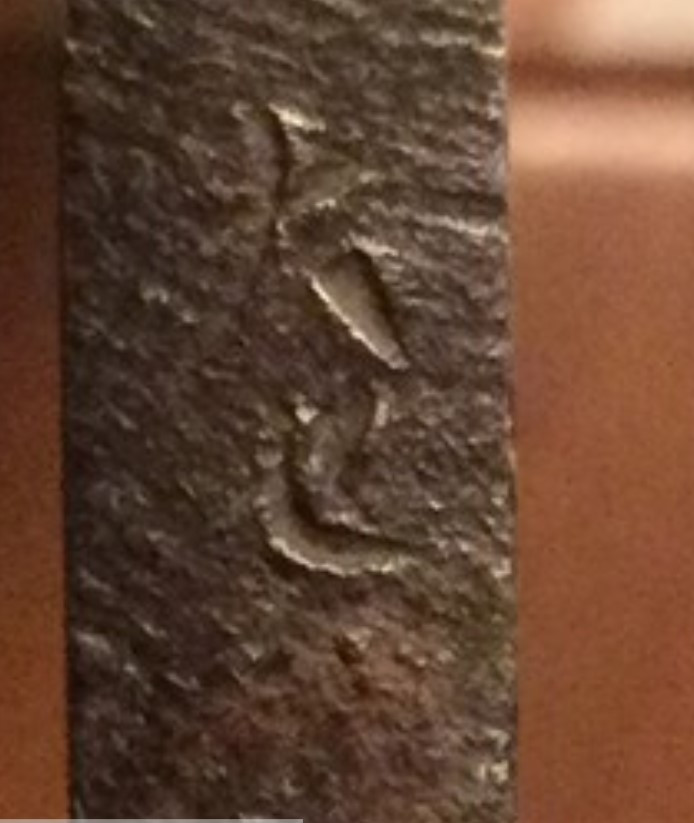
Partially and poorly struck stamps can really play tricks on us. I know I've been down a couple of rabbit holes with some! Many of the Gifu stamps I have on file are really poorly struck. Seems symptomatic of their inspectors, for some reason. Here's how I see it: