Mantis dude
-
Posts
340 -
Joined
-
Last visited
Content Type
Profiles
Forums
Events
Store
Downloads
Gallery
Everything posted by Mantis dude
-
John, Well ok we didn't solve it (I was hoping to tackle world peace after this) but the black color is a tip so some clue has emerged. Thanks.
-
John et al, Following this line of thought, I held 4 tsuba together that I have. I see the black on one papered choshu tsuba. It is black. I am not so sure that this is black, it seems more brown and is papered to Hagi (one of Choshu's sub groups)- my tsuba #35. It is a very light and delicate piece. My tsuba 47 is brown but might have some condition issues so the color may have been affected by the life its lived. I always considered it Choshu based on the one above and some other similar guards I have seen labeled as choshu. Would you disagree? My tsuba #13 which has traveled around the world to get to me was sold as Choshu- (from my tsuba page narrative), a knowledgeable collector said this was a prime Choshu example but others have said Bushu. It is brown also. Wish I had a papered piece to Bushu to compare- any comments? If you want to read details on the tsuba go to my tsuba page http://www.freewebs.com/kamakiriken/tsubaupload.htm Would be nice to get to the bottom of this bushu/choshu assignment debate! Thanks. Ken
-
I remember reading once that choshu was more apt to be the same on both sides and bushu is likely to be different on either side (I think I got that right). However, not sure I have actually seen that in actual application. Can't remember where I read that, but throwing that out there. Perhaps, saying if it is the same on both sides indicates Choshu.
-
Rich, It is funny you say that, since I went through all those schools saying "that could fit" or I saw a similar piece in a book. I have 2 definite mainline line Akasaka and a few other most likely school work and the metal didn't seem to match so I eliminated that school. I guess that is where handling hundreds of each school comes in handy? (missing that part). It did start to make me crazy, wait that looks like it too, next page wait that is also similar..lol.....Well going to enjoy my Sunday, enjoy!
-
Hey John, I appreciate your thoughts (right or wrong). I wish I was better with color and perhaps could say more about it although, I think the picture isnt too far off. I want to say it has a purplish look. It seems to be a heavy guard. I want to go koshoami but once again that "it is better than it is mentality" takes over. I have a shoami sukashi papered piece and this steel seems much darker in color and better all around. There is something about opening up a tsuba that has just arrived and it seems some of the better pieces just have a better feel to them. I just get that impression. I will have to just bring it to a person live one day. Either way, it is an unique piece and nice addition to my collection. I have been really lucky these past few months and have added some good pieces overall, maybe one day I will actually be able afford them! Thanks again all the best.
-
Hi all, Picked up this fuchi off ebay. I like the design of it and is a bit different from what I normally see. To my surprise it was actually signed and I must admit that there is something very satisfying about translating a signature. It translated to Iwamoto KonKan with Kao. The next part was to try and determine if gimei or not and after seeing some signature's out there I think it is a gimei. It was interesting to learn that this artist is considered to be one of the top kinko guys and therefore one of the most forged smiths out there. One of the nice things is that even if a gimei you still learn about the supposed to smith and his skill level, etc. So therefore, it is still a good learning experience. So the piece is gimei, however, does the piece still fit the style of the school? Any opinions? Thanks.
-
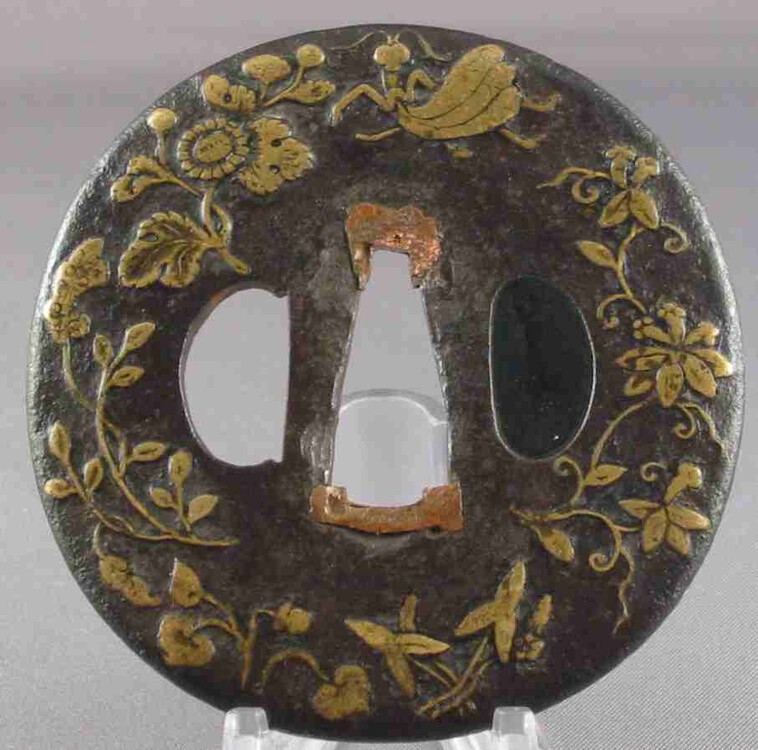
Hey All, I did a bunch of looking and the more I saw the more I thought heianjo fit. Nan, if you do some reading you will find out that both techniques were utilized by heianjo. I get this "can this be too good to be true feeling" sometimes and start thinking a piece is more than it is, etc. So John, I appreciate you comments. It is nice to gets some confirmation on what you think you are seing. The overall design/layout fits with the school from what I saw as well as the flowers/leaves are very alike to other pieces I saw in some books. I came across some pieces very similar but with a squirrel instead of the mantis. I have one tsuba that is papered to heianjo (tsuba 48) but it has a different feel and look to it. I have one other piece and the layout is not that different but it is a late edo copy. It was pointed out, go back to the plate, many of these late shiirimono type knockoffs have this glassy look on the tsuba plate. Hopefully, you can see the differences from the pics. But this last piece plate doesn't have that glassy plate look like the one aboe. It was nice to have a few to compare. This tsuba was also tsuba #65 for the collection, I always like assigning milestones numbers to a piece. It is fun to have my collection grow. Thanks for the comments.
-
Hi all, Another one I need help kantai. It is a nice dark iron color. 6mmX 78×77mm . Possibly Shoami? another guess maybe toso myochin? Age guesses? Seems decent. Any other guesses or info for it? Do these look like bones to you guys on the rim? Thanks. Ken
-
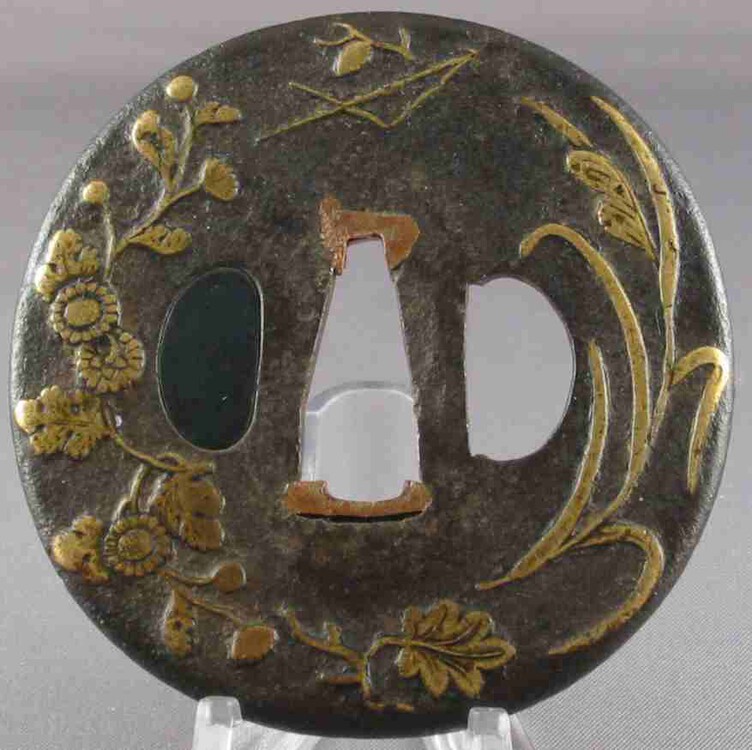
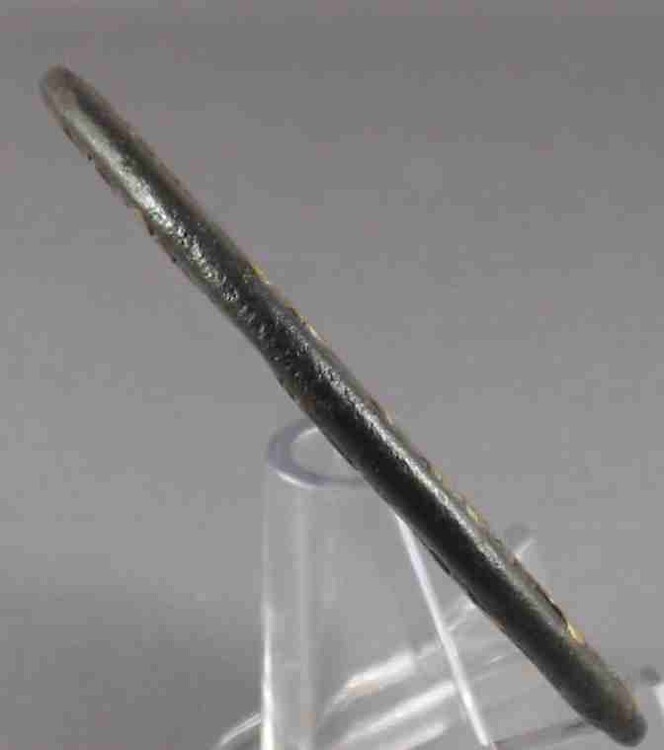
Hi all, Picked this tsuba up among a few others, just want to confirm it is likely Heianjo. 4mm X 70.5×73mm. Plus if anyone can put a time frame to it would be nice. thanks. Ken
-
Thank you so much for the help. I always wondered what the book was so when I saw a similar one for sale I had to know. Your help is most appreciated.
-
Curran, There are certain tsuba that just stand out a bit more than others and I must say I like this one even if it is missing the most important ingredient (a mantis). Interesting results, glad you went for it. I think the general statements are just the reflection that it is really hard to nail down fittings and they are being cautious. The pendulum swings I am sure and it has swung to conservative. It may take market forces like you just expressed, not sending anymore. Maybe for them to realize people want more information will take a reduction in submissions to wake up the judges to the peoples wants. Than again, these are guesses, albeit educated guesses and I don't blame them for being conservative with stamping their name on it. Congrats anyway.
-
Hey all, I have this book, can someone tell me what it is etc, http://page13.auctions.yahoo.co.jp/jp/auction/r42615991 It just so happens I saw the auction of the same book. It has tons of pictures of swords. Thanks for your help. Ken
-
Have to share this story. My next door neighbor that I grew up next (good friend of my parents), told me that he had a friend who was selling his father's collection of samurai sword items. He said he was taken to the display and given a tour (izzard's shop I assume). He said he picked up a catalog for me. It was the Mosle collection. 2 days beforehand I had ordered the catalog. If only I had known before hand perhaps I could have had a shot at the mantis pieces that were for sale. I guess the kids couldn't agree on what to do with the remaining collection and decided to sell it. So close to getting the inside track and plus the prices quoted where not in the low end range it seemed. Everytime I see my ex neighbor I think back to what if. Just had to share that.
-
With so many fittings available, I would also vote for preservation. It may take a bit longer to find the right item but better that than ruining or altering an older piece. Enjoy spring!!!!
-
I know why I have seen it- They are repro'd (not saying yours is) just that it is a common repro style. I am sure there is a legend attached to it. http://cgi.ebay.com/Japanese-Sword-Menu ... 240%3A1318
-
I would say that you hit upon an important part of looking at tsuba, cutting corners is a major activity and quite frankly what happens on most of the tsuba in our hands. These metals were expensive and if you compare real top work with mediocre, it is very likely that instead of using all shakudo, a piece may be iron with shakudo overlaid or gold overlaid instead of solid gold, etc. even in the base metals, sometimes you will find a tsuba where there is a middle layer that isn't the high cost metal. Mito, Nara, and Aizu shoami are hard and I still struggle with them. However, the technique of Aizu shoami I think could be as good as those they are copying, but the base plate is the difference. At least that is what I think based on a few tsuba I have where the mantis execution are dead on for each other, it goes to the plate and that is the difference. Still, looking at base metals and seeing if corners were cut - so to speak is a definite area to evaluate a piece. Even Early Mino pieces can be made of copper and colored black to simulate shakudo. Menuki may be a base metal that looks like shakudo but isn't. I don't have an eye for all of that but that is one are I hope to approve upon. Looking at real quality pieces can be a real help in that and learning what the real quality inputs are versus the mediocre items. Would be nice to have a teacher and collection to see these differences.
-
Menuki comparison/ help with translation
Mantis dude replied to Mantis dude's topic in Translation Assistance
I have to laugh Marcus, I have noticed that in general nihonto collectors seem to be pretty exact individuals. Translating Japanese text is an adventure that I don't think I would ever undertake but I do sort of enjoy trying which surprises me. Although I admit I enjoy more the translation of a signature on a tang than text. All help is appreciated and I hope to remember this for the next time. All the best. Ken -
Menuki comparison/ help with translation
Mantis dude replied to Mantis dude's topic in Translation Assistance
Thanks Guys! I appreciate the help and it helps fill in some info on my menuki set. Interesting that that set was papered, so I assume mine would also, not that I need or want to submit. I have the info I need. All the best. Ken -
compare catalog tsuba/Need some translation help on tsuba
Mantis dude replied to Mantis dude's topic in Tosogu
Thanks, I am familar with that chinese legend (wouldn't be the mantis dude if not). Thanks for the help. Good to know about kofu really means edo, I should have known that but don't think I ever heard that before. It states it is a shoami piece so I will assume that my piece is as well? Reasonable assumption assuming the catalog is correct. it was still neat to find a piece so similar. I appreciate the help. all the best. Ken -
Hi all, Found a similar set of menuki in some old sales catalogs to a pair of menuki I already have. I tried to translate but didn't get much other than menuki mumei Kyogingushi (not exactly sure what that means or if I got it even correct). It says autumn insects but after that I don't read kanji. Can someone tell me what it says. Would be great to be able to fill in some details on the menuki. thanks.
-
Hi all, I recently acquired this tsuba, from what I can read it is says kofu ju mitsusada. I can't find this smith anywhere. I might add that is needs some patination restore and has been in my pocket a week now. I was going through some old catalogs that I purchased as reference and I found a very similar piece. The tsuba when overlaid on the catalog is almost exact except for the leg position and a few minor things like that (matches extremely well, the catalog pics are obviously real size). I can translate a little I can read tsuba mumei shoami. 1. can anyone comment on the mei 2. help translate what the catalog says about the pictured piece. I hope there is some good reference material to extrapolate to my piece. Thanks
-
The seller is claiming umetada? Any one see that? I am debating whether going for it as well. Just to share some similar examples you can see tsuba #20 and #22 on my website http://www.freewebs.com/kamakiriken/tsubaupload.htm. There are a little better descriptions there. #22 is papered to shoami by the NBTHK This one doesn't have papers but is close I need to reshoot some of these pictures. Another project for the website, redo not so good pics.
-
Actually, I am not sure if they are a match, it is posted on my website under fuchi kashira, I actually wrote, - "Here is a nice Fuchi Kashira with mantis and plants done in shakudo and gold. Not sure they are a match fuchi is nanako and kashira is more isheme, a bit of a size difference too but the gold band on the edge look alike." So I agree with those observations. Just reading Hayne's Index of Japanese sword fittings & assoc. artisits... There is a kozuka ... the piece is marked: Sankodo josui, the granddaughter of Kamo, after a picture by Okyo. It also mentions a tsuba in Mosle that is not done in Murakami school style. So lots of questions to be researched but an interesting aside, the fact it maybe done by a women in of itself is something different. Curious how a women artist would have been viewed in those times? Any comments to that statement even how were women perceived in any of the arts vs. Men. Sort of a side issue from the validity of this piece but still both are of interest to me. Thanks for the continuing input.
-
Markus thank you! That is always the next question, is it real or not! Will be nice to research this a bit more. Interesting though that the artist is a female. I remeber reading that women did work om fittings, I think they were tasked with doing a lot of nanako? But I assume that is fairly uncommon for them to be signing artists? Always nice to learn something new. Off to try and find a bit more info. Thanks again.
-
Hi All, I hope everyone is doing well and enjoying the new year. I have had this fuchi/kashira for several months now but forgot that I needed help in translating. Here is just a pic of them The signature Thanks.