


Geraint
-
Posts
3,123 -
Joined
-
Last visited
-
Days Won
10
Content Type
Profiles
Forums
Events
Store
Downloads
Gallery
Everything posted by Geraint
-
Dear Steff. If you are trying this then you definitely need this book that Jussi recommended, https://www.amazon.co.uk/Art-Tsukamaki-Pocket-Thomas-Buck/dp/1505226147/ref=sr_1_1?keywords=The+art+of+Tsukamaki&qid=1578928345&sr=8-1 Lots of really useful practical advice and clear diagrams. The author is the person who runs the website that Ed suggested. Look forward to seeing some of your work. All the best.
-
Dear Steve. Here's one. The sword Kenny has is a civilian handachi koshirae and a rather nice one at that. It has resemblances to a kaigunto koshirae because they were based on tachi koshirae but it is most definitely not a kaigunto hence the observation that the kaigunto seppa and tsuba combination would look out of place as it will never be anything but kaigunto. An exact parallel would be sticking shingunto tsaba and seppa on a civilian katana, The extra seppa would certainly take up the space though. Good thread on handachi here, http://www.militaria.co.za/nmb/topic/6503-literal-meaning-of-handachi-applied-to-sword-koshirae/ Good place to have a look to get some ideas Kenny. All the best

-
Dear Kenny. I hater to disagree with Steve but I think a Kaigunto tsuba and seppa, the set on the Ebay link, would always look like what they are and would ruin this koshirae. You don't need anything flashy, how about something like this one? https://www.aoijapan.com/tsuba-mumeiunsigned/ Bear in mind the overall size of the tsuba as you look, generally larger tsuba for larger swords and too big a tsuba would look a little odd on yours. All the best with your hunt.
-
Wow Peter! They are both really nice but I'm in love with the butterfly! All the best.
-
Dear Ken. Late to the party but to answer some of your questions...... I don't think your sword was ever wrapped but it would have had menuki, I think I can see a pale shadow on one image just above the reluctant mekugi where one would have been. I would add my vote to the pre 1600 camp though be aware that age alone, while fascinating is not a guarantee of quality. I think we expect this sword to have been shortened which in part may account for the rather straighter blade than you are used to. We always enjoy the possibilities when a sword like this pops out of the woodwork. Chuck's advice about attempting to remove the mekugi is great, there is one more possibility which is that it is in the form of two sleeves that are a friction fit in each other, really worth having someone who knows what they are doing take a look. As to what you paid for it, well I can hear the sound of a lot of people banging their heads on the table and muttering, "75 Euro, 75 Euro, why don't I ever find anything like that!" Enjoy! All the best.
-
Dear Kenny. There is hope here. I have attached a picture of a very similar handachi wakizashi of mine which has two pairs of seppa. It is quite possible that your sword had the same originally. Tachi often have more than one set of seppa and shingunto and kaigunto mimic this with up to four sets of seppa, some of which are sometimes quite thick, so it is quite reasonable for a handachi to follow this pattern. If you find a tsuba that you like it is a relatively simple matter to make some seppa or have some made to take up the slack. Hope this helps.
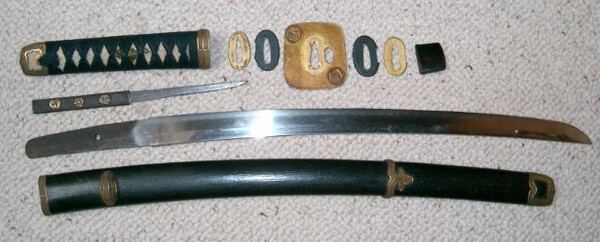
-
Dear Neil. I agree with Ed, Hoshu Takada ju Fujiwara Yukinaga. Compare here, https://www.aoijapan.net/katana-hoshu-takada-ju-fujiwara-yukinaga/ Can we see more of the sword please? All the best.
-
Information in the research of two swords that I have recently purchased.
Geraint replied to CaptainMac's topic in Nihonto
Dear Jim. It is not unheard of to have a daisho with both blades in wakizashi size, one just under katana size and one rather smaller, though in this case I think Steve's excellent analysis suggests that this pair were only associated rather recently. We look forward to seeing more pictures when they arrive. All the best. -
And if you listen carefully you can hear the sound of Mitsuhiro rolling in his grave. All the best.
-
RARE HIDDEN COMPARTMENT FOUND
Geraint replied to Tom Darling's topic in General Nihonto Related Discussion
Dear Wah. if yo have not yet delved into https://www.nihonto.com/ then here are a couple of taster's for you. https://www.nihonto.com/tanto-for-the-yoshiwara/ https://www.nihonto.com/tanto-for-the-yoshiwara/ The whole site is really worth exploring. More usually sen is a hollow slide accessed from the mouth of the saya into which a few coins could be slipped.. All the best. -
Dear Neil. You are well within reach of a number of members in the North of England, just waiting for one of them to chime in. An in hand conversation is what you need. All the paperwork should stay with the sword, I see no reason to doubt it's association with the history of the blade though the attribution will always remain problematic. Ray's assessment is to be trusted at this stage so go slow and find out more. All the best.
-
Dear Steve. This refers to the 2nd Division in the British Army, the letter may have been written by the Captain about the sword but not necessarily his own sword. All the best.
-
Dear Seth. If you have not already found it compare here, https://www.aoijapan.net/katana-echigo-kuni-mitsuoki/ As others have said this is a very nice sword to own, especially as it is an inheritance from your grandfather. Do you have any more of the story of how he acquired the sword? All the best.
-
Dear Rich. Just to add, the pierced tsuba is a nice touch and I wonder if the saya (scabbard) is lacquered wood or the usual metal variety? A light tap with a pencil should tell you, you can check with a magnet also. (Instrument maker by trade?) All the best.
-
Tanto New find needed help and opinion.
Geraint replied to Jacob1968's topic in Translation Assistance
Dear Jakub. Nothing funny, if there is a date it will usually be on the other side of the nakago, (tang). All the best. -
Dear _________(Insert name here). Please add your name to your posts as per the rules. With just this to go on your task is almost impossible, so many smiths signed as Yoshihiro. We can be fairly safe in ruling out the earlier ones as this form of sword is not produced in the earlier periods. A shot of the whole blade flat on rather than sloping away will help get the period from the overall shape, add some dimensions and we might get close to a time frame. You can probably rule out Bizen and Mihara smiths because of the nakagojiri. Nice niju habaki and don't worry about the stains, just surface rust. All the best.
-
Dear Robert. While the advice to do some study is sound I do not think this tanto is worthless. Have a check around bonji horimono for the blade carvings. I take it you have no images of the bare blade or of the tang? Given the mon on the saya and on the apparently silver foil habaki I would be inclined to investigate further. I do think is is Japanese and while probably late I think it is genuine. It is probably not of great value so an awful lot depends on how much you are being asked for. If you can get bare blade photographs and tang then that would help us provide more information. All the best.
-
Dear All. As a follow up to this thread Russell did get in contact with Paul who arranged for a meet up between Russell and I to look at the sword in hand. At Russell’s suggestion here is an update for those of you who are interested. The sword is in civil koshirae with a fairly basic set of mounts, gunto menuki and a tachi form tsuba and o seppa of fairly low quality. The koiguchi has gone astray but a kodzuka slot which has been filled can be seen. The combat cover is stitched tight over the civil saya with the horn kurikata still in place. The good news is that the blade is in fairly good shape in spite of some adventures. What I feared might be rust pitting in the kisssaki and monouchi from Russell’s very good images turned out to be impacted muck, most of which was easily removed leaving some superficial damage. Quite a bit of the original polish remains though with some staining and as far as can be seen it is still in a very healthy state with no evident flaws. The blade is quite substantial, has shallow sori and tapering to a chu kissaki, the hamon has yakidashi and becomes a billowing gunome midare with lots of nie to be seen, the boshi is healthy and intact, the nakago is in generally good condition. I only have one shoshin mei example but comparison between the mei on the sword and this example reveals some significant differences and so at this stage we are assuming that it is gimei. I think we would both welcome any additional shoshin mei if you have them to support or even better contradict what we have so far. Something of a disappointment but none the less it is a very nice sword. We discussed restoration and I hope that if Russell goes ahead with that he will show us the end result. I am delighted that it will stay with the family as an important part of their history and be cared for in the future. All the best.
-
Dear RJ. Please add your name as we all do. John is clearly right, have a look at some of the swords here to start to learn to spot the difference, https://www.aoijapan.com/ There are many other sites in the links art the top of the page. I hope you didn't have too much invested in this one but don't let it put you off, lurk here and learn, have a look at some of the items in the For Sale section, buy a few books and enjoy. All the best.
-
Dear Steff. This is a long term project you are on, another source of basic information is here, https://www.japaneseswordindex.com/tsuba/tsubaid.htm Explore the other pages a little. I'm pretty visual in my learning so I find that good auction catalogues are also useful, if you can get to London then do go to the viewings for some of the sales, that way you get a chance to handle pieces in number and of some quality. Enjoy! All the best.
-
Well, as I was the one who asked for pictures of the koshirae and we seem to be stuck in a debate about the blade let me add some thoughts. Adrian's most recent picture of the stamped mark on the seppa adds to my doubts. I think the lack of quality on these fittings, the very poor fit between component parts and the overall lack of crispness suggests reproduction. I suggest that this is a made up confection though I do think the blade is a Showato. The plugged mekugi ana was the original and the blade was subsequently modified to turn it into what it is now. I have what used to be called in the UK a, "flashy tachi", one made for the enthronement and even though it has the usual silver plated mounts it is well made and original, this one as a whole is not. I don't know how long it has been together but I would guess just a few years at most, just long enough for the mild steel plug in the mekugi ana to discolour slightly. Whether this was put together with intention to deceive or just because someone really wanted a tachi and couldn't afford one we will never know. Did the auction house know what they were doing? Very hard to say in my experience, very few have enough knowledge to describe Japanese swords accurately and, let's face it, their description of this one is hardly detailed. Adrian, I am very sorry that this has happened to you, this is a great hobby and I would hate to think that this would put you off it altogether. I do hope the auction house do the honourable thing here and refund you. All the best.
-
Dear Ken. Just a typo I think, it should be the Ashmolean not the Asmolean. Try this one. http://jameelcentre.ashmolean.org/collection/8/new All the best.
-
Dear Stef. Can I add to the suggestions with this, http://www.shibuiswords.com/ A great deal of information and some lovely examples. All the best.
-
Hi Stef. Nice find, as Piers says Higo koshirae. With some TLC this could be an attractive tanto. The end of the saya is something that one does come across but it is unusual. Look forward to seeing what the nakago is like. Please forgive me if I am stating the obvious but the mekugi looks as if it is horn and should push out from the side where the kodzuka would go. It should be possible to find the pieces you are missing as the gold nunome on iron is fairly typical for this style of fitting, a pair of menuki which do not need to match and a rebind and it should look grand. All the best.
-
Jumanji Yari - Kunishige or Kunihiro
Geraint replied to Rollingthunder's topic in Other Japanese Arts
Dear Carlos. Quite clearly this is signed Kunishige, I am at a loss to explain why the auction house are sticking to their erroneous conclusion except to say that very few auctioneers are sufficiently educated with regard to Japanese items and rely on an "expert" who they call on from time to time. If you bought it for 350 you did well but bear in mind that polishing these is not easy and getting someone to take on the task will be a little difficult. However I would have been happy to have a jumonji yari by this smith and would have dismissed the description without worrying about it. All the best


