mecox
-
Posts
925 -
Joined
-
Last visited
-
Days Won
15
Content Type
Profiles
Forums
Events
Store
Downloads
Gallery
Everything posted by mecox
-
Need help authenticating whether this blade is of value.
mecox replied to VoidedAbyss's topic in Nihonto
Jan is correct, but 亮信 in this case is read as Sukenobu not Akinobu. Family name is Toki. There were two brothers Sukenobu and Kanemasa making swords in WW2. Family background and examples here: -
Translation assistance on Type 98 acquisition and approx date
mecox replied to Eds's topic in Translation Assistance
This is 23rd generation Fujiwara Kanefusa. More info here: -
Shinoda Hiroshi Ujifusa 篠田 寛 氏房 UJI 11 UJI 25 Ujifusa was born 20 May, 1912 (Meiji 45) in Seki, and was trained by Kato Jumyo 加藤 寿命, who was from the Watanabe Kanenaga 兼永 school. Ujifusa was producing swords in the early-1930’s and in particular with the increased demands in 1937 after the Japanese invasion of China. More info and examples here on NMB Downloads:
-
Trapdoor Gunto info please?
mecox replied to Jason the Danish Greek's topic in Military Swords of Japan
Certainly been refurbished and some refitted. But a lot of the parts don't look to fit well. Certainly repainted saya and tsuba poorly rebound. The silver foil habaki also looks out of place. Yes waiting to see the nakago. -
@KiipuThomas, the pics and discussion are largely about shin gunto koshirae and the number of seppa, e.g. 3 or 4 pairs as opposed to 2 pairs. The 4 pairs look to be described as the classic for old tachi, and the 3 pairs on expensive gunto koshirae. The pic of newspaper at end shows article in "Rikugun Shikan Gakko" military school paper of Showa 19 (1944) that is basically saying the more seppa on luxury koshirae are not practical. This last item is a very "flowery" discussion of the topic.... "Joto" (expensive) fittings of 6 seppa...when new around the tsuba fitting not too tight or too loose (fitted with looseness of a fine hair) and this is usually for 2 pieces, but with 6 pieces it will become loose ("gata gata"). Also compared with 2 pieces the 6 pieces are out of balance.
- 1 reply
-
- 2
-

-

-
Legit EBay Katana? WW2
mecox replied to New2Collecting's topic in Auctions and Online Sales or Sellers
hello, how are you? mei reads Shige Saburo Sukeharu. 茂三郎助春 Is a kaigunto naval koshirae. Probably an arsenal smith and not common name or work. Looks to be a genuine WW2 Japanese sword but is very poor condition. Not sure why the handle wrap has exposed wood....has wrap moved up the tsuka? The tsuba and seppa are unusual however, and officers tassel in good condition. If you search for "sukeharu" there is another on this site in Feb 2022 必勝 茂三郎助治 Hisshō Shigesaburō Sukeharu -
Thanks Thomas, very helpful. But of course the more exciting thing is that the SUMO Haru Basho starts tonight in Osaka !!
-
@KiipuThomas, thanks for this extra. What I found of interest was the bottom line (translation by wife slightly different) 全国刀匠中ノ上位ニ在ル者 Zenkoku tōshō chu-no-jōi ni aru-mono. National Swordsmith Middle-Ranked Persons. But this shows "rank" of these tosho. I will compare this to the 1942 Banzuke of Kurihara.
-
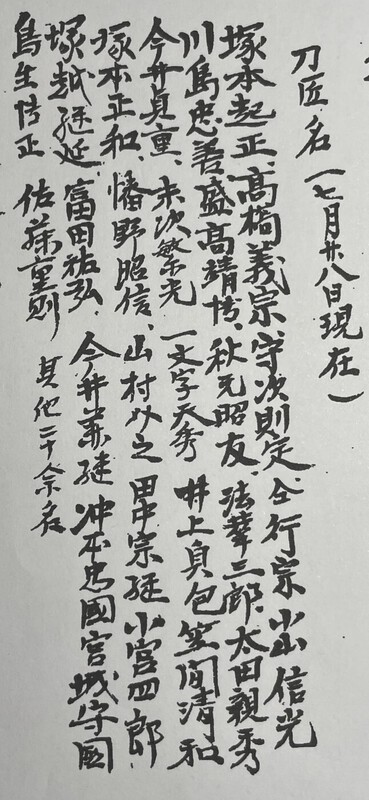
@k moritaMorita san, also please note I did not correctly "link" my earlier post. It should have been linked to: Mal, I thought you might enjoy reading this post by Nick Komiya. 1941 IJA Weapons Prices in today's values, Post #14 Source document can be found at the link below. 全国現代刀匠作刀日本刀展覧会開催の件 Any assistance with translation greatly appreciated, as some of these names are difficult.
-
Thank you for this additional information, I was not aware of it.
-
I used the wrong link for item below......it should be Thomas' post: Mal, I thought you might enjoy reading this post by Nick Komiya. 1941 IJA Weapons Prices in today's values, Post #14 Source document can be found at the link below. 全国現代刀匠作刀日本刀展覧会開催の件 I found this mail from Thomas and the original from Nick Komiya very interesting, especially the list of 27 swordsmiths invited to display swords in July 1942. Seems to be a selection of better tosho of the time, so I tried to translate and identify. Got most of them but we got stuck of some. Any assistance / correction is most welcome.
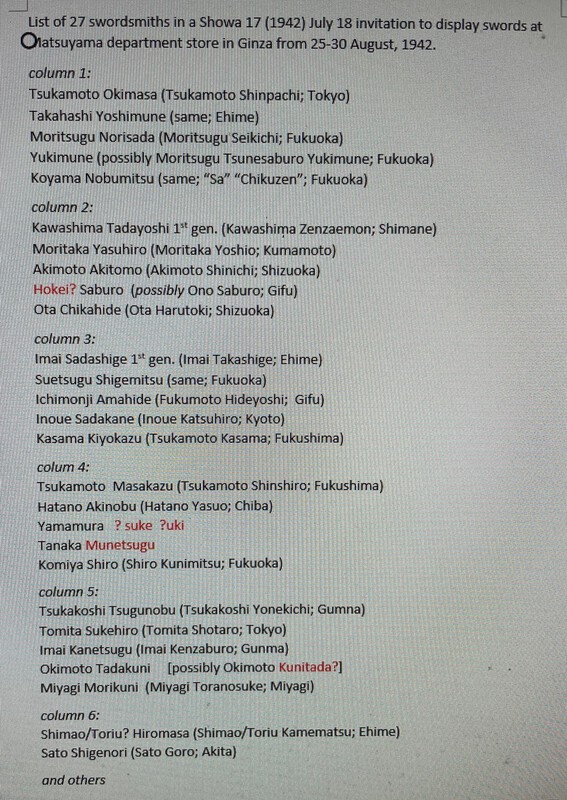
-
Isao Machii split a stone
mecox replied to DoTanuki yokai's topic in General Nihonto Related Discussion
I agree with Bruce and also Colin earlier. Difficult to say what the rock is, but it does look like a fine grain sedimentary rock with a prominent bedding plane, that he hit on the top (we don't see that view). The colour, texture and the dull sound of the sword strike suggest maybe a chalky (carbonate) material (Colins comment). Also the rock mass appears to be weathered, which can also produce a clay mineral content. Certainly if it was an igneous rock like granite it would be a completely different story...maybe with a broken blade. But the whole exercise seems pointless......be of some value if the details of the blade were known and some before/after pics. -
Yes very interesting, you could buy gunto and other swords at many locations including in major department store (dated 1942).
-
Rough 1945 battlefield-pickup sword - thoughts
mecox replied to Nelson's topic in Military Swords of Japan
yeah its not definite from pic. Scratch it and see. I also note that the close up of the saya lacquer shows it is thick plus has a pattern....not cheap war work, also has kurikata slot. -
Rough 1945 battlefield-pickup sword - thoughts
mecox replied to Nelson's topic in Military Swords of Japan
Nelson, need to take handle off to see the nakago (tang) to get a better idea of sword. You should be able to remove the wooden pin, then see if you can hold blade (carefully) with thick towel and tap down on tsuba (not menuki) with piece of wood. (do it over a bench). See if it gets loose. The "fuchi" is a post war addition...does not look to be pinned. Based on shape of blade, visible hamon and the habaki this could be an old blade. -
Folks, not sure of the relevance, but some odd things: nakago has 2 mekugi ana, tsuba has 2 holes for clip and looks like one seppa (3 up) has "35" not "25". Maybe these are original ?? Also: in the last pic of the fuchi with the "Roman numerals" is that a strip of copper inside it ? for fitting? plus in pic 1 of the underside of fuchi both nakago hole and clip hole have been altered (enlarged).
-
KANEOTO (兼音), real name Fujii Otoji (藤井音二), born Taisho 10 (1921) October 8, from Seki. He registered as a Seki swordsmith on Showa 17 (1942) April 9 (age around 20) living at Nagasumi-cho. In a 1942 ranking of 400 smiths was Ryōkō no Retsu (7th level of 7), and worked as a Rikugun Jumei Tōshō (maybe from 1943). He trained under well known smith Kojima Kanemichi (who had over 15 students in early war) but as young he looks to have had limited production.
-
OK but "Showato" blades were produced from at least 1939. My observations are that many of the Showato (blades) in these koshirae are better made ones (such as Jason's above), as opposed to late war quickies. Plus there is much evidence on the large numbers of sword stores and suppliers of gunto to officers, with a very wide selection of koshirae type, extras and blades....and this ranged from basic "budget" models to high end very expensive.
-
Translation assistance Type 98 and approx date-has inspection stamp
mecox replied to Eds's topic in Translation Assistance
Masahiro, Hattori Kazuichi (正廣 服部 一市) (Also 正弘). Kazuichi was born 30 July, 1907 (Meiji 40); he registered as a Seki tosho 25 August, 1942 (S17.8.25). More about him and other examples in NMB download: -
I would have thought same period as tsuka items, which to me are earlier. But just my thoughts, maybe early-mid war?
-
John, I have always considered these type of "nanako" punched design kodogu with the leather covered wood saya and leather strap, were budget koshirae made over a longer period, but particularly earlier in war. Largely based on the blades in them. Thoughts?
-
Jason and Kevin, your blade is "Noshu Osugi Ju Nagamura Kiyonobu Saku". The example shown by Kevin looks to be same sword as Slough page 85 with Tan stamp. His name was Nagamura Matsuichi and he was born Meiji 34 (1901) April 10. Registered as a Seki smith Showa 16 (19410 April 30 (just turned 40) and was living in Kamo-gun, Tahara-mura, Osugi. he became a Rikugun Jumei Tosho.
-
OK looks like a theme of childrens toys. I wonder if theme is repeated on reverse.
-
Hi Bruno, never found a name, but I believe they are students (of the tosho) at the Seki Token Corp. Interesting they have army caps.
-
Yes a "rattle drum" or denden taiko, but not sure of fish and is the other a fishing rod?