John A Stuart
-
Posts
8,372 -
Joined
-
Last visited
-
Days Won
20
Content Type
Profiles
Forums
Events
Store
Downloads
Gallery
Everything posted by John A Stuart
-
Hi Can Utkan, These are my thoughts. Where I live feels like the dark side of the moon sometimes so I can empathise with your situation. Shipping your sword to have it looked at before committing yourself is a very good idea. Firstly, can you trust your postal system? Can it safely return into your country? Secondly, you have to trust the person to whom you are sending your sword and trust his opinion. Thirdly, investigate 1 and 2 until you are sure that your sword is safe, and do not hurry. Your sword has a specific value, aprox. $2000 to $3000 in good condition. Do you see investing $3000 for a polish? Never mind what you can sell it for, do you value it enough to put out that much money. Personally I do not care about the value, I do what makes me happy and what I can afford of course. Some other collector may appreciate it a couple of hundred years from now. Just a thought. Luck. John
-
Hi All, This reference to price made me wonder. I have seen reference made about arming a soldier in various arena. A common way of relating cost of arming a knight, European and Japanese has been, to be fully accoutered, equal to the value of a village. This would be the chevalier or mounted samurai. The foot soldier and ashigaru etc. considerably less. How does the price of high quality tsuba avg. $10,000 relate to prices the samurai had to pay for top of the line tsuba? My thought is that we get them, in relative terms, cheaper. We can get tsuba for a couple of days wages and the big boys for a months pay, is this equivalent? I don't think so. John
-
Hi All, I was doing a quick look see for info on the 'Hizen no Kuni Ju Nobuyoshi' mei in the preceeding post and came upon something that surprised me. Amongst the Nobuyoshi cited in the Swordsmith Database was a smith that signed 'Nobuyoshi Saku' and as 'California no Kuni Nobuyoshi'. This is a fellow who went to Japan in 1938 and died in 1997 that became a Showa era smith. Real name Keith Austen. I found this amazing and quite a surprise. John
-
Hi Ford, Nice craftsmanship. Would be your journeyman piece, what? John
-
How do togishi make the colour difference when polishing
John A Stuart replied to kusunokimasahige's topic in Nihonto
Hi KM, Like all women they lose their looks over time depending on how they are treated. Yes, that is true but it is fairly robust as far as I've heard and should outlast us. John -
How do togishi make the colour difference when polishing
John A Stuart replied to kusunokimasahige's topic in Nihonto
Hi KM, Moses has an excellent site for polishing info, and he mentions nugui which is what you are refering to I think. John http://www.nihontoantiques.com/polishing%20index.htm The lines are made by the burnishing needle. J -
Hi Richard, If you wanted to buy only one book that touched on the important basics of nihonto I would recommend 'The Connoisseurs Book of Japanese Swords' by Nagayama. Also a reasonable price. John
-
Opinion on a WWII Type 98 Japanese Shin-gunto
John A Stuart replied to Syberz's topic in Auctions and Online Sales or Sellers
Hi Syberz, Crapola. Not even a good attempt to steal hard earned money. John -
Hi Mark, Looks like a kataochi gunome mixed with suguba or a saka choji midare with suguba. Long gaps between. John
-
If the kogatana was put in the kozuka using matsuyani glue then just heating it to about waters boiling temp. should loosen it to be removed. If just jammed it should pull out. If some other way was used it could be problematic. John see the following http://www.johnstuart.biz/new_page_22.htm
-
Hi Ruslan, Looks like it was a fairly nice piece. The patina seems to have been worn/washed off. If you can repatinate it it might be worth a go. John PS, Not knowing how the silver blade was installed I can't say how to remove it. If the pelican fellow can tell you it might be possible to suss it out. J
-
Hi All, Probably an amazing amount of work even if the info can be retrieved from the mists of time. I've run into it occasionally within the text of other docs. What had made me wonder was that on another forum a fellow had started posting just that for the Tokyo area. I found it very interesting. I share it now for those interested. John Ueno There was a mansion of Todo Takatora. His territory was Iga-Ueno han.(Current Ueno-city, Mie prefecture) Ueno was named after his home town. Ryogoku Named after Ryogoku bridge. Ryogoku bridge connect Musashi no kuni and Shimousa no kuni. Sumida river was the border. Ryogoku means both kuni(countries Kioi-cho There were mansions of KIshu Tokugawa clan Owari Tokugawa clan Ii clan. Ginza There was a silver coin foundry. Gin means silver. Shinjuku Shin means new, juku(shuku) means like station. In 1698, New station town was built there. It used to be called Naito Shinjuku because there was Naito clan's mansion(Shinshu, Takato-han). Current Shinjuku Gyoen Park was where the mansion was. Hyakunin-cho Hyakunin means 100 people, cho means town. Edo Bakufu formed arquebus corps to guard Bakufu. The corps were named Hyakuningumi. Hyakunin-cho was where Iga-Hyakuningumi lived. Hanzoumon is so named because it used to be the location of the gate to Hattori Hanzou's estates. Roppongi Roppongi means 6 trees. There were 6 clans' mansions. Their names are all related to tree. Aoki Ichiyanagi Uesugi Katagiri Kutsuki Takagi Yuraku-cho There used to be the residence of Oda Nobunaga's brothern Oda Nagamasu. His another name was "Oda Urakusai" 有楽斎 Uraku and Yuraku are same letters. He was founder of Uraku Ryu Tea ceremony.
-
Hi Taioson, It is possible but highly unlikely. Most artisans had their own particular part in the whole procedure. Sword forged by the smith, polished by the togishi, koshirae made by the sayashi with fittings by other metalworkers etc. A lot of times original matching fittings may have been damaged or been lost and then been replaced over hundreds of years. John
-
Hi Jeremy, The only way to determine how well a blade cuts is cut with it, just as Carlo says. There are so many factors that need to be taken in to account and niku is just one. The point that was being made before relates to the polishing not the forging, and that is traditional polishing lends itself to having some amount of niku because of the way the stones are shaped. Some swords will have more or less niku but all will have some and that could be traced back to the forging of the sword as to the larger degree of niku in some cases. High shinogi, low shinogi, hirazukuri and kasane. John
-
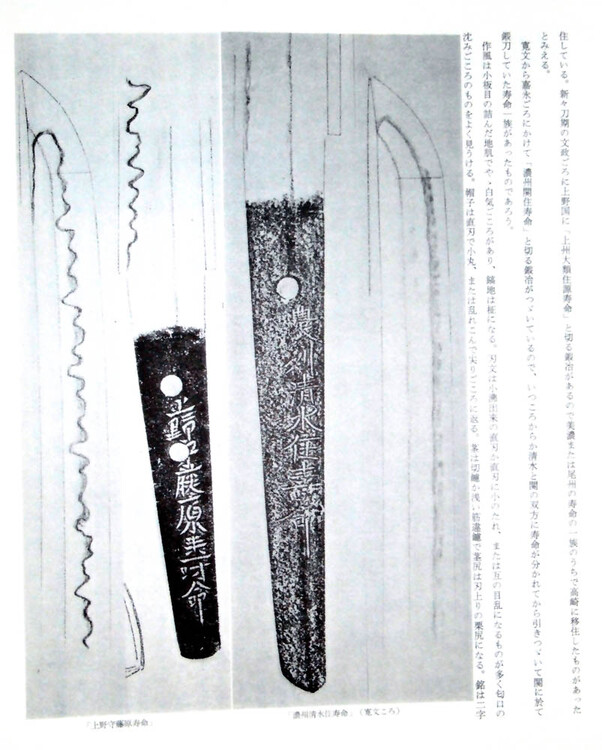
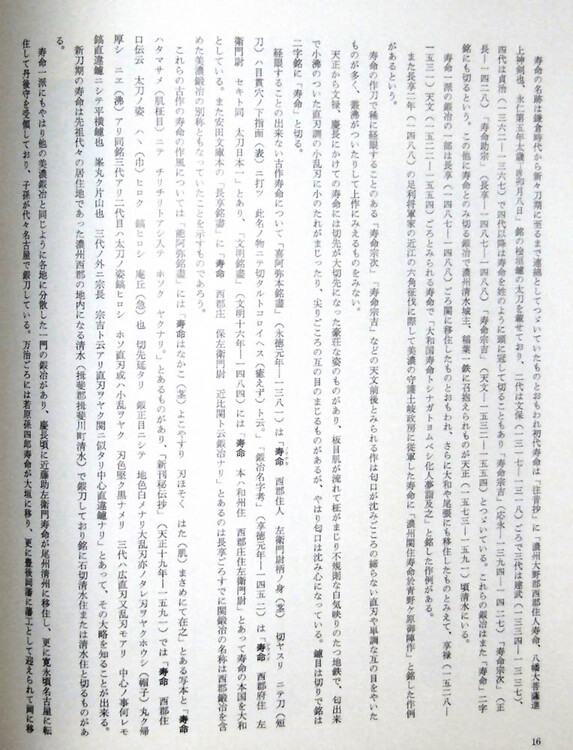
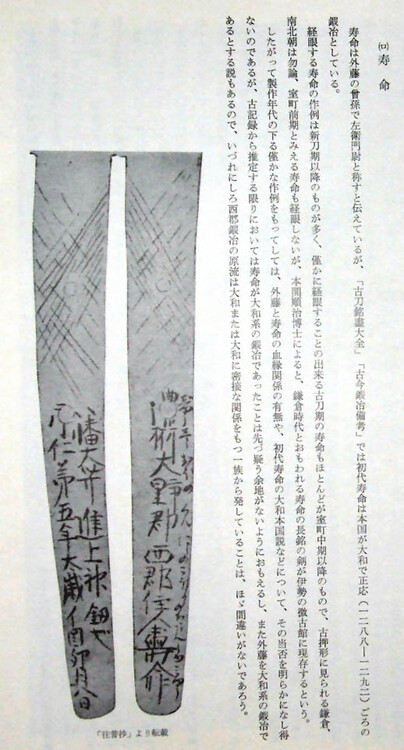
Hi All, The following information comes from the Minoto Taikan and specifically is about the Jumyo ha. I wonder if someone who is fluent in Japanese could translate this passage for me or give me a synopsis of its' content. I want to put the info on my website. I know it is fairly long but me trying to get a coherent translation one kanji at a time is beyond me. Thanks, John PS, I have higher rez pics available. J
-
Hi, I have always taken this way of placing a smith in the timeline, when there is no birth or death date as meaning that there are examples that have been dated to a particular era, the Eikyu or Geno eras for example, to give a sense of when they were in production and to extrapolate from that. John
-
Hi Ed, If I was wealthy I would attend them all. Having no money, if I could attend only one, given that they had equivalent stature, I would choose the Minneapolis show. This is because I have interest in the other aspects of Japanese art and culture and would appreciate the other exhibits and presentations. However if there was too much crammed into to small a venue and too short of a time, it would be frustrating. A show that had a lot to see/experience would have to be say, an one week exposition. John
-
Hi Ed, Thanks, that sounds interesting. I'll see if amazon or alibris has it. John
-
Hi Stephen, Thanks. Those lists are great and I have filed them. I hope to extend them if they are available. For example, to include name origin, such as what does Gifu mean and how did it get that name. Happy New Years to everyone as well. John
-
Hi Jeremy, We are having a discussion about niku on another board and it has raised some interesting points. One member who is a polisher had brought up this point and it may be pertinent to your question. All blades polished in the traditional way will have niku,[ not just because it is desirable (my point)], because the shape of the polishing stones are such that a perfectly flat plane does not develop. Even hirazukuri blades will show some niku. John
-
A Scene From Milt's Dental Office...
John A Stuart replied to Pete Klein's topic in General Nihonto Related Discussion
A reversal of 'Cat got your tongue'. Or. Milt's collection agency. John -
Hello All, Does anyone know where I can get a book that lists the modern names of towns and villages in Japan with their old names, the meaning of those names and the new and old kanji for them. Thanks, John
-
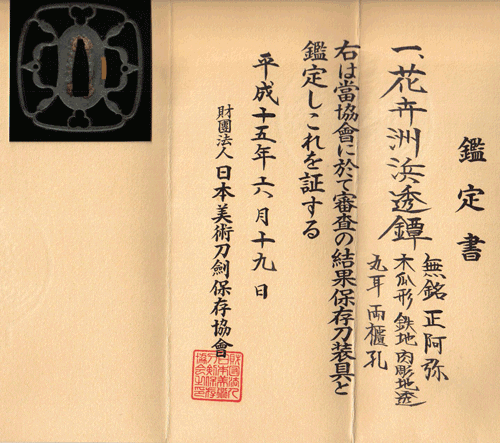
Hi Milt, The papers say mumei shoami. I never translated the rest. I always thought of it as Akasaka. Not so? John
-
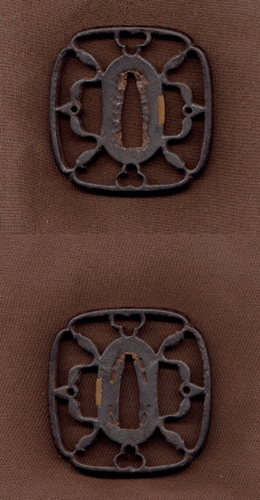
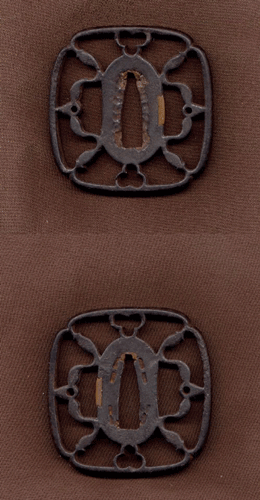
Hi Koichi-san, Yes, it is noticeable when you draw attention to it. The left half has the direction all one way and the right has the directions divided to two directions. It doesn't hurt the theme of the tsuba, but, yes I think when cutting out the design there was an error and the smith did not want to waste half of a weeks work. Pete, your examples really show how precise markings can identify a particular school, or at least be a part of the identification. While we are on the subject, I have a couple of Akasaka tsuba that have the same markings in the seppa-dai. I refer to the longitudinal punch marks. What is the purpose of these? John
-
translation help
John A Stuart replied to John A Stuart's topic in General Nihonto Related Discussion
Hi Koichi-san, As ever your help is impeccable. Thanks a lot. John