All Activity
- Past hour
-
Recently I could not resist buying a small to medium sized Imari bowl. Around the rim are five holes. Asssuming that the holes would enable stringing and hanging, what would be the purpose of the bowl, I wonder? Today we might toss the car keys in there. Back then, what? One person suggested a mosquito coil, and I can kind of imagine a set of fire lighting equipment, i.e. striker and flint. Photos in the pipeline
-
 I remember seeing the handle name Winchester, but had no direct contact as far as I can remember. So brave of his wife and parents, and so much is left unsaid...
 -
 So sad.
 -
You can use a magnet to see which components are steel/iron vs fibreglass, resin or other material. it will help you to know what exactly you have bought. Although new, a lot of work has gone into assembling it. Absolutely nothing wrong with enjoying this as a highly decorative display item (for a fraction of the cost of the Edo equivalent) These armours are usually available in the $1500-2000 range although some are horrendously priced on eBay and misdescribed as Edo or “genuine vintage” (whatever that means) I have recently started to collect armour……it can be rather addictive and is certainly very very challenging as there is so little reliable written information in English (compared to swords or stamps or coins etc🙂) if you get “hooked” and want to progress start with components….masks…Kabuto and exercise extreme caution seeking advice before diving in. Pieces in poor condition can be bought for very little yet can still be interesting. PS……I’m what Bowie would describe as an “absolute beginner”
-
 Another common one is putting blades into shirasaya with legit sayagaki (using a file rasp to ensure the sayagaki fits the new occupant). Regarding mukansa blades - Ono Yoshimitsu swords can easily sell for the price of a Juyo, and there's no shortage of cheap-ish gendaito and shinsakuto with Bizen-style hamon that one could pass off as his work to the unwary.
 -
 Those are pretty egregious examples. The second one is comical. One also needs to be very careful with papers. A couple of years ago there were 2 'Juyo' blades by Go Yoshihiro and Awataguchi Kuniyasu with altered nakago and hamon to match the NBTHK oshigata from stolen papers. More recently this fake Sadamune. It's a minefield out there.
 - Today
-
 Born 1984? That is absolutely heartbreaking. 😢
 -
I didn't realise mukansa were also being targeted but I suppose it makes sense if someone with a chisel is trying to make a quick buck. 😳 On my Yahoo travels today, I also came across a Kiyomaru and a Chikuzen no Sa. Must be my lucky day! 😬


-
Yes, this would be an unmissable exhibition. A broad range of blades from top makers with a focus on middle Koto period. I'm a little surprised a signed Masamune was only valued at $665K though, but a Juyo mumei Enju is $233K Full size oshigata under the blade is a great idea to inform the casual observer and assist those with some knowledge.
-
New member, old sword, can't remove Tsuka
ROKUJURO replied to MichaelL's topic in Fake Japanese Swords
All good things come together! -
Sounds like a very well-done exhibition, glad to hear it had a good attendance. Hopefully other exhibitors will take some lessons from this.
-
Yes, it's become increasingly prevalent, and not just for historical smiths. I've seen a few gimei of Ningen Kokuho and Mukansa smiths as well. This sort of thing is a big factor behind the push to make the NBSK the shinsakuto equivalent of NBTHK certification, especially with some Chinese forges now at a point where they're able to produce stuff more or less on par with entry-level Japanese shinsakuto.
-
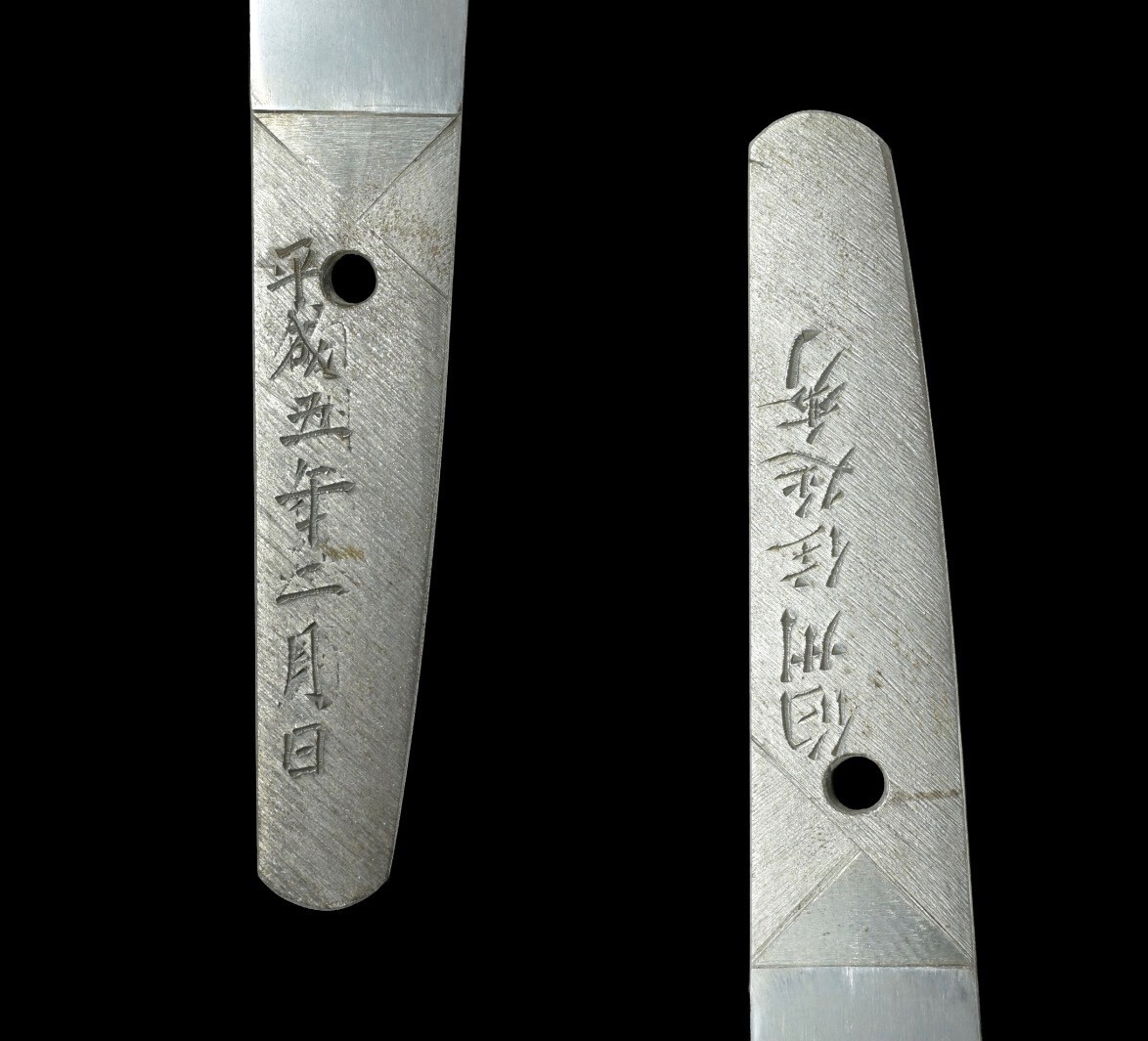
As some of you know, I spend a lot of of my retirement time In Japan looking at the auction sites like Yahoo. Everyone, except the most woefully uninformed, knows that a decent level maker without current papers will be sporting a fake signature. However, I'm starting to see a pattern where it looks like nakago are often being reworked before the blades are put on the market. The first example below clearly shows overworked yasurime but you can still see traces of the original signature under the new Kanji. On the second, the signature goes into the fuller in a way that I've never seen before. Best, Hector


-
 I have been advised of the passing of Brian Klingbile (Username Winchester) by his wife. She had this to say: "This is Brian's wife, Sarah.....Unfortunately, Brian has passed away. Thank you so much for providing such a wonderful forum. Brian was new to collecting, and was excited not only to connect with others with similar passions, but to have access to learning opportunities for his new passion. What you have here is amazing, and I wanted to let you know that you make a positive impact on people's lives even if you don't hear this on a regular basis. Thank you for being so welcoming to Brian. I have attached Brian's obituary in case you or anyone else was interested in it. I don't know who Brian all connected with (or to what level), so I will leave announcing or contacting others up to you. I am comfortable with this information being shared. https://www.zimmerfuneralhome.com/obituaries/brian-klingbile " Our condolences go out to those who knew him, may he RIP.
 -
You can also put some padding into the sleeves (kote) so that they get a more “arm like” shape. Cut two cardboard tubes of about 8-10cm diameter, length normally 20-25cm, and wrap the shin guards (suneate) around. The shoulder guards (sode) are sitting a bit high. That’s probably because the bar of the stand is too long. It should be about 36-38cm… Guess that will enhance your display!
-
 The Honno-ji Temple Museum DAIHOUDEN (The temple where Oda Nobunaga died), has been hosting an excellent exhibition for the last 8 months entitled "Valuing the Invaluable Symbols of the Warrior Class". This has been an excellent exhibition that saw a large attendance. Here they did something more than just show the sword. They also produced life size Oshigata of the whole sword and displayed this below the sword with explanations so the people visiting the exhibition could compare it directly with the sword so that they knew what they were looking at. Basically like looking through the eyes of a Hon'Ami appraiser. This was a great idea. They also provided the valuation according the Hon'Ami based in Gold Coins of how much each sword was said to be worth at the time in gold pieces and converted this to today's value. They gave only one value but the truth is that there are three values that could have been provided, the Gold Price, the Rice price and the Labour price. The most valuable is the labour price whilst the rice and gold price has not really kept up with inflation. Their price appears to settle somewhere in the middle. For example the Masamune Tanto had a price of 50 pieces in 1639: - In terms of rice this would be worth around 2-3,000,000 yen today. - In terms of gold this would be worth around 20,000,000 yen today. - In terms of labour where 1 ryu was equivalent to roughly one year's wages of a labourer. The this would be worth around 200-300,000,000 yen today. These are what the museum estimated today's value* equivalent would be from lowest to highest: - Hirotsugu Katana: 20 million yen (approx. $133,000) - Enju school Katana (attributed Juyo): 35 million yen (approx. $233,000) - Sekishu Dewa-ju Naotsuna saku Tachi (Juyo Bijutsu): 50 million yen (approx. $330,000) - Hasebe Kunishige Wakizashi (Hon'Ami Kōjō origami): 60 million yen (approx. $400,000) - Rai Kunimitsu Tanto: 80 million yen (approx. $530,000) - Norikuni Tanto (Juyo & Hon'Ami Mitsutada Origami): 100 million yen (approx. $665,000) - Masamune Tanto (Hon'Ami Koon Origami): 100 million yen (approx. $665,000) - Rai Kuniyuki Kodachi: 150 million yen (approx. $1,000,000) - Bizen Osafune Kanemitsu Tachi (Juyo Bijutsu & Hon'Ami Mitsutada Origami): 200 million yen (approx. $1,330,000) - Rai Kunitoshi Tachi (Tokubetsu Juyo & Hon'Ami Kōjō Origami: 300 million yen (approx. $2,000,000) This was very interesting and if correct it again confirms that we are living in the 安刀時代 (Era of the cheap sword). 日本刀の美 made a great video of this exhibition that you can view here and you can read more about it here on from Tamaki Joji Togishi's blog post. *I never attended the exhibition but did a quick google and found only one post but without any photographic evidence I could not corroborate these numbers and I could not find anything else so if you did attend or are going to attend before the exhibition closes this weekend, please confirm or deny these numbers. Thank you.
-
untilNagoya Sword Museum will be hosting it's very first exhibition of the now world famous tachi MIKAZUKI KANEMITSU that was purchased at Sotherby's from the Paul L. Davidson collection on the 25th March 2025 for an undisclosed amount via silent auction. This exhibition will only feature Bizen Swords showcasing the brilliant works of sword smiths active in Bizen Province (present-day Okayama Prefecture). There are going to be a proverbial festival of swords on display, see here. This is probably one of the most anticipated Nihonto exhibitions of the year. Prices: Adult: 1,200 yen Senior (65 years and older): 1,000 yen University: 500 yen Students: 300 yen Disabilities: Free For more information click here.
-
Thank you for the info, Nazar. John C.
-
Sam: What's interesting is that this could be the genesis of why the Chinese fakes have offset machi. I could imagine them taking apart a type 95 and thinking this is how it is supposed to be done. John C.
-
Thanks for the reply. It looks good, worth the extra effort. (I've seen other attempts around the world to make shirasaya that for various reasons just look wrong!)
-
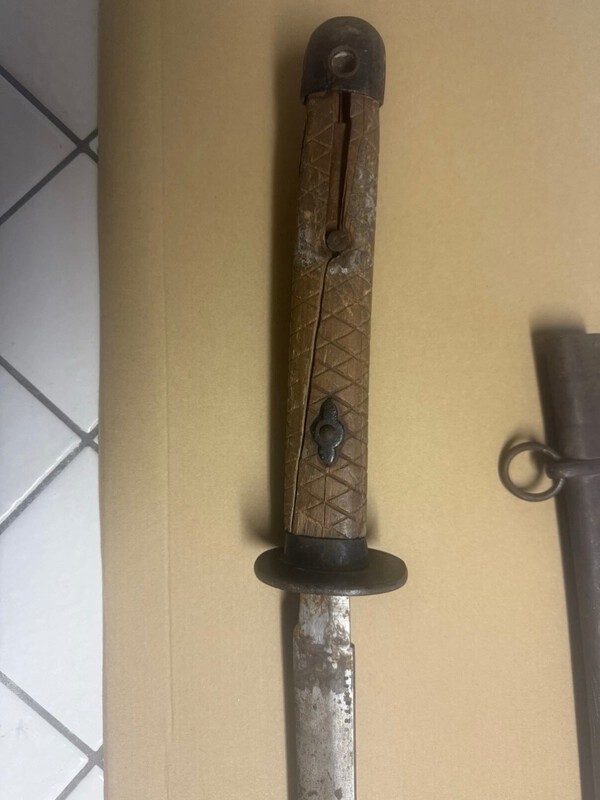
Me thinks 212465 and note the end of the tang in relation to the hilt. Thanks for posting.
-
Steve: I think your method with the foam was fine, just switch out the foam for leather. There is an old weightlifting belt on shopgoodwill that would make a dozen very thick seppa. https://shopgoodwill.com/item/254983331 Just lightly trace a seppa onto the belt using an exacto knife. Then slowly cut through with the exacto knife, which make take several passes. You can then treat the seppa just like wood and sand the edges smooth and even burnish the edges (to smooth and round them) with water and the shaft of a screwdriver. John C.

-
Honoki is much easier to work with. Almost as light as balsa (hence the light weight of shirasaya). It also tends to have long straight grain, which again is perfect for shirasaya. Maple is much harder, denser, and heavier. And as a consequence, much harder to carve. I had to stop about every 10 minutes and re-sharpen the tools. But the upside is that hard maple doesn't dent as easily. In any case, honoki is nearly impossible to get here in southern California. My local wood suppliers didn't even have American magnolia. I just happen to have some left over maple from another project so I used that because of the grain and color. John C.
-
While we’re on the topic of ha-machi and mune-machi alignment. Here is a rare glimpse of the machi on a wood handle Variation#8 that displays misalignment. Looks like a seki stamp on the blade, and I think the serial number is 215465, although the eBay photos make it very hard to see.

-
As a decoration, why not? And you can learn a lot from the construction since it looks like it closely follows traditional work in many places. Personally I would put a wider pedestal underneath the yoroi-bitsu box just to give the whole thing added height and presence. You might want to add a sword at the side? And I would take the two long cords and tie them behind the neck as a first step in how to correctly tie a shinobi-no-o. A fun journey lies ahead! I feel sure that in due course as your budget allows you will be filled with a desire to collect old parts or even display a genuine old set too.