watsonmil
-
Posts
1,406 -
Joined
-
Last visited
-
Days Won
4
Content Type
Profiles
Forums
Events
Store
Downloads
Gallery
Everything posted by watsonmil
-
Dear Jan, To slightly correct Ian's description .. " That gun is a very late one made after the American's had introduced percussion cap ignition. " This gun was not MADE after the introduction of the percussion cap, ... rather it is a CONVERSION of an existing matchlock to the percussion system. A few guns were made by the Japanese using the percussion system, ... but this example is not one of them. ... Ron Watson
-
This Week's Edo Period Corner
watsonmil replied to Bugyotsuji's topic in General Nihonto Related Discussion
Dear Piers, Impressive, ... you realize that a round ball of 20 monme = 1157 grains ( grains is the normal method of weighing projectiles of musket / rifle caliber ). That is equivalent to 2.4 ounces of projectile. A projectile of 100 monme weighs in at 375 grams = 13.23 ounces .. ( a small cannon ). Given these weights of ball and calculating out the ft/lb recoil, ... either of these two guns the 20 monme or especially the 100 monme gun will be completely impossible to hang onto if loaded with anything other than a blank ( powder and wad only ). The Samurai out of necessity would have had to have something for the gun to land in once it left the shooters hands upon firing ( for the 20 monme gun ) and some type of seperate mounting ( carriage ) other than hand held for the 100 monme gun. ... Ron Watson -
This Week's Edo Period Corner
watsonmil replied to Bugyotsuji's topic in General Nihonto Related Discussion
Dear Piers, Now that's what's called a " hangfire ". There's got to be at least a full second between the ignition of the priming powder and the detonation of the main charge. A good deal of what appears to be severe recoil is the shooter's muscles relaxing just a split second before detonation . Just as well he had the gun tied to his left hand ! ... Ron Watson -
Dear Barry, All three guns are Kunitomo work. It would be of interest to have photographs of the signatures. I am rather surprised that you found three guns of virtually identical proportions and style together. Wonder what the story is behind that ! Thank you for the photographs. ... Ron Watson
-
HAGOITA a Japanese Art Form
watsonmil replied to watsonmil's topic in General Nihonto Related Discussion
Dear All, I should have mentioned this before, ... but better late than never. In order to preserve your Hagoita, ... it is best to wrap the entire paddle with a sheet of clear plastic wrap ( suran wrap ) folding the overlap to the back side of the paddle. This will protect the paddle from dust, smoke and other air-borne pollutants. I also placed a tiny ring screw about 1 inch from the top corner or the paddles and this allows you to hang the paddles from tiny nails for a more pleasing display. ... Ron Watson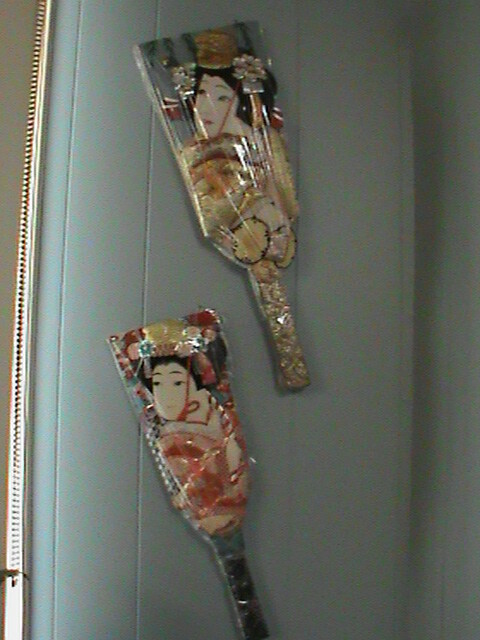
-
Dear Piers, Appears to be over-all temper to my eyes, ... but the polish is not the best to see minute detail. Still a very nice yanone. How many more treasures do you have upstairs ? ... Ron Watson
-
HAGOITA a Japanese Art Form
watsonmil replied to watsonmil's topic in General Nihonto Related Discussion
Dear Ken, One of the major dealers in Hagoita is : The Minamikawa Doll Factory in Tokyo. I did a Google search and came up with this link: http://www.ebay.com/itm/Big-Kabuki-Japa ... 2565fd84f9 If this link does not work just go to eBay and search item number : 160624903417 . Be sure to scroll down the entire page to see the workers actually making Hagoita. These people seem to be among the premier makers of modern Hagoita. In the off season they use eBay to reach out to the entire world for sales. It seems to be the quality, and how elaborate the work is that gives modern Hagoita their value. ... Ron Watson -
HAGOITA a Japanese Art Form
watsonmil replied to watsonmil's topic in General Nihonto Related Discussion
Dear Ken, Glad you found some answers, .... what might surprise you is that brand new Hagoita can vary in price from a few dollars to over $1000.00 depending on the quality ! ... Ron Watson -
Dear Adam, Virtually all tanegashima ramrods are one piece wood. I have two examples that are steel ( both are pistols ). ... Ron Watson
-
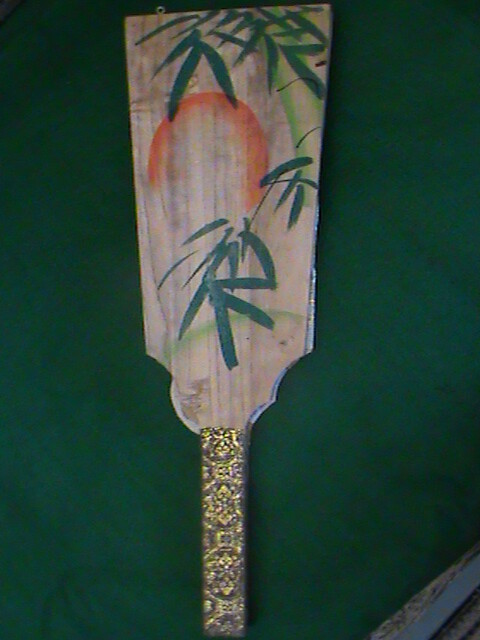
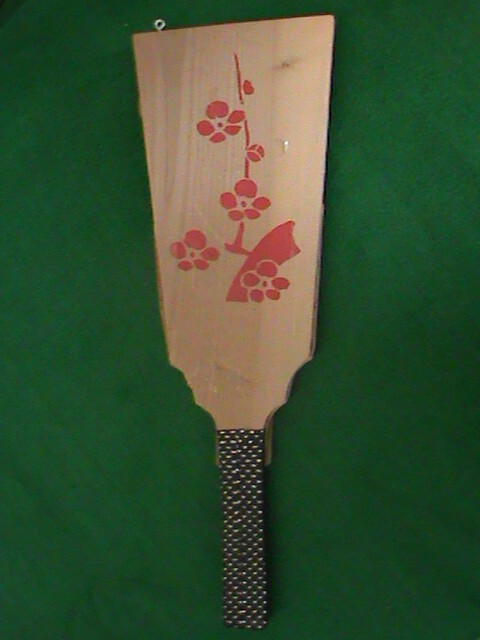
Dear Members, A short article on an Art Form that has not been addressed on the NMB previously, ... but one that has significant meaning to the Japanese. On Dec. 17 - 19th at the end of each year, the Hagoita ( battledore ) fair is held at Sensoji Temple in Asakusa. Each year thousands of people come to shop for them. Hagoita are used as an effigy to rid people of misfortune and disease. In Japan, old Hagoitas are taken to shrines and burned. This is called Otakiage. The Hagoita is a rectangular wooden paddle used to play the game called Hanetsuki. It is similar to a badminton game but without the net. Although the game is rarely played anymore, ... it was usually a game played by girls on New Years Day. The shuttlecock was batted back and forth using the back of the paddle. Each time a participant missed and allowed the shuttlecock to strike the ground, a stripe of black ink was drawn on the participants face, and the game continued until one participant's face was completely covered in black ink. The Hagoita were traditionally decorated on one side with three dimensional representations of Kabuki Actors, Sumo Wrestlers, and often Geisha. The backside of the paddles are usually decorated with a very simple painting of foliage, birds, or scenery. The shuttlecock is a small ball that is the seed of the Mukuroji tree ( Mukuroji means children's health ) with feathers attached to the seed. This is why many people buy or give the Hagoita and shuttlecock as gifts and thus pray for the health of their children. It is interesting that the market began around 350 years ago. The current market attracts around 300,000 people a year and only Hagoita are sold from approximately 50 stalls. The examples I picture are from my collection of Japanese Art, and were purchased approximately 30 years ago at an antiques and collectibles fair. By the appearance of the boxes I should think they are of 1950 - 60's vintage. They are both beautifully rendered in three dimension using various textiles,sequins, wood and paper. The taller of the two measures 18 1/2 inches, while the smaller measures 15 1/2 inches. I would highly recommend watching for these as they are very attractive hanging on the wall in any room. Any errors in this short article are mine alone. ... Ron Watson



-
Dear Jan, The Bubulous shaped poppy muzzle leads me to believe this to be a product of the Sakai school of gunmakers. Although there are elements of the Kunitomo, ... I think I would stay with the Sakai school in this case. I agree with Piers that it may be of early to mid Edo in date as later Sakai guns are quite often overly decorated whereas your gun is quite plain. Sadly the patina has been removed from the barrel. If it were mine I'd repatinate it ( or have it professionally re-browned ) using a plum brown barrel browning solution. The bright steel does nothing for the gun's appearance. ... Ron Watson
-
FLINTLOCK TINDER LIGHTER NETSUKE ( SNAPHANCE )
watsonmil replied to watsonmil's topic in Tanegashima / Teppo / Hinawajū
Dear Sir, Please sign your posts with at least a first name as per the NMB rules, .... I have sent you a PM ( private message ). ... Ron Watson -
This Week's Edo Period Corner
watsonmil replied to Bugyotsuji's topic in General Nihonto Related Discussion
Dear Piers, Sadahide (1807-73) was a prolific but minor printmaker, who had trained under Utagawa Kunisada (1786-1864). He produced theatrical prints, contemporary scenes, and pictures of foreigners, such as this one. He was one of eleven Japanese print artists who showed their works at the Paris Exposition of 1866, for which he received the Légion d'Honneur. Sadahide's works incorporated the Western technique of shading. He worked primarily in the early 1860's and is well known for his depiction of foreigners. ( the above information courteousy of the British Museum web site ) ... Ron Watson -
Dear Brian, Well dig out the mounted yanone and lets have a look. You are quite correct in stating some tangs contain tiny filemarks. The polished example I pictured has filemarks much like the nakago on a sword. The file marks on my Yanone are katte-agari. I have not seen filemarks on ALL yanone tangs however ( possibly due to rust ), ... but I too have noticed the slightly bevelled edges on ALL genuine yanone tangs. Whenever I see sharp angled corners on the yanone tangs on yanone being offered, I have ALWAYS wrote them off as being copies or forgeries. We probably should not help the forgers with that bit of indescripency, ... but now it's out . ... Ron Watson
-
Dear Brian, What a wonderful collection, ... the variety and styles of yanone seem almost endless. They are truly fascinating. The scarcity of really fine examples somewhat surprises me. I see so few on offer, and the truly magnificent pieces such as found in the Grayson collection are forever lost to the collector world. It would be nice to see other NMB members share some photos and write-ups concerning yanone that they might own. I am sure some of our members have even MOUNTED specimens that they could picture showing the differences between the mountings of say target shafts to battle style shafts. I currently have some of mine mounted on ex-target shafts simply because they display better. Piers, ... I know for a fact that you have a few, ... how about some photos and provenance. A word of caution however like all things Samurai, ... the Chinese have been busy applying their copying skills. Brian ... a top notch suggestion for a more extensive thread and many thanks for the visual candy ! ... Ron Watson
-
Dear Piers, Indeed they are beautiful in polish, ... but just try and find a polisher . I have a very nice pierced example also signed, ... but no one is interested in polishing it. Most being overall tempered, ... a polish would only serve to put a clean shiny non scratched finish on the majority anyway. Most that I have in my collection, ... I would call utilitarian, ... meant for combat and once fired never to be seen again, ... so the workmanship did not warrant the same care as a sword. ... Ron Watson
-
Dear Curran, You can see three photos of my yanone on page 1 of this thread. I am sorry you chose to sell your example off. What in the world made you superstitious about owning a fine yanone. The only superstitions from Japanese artifacts I suffer from are when I handle my Nobuyoshi Katana. Having been made in the 1490 - 1510 era, and having been surrendered during WWII, .... a 500 year life span would almost certainly guarantee it having removed a few heads along the way ! The small amount of superstition the blade causes are far outweighed by it's beauty however. ... Ron Watson
-
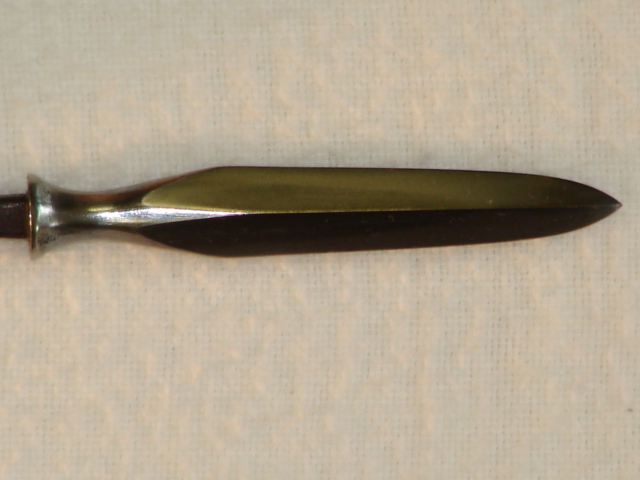
Dear Piers, I purchased my example ( similar to Curran's but not the same point ) back in 1990 at the Chicago Sword Show I believe. It was in perfect sashikomi polish at the time and still is today. Tempered like a sword in suguha, the hada itame. OA length 8 5/8 inches, blade 2 1/2 inches. ... Ron Watson
-
Dear Ford, My heartiest congratulations. After having seen ( but not owned ) any of your work, ... I was very pleased to see your work recognized for what it truly is ... PERFECTION in metalwork. It is my hope that this recognition translates into commissions from collectors worldwide. After all the years of study and persistance it would be a shame to give up on what you truly love creating ! ... Ron Watson
-
Dear Piers, The Kanji were translated for me : Kiyotsugu saku. Supposedly of the Nio Choshu school province of Nagato .... Circ. 1688 - 1736 ... Ron Watson
-
Dear David, A nice group of yanone, ... thank you for posting the photographs. I have only one that is in POLISH. Photographs attached. ... Ron Watson


-
This Week's Edo Period Corner
watsonmil replied to Bugyotsuji's topic in General Nihonto Related Discussion
Dear Piers, I am sorry that I did not see the Ojime before posting my dribble about Tibet ( although I believe the Tibetans also made small ojime like beads ), .... so to be honest I'm not 100 % sure my Tibet theory is dribble. It's getting too late here to think logically, so excuse my contradictions. If it is Japanese in origin, .... it is most unusual. Did the Ainu produce for trade any Netsuke, Ojime, Sagemono ? I do not believe I have seen any photos of them using such accessories themselves. Very unusual items. I would agree that the handle could well be for a parasol, .... but where does the Ojime fit into that cinerio .... which brings me back to the Tibetan theory . ... Ron Watson -
This Week's Edo Period Corner
watsonmil replied to Bugyotsuji's topic in General Nihonto Related Discussion
Dear Piers, There is something reminisent of TIBET art in the antler handle. Just a gut feeling I have, ... it reminds me of something I've seen before, ... I just cannot place it for sure. If it is Japanese at all, ... my guess would be the Ainu. ... Ron Watson -
Dear David, We are still awaiting your photographs. In the mean time here are three of the several in my collection. Does anyone know the name of the bottom type ?? It is a rarely seen ( for me at least ) type that appears to have been designed for armour piercing. By the way David, ... relatively few were polished to such an extent to show a hamon. Perhaps most were tempered overall, as once fired they were unlikely to be seen again. You also asked whether it was OK to mount your heads on existing shafts of existing yanone ( target arrows I presume ). I see nothing wrong with doing this so long as you make a note of what you've done so that no one confuses the fact that the shafts once belonged to target arrows. I know I have done this and they make a much nicer display item mounted. ... Ron Watson

-
The most beautiful things.....
watsonmil replied to Anthony de Vos's topic in General Nihonto Related Discussion
Dear Anthony, Unless a major old time collection comes up for sale, ... NO ! There are some fairly good Chinese reproductions out there in the market, .... but to find that quality today on the market and GENUINE is virtually impossible. ... Ron Watson PS. Yes indeed they are VERY beautiful .