


Bruno
-
Posts
1,196 -
Joined
-
Last visited
Content Type
Profiles
Forums
Events
Store
Downloads
Gallery
Everything posted by Bruno
-

Greetings! Looking for information on a blade.
Bruno replied to analog addict's topic in Translation Assistance
Yes nothing special except maybe if cutting edge is several cm longer than 66 cm, in that case it could be a kind of special order for a tall officer. Otherwise no, value of it is around 700 to 1000 USD I would say. -
Greetings! Looking for information on a blade.
Bruno replied to analog addict's topic in Translation Assistance
Maybe NO SHU SEKI JU KANE......KAZUNORI SAKU -
You will find this stamp on page 65 of SLOUGH's book. I do not have a scanner here.
-
Greetings! Looking for information on a blade.
Bruno replied to analog addict's topic in Translation Assistance
I think the gunto is signed NO SHU SEKI....KANE......KAZUNORI SAKU -
Thanks Eric, I will look at it for sure.
-
Hi Geraint and thanks. Ha yes thanks I think I see what it is now, well exactly what Morita san was showing! :D So the lack of visible funbari is like a mistake in the making of the sword?
-
I do not understand what "funbari" is, even with Morita san's draw. What is it and why a sword looks "weak" without this "funbari"? In what sense it is "weak"? Anyone has an idea? Thanks
-
The ha machi looks small, a sign of tired blade I think.
-
-
Thanks Chris. Roy, You say in your description Amahide was RJT, however I cannot see him in Dr Stein's RJT list. Anyone knows why? http://home.earthlink.net/~steinrl/gendai2.htm I have never seen any Amahide's blade with a star stamp. According to Dr Stein's website, "not all blades by Jumei Tosho swordsmiths were star stamped. If the blade was a private or direct purchase or not for military use, there will be no stamp appearing on the nakago." I thought when a blade made by a RJT smith without star stamp, the only reasons were : 1° The sword was rejected by Army inspection (kizu etc...) 2° The sword was made when the smith was not yet RJT Anyone can enlight me on these two points? Thanks
-
Is there a possibility to know who where the others 14 swords makers employed by Amahide? I mean are they listed in the Seki kaji tosho list or were they just unknown guys?
-
-
I would love to read it, I hope someone has it somewhere. Thanks
-
I would say the shinsa team could have judged the quality of the blade. I would not be surprised that among the numerous stamped blades some were much better made than the big bulk. Even if not traditionnaly made they could have nice global shape so got a paper from shinsa. This plus the historical side can produce more than a few times a shinsa certificate.
-
Yes the case by case seems to be the rule, here is what Tsuruta san added: "generally speaking seki stamp and seki stamp and also showa stamp are not allowed to hold these swords. But sometimes at the sword inspection, sword expert permit the blade as general sword. If some one who fought at the war front, some kind judge permit to hold this sword for his long severe fight. Recently these swords are reducing rapidly. So NTHK permit as genuine regular sword I think. We are not sure that these Katei organ accept as genuine Japanese sword or not. But recently the price of these swords are increasingly higher than before. Kind regards. Kazushige Tusruta" I wouldn't be surprised to see more papered in the future.
-
Hi John, I too am interested in Amahide. Who was Seki Sengo Masayoshi? A good smith? There are 3 Masayoshi in Slough's book but no Seki Sengo.
-
I am having hard time to upload it!
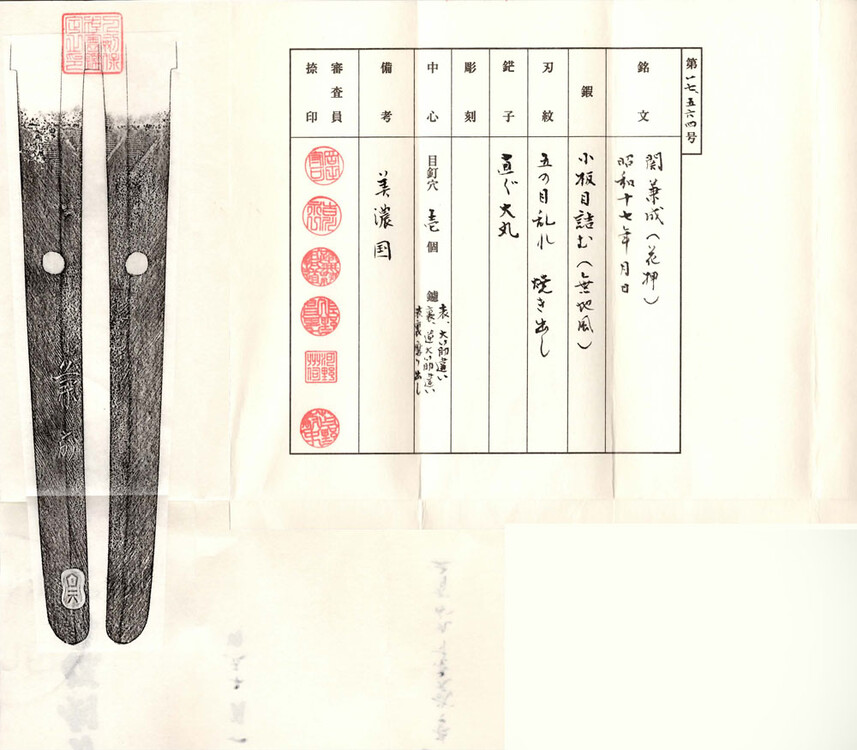
-
Oups! Here is the paper. What does it says?
-
...And here is the Aioi's answer, not exactly what I asked but it is an answer! :D Quote : Dear Mr. Bruno HERRMANN san. My customer submit the blade to NTHK shinsa recently and got the paper. I think the blade is called Hantanren sword. The blade was polished nicely.(polishing cost will be ¥80,000) The blade also accompanied with Gunto Koshirae. Even if the blade is a consignment sale, we will buy back 70% of the sales price at anytime. Recently army Gunto sword which is hantanren or mutanrento sword, price is higher than before. It means army gunto is treated as precious historical sword. I think NTHK issue the certificate as historical sword even if the blade is Hantanren sword. We attach the certificate. Recently a lot of Japanese swords are exported to foreign countries. I think this tendency will be increasing. Japanese swords are treated as investment. Unfortunately Japanese people are not interested in Japanese swords, many visitors visit Japanese sword museum and also ever growing sword expert like you. After 15 years later, good or bad Japanese swords will be exported to foreign countries like wood block printing or Netsuke while Japanese people are sleeping! Would you please understand this situation. kind regards. Kazushige Tsuruta
-
I have asked Aoi, what NTHK level got the showato.
-
And is it written what level get the showato when it passed the NTHK shinsa?
-
Forgive my ignorance, but what does this mean exactly? That a Seki stamped showato has been judged by NTHK at a level superior than Hozon? I found that by googleling: "Kantei-sho will be issued according to the following system: 60-69 points: Shintei-sho (equivalent to the NBTHK Hozon level) 70-79 points: Kantei-sho (equivalent to the NBTHK Tokubetsu Hozon) 80+ points: Kantei-sho (plus eligible for the yearly Yushu shinsa held only in Japan)" What is the real reason for such unexpected appraisal? Thanks
-
So do I!
-
Need help verifying authenticity of a Gunto (pics inside)
Bruno replied to Bassmaster360's topic in Military Swords of Japan
Just by saying that, you can be sure they intentionaly lied to you in order to crook you. Only for that reason, I would not buy it. I bet this fake sword comes from one of numerous Ebay Chinese sellers. You can buy a real gunto on Ebay for 500 USD easily. There are plenty! -
Fujiwara Kanenaga, anti-rust steel and "real hamon".
Bruno replied to Bruno's topic in Military Swords of Japan
Water quenched hamon, that is interesting...It would be nice to see some good shots of these blades. Not so easy I guess. I haven't seen any till today. :?

