Robert S
-
Posts
544 -
Joined
-
Last visited
-
Days Won
1
Content Type
Profiles
Forums
Events
Store
Downloads
Gallery
Everything posted by Robert S
-
The carving on this is relatively crude. Does anyone have any idea what the history is of these relatively poorly carved tosogu is? A friend has a katana in koshirae with a kabuto gane showing a sumo wrestler which is similar quality workmanship, and I took it to be probably a non-Japanese imitation... but maybe I was wrong.
-
An interview with a modern swordsmith
Robert S replied to Alex A's topic in General Nihonto Related Discussion
Lovely article. It definitely refocuses me on the thought that as part of Nihonto appreciation, commissioning a sword as a way to help keep the art alive is important where possible. -
Looking to buy my second nihonto katana
Robert S replied to VRGC's topic in General Nihonto Related Discussion
Take a look at this link, which is sometimes useful for sorting out ratings, dates, etc. : https://nihontoclub.com/view/smiths -
Identification help for sword
Robert S replied to Fudoshinken's topic in General Nihonto Related Discussion
That is an interesting appearance in the hamon area. Attached a photo of an acid polished blade with the hamon apparently still fully present, for comparison.
-
Lewis: I totally agree with your comment on "preponderance of swords coming from Japan with such heavy obscuring Hadori". I think there is a real issue there. I frequently see pictures of blades where even in the picture you can see that the hadori polish has little to do with the real hamon. To my mind this is where the link with art restoration comes in. I would characterize that sort of polish as being really bad art restoration, with the potential to terminally damage a blade if it has little meat left. To my mind there is little difference between a fake boshi and a polish where the polish obscures the hamon, and makes the blade look like something it isn't (better or worse). Being perhaps a little controversial, but I'm not sure that that form of polish is much better than the amateur attempts that are robustly discouraged (for good reason) on this site. Robert S
-
Hand painted as far as I can see... Robert S
-
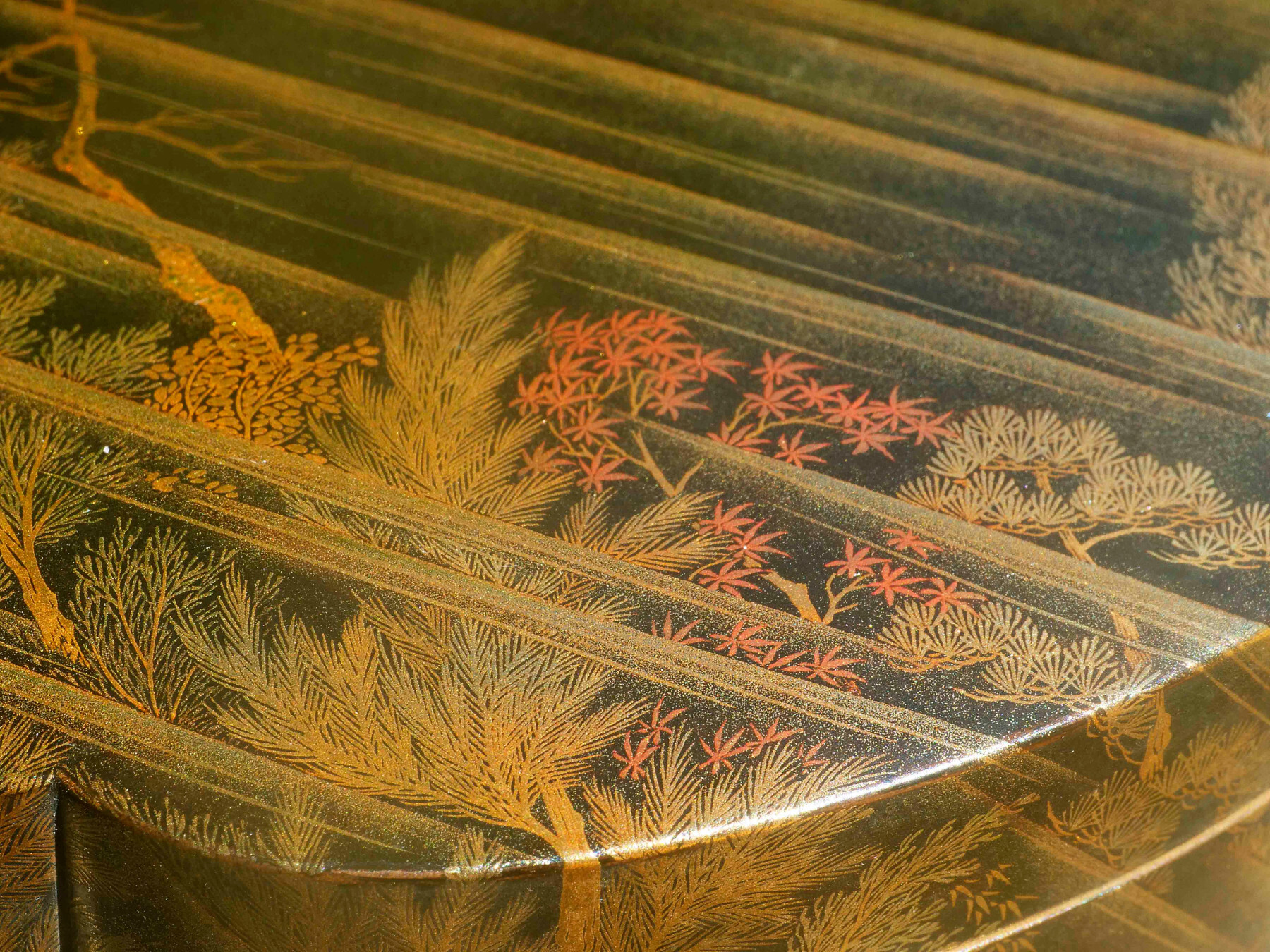
I picked this up at the recent Bonham's auction - late 19th century Japanese lacquer box, about 3 inches across the longer direction, showing an autumn wind in a forest at almost unimaginable levels of detail. The craftsmanship is completely stunning. Robert S.


-
There was a lot of amazing work in that sale... and it's interesting how much of it didn't sell. I ended up getting one of the lacquer boxes (lot 69): my first experience with Bonhams, and likely my last. Unfortunately, they haven't moved into the 21st century in terms of providing seamless payment, shipping, etc., and I wonder if that is part of the reason for the poor performance of that sale. We're all used to much better service these days...
-
How on earth they mistook a mantis for a lobster... Any chance this was compiled during oktoberfest? Robert S
-
Looks like it might be a relative of this: http://world.seiyudo...m/product/tu-100423/

-
Juyo Koto by the numbers. (Sort of)
Robert S replied to Mushin's topic in General Nihonto Related Discussion
Not to throw too many cats among the pigeons... but I wonder how much of this is also due to familiarity bias - i.e. people have seen many Rai Kunimitsu blades, so when a mumei (or really good gimei) blade comes along which resembles Rai Kunimitsu work it gets attributed to them... even though it may be by an unknown smith working with similar techniques and/or imitating their style. In general in the arts attribution without solid provenance remains a (highly educated and carefully founded) guess, and the context for those guesses changes over time, as is for example the case with attributions of western paintings to specific artists. Robert S -
I definitely don't think that it has to have been consciously made as art in order to be appreciated as art. In fact, that would go against the whole "tea" aesthetic in Japanese art, which includes, and really, is based on, the appreciation of simply made utilitarian objects as art. To me, art is about focus and investment, and not necessarily about intent. With the rare truly artists, you don't witness their creation, but rather their witness of their creation. For instance, with truly great musicians (as versus just technically incredible musicians), I experience that I am listening to their listening, not their playing (Hendrix, for example). Likewise with swordsmiths, if they have truly "become" their craft, I am seeing the result of their observation and constant re-invention of their own process. Japanese craftspeople tend to move in that direction by the simple intensity of their apprenticeship - they've learned by watching, not by systematic instruction - which probably explains why so much Japanese "craft" rises to the level of art. Robert S
-
I saw that one too - the hamon is outrageous. It's a lot of $ for tokubetsu hozon, but certainly not your run of the mill work.
-
I tend to agree with Alex: Buy something cheaper as a learning process. Even better, in my opinion, buy something very cheap, without papers, in decent but not great condition, but which appeals to you aestheticly. You can then have enormous fund with a) the learning process, as you try to figure out what you have, b) getting it polished, if necessary, and C) sending if for shinsa if you think it merits it (and discovering how wrong (or right) you were in your initial guesses and subsequent learning). My first post on this site about my first sword was full of an embarrassing number of errors, but the much more knowledgeable folks on this sight got me headed in a better direction. Like you, I could afford a much higher priced sword, but it would come without the mystery and learning process (both about swords and about polishing, shinsa, etc.). I may have bought something which turns out to have little merit at the end of the day, but for the $1,100 I paid i have already gotten several times that price in learning and enjoyment, so I figure the real price of the sword at this point is zero... and I still love it. One approach... Robert S.
-
Speaking as the now "proud" owner of an acid etched blade :-), awaiting repolishing, that doesn't look like acid etching to me... but it is a distinctly odd hamon, although I don't have the expertise to say why.
-
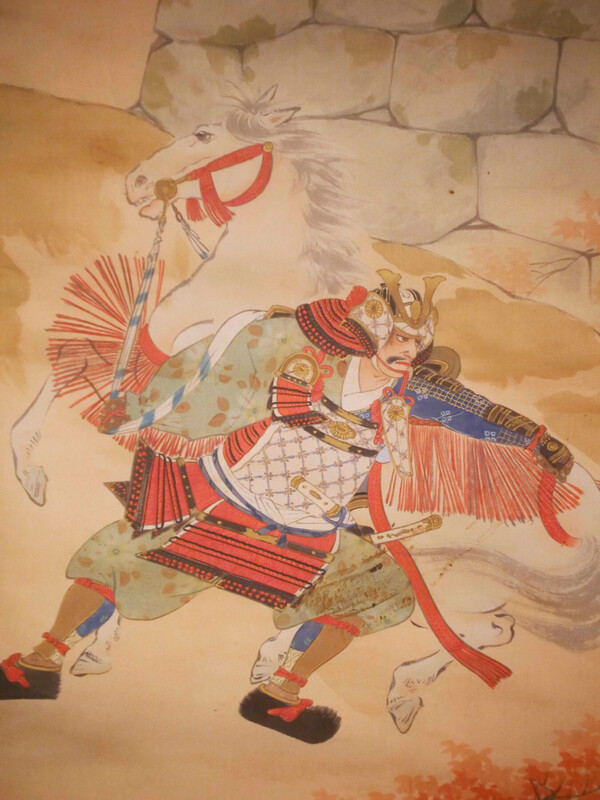
This is the central image of a scroll painting that was purchased by my family in Japan in the late 1920's or 30's. It was pretty obviously painted around that time, significantly influenced by western art, and was probably aimed at the tourist market. I find it interesting though that he was portrayed carrying a tachi, plus a companion blade in the edge-up position.
-
I agree with Jean Collin. I don't see any signs of casting on the tsuba. Nice one! Robert S
-
Yves: Do you think that Daisho would typically have had matching menuki? I'd sort of wonder of they might not have had different but related menuki sometimes, to sort of extend the symbolism - like symbols for perseverance and for strength.
-
Rust/ staining on sword.
Robert S replied to Mick taylor's topic in General Nihonto Related Discussion
Brendan: That's crazy. What's going on with Border Control? Shortage of staff/funding? I brought a sword into Canada from Japan recently, and it took less than a day to make it through customs... and they declined to charge me duty or tax... although I suspect that may be an error, so I'm not mentioning it :-) -
Keeping my hands strictly in my pockets - there are some lovely things here. Inspiration for things to make, though :-)
-
Mauro: I thought ko-kinko as well. It's odd that whoever put the shoami mei on it used the alternate form of the last character. Mysteries! Dale: That's great - really helps understand that shape! Robert
-
Having done some casting, my first instinct is that this is cast - looks like they didn't bother chasing and polishing down in the voids, where-as if it was carved all the surfaces would start with the same treatment. However, that could be just corrosion fooling me.
-
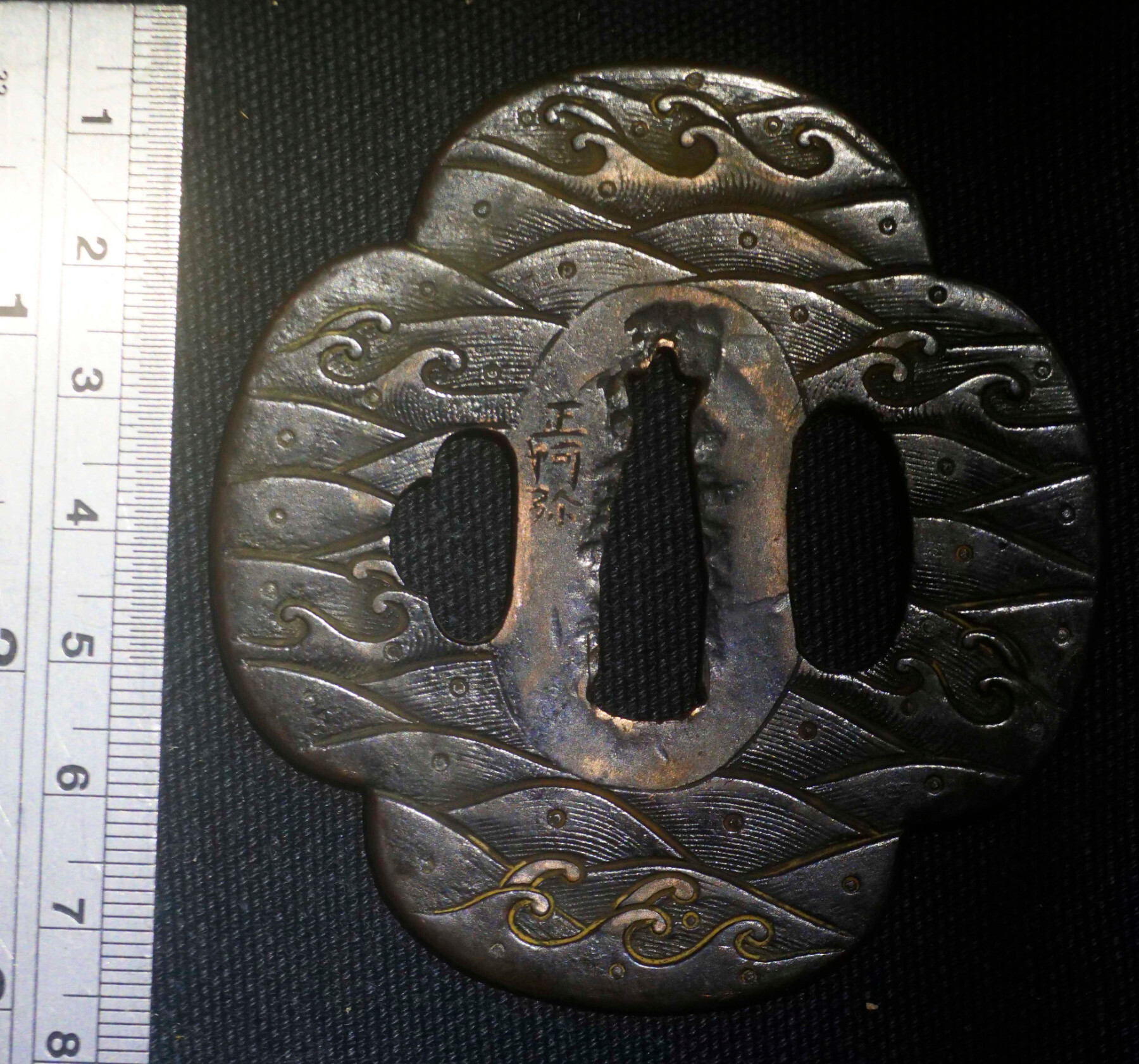
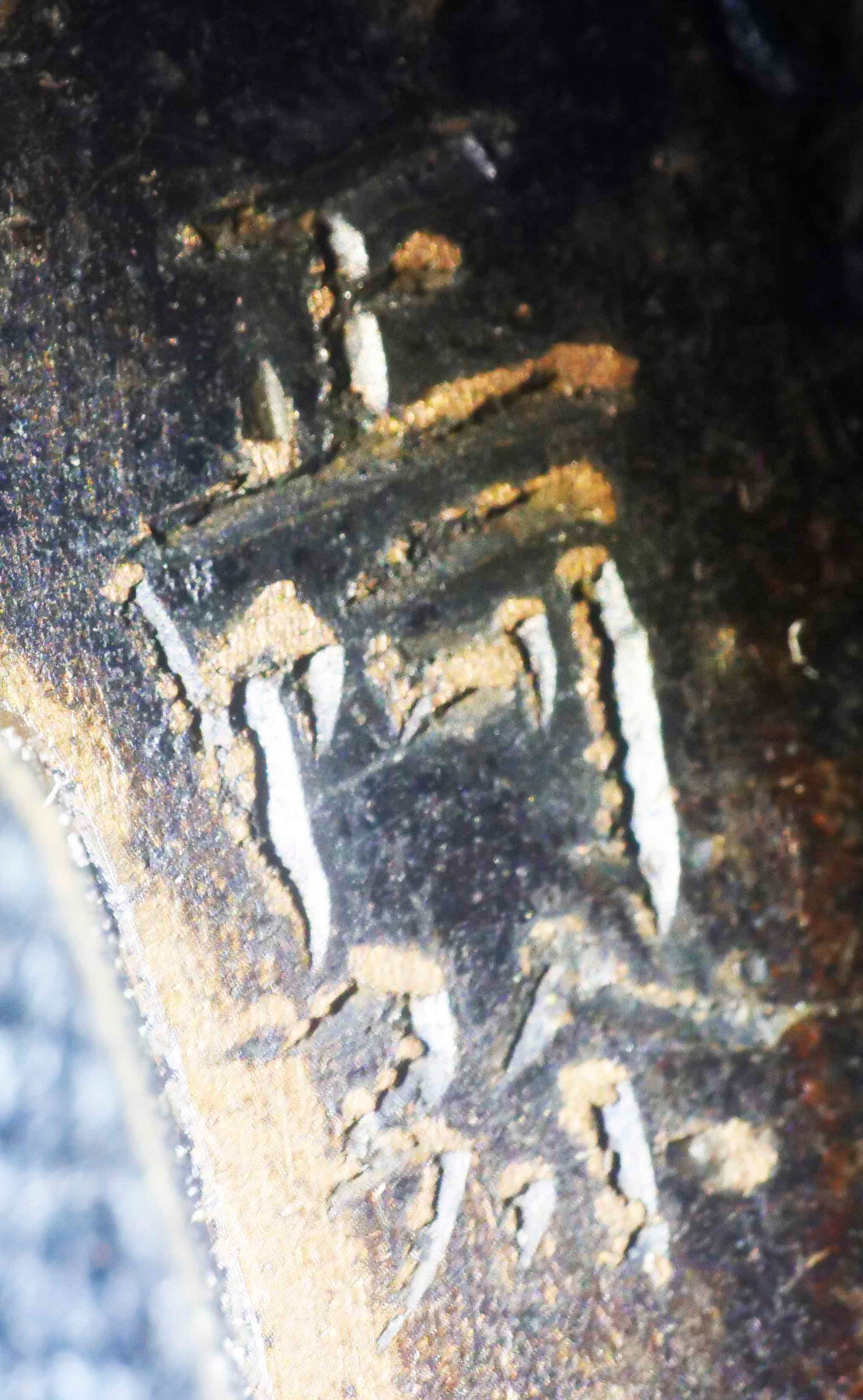
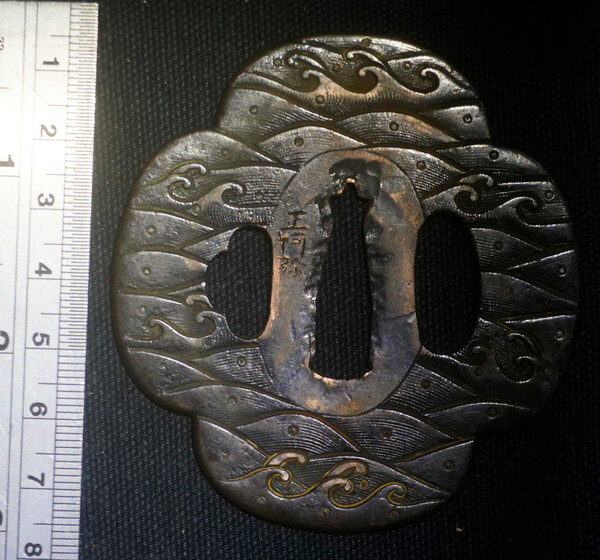
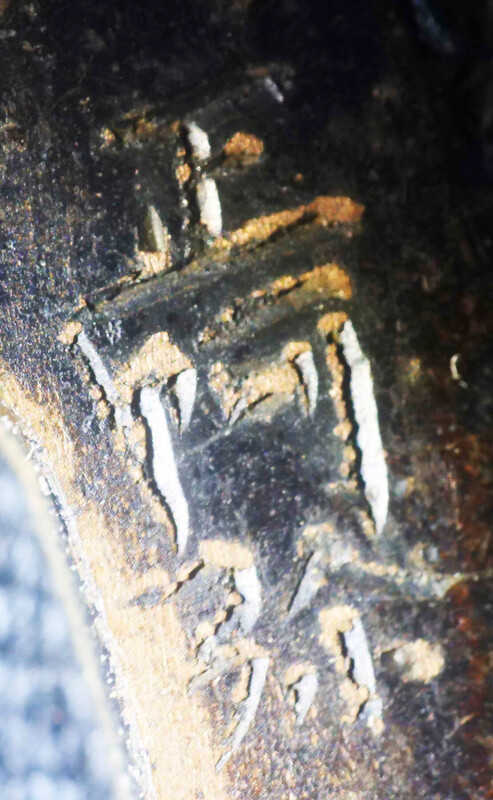
I had previously shared a photo of this tsuba in a post about the wakizashi I recently acquired, but I have some specific questions about it It's a copper alloy (shakudo) tsuba with a Shoami mei. Does the shape of the Nakago ana indicate that this was previously mounted on a sword worn edge down, or is there another reason for this shape? Does this work look like a Shoami piece? Is it possible that if it was converted from edge down mounting to edge up mounting, it was signed by the Shoami artisan that did the conversion? Any thoughts on the form of the "mi" character? I have seen this alternate form of the simplified character on a couple of tsuba attributed to the Iyo branch of Shoami. Thanks for all thoughts and wisdom! Robert S
-
Thanks again everyone for the guidance and thoughts - really helps me learning what I am seeing - it's so easy to get way off track when you know as little as I do :-) . I think I'll consider whether to get it a proper polish - I know it's probably not monetarily worth it, but it feels like it would be rewarding to see what that would bring out. I did wonder whether those nioi/ni islands in the ha would be diagnostic of a particular maker or school?
-
Rivkin: Thanks so much - super helpful. Does the extremely slender/light/tapered shape also suggest Mino to you? So many of the wakizashi that I see from that period seem to be much more robust.