John C
-
Posts
3,410 -
Joined
-
Last visited
-
Days Won
21
Content Type
Profiles
Forums
Events
Store
Downloads
Gallery
Everything posted by John C
-
Well, there's your answer. It just got worse with the made-up chicken scratch. No reason to look at it any further. I would pass on all of it. John C.
-
It seems in some ways these were produced for troops, though as cheaply as possible. The troops may then have engaged in "trench art" to simulate the real thing during down time. But I agree that it would be too much effort for a fake... make a casting and get it over with if you are going to fake it. Just thinking out loud. John C.
-
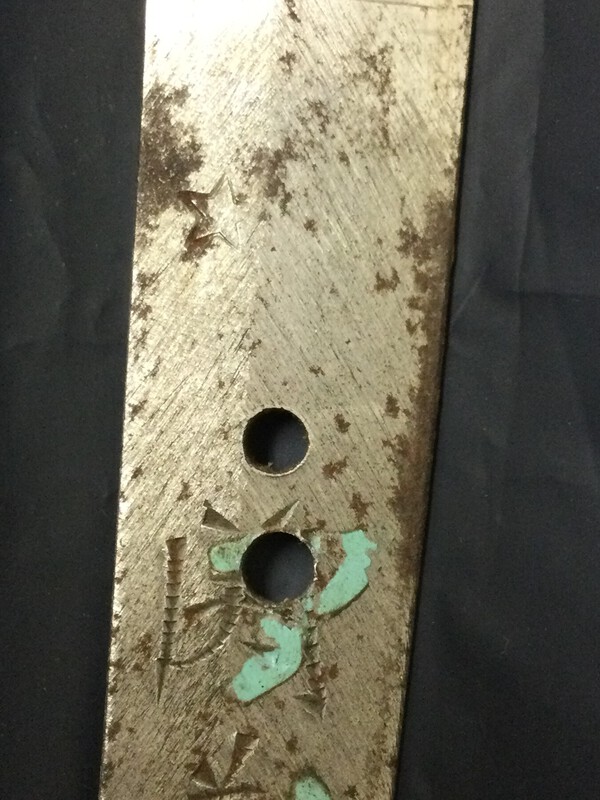
Mal: And the star stamp. John C.
-
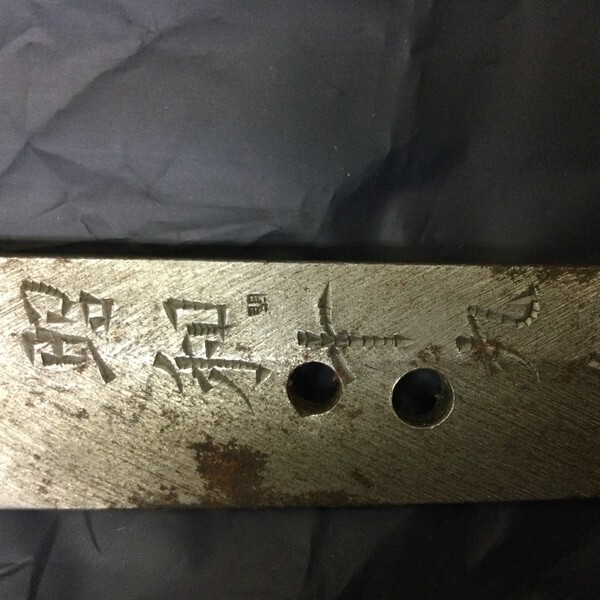
Mal: Here are the stamps. John C.

-
Francois: You are correct! After looking at the sword in detail, the seller used pictures of the actual sword and "augmented" the listing with pictures of the Yakiba sword! Attached are pics of my sword in hand. Everyone please comment on this sword. My feeling is the sword and mei are correct, however what the seller did bothers me. John C.

-
Francois: I see what you mean. I will try to take close ups of my blade and post them for comparison. But I do not have very good cameras.
-
More pics of the blade... taken from the auction site. I could not capture any good shots. John C.


-
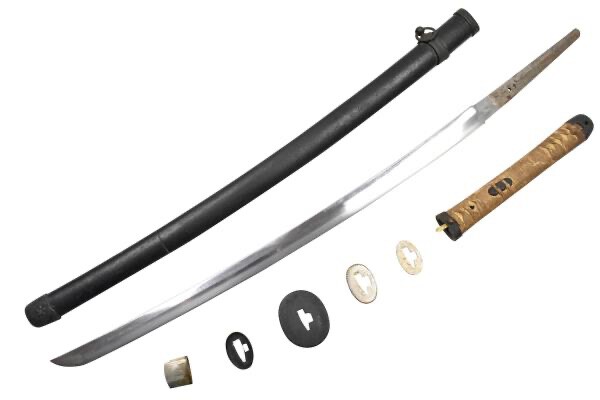
Hello everyone: I have some questions about this Kanehide gendaito you all might be able to answer. 1. Do you think the mounts are original to the blade? I ask because there is no makugi-ana near the bottom of the nakago. 2. Why would there be two sets of painted assembly numbers? Is that related to possible changing the koshirae? 3. The blade is star stamped with two small seki stamps (one in the date and one on the mune). The stamps are correct, however, seki and not NA stamp? Is that common? Thank you, John C.

-
Is the type 32 in the same boat as the 19?
John C replied to Bridges's topic in Military Swords of Japan
Not sure about the stamps. Ohmura mentions a taisho era "2" works for the arsenal. These marks are 3, 4, Dai, above the Tokyo arsenal mark with two inspector marks below. Not sure what the 4 is in the middle and the Dai looks pretty sloppy. Is there a "Ho" stamp below the serial number on the scabbard? It's hard to tell. Just my observations. John C. -
As Matt H. said, I have not seen a dip in the market. I have yet to find a sword at low prices that others say they pay. But that said, remember that any collectable is speculative - may go up our down - based on current interest. So IMHO, pay what you are comfortable with if you really want it. Enjoy it. Stare at it. Study it. I think the only real regret is not owning the one you wish you had bought for your collection. John C.
-
The real value at this point would be in the leather cover. But to answer the question directly, it probably was not an official gunto. Even family swords purchased at the end of the war by the army had to be at least 21.5 inches in length. John C.
-
In the second pic, is he using his sandal? The last pic reminds me of the scene in David Bowie's Merry Christmas, Mr. Lawrence when the sword was being purified prior to an execution. John C.
-
Did it come with a tsuba (guard) or just what is seen above? John C.
-
Based on the position of the last kanji, it looks as if the mei was added after the nakago-jiri was re-shaped from its original. My vote is for gimei. John C.
-
Difficult to see but it does look acid etched. All you can see is a line with no "activity." In addition, the blade is the wrong shape and too evenly "polished", which I believe based on the pictures is just chromed. Best advice is to use this sword as a learning tool to discover what a real sword looks like...and doesn't look like. Regards, John C.
-
Okay. So I think I got it partly correct. The statement I made above was in reference to the article's mention of "a subdued whitish color", which is different from what Tadayoshi was doing (at least that was my understanding). I will need to go through Markus Sesko's kantei series (which I have already started reading) to further my understanding of what these elements actually look like on a blade. Applying the verbiage to actual examples will hopefully help me visualize the differences. Thank you, John C.
-
It's hard to tell without seeing the rest of the blade. But keep in mind that signatures have always been faked; often times extremely well. In fact, blades are judged on the elements of the blade itself regardless of the signature. Pretend it isn't there and focus on the aspects of the blade. You may find it is a decent war relic after all. John C.
-
John V.: Is that an example of Hizen tetsu or maybe slag left behind in the forging process? John C.
-
You can see that the end of the tsunagi has straightened and does not match the curvature of the blade. That is probably what is causing it to bind. You can sand the end of the tsunagi down so that it fits, which will change the end shape or you can steam (or boiling water) bend the end back into shape (google how to do this. You will need a jig or form). But as Mark said, it's just there to hold everything in place when the blade is not there so it is up to you. For that matter, make a new one! John C.
-
Kyle: I think both are not original to the blade, meaning they are not factory. The mark is probably a "mon" (family crest) carved into the tang by the owner when he was bored...or after it was surrendered. The signature is fake as well, though this is quite common. John C.
-
At this stage of my development, I should have picked a gentler task! It seems Tadayoshi's style was similar to that of the masters he copied; e.g., Shizu Kaneuji. One of his “trademarks” was to use a “dense” ko-mokume hada known as konuka-hada. I have also seen this described as “tight” or “fine.” (https://nihonto.com/shodai-hizen-tadayoshi-初代肥前忠吉/). Another was his chu-suguha with deep ko-nie and ashi. Of note, early on Shodai Tadayoshi had a coarse, unrefined Koto style hada called Hizen tetsu (blackish steel with ko-mokume hada typical of Koto work). This would be different than what would be seen in a typical Naoe-Shizu blade. In terms of Naoe-Shizu, the style was similar to that of Mino shizu with less curvature and somewhat lighter blades. (http://www.sho-shin.com/naoe.htm). In addition, they favored a wide mihaba and O-kissaki (https://new.uniquejapan.com/a-naoe-shizu-school-juyo-katana/). Moreover, the typical Naoe “signature” was no signature (mumei). I know this does not answer the question directly, however I think the first step in identifying an utsushi blade would be to understand the styles of 1) the individual purporting to have made the blade, or 2) the school to which it was attributed. I will study the elements of kantei over the next few months and re-visit this topic at a later date...and hopefully be able to provide more cogent response. Oh, well. I gave it a shot. John C.
-
Jay: Personally, I would not use gun oil as it may "open" the pores of the steel, which it is designed to do. Choji oil (sword oil) is 90-99 percent mineral oil. So if you have some food grade mineral oil (it's lighter than standard mineral oil) you can use that. A VERY thin layer is all you need using a clean cloth, preferably microfiber. Grey Doffin recommends sewing machine oil, which is also good. As for the scabbard, you may consider a very thin layer of wax. But really, you don't need to do much to it. Another consideration is whatever your goals are for the blade. Some folks here restore their blades and scabbards (by painting them) because they want to display them and are not concerned with intrinsic value. Your blade; your choice. John C.
-
STEFd: If you bought it knowing what it was, then I think you still have an interesting piece of history that tells a story of the opening of the East to the West. And in a separate way, an historical piece on the history of commercialism and tourism. John C.
-
Jacques: In an effort to learn, I'll bite. Firstly, I had to google "utsushi", which I assume means "copy." Secondly, I looked for a connection between Tadayoshi and the Naoe-Shizu school. I could not find a connection, though admittedly my resources are quite limited. I did find out there were 9 generations of Tadayoshi, with the 8th gen not receiving a title (from Nagayama). Next, I looked up the qualities of the Naoe-Shizu school. I found an article that referenced the following description about a Naoe-Shizu blade: "This blade demonstrates many of the qualities that make Naoe-Shizu stand out above the norms of the time. The sugata is grand without being excessive, the hada tight and clear with a lot of activity and the hamon is gently cultivated and complex. It skilfully [sic] avoids the excesses of the period while at the same time it resisted falling in to the contrived patterns so familiar in Mino work." As a novice, I am sure I am missing a connection here. But to give a specific answer about sugata, hamon, etc.,, I first need to know whether or not Tadayoshi is somehow connected to the Naoe-Shizu school. Any hints? John C.
-
Gaikotsu Katana? Help, info needed
John C replied to Bridges's topic in General Nihonto Related Discussion
You can find more of this theme from Fred Lohman, if you decide to get it and deck it out. https://www.Japanese-swords.com/pages/skull.htm John C.