
Soshin
-
Posts
2,934 -
Joined
-
Last visited
-
Days Won
3
Content Type
Profiles
Forums
Events
Store
Downloads
Gallery
Everything posted by Soshin
-
Hi Henry W., Thanks for the reply. I love the solid gold fukurin don't see many of them. :D To answer my question above truthfully the longest I have waited for a tsuba is only about four months. Bulding patience and saving money is a work in progress for me. This is not counting the very few high end tsuba that I traded much of my former collection for. Yours truly, David Stiles
-
Hi Everyone, Just wanted to post this link to a new article I found online by very long time collector, scholar, and prolific writer about tosogu Mr. Robert (Bob) Haynes: http://www.shibuiswords.com/joshuHaynes.htm. The website also contains fair amount of information about him you can also search the Tosogu forum and find fair amount of information about his work. It is a really interesting article to read as it discusses his most recent (March 2012) acquisition of a famous tsuba which he waited the last 60 years to purchase. In a era of short attention spans, quick fixes, express shipping, and impulse buying on eBay ( ) it is really refreshing to read about someone waiting that long to purchase a tsuba let alone anything. The take home message I get from reading the article is to keep saving my money for the really nice pieces that sometimes goes up for sale if you are very patient. What is the longest you have waited to purchase a tosogu? Comments, questions, your own stories are welcome. Take care and thanks for reading. Yours truly, David Stiles
-
Hi Grev UK, A little hint the last character is the pre World War 2 unsimpilfied (many strokes) Kanji for tsuba. I hope this helps. Yours truly, David Stiles
-
Hi Everyone, Just wanted to let everyone know that after searching my large collection of NBTHK Token Bijutsu monthly magazines I was able to locate a issue that had a small section about the Goami (Kiami) school from Aki Province and provided four signed examples. It is issue number 625 from 02/2009 for NBTHK members. Why I am quoting Curran's remarks above is that in the introduction about Goami school it discusses on page 28 that their were two representatives of the Goami school that used the name Masachika and would sign their work "Goami Masachika" the first being during the early Edo Period and the later which worked in the Tenmei era from 1781-1789 during the later part of the Edo Period. The magazine also says that the Goami workmanship is artistically Shoami with ita-tsuba done in sukidashi-bori with zogan or sukashi-tsuba done in nukubori ji-sukashi with zogan. All four Goami signed examples have a polished finish or migaki-ji surface this is contrary to John L. comments. Unfortunately no examples they provide have any inlays or zogan of any type. With this all said I still agree with John L. analysis of my tsuba a begin a presentation tsuba or Kenjo-tsuba of the Awa Shoami school primarily due to it being unsigned with high quality and large amounts of inlay work and the fact that there are places along my tsuba where the inlays have been carved. This is a characteristic of inlay work of the Awa Shoami school who often made Kenjo tsuba. I learned these important facts after reading the Awa Shoami and Kenjo sections in Tsuba An Aesthetic Study. Comments or questions are welcome and thanks for reading. Yours truly, David Stiles
-
Hi Everyone, After reading the Awa Shoami section of Tsuba An Aesthetic Study the answer to my above question is yes. The Awa Shoami school used both inlay techniques using different soft metals on iron around the time of th fifth generation master Masayasu of the Hirata family circa the middle Edo Period. Haynes's index lists in entry for Masayasu (04768.0) a work period of ca. 1750. Would love to see some more examples of his work so I will keep a look out. Hi John L., Thanks for the additional reference added information about the Goami school. Yours truly, David Stiles
-
Hi Christian, Thanks for the information about the really nice tsuba I like on eBay. Now I know what to ask for when I make a offer for it. I'll let the seller make a little profit but not over a 100% profit. Alex, This is an example of asking a more experienced collector their opinion before you buy something specificly on eBay. I hope you find this information helpful. Yours truly, David Stiles
-
Hi Alex, Here is a link to my current favorite tsuba on eBay and at a fair deal: http://www.ebay.com/itm/16-C-TSUBA-NBTHK-TOKUBETSU-HOZON-Japanese-Samurai-Sword-Menuki-Fuchi-Kashira-/280938925562?pt=Asian_Antiques&hash=item416943cdfa. One correction I feel the tsuba is likely 17th Century (1600s) as it was papered to Shoami and not Ko-Shoami by the NBTHK. I need to get back to saving my pennies I hope my piggy bank is large enough. :lol: Yours truly, David Stiles
-
Hi Geraint, Both look to me (i.e. opinion) like middle to late Edo Period kinko tsuba about average quality for the time period. The second one might just get a attribution to Kinko if submitted for shinsa. I not sure I can get any more specific as this is not my area of focus for my collection and both are not signed which does help. Yours truly, David Stiles
-
Hi Brian, Glad you like the tusba always good to keep the administrator happy. This tsuba was the replacement from Grey Doffin for this tsuba discussed on the NMB: http://www.militaria.co.za/nmb/viewtopic.php?f=2&t=13376. The tsuba while showing some evidence on the seppa-dai of being mounted on a Nihonto for a while at some point displays all of the characteristics of a tsuba that has been very well taken care of by all of its former owners and have avoided excessive tarnishing of the brass and rust pitting of the iron. I am always happy to see this on a tsuba. :D In regards to your second question to the best of my knowledge the inlays are brass and not gold but I can do more research on this. Does anyone know what low alloy gold look like mixed with brass? Hi John L., Thanks for the reply I agree with you analysis of the similar tsuba listed on the Lion's Gate website. Looking at my tsuba I also would agree with the middle Edo Period age as the iron looks very well forged but homogeneous in character and lacks any tsuchimei-ji or tekkotsu on the surface or along the rim typical of Shoami tsuba from the early Edo Period. One quick question about the Awa-Shōami school did they also use brass flat inlays (shinchu hira-zogan) techniques with their inlays in addition to the normal kin nunome zogan type often seen on Kenjo tsuba? Thank again for taking the time to answer my question. P.S. Attached is another photograph I did with my iPhone under different indoor lighting. Enjoy. Yours truly, David Stiles

-
Hi Everyone, I came across this other tsuba that is the same design but not rendered nearly as well and in poor condition in terms of the iron plate: http://www.antiqueswords.com/product-1132-Outstanding-Early-Edo-period-Ko--Hagi-Iron-Katana-Tsuba--ca.-1600.htm#ad-image-0. Lion Gate says that it is a Ko-Hagi tsuba circa 1600. I didn't know this school used brass inlays in their designs but then again I am not familiar with that school. The measurements are similar to mine with the exception of thickness my tsuba is only 4.0 mm thick at the rim. The 4.0 cm thickness might be a typo. Enjoy everyone questions and comments are always welcome. Yours truly, David Stiles
-
Dear Jean et al., Thanks for the notice. I am not really interested in collecting tsuba with such a similar design. I want to keep my collection relatively small will only nice too great pieces all in excellent condition. The tsuba in the auction I would likely get it in hand and start to rub it with some bone and a cotton rag and have it collapse into rusty fragments. The rim looks heavy pitted by rust. I also find it interesting that the nakago hitsu-ana has not been altered. Yours truly, David Stiles
-
Dear Peter F., Thanks for the link. It does look very similar to mine but I agree my tsuba is in much better condition. It might have been made in the same work shop as my tsuba in the Edo Period. The auction text does not saying anything about Yagyu but it does state Edo Period. Yours truly, David Stiles
-
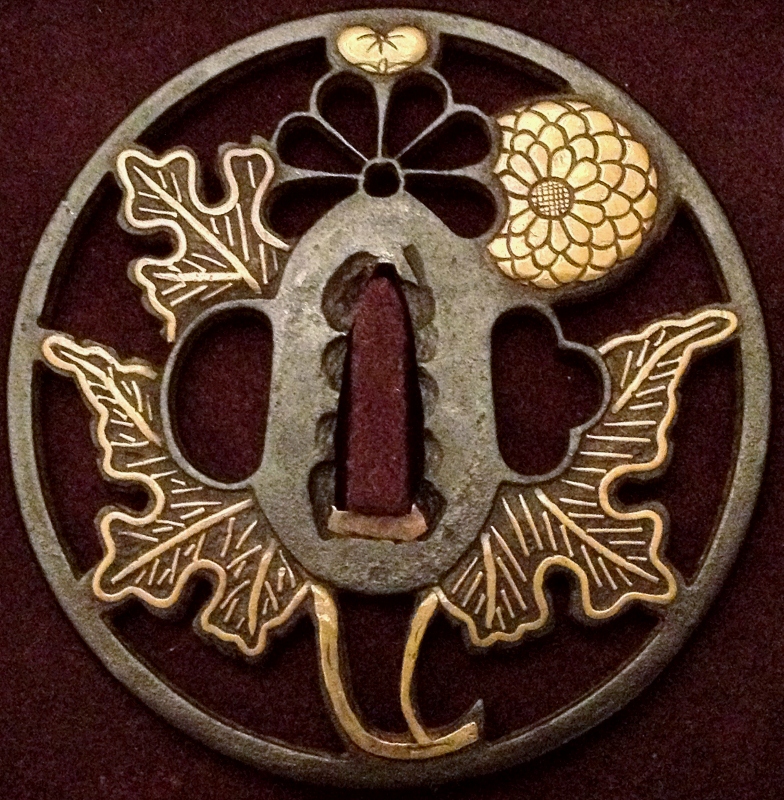
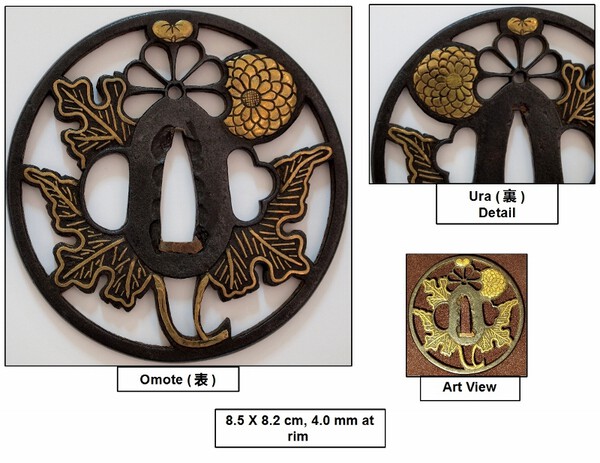
Hi Everyone, Here is the new tsuba to my now much smaller collection who the former own was thinking it was a work of the Goami (Kiami) school circa the early Edo Period. It is unsigned. Two of the photographs were photographed under different light conditions and angles. I don't have much experience with photographing tsuba with this much inlay work. The size of the tsuba is a large one at 8.5 X 8.2 cm with the thickness at the rim is 4.0 mm. I am thinking it could be Goami or possibly Kyo-Shoami work. Often you see this intermix of ji and kage sukashi is Shoami designs along with inlay work. The design is of the Japanese Chrysanthemum (Kiku) with leaves. Not sure what flower is pictured in the inlay at 12:00. It might be a flower bud but I am not sure. The overall feeling of fine craftsmanship of the tsuba and specifically the quality of flat brass inlays (shinchu hira-zogan) is wonderful. The very dark brownish black color of the iron contrast well with the finally patinated brass inlays. Please feel free to comment and questions are welcome. :D Yours truly, David Stiles
-
Hi Curren, Thanks for the additional information. I was going to purchase that book as well soon. It came up in my Google search. Here is the Haynes Index entry for H 03836.0. Yours truly, David Stiles
-
Hi Everyone, I came across this another tsuba that is signed Goami (Kiami) Masachika Saku here: http://www.silk-road.us/masachika1.html. The current owner lists a Haynes Index reference number 03836.0 and an association with the Kyo-Shoami school. I will check my copy of Haynes's index for that entry and update this post when I get a chance. I hope to be able to take some photographs of my tsuba on Saturday and update this topic. The above example is also consistent with my tsuba as well. Yours truly, David Stiles
-
Dear Pete, Thanks for the link I didn't know anything about it. Being a JSSUS member I will purchase the translation. Yours truly, David Stiles
-
Dear John L., Thank you so much for the Kanji of the name which I didn't know and all of the alternative readings of these Kanji. I find it interesting that the last two Kanji is the same as the Shoami (阿弥) which has its origin in the Ashikaga Shogun government of the Muromachi Period as a title given to subjects gifted in the arts. I will do more searching on the internet using these alternative readings and the Kanji themselves. I will check the reference out as soon as I can. If anyone as the reference please reply or PM me as I would like personal copies of these three pages two from the translation and one from the Japanese original text. I will also check my massive collection of the NBTHK monthly magazine for any fine examples of this school work. Why I am asking is I think I have a new tsuba from this school after reviewing the previous owners notes about the tsuba and wanted to do more research about it. I will post photos of the tsuba in question as soon as I can. P.S. Did a quick Google search for "Goami tsuba" and found this NBTHK Hozon dai-sho example of the Goami (Kiami) school: http://www.sanmei.com/contents/media/tu ... 1788_E.htm. The seppa-dai shape, ryo hitsu-ana and rim style is very similar to my tsuba. Yours truly, David Stiles
-
Hi Everyone, I have been actively searching for references for the Kiami School from the Edo Period. I came across little bit of information from auction websites. Starting with eBay all the ways up to Christie's and other fine auction houses. From the very limited information from the auction websites I found that Kiami school made gift tosogu used by Daimyo. This makes me think iebori versus machibori kinko. Their tsuba are often worked in brass, silver, and gold hira-zogan (flat inlays) along with both kage and ji-sukashi. This there any relationship between Kiami School and the Kenjo (presentation or gift) tsuba discussed in Tsuba An Aesthetic Study by Torigoye and Haynes on page 217? It discusses the Kenjo tsuba being produced for the upper classes of Kyoto including Daimyo and were almost always unsigned using some of the above techniques including nunome-zogan. Would love to find some references, examples, or information about the Kiami School in either English or Japanese. Thank your for taking the time to answer my request for references or information about this school. Yours truly, David Stiles
-
Hi Henry, I'm trying to find a smiley for envy. I think this could be it but I am not sure. As I have said again before in the thread. Very nice tsuba! :D Yours truly, David Stiles
-
Hi Everyone, I would like to take a moment to thank Ford and Lorenzo for pointing out what was at the time a new addition to my collection. Please continue to help other people in your free time on NMB. I am also thankful that I posted the tsuba on NMB to allow people to provide feedback about it. It would have been likely years before I would have learned the truth about the tsuba otherwise. Grey and Skip have been really great with allowing me to return the cast tsuba and exchange it for another tsuba from the same large collection. I will be sure to post the new replacement tsuba as I am sure It will be a interesting research subject. Yours truly, David Stiles
-
Hi Henry W., Again very nice tsuba. To me this tsuba was likely used on a Tachi and not a Uchigatana. This explains who purchased the tsuba from the Yamabushi website. One minor point with your write up the shape of the tsuba is maru-gata not goishi-gata. To see a good example of the goishi-gata shape please refer to my Daruma tsuba I posted with NTHK kanteisho. It says goishi-gata on the paper. Yours truly, David Stiles
-
Hi Matt L., Nice job. Keep up the good work. I normally only work on plain iron as anything will inlays like that is really hard to work with. Post more photos of your future work. Yours truly, David Stiles
-
Hi Colin, I like your tsuba better then the tsuba in the book. The expression on the Catfish face is much better in my opinion. In the Japanese text of the book the size is not listed for the tsuba. Your tsuba wound be a nice addition to anyones' collection. Yours truly, David Stiles
-
Hi Jean C., I used the incorrect term in my original post that you quoted. I was meaning lamination fold caused by the tsubako using three layers of two different types of iron. These lamination folds should not be confusioned with a casting seam and are a important kantei point for Yagyu tsuba. These lamination folds are not related to tekkotsu but Yagyu tsuba often also them as well. Yours truly, David Stiles
-
Hi Curran, Thanks for the reply and good summary. I think Jean C. means well but is mistaken in this regard lamination folds along the rim as a sign of cast iron production. I think this tsuba in question would fit into the other but likely Owari category. I already have one tsuba in my collection that I think is Ko-dai, Yagyu with a nice Sai-Hai theme. At some point in the future I will like to submit it for shinsa. In regards to the 1st era Yagyu tsuba from the early Edo Period you are completely correct. They are extremely rare and would be nice to see in hand at some point in the future but is not my cup of tea in terms of actually having them in my collection. Take care and I hope all goes well. Yours truly, David Stiles