Matsunoki
-
Posts
3,825 -
Joined
-
Last visited
-
Days Won
71
Content Type
Profiles
Forums
Events
Store
Downloads
Gallery
Everything posted by Matsunoki
-
The figure is Gamma Sennin and the bowl definitely belongs with it.
-
Eg……

-
You often find this kind of bowl (or Buddhist temple gong) being held aloft by bronze samurai. Usually Meiji. On the okimono the gong usually sits atop a shallow saucer which can be shaped vaguely like a lotus flower. The silk cushion that usually sits between the gong and the “saucer” is normally missing as is the padded stick used to ring the gong. Am I close?
-
Hi David I’m not sure what was happening in the Oz sword world in 80s or 90s but certainly in the UK during that time we had a few “restorers” who used acid (I wasn’t one of them!!!). Sadly some still do. Back then there were precious few polishers and precious little widespread knowledge or understanding so many swords suffered at the hands of mis-informed (but often very enthusiastic) diy practitioners! Maybe it was the same down under?
-
Don’t “suppose”. Check it. Too late once it’s done.
-
Photos still not great but the fittings excl the tsuba look like en-suite iron Han-dachi mountings. Double habaki looks old. Saya looks old with ishime black urushi. Blade looks like it’s had an acid clean-up sadly. Someone swapped the tsuba at some point. A genuine old sword that’s been a bit “got at”?
-
Usually it is the Kogai that is stored in the slot running under the kurigata. The kogatana/kozuka is usually stored in a slightly wider slot on the other side of the saya ie the side that faces towards the body when worn. There is often a reinforcing small fitting at the base of that slot which can be made from various materials…..most often lacquered horn but also ivory, metal, wood. For example…. KOZUKA KOGAi Hope that helps?


-
One last comment. the orange encrustations are as you know rust that is erupting through a surface coating ie iron oxidisation the black is almost certainly a thin coat of black urushi that has been applied and you have successfully cleaned it off. presumably the urushi was applied to protect the fittings from rust or to tone them down for aesthetic reasons now I am gone
-
Sorry, I’m not bothering anymore. You are right.
-
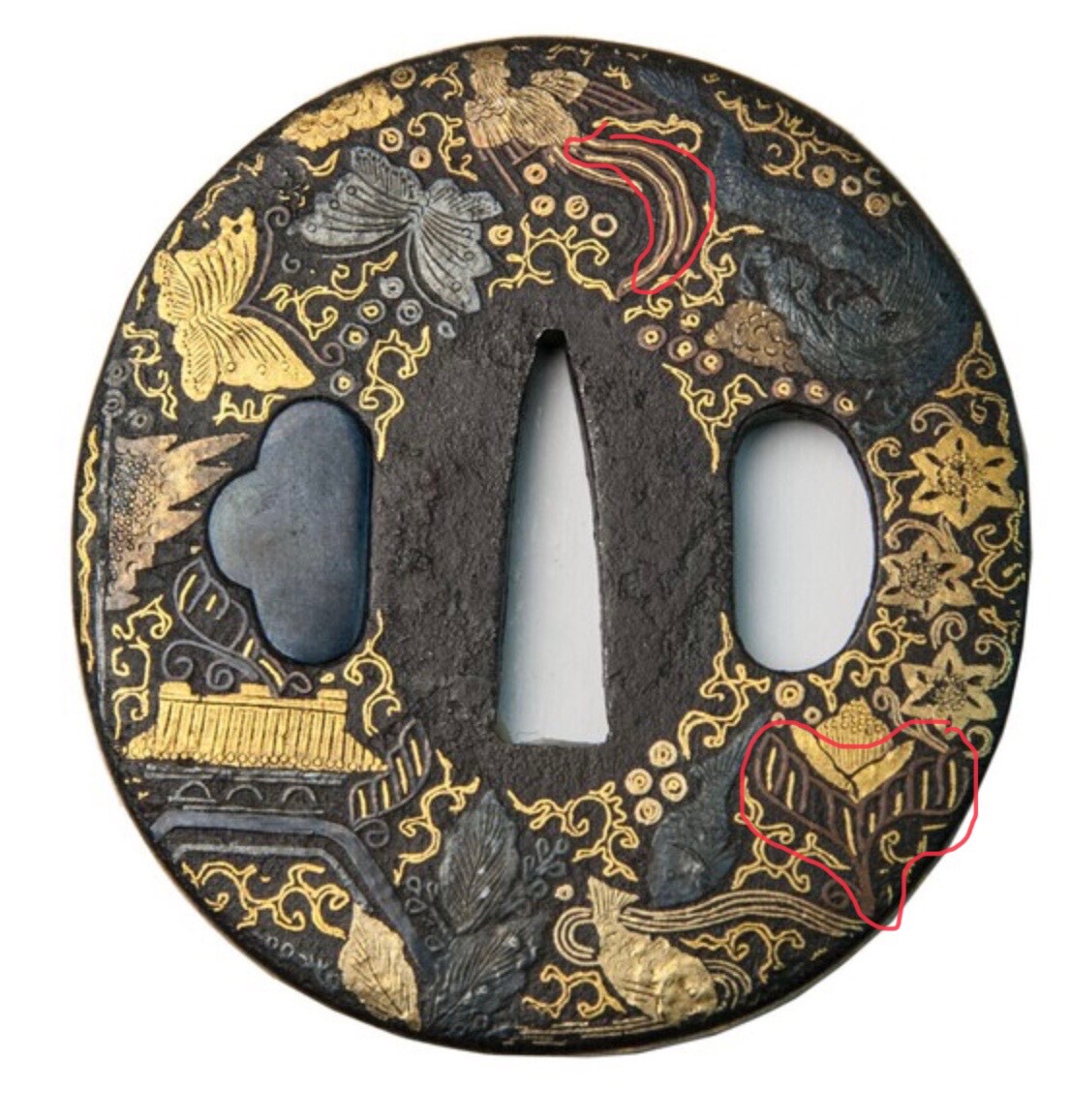
Afaik gold does not oxidise to black….or any other colour in normal atmospheric conditions. Be serious. I’ve handled a great many items made by Komai and other artists using the komai techniques. Tsuba, boxes, kodansu, koro etc and where silver nunome was used it often looked exactly like the butterfly, dragon etc on the pieces in question especially if it hadn’t been cleaned. I have never seen gold oxidise to that colour, not even low carat gold. you sometimes see iron oxide that creeps over the edges of both the gold and the silver nunome but it is totally obvious ……it looks like rust….its orange! ……so, it’s not so obvious is it?
-
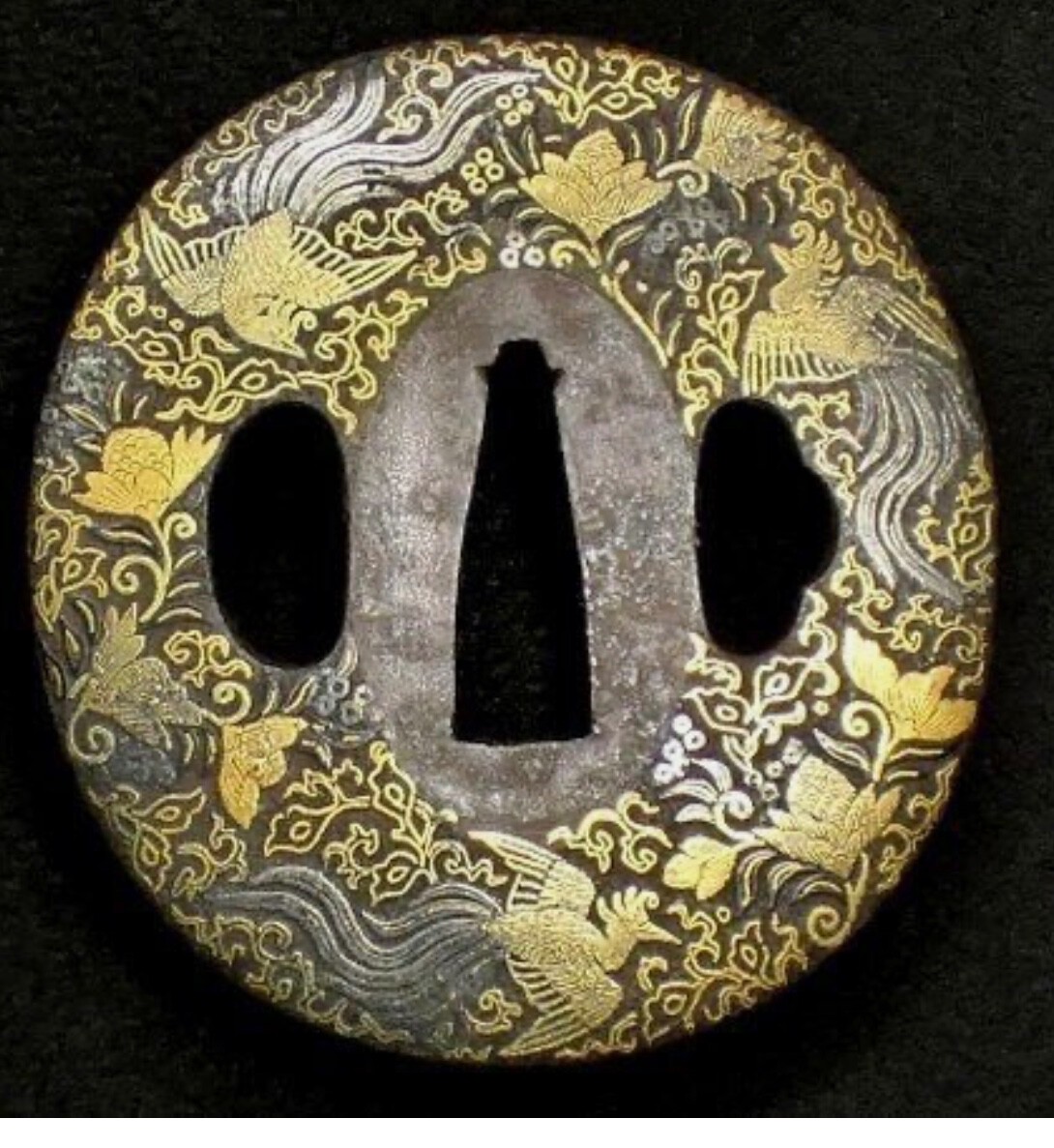
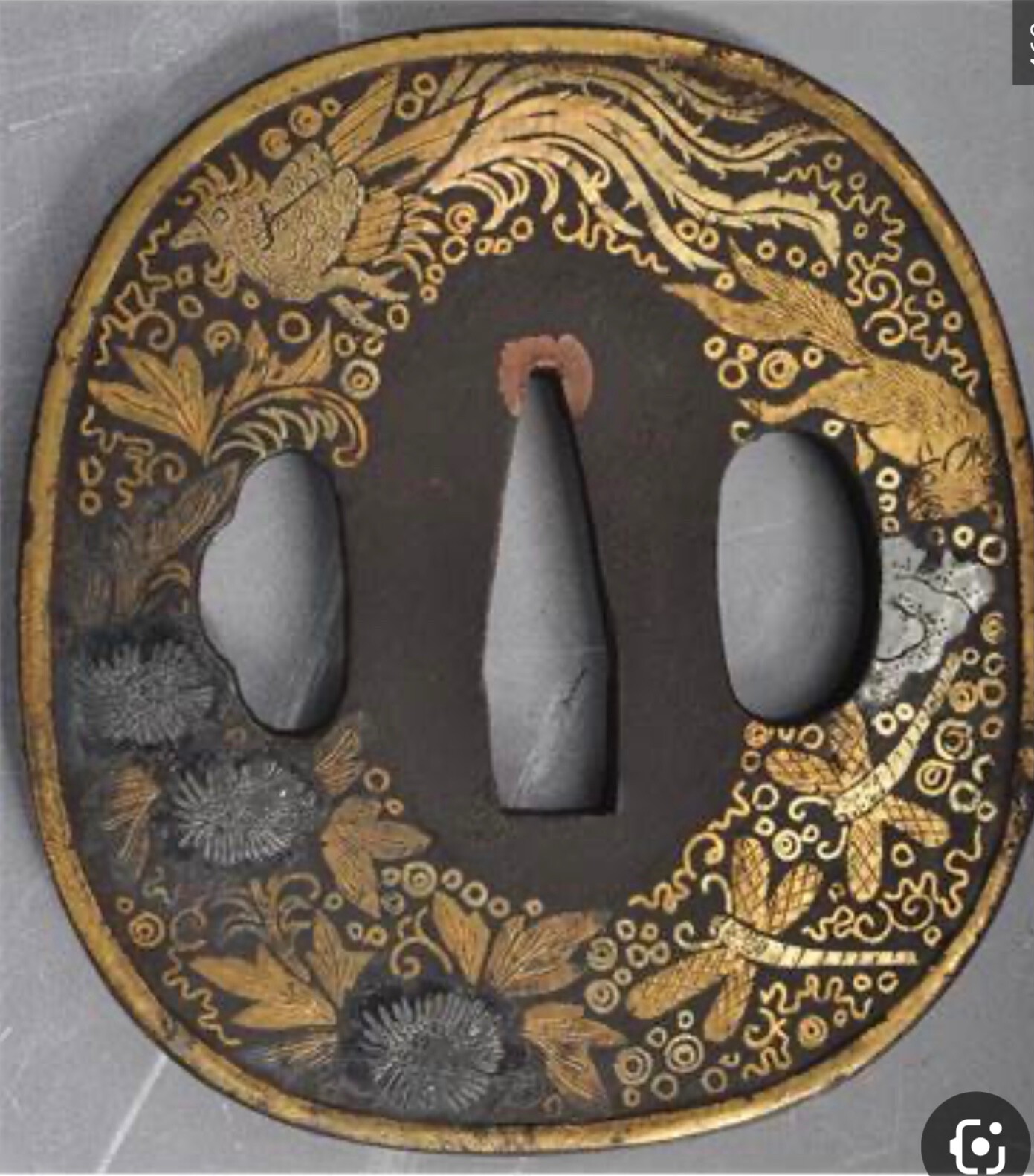
Similar examples of mixed silver and gold nunome? on one (imo)you can see where the silver has “bled” onto the iron as frequently happens on “komai” style tsuba


-
Seriously…dragons, butterfly etc ..all gold originally? So one fish is perfect gold, the one right next to it has lost 100% of the gold? The dragon and butterfly have very precisely lost 100% of their gold yet surrounding details escape unscathed. To me those areas look exactly like old silver nunome that has simply tarnished. (The use of mixed silver and gold nunome on tsuba is not that unusual is it?) Gold itself as we know does not tarnish so what technique/material (base and overlay) are you suggesting was used to create the dragon, butterfly etc that facilitated such precise discolouring leaving no trace of the gold?
-
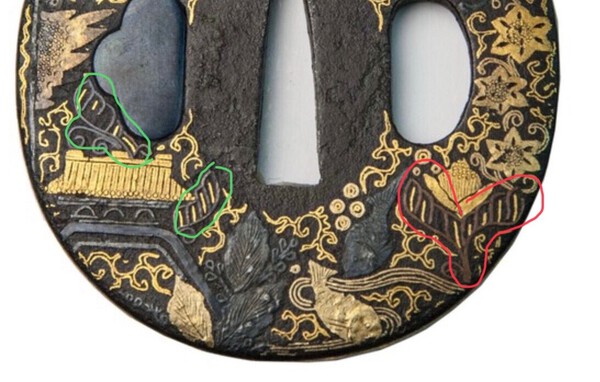
Also compare the area outlined in red to that outlined in green. Would you argue the green area has also lost its nunome from what appears to be the same technique but in a silver “inlay” that to my mind also looks like it never had nunome on it? It looks like the artist used the same technique and design within both the red and green highlights….ie thins lines in a different material that never had nunome in them. There is absolutely no trace of residual gold overlay. Your theory of oxidisation followed by cleaning makes no sense to me.
-
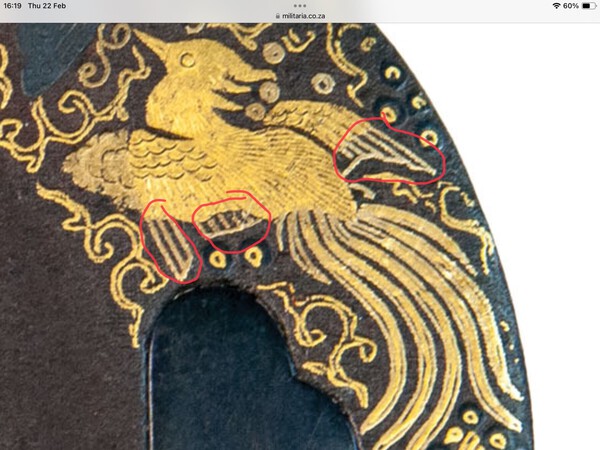
Doesn’t look remotely cleaned to me. The shakudo and silver nunome look exactly as I’d expect them to look….ie untouched, or are you now going to suggest they have been subsequently repatinated? Or just the areas that suit your argument have been cleaned? I’m well aware of the value of the forum.…..and I’m not unwilling to accept the obvious, I’m just unwilling to accept all that you say when a lot of it is not actually obvious. If you look very closely at the detail on the one Dale posted I believe you will see the fine lines in question are a subtle different colour to the remainder of the gold. (See red outlined) These also correspond to the areas where the nunome appears to be missing. Possibly a different alloy of gold? Possibly a different alloy altogether? Again, I like facts, not opinions. However you obviously don’t like your opinions being challenged and instead resort to …..
-
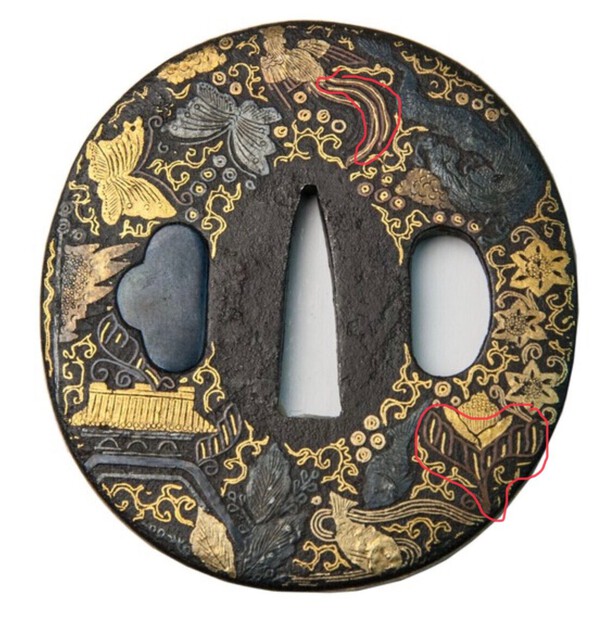
Then please explain why the gold is well adhered to the iron but apparently totally lost from the copper with no trace remaining whatsoever….see the two areas circled in red Anway, seems only you and me care🙂
-
@Tcat Hmmmmm, I’m not so sure. It appears that there is indeed copper inlay but absolutely no evidence that any of it had gold nunome applied on top. It looks like two totally different techniques to me especially on the “flower/bud” bottom right on your example. And if it was used to create a better base for nunome adhesion I’d say it’s failed miserably. Nope, I’m not convinced. I even wonder if the “copper” (if that’s what it is) is also applied using the nunome technique. Cannot see why not if it’s thin enough and softened.
-
@Ilovekatana please can we see an image of the full length of the nakago looking down on the mune? To my old eyes the lower portion of the nakago does look pretty old…..be interesting to see if the nakago kasane varies along it’s length Also looking at the nakago overall it looks machi okuri and to me there is clear evidence of reshaping to create especially a new hamachi. You can see the tapering. You can also see fresh yasurimei on the mune below the mune machi. I’d say the nakago has had a lot of reworking. Just opinions…..probably worthless🙂…..but I like to try and actually see rather than just look.
-
You say definitely…..evidence?…..or just your opinion?
-
Had to look that up Brian……thanks for educating stoneage man🙂. Now I understand…..but it was much simpler back then in that stoneage.
-
Staying off topic (sorry) but can someone tell me what exactly the people that post these “spams” actually get out of it? Yes, sorry (again🙂)…..I know I’m tech stoneage but I’d like to understand.
-
Howard, the generic term for your box is “kobako” ie small box. Looking at the condition and decoration it is most likely early Meiji but good quality. I do not think the decoration is intended to specifically represent family kamon. When “pure” kamon are used on lacquer the intent is much more obvious ie they use actual Mon with no ambiguity. However having said that, at that time the use of kamon in art became a very loose matter for example Imperial and Government kamon were plastered over all sorts of things that had no connection to actual original affiliations. Your brocade or diaper pattern designs together with natural subjects were often used on lacquer from this period. If you search Bonhams past lots for kobako you will find many to compare in a great variety of shapes, designs and techniques. These boxes probably did not have a specific purpose beyond just a pretty useful little box more likely used by the ladies of the period be they Merchant or Samurai. (Merchant is far more likely although like many things at that time….they appealed greatly to the early Gaijin)
-
Henry Google “NHK TV. Go to the website Find “on demand” search for “Murakami. ….and you will find three or four programmes dedicated to this subject Happy watching…..let me know if you find them. Colin
-
Hi Jean, not all hagire are at right angles. Some time back a sword appeared on here for sale. It generated some controversy because it had a looping/curving hagire that someone had tried to cover up to facilitate a sale. I’ve also seen an angled hagire where water ingress into it had caused pitting along the length of it which if you didn’t look closely you could have mistaken it for a ware….except of course it was on both sides Be interesting to see the other side on this one. I guess there are no “absolutes” in this subject🙂
-
http://www.japaneseswordindex.com/kizu.htm#:~:text=JI-ARE - Irregular or raised,bent blade having been straightened. or
-
That “flaw” is in the hamon (never good news) and looks like it could extend from the edge…..is it hagire? Yes many old blades have flaws but this one looks nasty and is in just about the worst possible place. if it is hagire it is fatal