Kolekt-To
-
Posts
341 -
Joined
-
Last visited
-
Days Won
1
Content Type
Profiles
Forums
Events
Store
Downloads
Gallery
Everything posted by Kolekt-To
-
Thanks Bruce! I know you appreciate the value of restoring a sword to it's former glory. I've learned there's some minor things that I can do to improve koshirae (other than cleaning and oiling, I would definitely not mess with a blade!), and I'm now connected with a couple of Koshirae restoration experts that I can call for more complex/intensive work. Therefore, the prospect of acquiring a sword that needs a little work is no longer a deal-breaker - in most cases I can see how it can be repaired or restored, then it's a matter of time and resources to get the desired results. And, I'm finding that there's something very satisfying in taking a worn-out, beat-up gunto and making the needed repairs. Now, if I can only secure those needed spare parts: Ishizukes, kuchiganes, etc. Lol
-
Beautiful Bruce! Fine examples with nice koshirae and blades. And the leather saya covers look to be in good shape and are very cool!
-
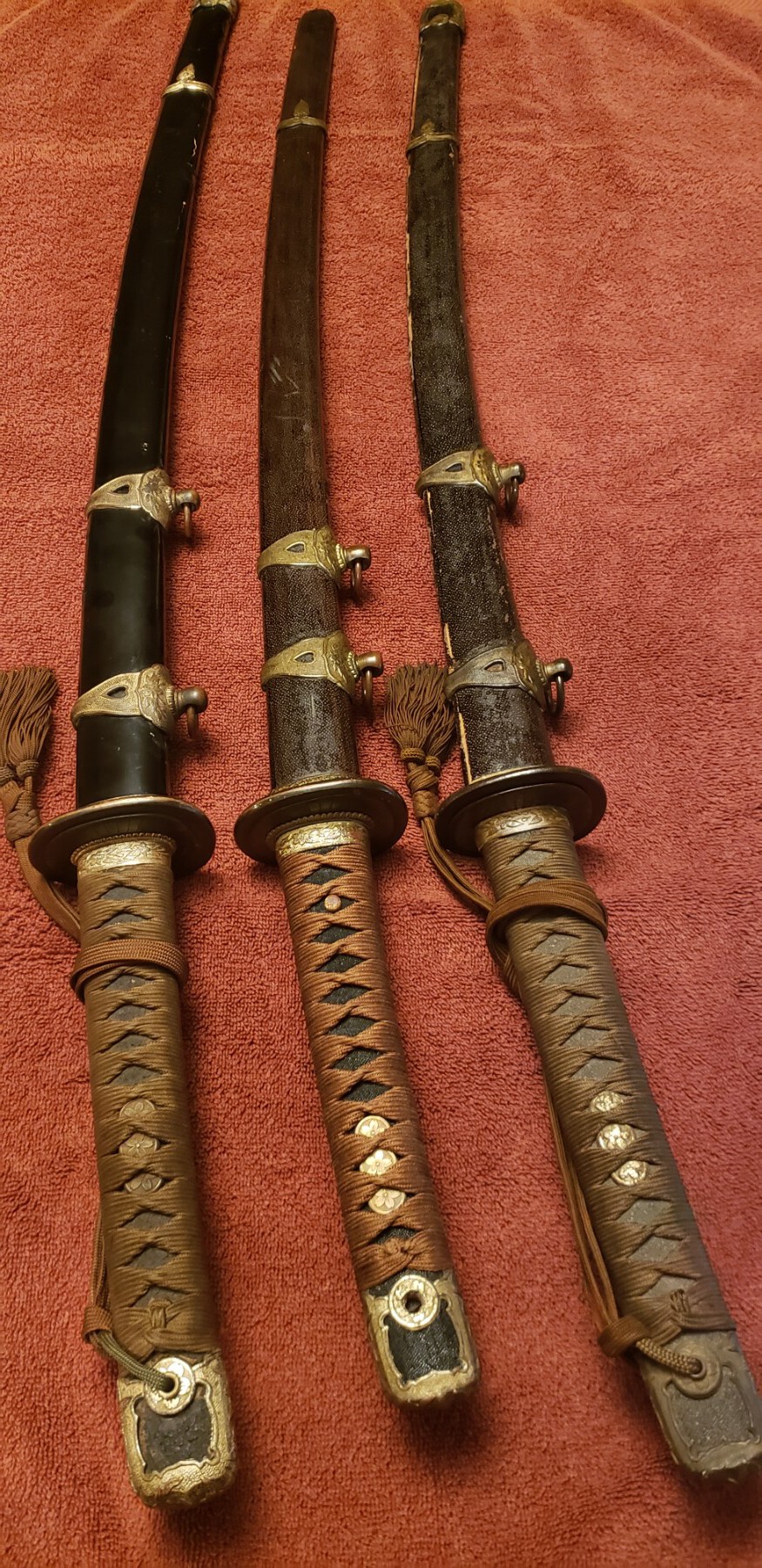
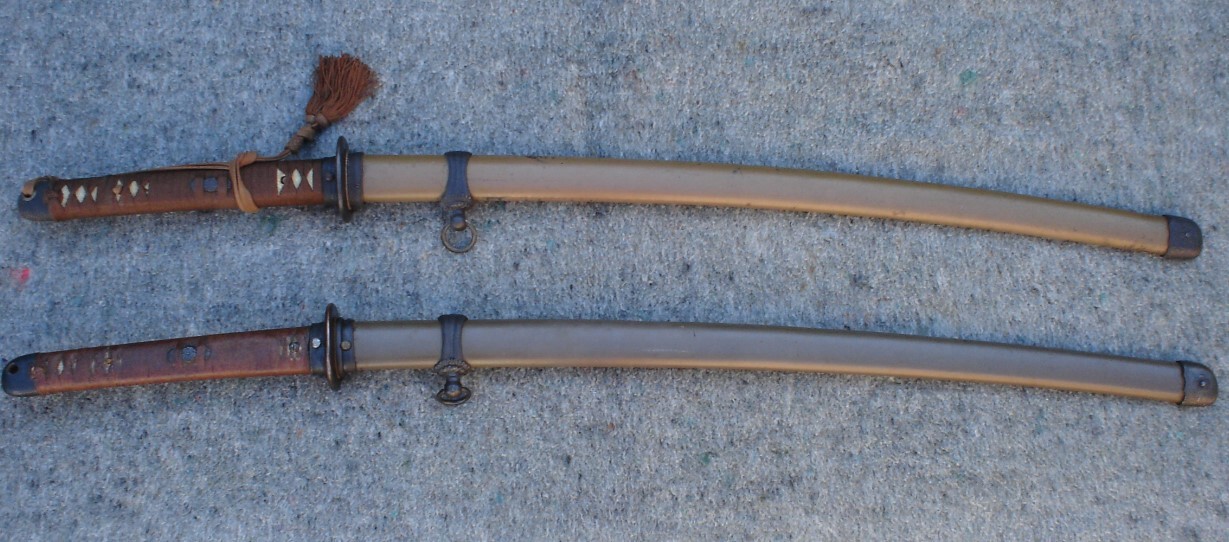
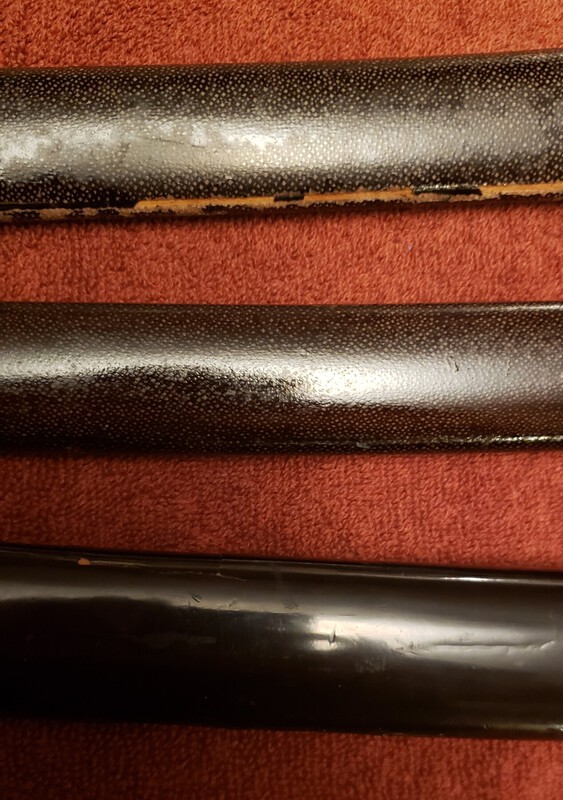
On a whim this evening I decided to lay out three of my Type 97's to compare their sayas - photos attached. In the first photo, from Left to Right: Toyokawa arsenal with black lacquer saya, Toyokawa arsenal with lacquered shagreen (shark skin) saya, Tenshozan Forge with lacquered ray skin saya. In the second photo, close-ups of the sayas' surfaces from Top to Bottom: Tenshozan Forge with ray skin saya, Toyokawa Arsenal with shagreen saya, Toyokawa Arsenal with black lacquered saya. I find the various Kai Gunto saya types interesting.

-
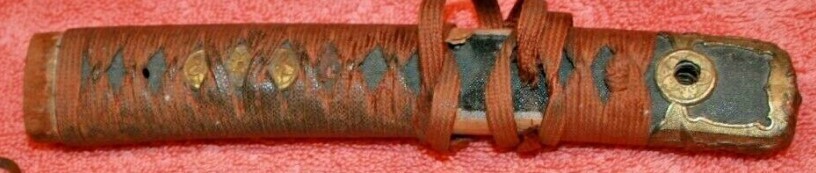
Also, a new pair of menuki (authentic, not replica) were added because one set of the gunto's original pair of menuki was missing. I wanted the menuki to match, so I removed the remaining menuki from the Tsuka and added the pair of matching menuki that were spare parts harvested from a salvaged Kai Gunto tsuka I had in my inventory.
-
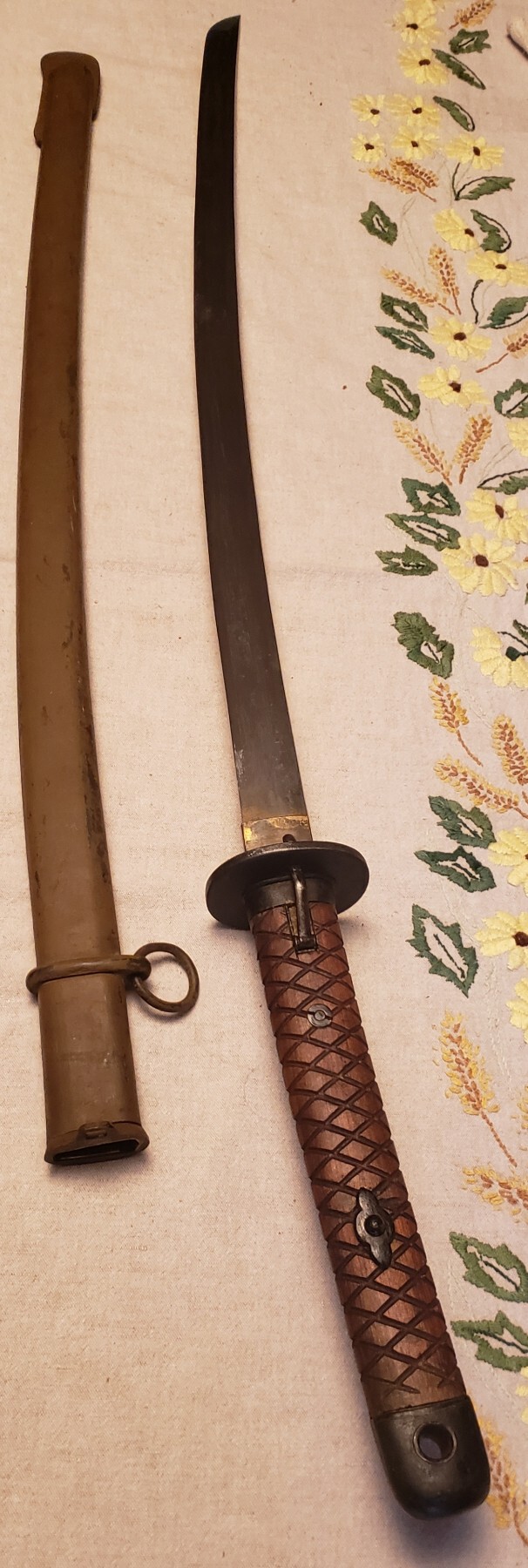
So, I just got one of my Type 97's back from my local Koshirae repair guy after he performed a Tsuka re-wrap. This is a Hattori Masahiro (of Takayama Forge fame) Kai Gunto that I purchased a few months ago. The Ito was torn and was generally in bad shape - needed a re-wrap. Randy has a solid reputation for doing excellent Koshirae restoration work and I'm very happy with the results (and his price was very reasonable). I'm fortunate that he resides in my area, so I did not have to ship the sword to him. Attached are Before and After photos.


-
I like your salty response Stephen!
-
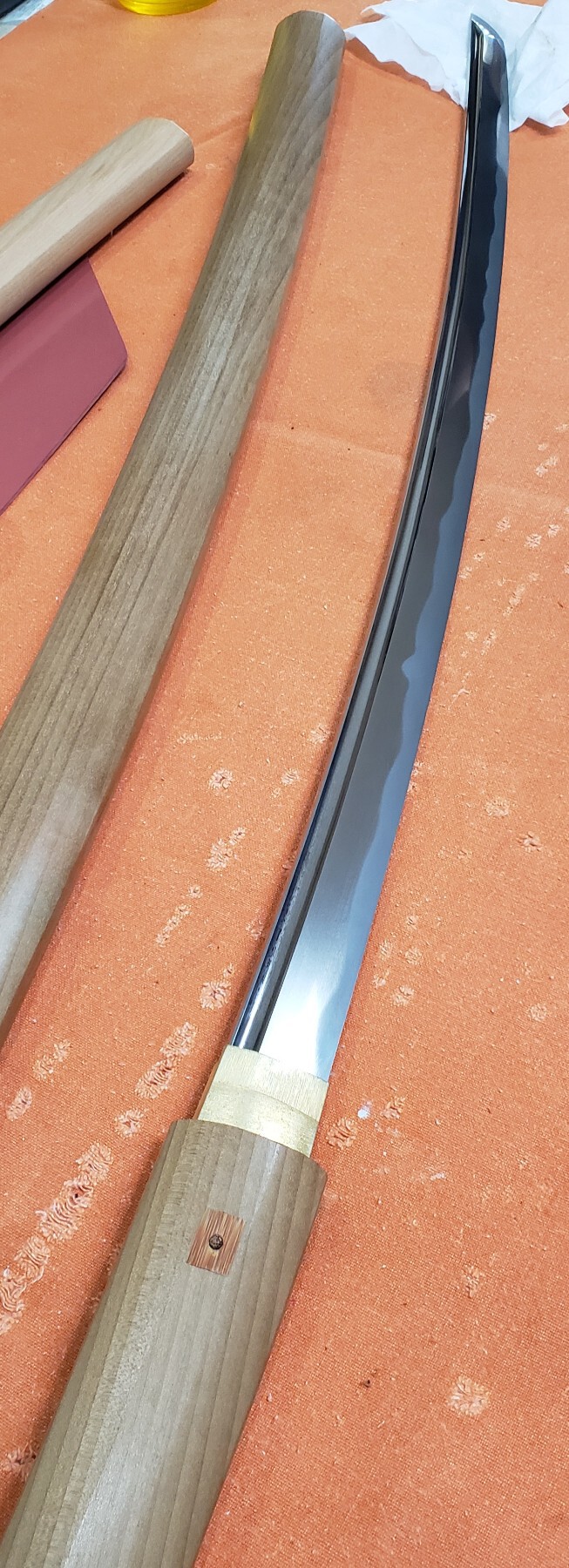
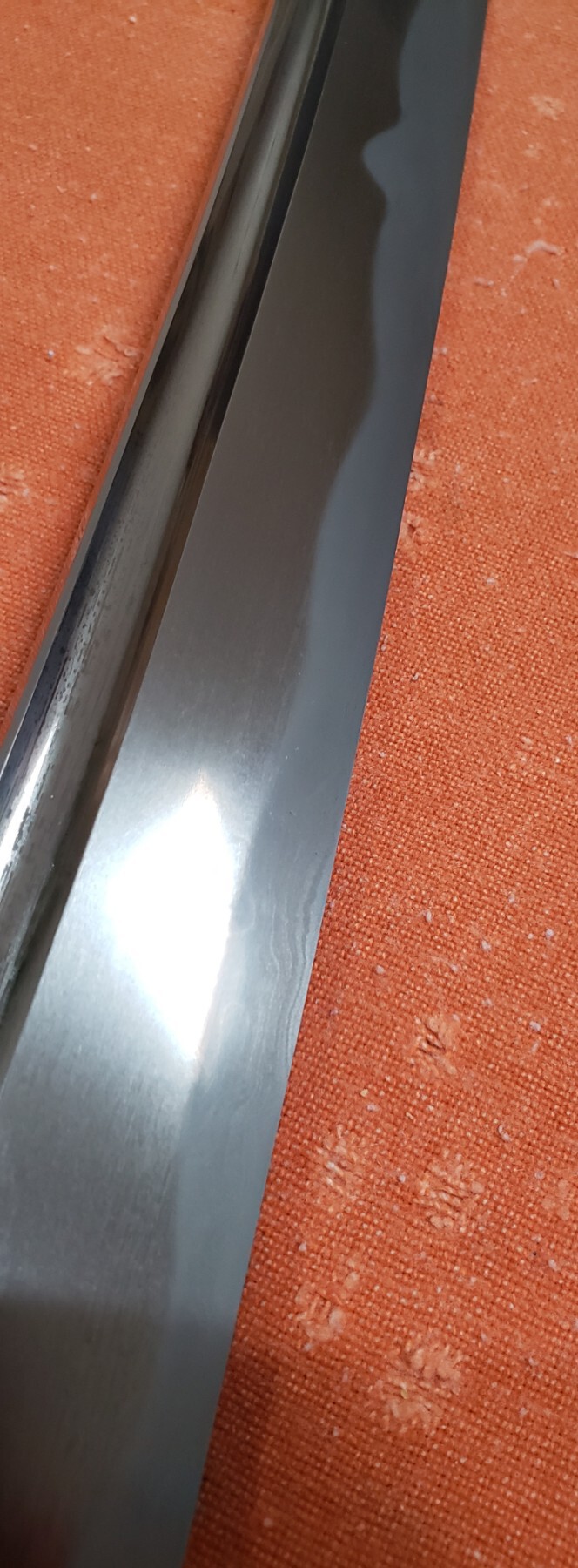
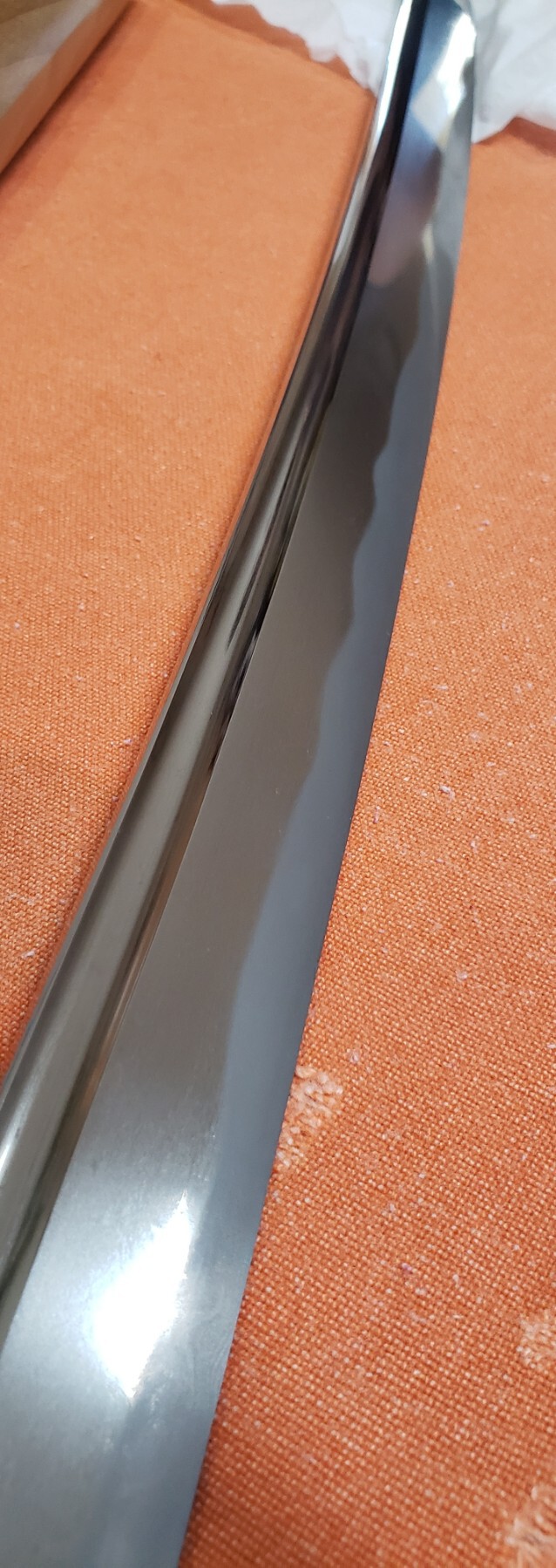
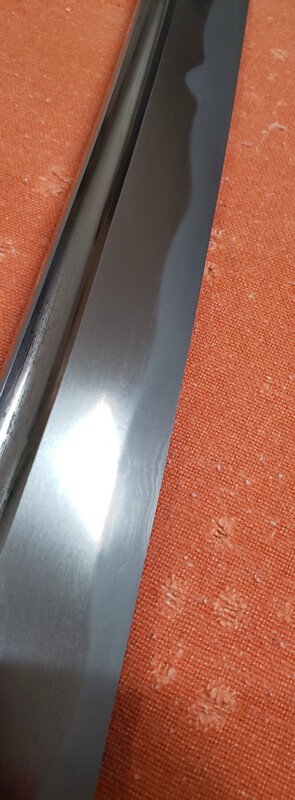
I don't normally post in the Nihonto forum (I'm a Gunto nerd and usually post on the "Military Swords of Japan" page), but when I do... I post something special. I was at my Japanese Sword Collecting Mentor's home last weekend (yes, I'm a newbie - got into Gunto collecting earlier this year) and this was one of the swords he showed me during my visit. It actually does not belong to him. He's the middle man for a polish job that was recently completed - a well-known, reputable sword polisher in San Francisco performed the polish. The sword will be shipped to it's owner soon. I was told that this sword is over 1000 years old and that the swordsmith is Suke Kani of the Ko-Bizen (early Bizen) school. Attached are a few pictures of this exceptional sword. I was allowed to handle the sword and to observe the blade under proper lighting. It was a great experience, especially for a beginner hobbyist.


-
Type 3 is definitely a better reference term than "Special Naval Landing Forces" which, as we are aware, is the wrong term for this type of Army Gunto.
-
Thanks John! Interesting sarutes, for sure.
-
I haven't seen many photos of Rinji Seishiki guntos with tassels. I do remember reading that, officially, they should not have sarutes attached. From my understanding, if tassels were employed, they would be the standard Army type (e.g., Brown/Blue for company-grade officers), and I assume they would be correctly threaded through the hole in the kabutogane, since they would lack a tassel loop or sarute. Is there any evidence of officers attaching a plain steel loop, or actual patterned sarute, for hanging the tassel? I have attached a photo below that appeared in a thread on this board showing two guntos in RS mounts where one has a tassel attached. Were tassels common on the Rinjis? Were they always threaded through the hole in the kabutogane without utilizing a sarute or steel ring, in accordance with regulations?

-
FYI, the bidding is currently at $1700.00 USD for the gunto in the photos I posted. Seems a bit high, however, as stated here, these are known to sell for up to $2000.00, and Type 95's in decent shape aren't cheap these days, either.
-
Auction for Type 95 NCO
Kolekt-To replied to KuraiValo's topic in Auctions and Online Sales or Sellers
Hi Jake, Watch out for fake NCO's swords - they are the most faked of any type of Gunto. Most of the fakes seem to come from China. The first version Type 95 NCO swords are the most commonly faked (the ones with the brass tsuba). This sword appears legit to me. It's the 1st variation of the 2nd version Type 95 characterized by a plain iron tsuba and top-latch release mechanism (note: the 2nd variation, less common, of the 2nd version features a side-latch release mechanism). The 3rd version of the Type 95 is nicknamed the "Pineapple sword" due to it's having a wood tsuka with cross-hatch pattern cut into it, and there are even later variations of it featuring a different style of wood handle. Anyway, these Type 95 NCO swords are usually sold in the $800 - $1200.00 USD range. I have seen some sell for as high as $1600.00. And then there's the very rare copper-handled NCO swords - those sell for thousands of dollars. They were the very first of the Type 95's and less than 7,000 were produced, if I remember correctly. You can find decent Type 98's and Rinji Sieshiki's for around $900 - $1200.00 if made by a Seki smith or a low-ranked swordsmith. The Type 98's made by RJT smiths go for more, sometimes a lot more - often $2000 - $3000.00+. Then, there's the swords that come with ancestral (family) blades and they can be quite pricey, as well. Also, the Type 97 Kai Guntos (Navy swords) can be expensive, though you may still be able to acquire a sword with an arsenal blade (such as Toyokawa) for under $1200.00. I have only skimmed the surface here and I am giving estimates based on what I have seen and experienced with buying swords over this past year. I am new to the hobby, as well. I'll learned a lot about the hobby and about Gunto collecting since the start of the year. Good luck and happy collecting! -
Thank you Trystan!
-
This Gunto is up for sale on Gun Broker and I'm confused about it. The blade has a fuller (as seen on Type 95's, and on many older blades) and has a tang with a Kokura arsenal mark (I say mark instead of stamp, because it looks to have been chiseled into the tang). I'm still new to the hobby and this is the first time I have come across one like this. Is this a Type 95 Kokura arsenal blade in Type 98 mounts? Did the arsenals produce some blades to be mounted in Type 98 koshirae? What are we looking at here?


-
Very nice set of tassels Bruce - you've inspired me to acquire a few more. Lol
-
Just a reminder that the Toyokawa Naval Arsenal suffered significant damage, with great loss of life, from a B-29 bombing attack on August 7th 1945 (just 8 days before the Japanese surrender was announced). Does anyone know if they continued to operate and produce armaments for another 8 days until the war ended? I was under the impression that the arsenal ceased production after the bombing.
-
Help on Identifying Age and Signature Gunto
Kolekt-To replied to Winchester's topic in Military Swords of Japan
From the lists of smiths that have been referenced here in the past, I see that there were at least three known war-time smiths with the name "Sukemitsu", and even one named "Sukimitsu"*non-RJT smith. I saw one named "Fukuda Sukemitsu" and the Mei reads as "Seki ju Fukuda Sukemitsu", so could we be looking at a non-traditionally made blade made by a Seki smith? The serial numbers on the blade and saya, which I believe to be uncommon on Type 98's, are also suspect and have me leaning toward this being Showato rather than Gendaito. Am I completely off target here?.jpg.5ca9b8040bd41574b9256163249b115e.jpg)
-
Interesting topic. Here's a photo of my "Pineapple" sword. Unfortunately, the serial number on the blade does not match the number on the saya, though both are composed of five numbers. Looking forward to the mystery of Cliff's sword being solved.

-
Hi Cliff, I may be new to this hobby, but I already know that you should post some photos of your sword - the guys here will be wanting to see what you've got so they can provide their experience and insight to tell you what you've got. By the way, I own a 3rd version NCO sword ("Pineapple sword"), as well.
-
Saya hanger terminology - clarification needed
Kolekt-To replied to Kolekt-To's topic in Military Swords of Japan
Thanks guys! So what is an "Obi-tori"? I have also seen this in reference to gunto suspension mounts - is it a component of the Haikan/Ashi? -
This should be an easy one for the experienced collector - I would like some clarification for terms used to describe the hanger piece of gunto sayas. I will list the terms and I'd appreciate it if you guys would comment and specifically define these terms. I'm a bit confused, currently. Here are the terms: Ashi = ? Haikan = ? Obi-tori = ? From my readings thus far, it almost seems like these terms were used interchangeably in reference to the saya hanger(s).
-
Thanks for the photo of the Navy tassels John! I have several and they are of the same dark brown/chocolate hue with some slight variation among them. From reading Nick Komiya's posts on a thread linked here, as well as posts from above in this thread, I am confident that, in my photo, the medium brown tassel on the left is a Gunzoku (Civilian) tassel (would have most likely been attached to a Type 98, from what I read), and the tassel on the right is Navy (albeit a bit faded). So... time for me to remove another Gunzoku tassel I own from... an RJT Rinji Seishiki! I'm thinking that my RS needs a standard company-grade Brown & Blue tassel, not the medium brown Gunzoku tassel that's now attached. I have really received an education about tassels this evening - thanks guys! Just have to say, the topic is a little confusing and there's a lot to digest.
-
So, this begs the question, have some of the 3rd Version NCO swords (e.g., the "Pineapple sword", the segmented pattern wood Tsuka type, etc.) been known to have these medium-brown tassels attached? Is there photographic evidence from the war? And, please clarify if you may, I was under the impression that some late war Type 98's had these medium-brown tassels attached, instead of the typical company-grade brown & blue tassels. Also, I haven't yet had time to check out the info from IJA swords, or search this site for Neil's thread on Tassel storage, but will do that this evening.
-
Thanks Bruce for the clarification, and thanks Neil for the example in the photo. And, yeah, I think I'll have to put a Mantesu on my list for a longer-term collecting goal.