Bugyotsuji
-
Posts
14,690 -
Joined
-
Last visited
-
Days Won
298
Content Type
Profiles
Forums
Events
Store
Downloads
Gallery
Everything posted by Bugyotsuji
-
Eric, that's a kind thought. Thank you. You are very close! It's actually on the 18th of Feb, six hours from now here in Japan.
-
This Week's Edo Period Corner
Bugyotsuji replied to Bugyotsuji's topic in General Nihonto Related Discussion
Ian, When you say the lacquer one, which one do you mean? They both have lacquer on them. Your tanto had a similar brass kozuka in the saya? It does indeed look like a one-piece kozuka to me, but I wonder why it is made of brass? A form of tsunagi? Franco, What kind of 'tray' is that? The scene is not one I have seen before, but I really like it. The Netsuke looks Meiji/Taisho, but it's difficult to tell from those pics. Do you collect Netsuke? Milt, That Harunobu print? is lovely. The facial expressions are stunning. I hope you are not selling it... -
Not sure if replies are allowed to Brian's excellent translation posting guidelines. If not, please ignore and or erase, as necessary. As one who attempts the occasional translation, could I request that in addition to the short written background to the request, if possible you take two ot three clear shots not only of the specific part to be translated, but also of the overall view. If paperwork, that should be sufficient. If a Mei, a shot of the Mei, another of the nakago itself, and maybe a couple of the blade including the kissaki would make the translation easier. Anyone who has done any translation will know that without the context it is very hard to get comfortable. Most people do the above naturally; just occasionally someone posts the bare minimum photo and this can raise frustrating questions about the whole point of the exercise.
-
You won't be able to read Mei like that if you study 'decent' Kanji! :lol:
-
This looked like an interesting meaty thread so I got ready to go back and read the whole thing. It was disappointing to discover a series of links to eBay with no comment in many cases. At least we can click on the links, I thought, but no, most of them are no longer available... I've missed the boat. If a late comer might be allowed to make a suggestion? When the links to the eBay auction are worth keeping, can we not save the pics and post them for more 'permanent' reference. Pretty please with sugar on. :D
-
This Week's Edo Period Corner
Bugyotsuji replied to Bugyotsuji's topic in General Nihonto Related Discussion
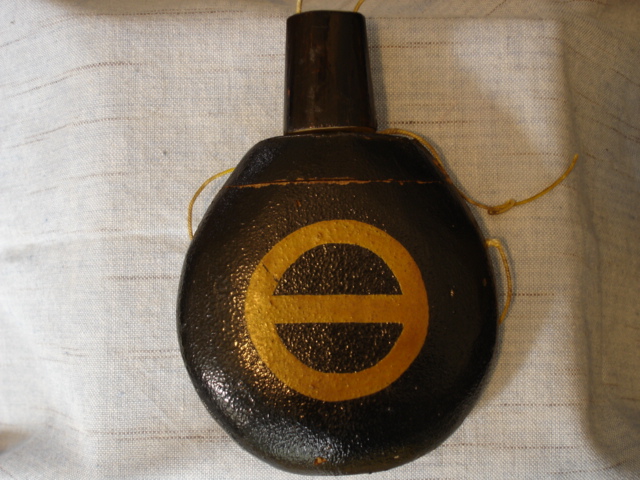
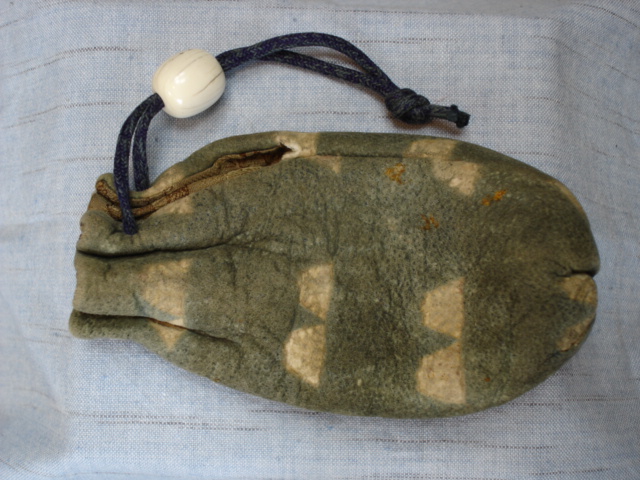
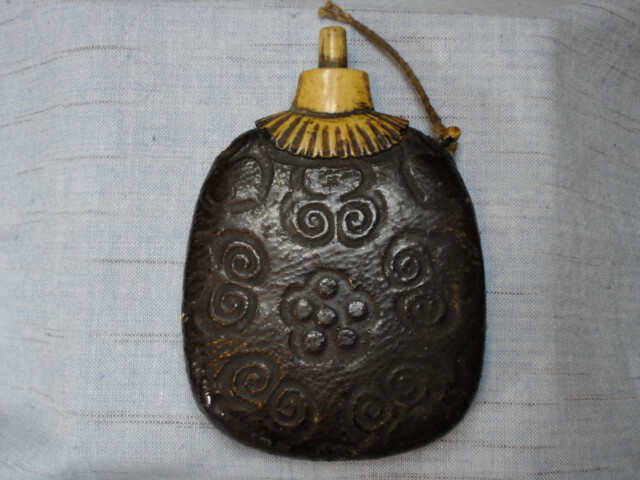
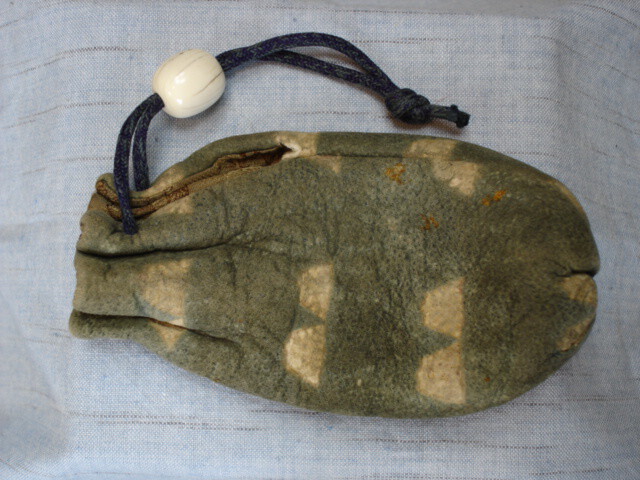
Well, another week; we had some interesting posts last week which took us to the crossover period when Western artists were finding inspiration in the newly-discovered artistic traditions of Edo Japan. (There was a huge influence in the opposite direction on Japanese artists.) Last week I bumped into a French dealer from Germany named Jean Jacques, buying swords and Tosogu for an exhibition in Brussels in May. It's very rare that I will ever meet a Westerner in these parts. Today I was introduced to Thomas, a dealer from Belgium who goes to Tokyo once a year, but was persuaded to try the depths of the countryside. He found a mine of WWII stuff today, he was telling me. Just to keep this thread ticking over, I am posting some recent finds: a kinchaku purse, and two priming powder flasks. These smaller primers tend to be more valuable to collectors than the larger gunpowder flasks proper. They rarely come up, and I grab them when I can. We use them for displays but it's hard to equip new members. Both of these can probably be repaired to live another day. Do I keep them for my collection, or donate/sell them for service as matchlock company equipment?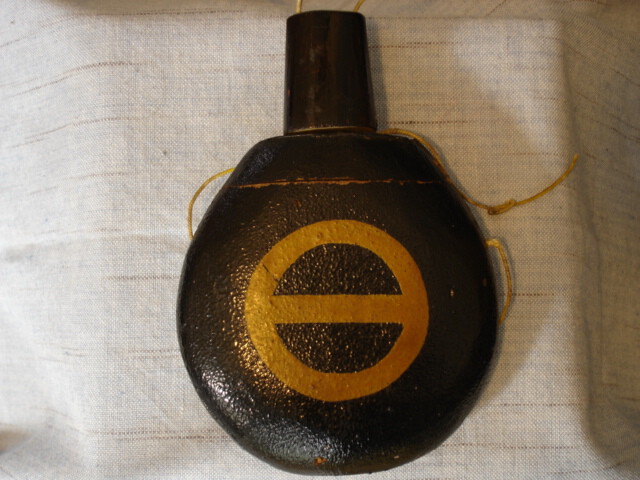
-
Well, it's Latin and people quote it to each other in the West, but there is nothing exactly the same in Japan. The translation sounds a bit like a translation and may need further explanation. In my dictionary the first thing they give is 買手å±é™ºè² 担 Kaite Kiken Futan (Buyer takes responsibility for any danger) You could say 授æ¥æ–™ã€€Jugyo-ryo, which has been quoted at me on many an occasion!!! :lol: It means, "Write it off as tuition fees." The difference to me is the Western phrase is kind of thrown at you and gives no solace. The Japanese phrase is humorous, and having a little true philosophy in it, easier to accept.
-
I hope you do not mind a few corrections. The final kanji is 極 (kiwame). So, the text means "Mihara Masachika; attributed by NBTHK". Well, I do mind and I don't mind! :lol: That character was a pretty good guess (I thought) and I got egg on my face again in public! It hurts my pride. Thank you for pointing it out, Koichi san. I am trying to emulate you, but it is VERY HARD WORK getting everything precisely correct. I must have gone back and edited small detail about 10 times. I began to realize this morning that unless I can do a proper job, I am not helping anyone; in fact I am getting in the way. You carry a heavy weight here. I wish I could help. Again I have learned that whenever I am not sure I must put another question mark. PS I have added an apology above.
-
See edit above, and read Nobody's correction below. 証 'sho' should be 極 'kiwame' Apologies!
-
The saya is mostly the same as the paperwork except for some small detail: At the top is the name Mihara Masachika, (attribution? my comment) The next section just writes out in full NBTKH Kyokai (and a final 証 kanji to certify?) Then: Kinzogan, æ®‹æ¬ æœ‰zanketsu ari = Gold inlay, with remaining and missing (parts) The bottom section gives the length of the blade. 二尺三寸一分強 Just over 2 Shaku 3 zun (sun) 1 bu kyo PS Looking at the remains of the gold inscription, one vertical stroke between 切æ– and 山野 suggests there was another character. Then the name Yamano is offset more into a central position on the Nakago.
-
Hi Tom, Good to see you and thanks for showing us your purchase. Just a quick translation of the inscription: ç„¡å (三原æ£è¿‘) (時代室町後期) Mumei, (Mihara Masachika) (Jidai Muromachi Ko-ki) Period Latter Muromachi (金象嵌) 三ッ胴切æ– 山野__(花押) (Kinzogan) Mitsu-do setsudan, Yamano unreadable (Kao) Gold inlay, cut through three upper bodies, Yamano (___) Kao Shinsa Result: Hozon Token
-
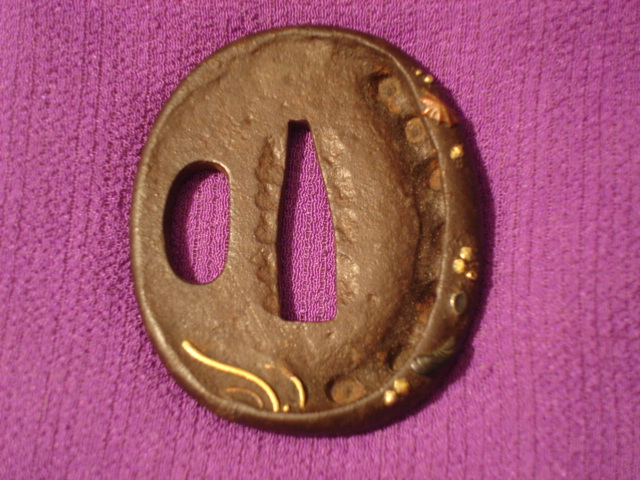
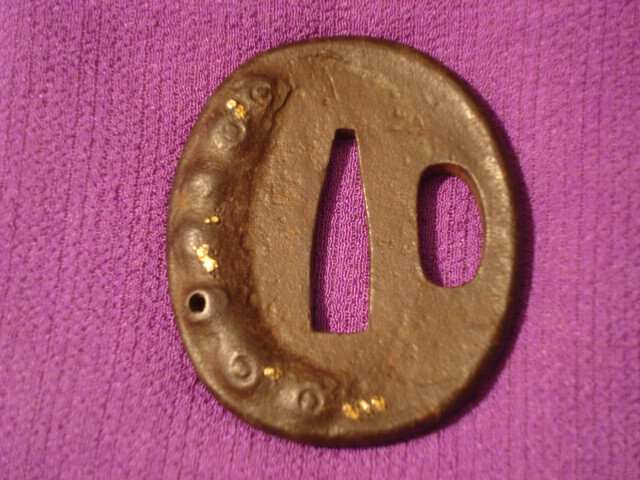
Thank you John for your insight. This has increased the value (to me) of my birthday present to myself. I am aware that you cannot be certain and that you are prepared for someone to come on and say no for the following reasons, but it has given me something to chew on. Some of the 'incrustation' (I like that choice of word) has been lost, unfortunately. Rusting tends to lift zougan off. I suppose the exposed position on the edge of the mimi was not very practical either. This gives us a hint ... impractical = later work?)
-
OK I'll attempt the label. I hope Koichi san is not doing this at the same time! 福井県 Fukui Ken (Prefecture), 三方郡 Mikata (?) Gun (County), 南西郷村 Nansei Go Son (village), 郷市 Kyoichi/Goichi ? and the name is 楠 Kusunoki 清 Kiyo/Kiyoshi (?) *Without knowing the actual place names in Fukui Prefecture it's hard to guess the local readings. The Kanji on their own are fine as long as no-one tries to pronounce them!!! :lol:
-
Thank you the link, Ford. Very good quality and well-thought-out web page.
-
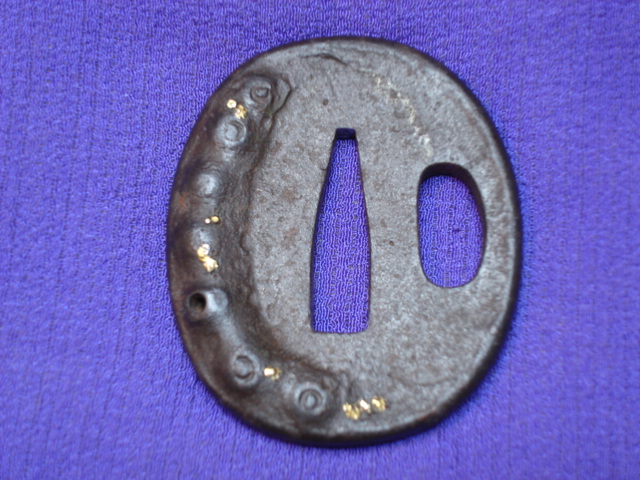
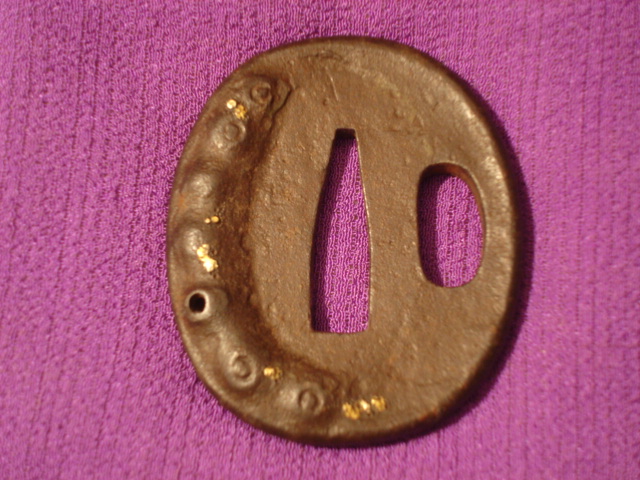
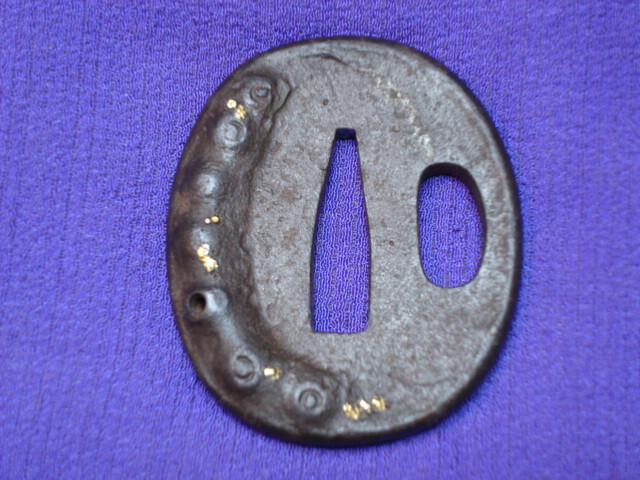
Hi all. I was given this small Mumei tetsuji tsuba for my birthday which is next week. Don't ask... It comes from a reputable major sword shop and I know the people well enough that it is not a 'fake'. No information was given with it; my primary concern is that I really like it. Looking through several books points me in the stylistic direction of Kanaie, (iron quality, hammering and furled mimi) but I am unable to narrow it down further. It is takabori and has a hammered surface. The shells on the omote mimi are done in shakudo, kin, gin, shinchu and do, in exquisite detail. The abalone volcanoes look 'punched', and one has broken through. We had a thread talking about awabi/abalone shells, and it could even have been mine, but searching hasn't pulled the right one up, otherwise I would have posted this there. The photos have been taken under two sets of lighting, one with 6 fluorescent rings, the other with just one incandescent bulb. The true color/clour is somewhere in between. Any thoughts on age, school, artist would be much appreciated. :|


-
The tag is not too difficult either. It's just the name and address of the wartime owner. Dunno what the 1500 refers to, though.
-
A good find! Thanks...
-
Help deciphering a Mei, Please
Bugyotsuji replied to hybridfiat's topic in Auctions and Online Sales or Sellers
Jacques. Excellent links. No more questions. Thank you. -
This Week's Edo Period Corner
Bugyotsuji replied to Bugyotsuji's topic in General Nihonto Related Discussion
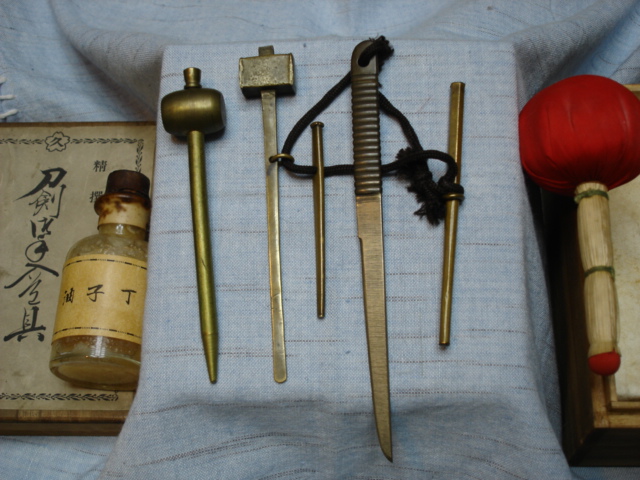
Someone mentioned cleaning kits the other day. Recently I found an old kit where the oil has turned into a kind of wax or something! In the photo I have included an old Edo Period Mekugi Uchi and brass hammer. There are various bits that came with it that I have strung together. I don't know what the brass blade is for, but it doesn't appear to be so old. Likewise the other rounded hammer is probably less than 70 years old.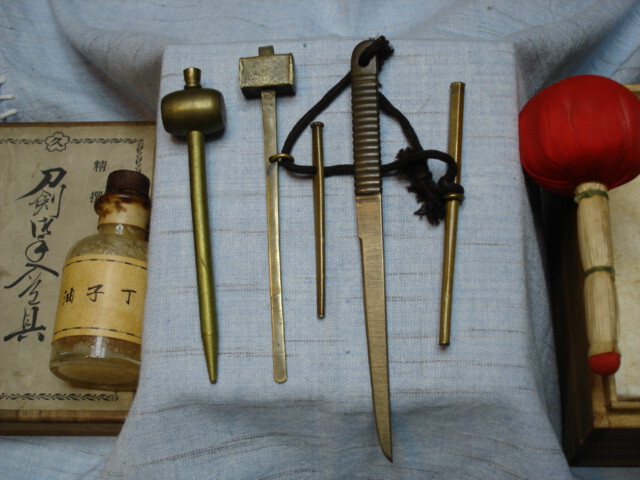
-
This Week's Edo Period Corner
Bugyotsuji replied to Bugyotsuji's topic in General Nihonto Related Discussion
I was looking at a sword in a museum today that recorded in the Mei that it had cut through two dead bodies at Tameshigiri. This reminded me of your picture above. The sword would not just find the right place between the joints, but would cut right through the bones! Van Gogh also collected Chirimen-e when they were simply Ukiyo-e that had been minutely folded into a kind of crepe and used as packing for tea containers. -
Today I was watching a deshi finishing off a black urushi saya at an urushi nuri workshop and thinking about asking him to look at my saya. Too many people crowded around so I gave up. (Some time ago, I stepped back when changing out of armour/armor and I heard a crunching sound under my heel) Asking someone to do it perfectly for you would be one way, but it might prove expensive.
-
Why don't you ask the NTHK directly about their "kinsei" attribution? And while you're at it, tell them to fire the guy who writes Japanese like a first-grader .... Too right! Or... who writes Japanese like a Western learner! LOL at Guido. :lol:
-
Help deciphering a Mei, Please
Bugyotsuji replied to hybridfiat's topic in Auctions and Online Sales or Sellers
There seem to be three readings of this name, but I am not sure which is the 'accepted' correct one. Is it 1. Rai Kinmichi, 2. Rai Kanemichi or 3. Rai Kindo? My first instinct was no 2. Kanemichi for the sound, which doesn't mix On and Kun readings. But then I found a reference to 3. Kindo, which keeps true to the On reading of Rai; this also seemed good. Finally I found a reference quoting all three readings and thus decided to post the question. -
This Week's Edo Period Corner
Bugyotsuji replied to Bugyotsuji's topic in General Nihonto Related Discussion
That's a gorgeous manju Netsuke there, Eric. All of what you say rings true. What slightly puzzles me is how the section of ivory signed by Masamitsu (my first impression was how similar the Mei was to a Netsuke-shi) with that scene could have been independently created. Unimaginable in Japan as a stand-alone object. It must have been an order from Europe. The lost wax decoration by Barbedienne would have been added later, but can you be sure that they never met, or never cooperated? -
Good to see you here, Andrew. My eye is completely untrained, but that looks like a good solid blade, and you may have got a bargain. I suspect that the chip has knocked the price out of that. A very good start to your studies. I bought my koshirae separately and had the sori of the saya adjusted for it.