Bugyotsuji
-
Posts
14,680 -
Joined
-
Last visited
-
Days Won
298
Content Type
Profiles
Forums
Events
Store
Downloads
Gallery
Everything posted by Bugyotsuji
-
As is often the case, while I was waiting for help here, I went out and talked to some people and managed to get a part answer elsewhere, so I will post that here. Pure gold for the edge band of a tsuba, the fukurin, would cause problems with permanency of fit, apparently. The lightness in colour indicates addition of silver. In order to strengthen the gold, pure silver was added to it, until the gold was about 16 ct. (For reference, 18 ct is 75% gold and 25% silver, so the gold content would therefore probably be just less than than 75%.) Next question! This tsuba has a very fine curved line sukashi in the iron on either side. Holding it to the light I noticed something caught in the cut. The only thing I could work into the gap was a sheet of paper, but that wasn't strong enough to shift the blockage. I tried a cutter blade and a pin, but they were both too thick to go into the gap. As I was messing around it began to dawn on me that to cut such a line would have required magical skill with a...a...a... what? A series of super fine fretsaw blades? I even considered buying a blade and snapping off the eye at one end in order to slip it through... (PS It turned out to be a small ball of rust which I picked away at gradually with the tip of the pin from all sides until it was gone.)
-
You're welcome and thanks for the thanks, on behalf of the 'team' (?)
-
Quick question about "gold". When the NBTHK paperwork says 金 Kin, (as in Kin Fukurin) does it actually mean gold, or does Kin cover anything yellow and shiny, like brass? As an adjunct to this question, do they test for gold, or is lack of oxidation/discolouration a good enough indication for them? Does anyone know what purity of gold was used in Mid-Edo? Was it mixed with silver, like the coinage? If it was mixed, was this for cost reasons, or for reasons of strength, or beauty, or what? in advance.
-
What Moriyama san has not said is that the rest of the characters in the second picture merely repeat what is written on the side of the saya, ie "Made by Masamune. Valued Possession of Toki Yorichika."
-
Help needed for Fuchi/Kashira Mei translation.
Bugyotsuji replied to pigeldee's topic in Translation Assistance
Hi. The kinko will have a way of reading his own name that is 'correct' for him. I can find six people who signed with these characters. It can be read in many ways, eg Toshi-hide, Toshi-kazu, Toshi-hiro, Toshinaga, Toshinobu, but the second Kanji will have one reading that tsuba experts will know and share! Let's wait and see. The third mark is his 'kao' or flourish. Let's make a stab at Toshihisa!  -
Kokan Nagayama defines the two words in much the same way as Brian above. Hagarami: an oblique crack in the cutting edge. (As opposed to Hagire which is vertical)
-
Relationship between Daimyo and Katana-kaji, Takumi?
Bugyotsuji replied to Bugyotsuji's topic in Nihonto
Of my Sensei's two suggestions, Kunifusa and Kunimasa, the latter makes the most sense. He and his ilk lived and worked where Date Munetada's castle was located, in Uwajima, the centre of Iyo no Kuni, around about the right time, 1790-1890. Four Kunimasa are listed in the Token Soran, p 183, for Uwajima under Shin-shin-to. One was active in Bunka 1804-17, and came from 水心子正秀門; one was his child, active in 嘉永¸ Kaei (1848-53); and a third came from 肥前忠吉門 Hizen Tadayoshi Mon and worked in Uwajima around 文政 Bunsei, 1818-29. The fourth seems to coincide with the following entry in the Token Yoran (see below), and was the son of the third above, and is, according to the Token Soran, to be distinguished from Number One above. An entry in the Token Yoran gives a Shin-shinto mark to 国正 Kunimasa of 伊予 Iyo in 文久… Bunkyu, ie 1861-1863, (when Date Munetada retired from active political life at about 70 yrs old and built the castle gardens. Remember he lived to be 100, it was said.) Quote from Token Yoran, p.42: 備前祐春門 School of Sukeharu, Bizen. An example of his Mei is: 予州宇和島住藤原国正 Yo-shu Uwajima-ju Fujiwara Kunimasa Well, it's all as clear as mud, but please forgive me for trying to pin this thing down... To summarize, in case anyone lacks the time to read the whole thread, there was at least one Iyo Kunimasa smith resident and working in Uwajima when the 7th Daimyo Munetada, (directly descended from Date Masamune's oldest son), emerged from the castle and forged, and cut his name into, a Mamori-gatana. The tanto is papered Hozon (so far) by the NBTHK as Shin-shin-to. A large question is how old was he when he made it, and which of the four 'helped' him. I wonder if there is a time in a Japanese person's life when he/she suddenly desires to possess/create a Mamori-gatana? In your 20s? In your 70s? This is the closest I have managed to get so far. Sensei thinks he may be able to tell from the blade. I've lent it to him as he wants to display it at the Shibu-kai in September. Great honour/honor for me. (I may go back and edit this post as extra thoughts strike... thanks for reading if anyone has made it this far! ) -
Re-reading this old thread I noticed in Sencho's quotes from Hawley above that it says "15 (points)". What do these 15 points refer to, I wonder? One article mentions that 120 on the H scale might be worth 10 million JPY today, or 90,000 US? Edit. Just had a look around and discovered that 15 is not very good in his opinion. I bet he never actually saw one! :lol: My sword did get NTBHK Hozon status, but I am wondering whether to go now for Tokubetsu or not. :| Is there a glass ceiling, where all swords of a certain ranking are doomed from the start? I mean, if his reputation was based on one Wakizashi, and I have an unknown katana here, could this in theory elevate his ranking if it's good enough? Muneyoshi's master. I think the compass points to the earlier of the two Muneshige ie MUN683, (?) on the logical basis that this sword, made by his disciple Muneyoshi, is papered as Kanbun, 1661-1673. Would it not be usual to be working in overlapping times? Or am I overlooking something? In the Toko Soran, p609 it says Muneyoshi was "in the Mon é–€of Hitachi no Kami Muneshige, Kanbun".
-
Wow! Where did you find that? It's really helpful to have the whole background first. Otherwise it feels like you are being tested on something with absolutely no context!
-
What is that, a box? 美濃国 土岐 頼近 秘蔵 My first guess is 'Mino no Kuni' (writing down the right of the photo) Then... 秘蔵 Hizo = owned/treasured by... Here the guessing of the reading of the name starts, ... 土岐 Toki (Town/city in Gifu) ...and finally 頼近 (old kanji) Norichika? Yorichika? (Raikin?)
-
This Week's Edo Period Corner
Bugyotsuji replied to Bugyotsuji's topic in General Nihonto Related Discussion
That sounds like a great idea, Carlo. I'd love to do that sooner rather than later. Who is Franci, BTW? This summer I stayed in Japan through August for the first time in many years. This gave me lots of free time and I managed to do some things which had been eluding me. One was the creation of a notebook of what I have acquired over the months and years. (Failing memory.) I have seen widows who took no interest, unable to deal with their husband's stuff, who have called in a 'friendly' dealer to carry it all away for a round sum. "OK, 500 dollars, the lot..." In fact I am convinced that this is one stream that feeds the antiques market. Do you think this notebook is a good idea, and what do you think it should include? I have an index page indicating the various sections, eg 'Paper Lanterns' or 'Kiseru pipes'. For each object I write a description of it, why it is special, what it was originally on sale for, how much I actually paid, and what I think it is worth today. It is all written in such a way that even someone like one of my offspring who has shown no interest in what I have been doing, could understand. Or should it be in code? "Silver pipe, black bamboo stem. Marked 純銀 Pure Silver on both mouthpiece and bowl sections. Mei æ‘ç”° Murata. Paid 7,000+/- (?) JPY (Kyoto, Tenjin san, 1972)" This is to stop said supposed dealer straying too far from reality! :lol: -
Asakawa??? (Just guessing now) Just seen Moriyama san's suggestion for Nin, and I like it!!! So, not to get too confused, the final consensus is: "Kawamura Yoshihisa, a person of Seki" (Kawamura being his name and not the village, right?)
-
I've got the beginnings of it, but someone will fill the rest in shortly, I should imagine. What I can see is Seki-Ju, Nani(?)kawa Mura, Yoshihisa I.E. a smith called Yoshihisa who lived/worked in Seki. Can't read the name of the local village, though. PS Oops, Rich got there first! (So did Stephen...)
-
This Week's Edo Period Corner
Bugyotsuji replied to Bugyotsuji's topic in General Nihonto Related Discussion
Hmmm... now there's a thought. Bit late now, though... -
This Week's Edo Period Corner
Bugyotsuji replied to Bugyotsuji's topic in General Nihonto Related Discussion
Well, Stephen, I guess Brian has answered your serious question pretty well. There are usually two or three stalls with swords and tsuba and tosogu fittings, but in my experience they are either a) fake and cheap, or b) possibly genuine, but too expensive. The 'cheaper' offerings tend to be in the middle or towards the entrance to the stall, and the rather better objects under the nose of the stall-keeper. I don't consider myself well schooled enough to even enquire about the swords for sale, although I do have one dealer friend who is fairly honest and quite often casually gives me the background story to something I might have bought. Quite an eye-opener on occasion. I like sitting with him in his stall and checking his swords, spears, armour/armor etc., and letting him tell me about his swords or the goings on behind the antiques market scenes. He's also the auctioneer at the local area dealer's market. The answer to this week's quiz is that the tools were 200 yen each, but when I grabbed a handful he counted them and said 700 yen altogether, please. The silk obi? sageo? cord was 500 yen, but when I mentioned some slight discoloration, he grabbed it, shot a glance at it and shouted, 300! The katana-kake was 3,000 yen. He told me he had bought it off a bloke with a large sword collection just last week for 3,000 yen, but was happy to let it go at the same price. He was packing up. I didn't even haggle. Add it all up and the answer is a nice green 4,000 JPY, if you discount the cost of the expressway and the gasoline/petrol. (Actually I drove back the low road to save on highway tolls.) -
This Week's Edo Period Corner
Bugyotsuji replied to Bugyotsuji's topic in General Nihonto Related Discussion
Here are the tools from yesterday after a quick session with a wire brush, and a shot of the 紫檀 shi-tan katana stand and woven cord. (The little hammers are a mystery. I already had one which I tend to use as a mekugi-nuki, and was pleased to discover another. They must have had a purpose, but in what field?)

-
This Week's Edo Period Corner
Bugyotsuji replied to Bugyotsuji's topic in General Nihonto Related Discussion
Carlo, thank you so much for posting these! There is so much there to feast the eyes on, and it's difficult to know where to start with the questions and comments. In reverse order I have to admit ignorance of a possible Tokyo Olympics in 1940, but the idea fascinates me and I love your little bowl there. The sake cups are redolent of that magnificent time in Japanese history just before the military became too powerful and proud. So small, but containing so much! Glad you were able to provide translations of the various writings. So often that is lost and we see through a glass darkly. Using your description, I was able to 'see' the three dimensional quality of the first cup. Wonderful. PS Does Golden Kite mean the bird alone, or the kites that people fly in the sky, or both? And is the bird in the first picture a Hokkaido Washi, a sea eagle, or what? The closest I can find in my small birdbook is a goshawk, using for hunting/falconry throughout the world. And what tree branch is it sitting on? -
Yoshihara Daisho
Bugyotsuji replied to WoodbridgeGaijin's topic in General Nihonto Related Discussion
Great atmosphere in that two-shot there. You can see he is happy to have such an appreciative guest. Thanks for the cameo! Bet you can't wait to get your hands on the Daisho... -
This Week's Edo Period Corner
Bugyotsuji replied to Bugyotsuji's topic in General Nihonto Related Discussion
Yes, that Nihonto would have been for sale. B is the wrong answer. And maybe if we had a bit more conflict here it would liven things up! :lol: -
This Week's Edo Period Corner
Bugyotsuji replied to Bugyotsuji's topic in General Nihonto Related Discussion
Oh, all right, since you ask! I bought: 1. a set of very rusty watch/clock mender's tools with a little hammer and a brush thrown in. 2. A silk sageo? 下ã’ç·’ cord woven in the karagumi å”組weave, 1.4m long. 3. On the way out I noticed a very nice black Rosewood katana-kake stuffed in a box and made sure to find the stall-owner who was packing up to leave. Guess how much I paid for everything? Sword stand, silk cord and tools? a) 15,000 JPY b) 8,000 JPY c) 4,000 JPY d) 1,000 JPY -
This Week's Edo Period Corner
Bugyotsuji replied to Bugyotsuji's topic in General Nihonto Related Discussion
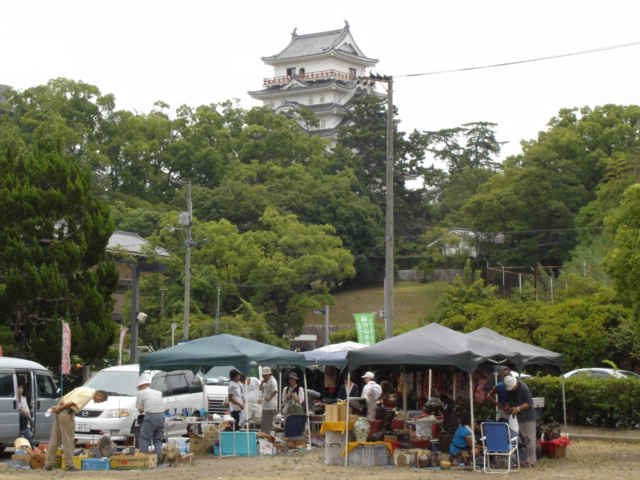
And something unusual for a Japanese city skyline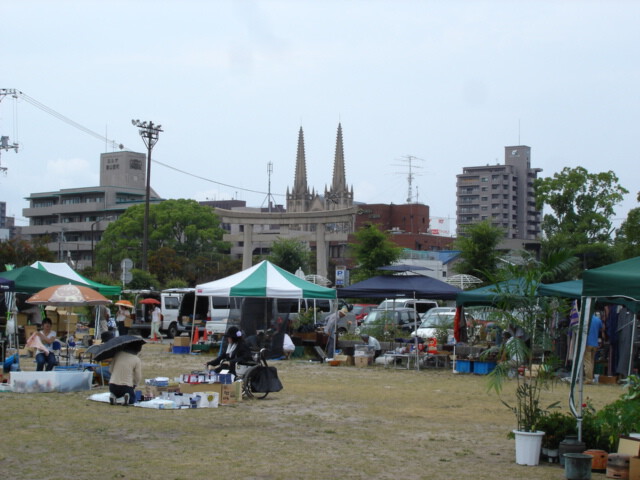
-
This Week's Edo Period Corner
Bugyotsuji replied to Bugyotsuji's topic in General Nihonto Related Discussion
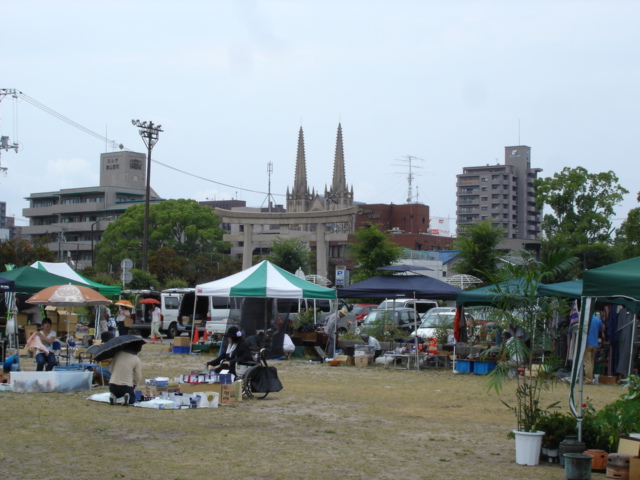
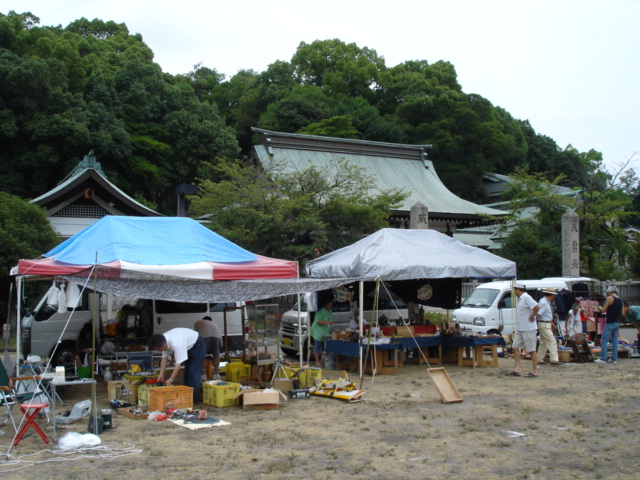
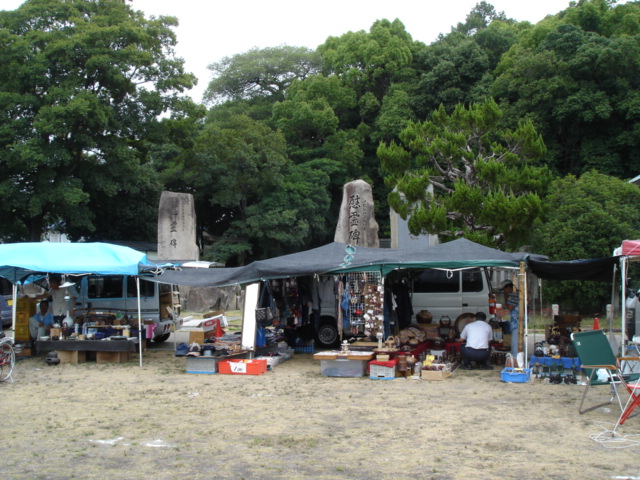
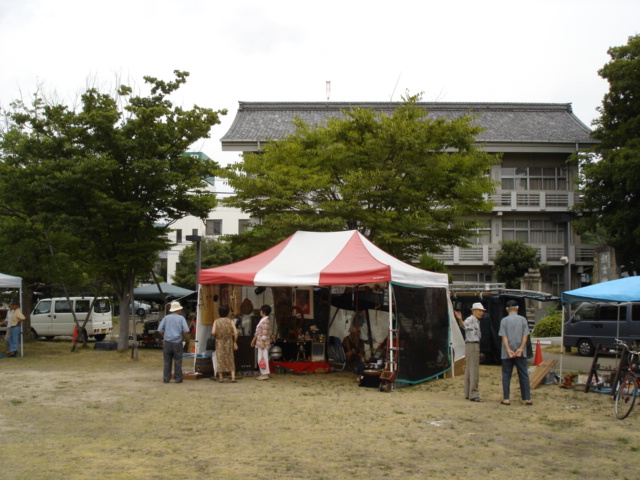
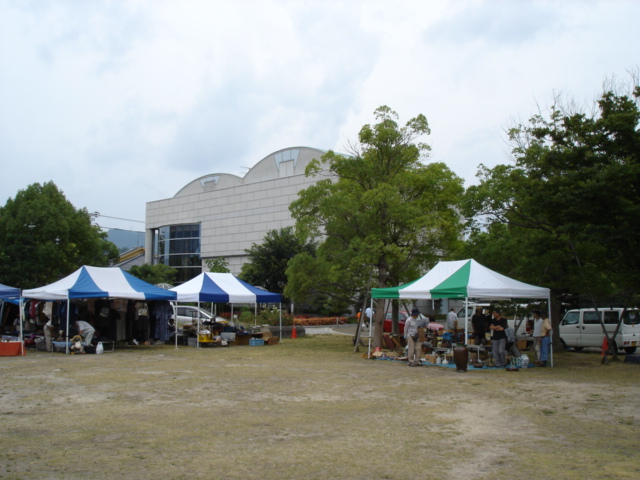
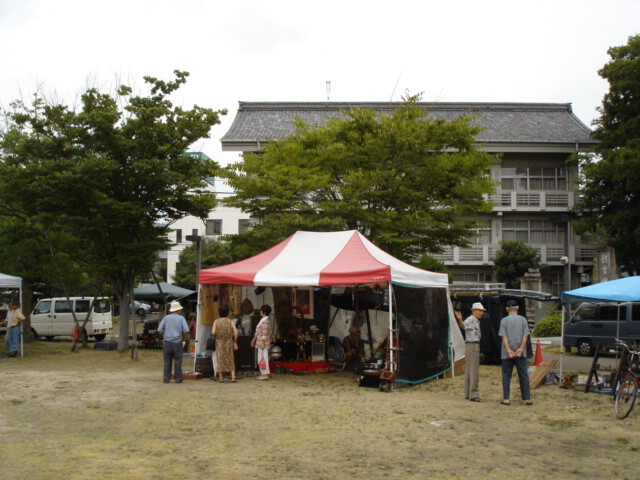
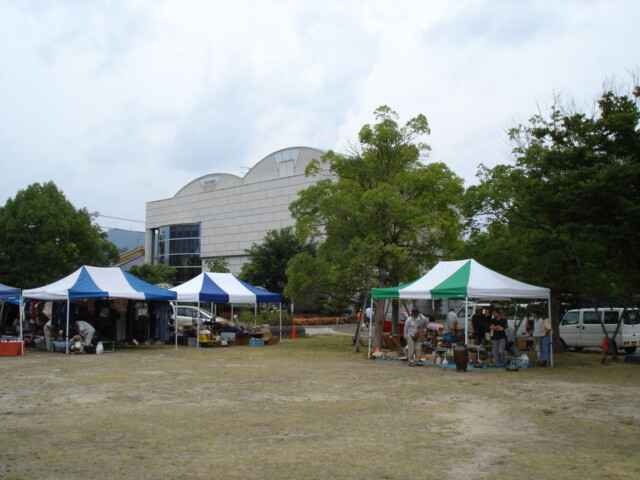
Stephen asked me a week or two back if I could get some shots of the antique fairs. Well, since then I have been to three or four, but forgot to take the camera each time. Yesterday I was at Ako Castle where they had about 40 or 50 stalls, and later in the afternoon at one of the convention centre/center antique displays. This morning I went to Fukuyama Castle park, but this time I actually remembered the camera. The grass was dead and brown, bearing sad witness to almost constant 35 degrees heat and very little rain for the last several weeks. I stood in the middle and took some shots around the radius. As you can see, it's a tiny affair, but with a little patience rummaging around, you can usually find something to take back.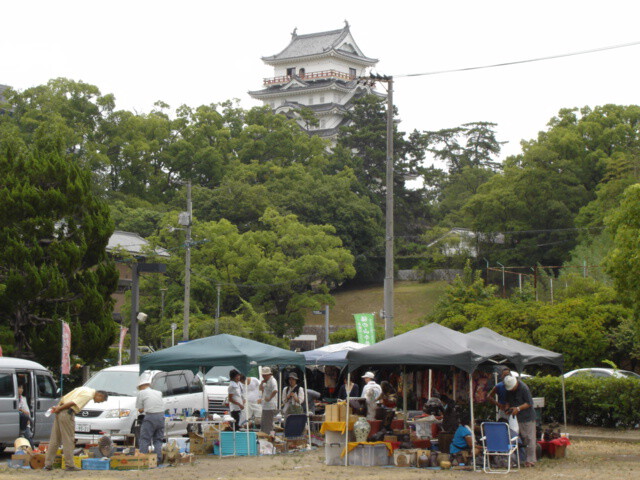
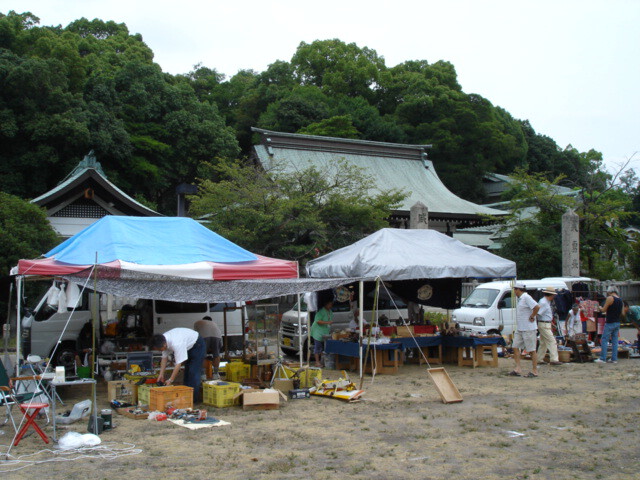
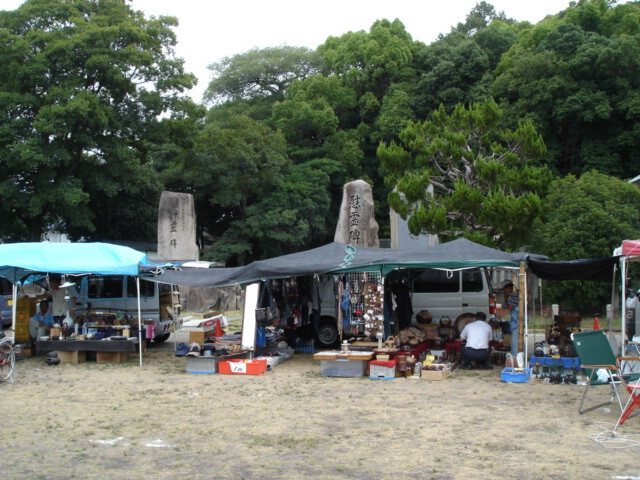
-
This Week's Edo Period Corner
Bugyotsuji replied to Bugyotsuji's topic in General Nihonto Related Discussion
Thank you for the detailed information, Moriyama san. -
Fraudster is copying my listing
Bugyotsuji replied to James's topic in Auctions and Online Sales or Sellers
How do these people work? Is this a parallel auction, and does the successful bidder then send money to the person in China? -
interesting Satsuma Masayuki inscription...
Bugyotsuji replied to Darcy's topic in Translation Assistance
One word.... AMAZING!