Ted Tenold
-
Posts
996 -
Joined
-
Last visited
-
Days Won
12
Content Type
Profiles
Forums
Events
Store
Downloads
Gallery
Everything posted by Ted Tenold
-
Hi Alex, I wasn’t ignoring your questions. I wanted to address them in greater detail and I needed to set aside some time. Alterations can include moving up the notches (machiokuri), shortening the blade from the nakago end either modestly or greatly, removal of mei, installation of horimono, or even corrections from the tip end such as on Naginata and Nagamaki where the tip curvature is removed to promote remounting for use as a bukezukuri mounting. In its history, a sword may have undergone one or more of these processes, some of which will eliminate evidence of another such as a machiokuri on a sword which is later shortened. My point on your sword was that it may be possible the hi were installed prior to the shortening of the sword. Determining the maker with any confident accuracy from images is, again, quite difficult to impossible. Swords are a three dimensional study while monitors provide a compromised two dimensional representation. It’s possible that a maker that worked in that style of hi made the subject sword, but don’t take those examples as suggestions of this swords origins. The practice of ending the hi with a margin between them and the koshinogi is to provide a buffer zone (if you will) of area that the tip can be pulled back if necessary without intruding upon carvings closer to the koshinogi, in which case would compromise the shape, structural integrity, and niku of the kissaki. It also puts a bit more weight and strength into a critical, yet delicate region of the sword. Some smiths practiced this as a part of their working maxim, but when looking at older Koto pieces, I generally suspect atobori on hi that end further back unless the maker (or the condition of the hi) precludes that. In swords with shoshin mei (genuine signatures) it’s a bit easier to conclude whether they are ubu or ato. In mumei pieces, identifying the maker can be a process of either including the features and health of the hi as part of the analysis, or separating them from the other features (hada, hamon, shape) of the sword, to determine the maker. If the hi demonstrate certain elements of installation, then one might be able to accurately conclude that they are ubu to the maker. A particular maker may have hi that are very wide and deeply cut for the blade, and/or ends of a particular style, with ends cut in a particular way. These are all clues to analysis. But if they seem to not fit in some way, or stand in opposition to the other characteristics of the sword, then one might have to suspect they were added later. All that said, after looking at your latest images I would add more points for consideration. I see that the hisaki (ends of the hi) look more like nagashi than sagaru (terminating a distance back away from the koshinogi) with the end cut to mimic the shape of the koshinogi. Nagashi is "tapering or washing away" to an equal point rather than the conventional end with the rising cut reflecting the koshinogi shape. The hi are centrally set in the shinogiji so that a thin road boarders either side of the hi. This is ryochiri style. Over time, as swords are polished, there can be geometric changes manifested through the removal of material. Horimono can be one of the most evident visual victims of depletion. Hi become thinner and shallower as the adjacent surface material diminishes thus changing their shape. Their ends begin to soften and loose their original shape as well to the degree that original ends can eventually become nagashi. They can even begin to loose their uniformity of width and the edges begin to meander along their length so they look crooked or squirrely. Smaller hi such as soe-bi can disappear in places and re-emerge along the length of a sword. Hi cut later in the blades history can obviously demonstrate a newer, healthier appearance against the overall sugata of the sword. Polishers must make serious considerations to how much and how far to polish hi and horimono of any kind if they are suspected to be original, because if they are, they should reflect the maker’s intended shape, the period and age of the blade, *and* balanced symmetrical condition to the sword itself. Taking the above into consideration, I notated your image of the munesaki. Looking at this image, one can see that there is a disparity in the termination points of the koshinogi at the mune between omote to ura and an imbalance in the width of the mune surfaces. This disporportion of shape from side to side can affect the depth and shape of the hi from side to side presently, and in the future. In radical examples, this also elevates the potential of shingane surfacing on the thinner side of the blade in the ji and/or shinogiji as one side of the kawagane (and the niku) may have been reduced more than the other. Restoration is many times about decisions of compromise to promote the greater good. Maximizing preservation while minimizing depletion is the primary consideration. The appearance of this imbalance could be a matter of your camera angle, but this can be seen on swords and thus am using what you’ve posted as the example. Seeing something like this compels us to look at all the features of shape and consider if they are original or alterations, and in either case if they are “as intended”, conditionally compromised, or just plain poorly executed. I would say that the new images sway me to think the hi may indeed be original and showing signs of depletion, but without having the sword in hand, we're all just speculating here. *edited for minor spelling errors and clarity*

-
Neil, Numbers on the nakago, whether stamped or painted are a product of tracking individual blades among tens or hundreds of others in a production environment. Even as mass produced swords, each has somewhat individual measurements and must be more or less "married" to it's mountings, that in turn must be kept together through the process of completion and production numbers accounted for by the factory or company. The mountings also often have numbers inscribed on them to help identify their group and to which blade they belong. Handmade blades (those with star stamps) can also have stamped or painted numbers. Whether they are a product of tracking completion by the arsenal after the smith supplied it, the company that mounted it for the purchasing officer, or the arsenal that completed it, is a matter of speculation. Because they rarely exceed three digits, my hunch is that they restarted the numbering process every month or so.
-
Brain, The mei looks rightous by comparison to me too. I also agree with Grey that your sword may have been slightly machi okuri. The placement of the ana on polearms can vary depending on the length and also upon the style and placement of the fittings on the Ebu (shaft), so I wouldn't worry terribly about that. The character, stroke order, depth, and style all look to be really good on yours, and I'd send it through for shinsa without much more consideration as long as the blade condition presents no objectionable flaws.
-
Hi George, From the image, it is difficult to make a clear comparison. Can you get some closer images of the mei, even if it's in groups of one or two kanji at a time? Stroke order, size, and character are very important. The reality of it is that even if members here find it a favorable comparison, the real judgment is made by those more qualified, and for that, the sword has to be submitted to a shinsa. Conditionally speaking, the fact that it's been greatly shortened with a gakumei will limit it's papering potential to lower or mid-level papers. Anyways, please do try to get some better closeups of the signature. The exercise will do us good. :lol:
-
Hi George, Out of curiousity, which are the references that define the 3rd and 4th generations? Perhaps some of the members also have them and can look them up. I haven't had a chance to compare this signature yet, but I'll take a moment and see what I can find at my first opportunity.
-
Thanks for that Jacques, but unless one of those smiths (or some other exception) made this sword, then your point is fairly moot. Perhaps my statement was a bit too concrete. I will revise it for clarity as I wrote it this morning in somewhat of a rush. How about..... Better? :|
-
The ends of the bohi terminate before (or nearly at, hard to tell from the image) the yokote and don't extend into the koshinogi. This indicates they are atobori. However, there's nothing to say that the suriage was done even after the bohi were installed. This is what I believe we're seeing; two (or more) subsequent alterations.
-
If we translate the symbol on the tang mathmatically, then I believe this sword to be the "summation" of Chinese components. :lol: Couldn't resist.... :D Seriously Joe, I agree with the others that this is not of Japanese origin.
-
I also agree with Ford. "Best" is a term that is very subjective. Craft and creation must be held in their own light and not by comparison of Kaga inlay vs. Nielo vs. Cloisonne'. Appreciation of art and craft is not about comparison so much as quality of workmanship and skill in the individual specimens. Even within singular culture and craft it's futile to ask such questions as "Who made better fittings, Ichijo or Tomei?" or "Which is the better sword, Bizen Mitsutada or Rai Kunitoshi?" Silly... Be careful Phillip. Let's not forget craftsman such as Carl Faberge'.
-
John, Walk away from it knowing the facts. Never argue with a fool or a drunk. Fuggetabowdet...
-
Not fake. It's real Japanese blade. Signature reads Yakumo Amatsu Masakiyo saku (meaning the maker's name is Masakiyo and he was from Yakumo village in Shimane prefecture), dated 1944. He's in John Slough's book, and maybe in the Gendai toko meikan (haven't looked there yet). Decent gendaito smith.
-
Black...grooves....get nooo, sa-tis-fac-tion.
-
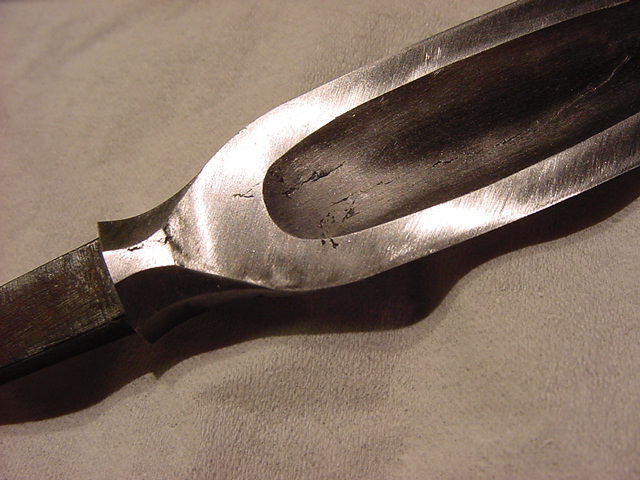
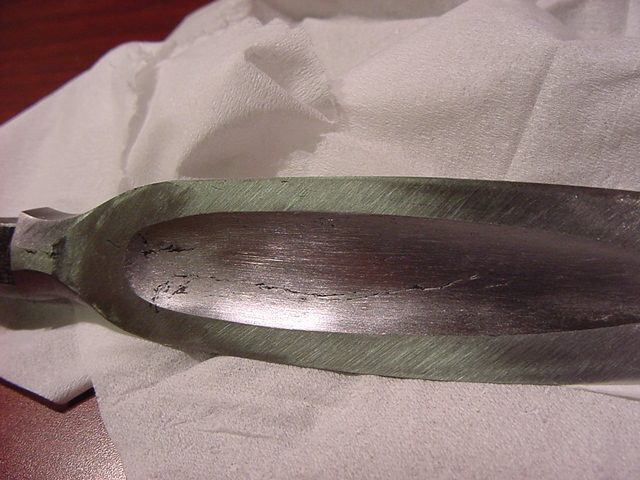
Interesting indeed. I never thought much about the possible religious significance of the color, but it makes sense. I have seen black lacquer, but only once. As for the motivations behind lacquering, here is an example of a yari which had lacquer (yes, red) in the hi. It was chipping and shedding from the surface and the blade needed polish. This picture illustrates what was under the lacquer which could not be seen prior to removal. Overall the piece is quite decent and well made with only a couple smaller ware which extend outside and adjacent to the hi and two or three small inclusions on the neck. When finished, it will again have red lacquer. Although it's not the absolute answer we'd like to have, the reason for it on this piece is pretty obvious to me. It's an Echizen Shimozaka yari that was cut down in to a Tanto in case anyone is wondering, and since most of these were viewed as utilitarian arsenal arms, lacquering horimono instead of polishing them is logical and practical for expediency and cost efficiency.
-
Sometimes.....all the above. :lol:
-
True indeed! But what you really should assume is that something is chasing them, whatever they are.....so don't stick around to find out. Run like hell.
-
I don't think the devil needs any help with this one. There is a minor stroke difference between this very common Naga character, and the *highly* uncommon form of Kiyo that it resembles. So the question would then be; "If the identity of this kanji is still in question, is there a smith with the name Kiyohiro utilizing that rare form of Kiyo listed in any references?" Yes, but you can really overthink these things sometimes and make them harder than they really are. When you hear galloping hooves in the distance, it's better to assume they're a horse and not a zebra.
-
Steve, In the row of "Hiro" kanji you illustrated, it's the second from the left.
-
Yeah, if you do decide to, proceed with caution. The latch mechanisms are often made of horn and can break. Over the years the sleeve can also become very tight inside the saya. Gaki is pretty rare anyways.
-
Hi John, Every one of the irekozaya style I've seen was of very high quality mounting. One in particular I remember was a Shikakke Norinaga tanto. By far one of my most favorite tanto ever, not only because the blade was gorgeous, but the koshirae was constructed of a rare wood, with solid gold fittings. I found a picture of it on John Berta's site, who owned it subsequent to when I saw it. Scroll down about half the page. Note the gaki on the inserted sleeve. http://www3.telus.net/sword/sword/index ... 0items.htm I think this may be the one Grey is also referring to. I was at the San Francisco show several years ago admiring a daito with saya that had stunning lacquer work. Very fine powders of cinnabar, mother of pearl, gold, silver, in formations of clouds. The sword was on the rack while I looked at the saya. It's become more or less a matter of habit that I check the koiguchi for the tell-tale mechanism that these have. It did, and I turn to my friend, who owned the sword at the time and said, "Very nice that this is an irekozaya". He turned to me and said; "Huh?" Until that point, he didn't even realize it had one. :lol:
-

SEVERE DISTRACTION IN JOHANNESBURG
Ted Tenold replied to Bazza's topic in General Nihonto Related Discussion
Lovely Hada. Okay, 'nuff said. -
Hawley's Japanese Swordsmiths
Ted Tenold replied to nindja's topic in General Nihonto Related Discussion
Holy Cow! $950?! Heck, my copy is signed by Willis himself, it should be worth twice that then! Nevin, out of curiousity I made a quick call and what I was told is that these haven't been available from Hawley's Library for quite some time; about two years actually. It was an expensive book to produce with low volume of sales, which in the book business, is the kiss of death for any edition. Your best bet will be to find one on the secondary market. They come up on occassion. -
Hawley's Japanese Swordsmiths
Ted Tenold replied to nindja's topic in General Nihonto Related Discussion
There are are a couple places to get Hawley publications. http://www.bugei.com http://www.bridgeofdreams.com http://www.satcho.com Try these folks and see if you can find what you need. I'm pretty sure Panchita is alive, but not sure if she's doing any direct sales. Good Luck. -
Komogawa, Please sign your posts with your name. Your profile only lists "K S". This is not acceptable according to the rules for participation here.
-
Eric, Ko-Mihara!!! Just kidding... I'd call it Enjyu. Why? Anyone else wanna take a chance?
-
Franco, Completely agreed. Or alternatively a desperate or stubborn attempt is made to bring up things that simply aren't there thus attenuating what is, or ruining it in some other manner.