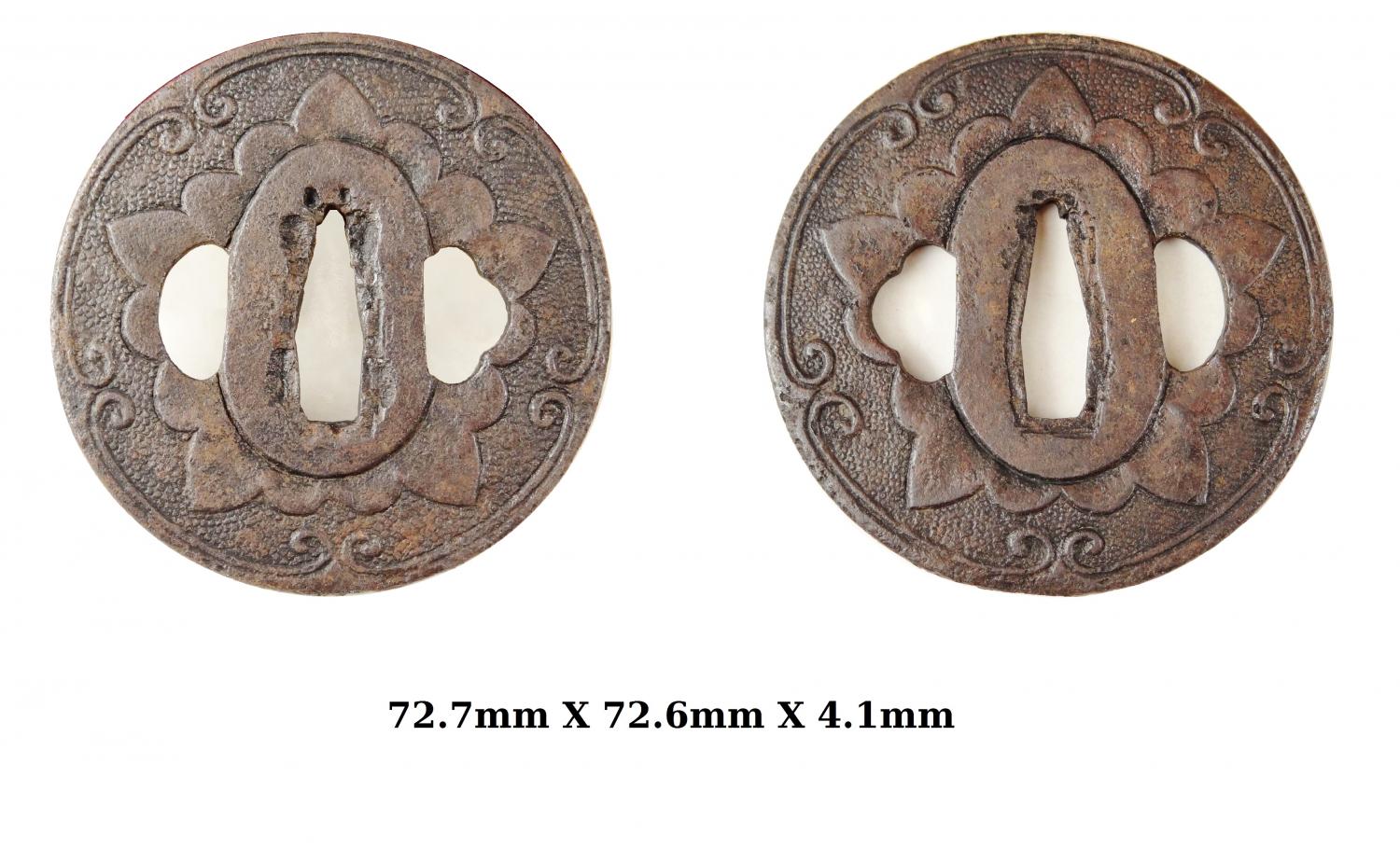
Spartancrest
-
Posts
4,000 -
Joined
-
Last visited
-
Days Won
109
Content Type
Profiles
Forums
Events
Store
Downloads
Gallery
Everything posted by Spartancrest
-
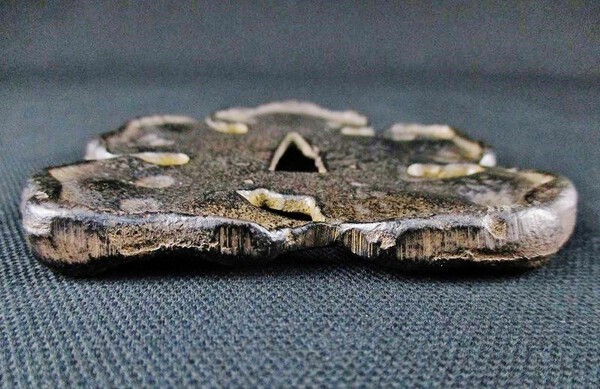
This subject has been discussed previously as far back as 2011, but just a short update on the growing number of these "tsuba" to use a word very loosely. I have added an often neglected view showing the bottom edge where the giveaway casting marks are often found. Collectors should be made aware of these often high priced 'Paper weights'. I continue to collect images of these things as they continue to pop up, there are a few right now on auction sites so have a real close look when you buy.

-
Peter There is a real similarity with your example Italian [plate XVIII] and the thickened edges of the first new example. The finish of the edge is a bit plain though, when you consider the detail on both faces. And of course there is no cupping of the plate that I can see but as most Japanese cupped tsuba were mounted in an opposite direction to European guards - perhaps as a way of keeping dust out of the saya - pierced guards would let dust in, so why cup them anyway?
-
Peter I have the opinion that some of the guards you displayed are repurposed "European" pieces, those that have a re-cut tang hole (not nakago-ana) would never have been made with a square section cut-through if made in Asia / Japan for domestic purposes why would they? The sword blade tangs of Asian swords were not thin square cross-section like those of Rapiers and Foils from Europe. Is it reasonable that these tang holes would be put in just for show, when if mounted there is no way this could be seen? It is perhaps more reasonable to assume that if they were indeed made in Asia or Japan they were intended as guards for European weapons not Japanese at all. What we see are leftovers altered for Asian and Japanese swords. I believe we have been looking in the wrong direction at a lot of 'namban' guards. As an after thought can anyone tell me if 'namban' or 'nanban' is the correct spelling? You can Google both and get just about the same results. It may well be a time to call them what they really are - Asian export guards.
-
Bruno P. Did you buy it from Japanese Antiques.com ? Listed as 'Bushu', You have removed the the catalogue number I see. (I stole the image from them for my records) I like the kagome ategane (ume if you prefer) - One that got away! I notice one small detail that is different to the guards I have, the background is more like ishime rather than dot punched (I won't go as far as calling it nanako.) Let me know if the ura is the same or if I have trouble with my eyesight! PS. mine were lot cheaper.
-
Torrez No not sarcastic, but I should have checked the subject image (thanks Jean) I didn't even notice the toad!
-
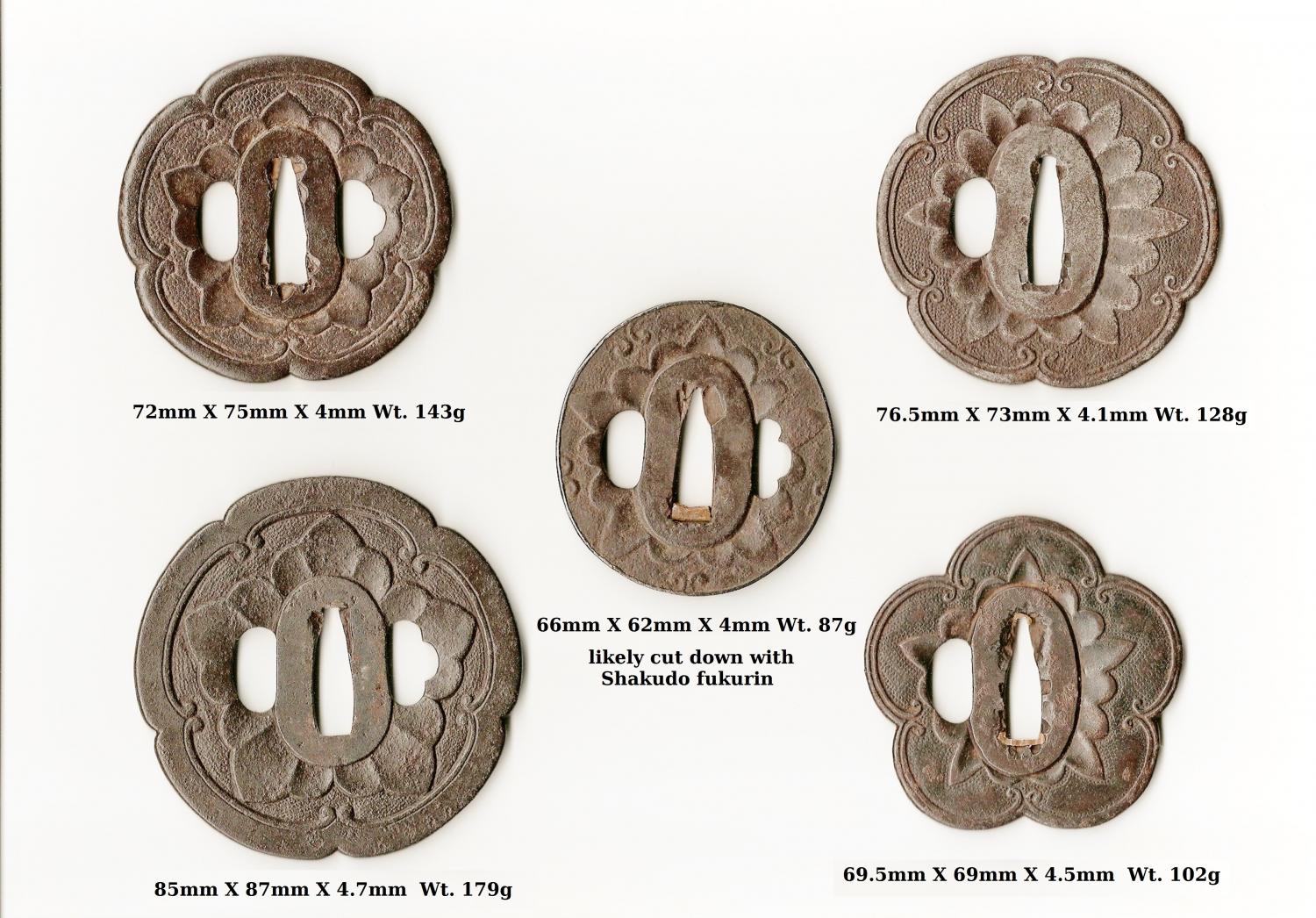
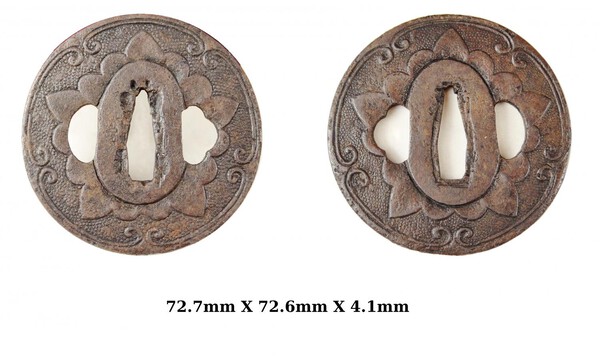
Just purchased number six in this series - that's near half the worlds supply (well maybe, I've only found thirteen in 30yrs! )
-
Torrez Your Daruma guard sparked my memory, it is a fairly common theme used by some great artists. Found these two: First Signed Yasuchika (on Worthpoint.com), the second by Umetada (and listed on eBay now). With your Kaneie, what a set that would make!
-
Torrez I think Jeans assessment of the guards is spot on. No.1 I have seen a lot of, must be thousands of them out there. No.3 also fairly common - there is what could be a collection series in this type, there is one with a fat faced child sitting atop a emakimona (picture scroll) that has the same 'look' and is also very common. The Kaneie (Kaneiye) are a real mine-field nearly everyone has one, but they were one of the most copied and there are a great number of 'Kaneie style' - meaning they have similarities to the works of the three 'Kaneie' masters. There are lots of these that have the signatures added at a later date, difficult field!
-
There is a very similar tsuba for auction, The flowers in this case held in a basket. https://www.jauce.com/auction/r388661477.
-
to Torrez What is the tsuba made of - the images are a bit vague, looks like iron but I have seen alloy guards that 'patinate' to look like iron. Does the tsuba attract a magnet? The only metals that are magnetic are Iron, iron alloys eg. steel (generally not stainless steel), cobalt and nickel. I only ask to eliminate the idea that your guard is cast - a soft metal alloy can withstand the impact forming the punch marks evident on your guard, but not a cast iron one. Believe it or not every collector should at least have a magnet in their tool kit! Meiji may get a bad rap from some circles, (not a favourite of mine) but some very pretty works of art were made then. Depends if you collect works of art or practical (often brilliant) parts of a weapon, there is room for both.
-
Torrez I have been collecting tsuba for near on forty years - but that doesn't make me an expert - There were many copies of tsuba made late Edo through Meiji and beyond, some were 'Utsushi' this at the basic level means 'to emulate' a past masterwork. However many cast pieces were made and these often come in various 'grades' some castings are very detailed, others are poor blurred pieces of junk. A section of cast guards were reworked and some carvings added after they were cast to give more definition to the piece, this is called 'Izarae' to clear/clean a cast piece and finer carvings then applied. See "Handbook: Of Sword Fittings Related Terms" Markus Sesko - 2011. It is my belief that at the beginning of the Western interest in all things Japanese, the demand for tsuba was such that at first, copies were made in a traditional way but as time progressed it was found expedient to cast copies and rework them, however as demand decreased so to did the quality and effort put into these cast works. This in my opinion would explain a lot of variance with some common examples. I don't think your example is cast, the tagane-ato (punch marks around the nakago-ana) don't look cast-in and would likely break the seppa-dai if punched in cast iron. Sorry to disagree with Jean C.
-
Ian C Nice - but you can see how fast this thing is spreading! 'Disinfectant' Dale
-
Richard George Hey that's a nice example, strong signature - not seen one before that is signed, Maybe we can trace the source of infection ! ☣ Same tsuba - different auction site. https://www.jauce.com/auction/c811784911 PicClick (Think these two were in close contact !) best bio-security ! Tasmania ☣
-
Alexsadr That one looks like it has mutated - getting scary. Lucky we have closed our borders so it can't get in!
-
They said it would get worse!

-
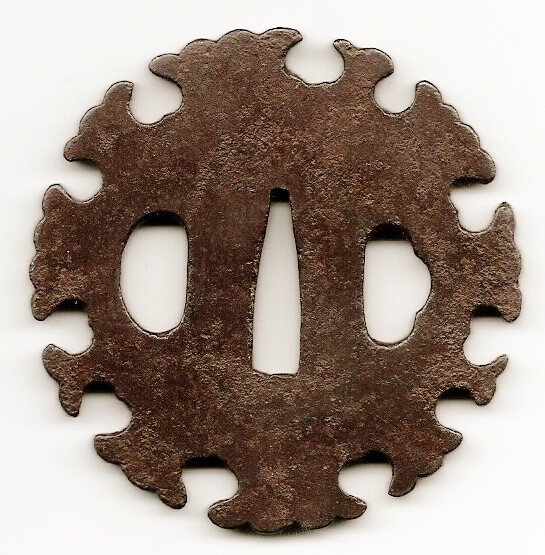
Well it has finally happened, my tsuba collection has come down with Covid-19 ! See the resemblance?
-
Mandrin Mansions archive. Description: "An interesting sword guard of unusual form. It is an eight lobed design like most Vietnamese guards of this shape tend to be. The washer seat is of typical Japanese form, but this form was also copied in Vietnam, mostly in the 17th century. It has an opening for a by-knife, but again such by-knives (cite>kogatana in Japanese) were also adopted in Vietnam. -The reason for this strong Japanese influence on Vietnamese arms was considerable immigration from Japan to Vietnam due to social unrest in Japan. The Japanese were not welcome in China, where they were regarded as pirates, so those who were good enough sailors pressed on to Vietnam where they settled and started new lives. Some masterless samurai found jobs employed by the Dutch VOC and other European traders.- Around the washer seat is a five-pointed blazing star, then a stippled background made with a round dot-punch, and the very border consists of eight shapes best described as drawer handles reminiscent of European work. These can also be extremely stylized clouds in the Chinese fashion. The whole effect of the decoration feels like it is mimicking tooled leather. A very interesting piece, worthy of further study." https://archive.mandarinmansion.com/images/nanban-tsuba/lobed-guards/lobed-guard1a.jpg https://archive.mandarinmansion.com/images/nanban-tsuba/lobed-guards/lobed-guard1b.jpg Excerpt from 'Nanban Tsuba and Asian Export Sword Guards' by James Lancel McElhinney. "A couple of mystery pieces. The numbers six and eight are auspicious in Buddhist iconography. The drawer-handle motif is a common enough device in Asian decorative arts. The central flower might be read as a stylized lotus, but the nanako-like stippling is a curious feature on an iron guard. Tekkotsu exists in the rim of the smaller of the two. Both are relatively thin, carved wrought iron plates, not cast, The late John Lissenden referred to Nanban guards that copied Iberian leatherwork. Portuguese sea-chests were often made of tooled leather, as was some upholstery and wall-coverings. I suspect this may be the effect the makers of these pieces were trying to achieve. ("Nanako" by the way is also a special nubby weave of silk that resembles fish-roe). At an antique arms show recently I saw an identical piece lying on a table. The owner told me that it had been made by a member of the Yagyu family in 1928!" http://www.shibuiswords.com/asianexportguards_files/alpha1.jpg http://www.shibuiswords.com/asianexportguards_files/alpha2.jpg
-
Peter Has the guard been cleaned recently? The sekigane look 'fresh' and the 'gold' on the wings look a little wrong - may be the quality of the image but looks more like 'gold paint' rather than applied by heat or percussion. I have not seen ategane [or ume] like this before, strange treatment. The Tonbo (Dragonfly) look like cartoon representations - could be modern anime prop. Could be wrong.
-
Vago Sorry I posted the topic in the wrong forum. In fact have just puchased three of them in the last month and looking out for more! Dale
-
Dear Brian. Yes have read both those articles, Mandrin Mansions had me intrigued, as the description of eight lobed examples, are in fact in the minority, so the assertion that they are Vietnamese based on their shape is in my mind not valid. I am rather taken with them for their naivety in execution and admire the tooled leather effect they have in hand. You realise the same guards are in both articles? Dale
-
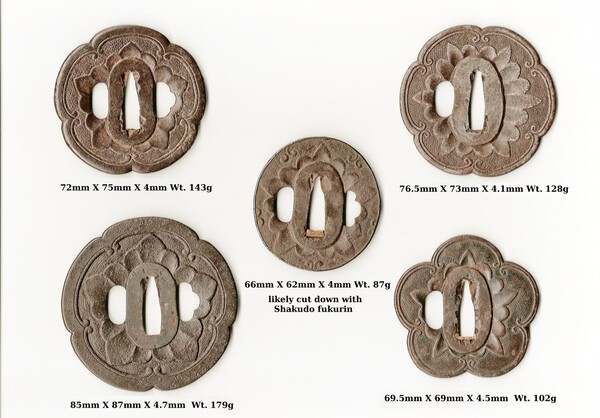
I have recently come across a series of tsuba - if that is what they are - other sources have termed them "asian export guards" as there is some dispute as to their origin. I have found at least thirteen examples, all slightly different and not cast. I have five examples in my own collection. One example not in my collection is listed as 'Bushu' but I have not found another attribution from that school. Another is described as Vietnamese based on an eight lobed design common in that country, however as I have found maru (round), four, five, six and eight lobed examples this reasoning would seem thin. (An eight lobed example currently on eBay.) I would welcome any comments or ideas as to their origin.
-
In reply to Lee Bray "catastrophic failure means the tsuba falls off completely, leaving a large space with loose seppa and habaki. With softer materials, I doubt they would break so completely and I think the core, or seppa dai if you will, will remain intact and keep your tsuka tight and useable." I have done some testing of my own, by remounting one of my swords without a tsuba- retaining the seppa and habaki. In the event of catastrophic tsuba loss, the sword remains completely usable and if the tsuka is made correctly remains tight. The loss of the mekugi however would have different consequences. This is a little off the subject of cast tsuba but physical experimentation rather than what we think will happen often shows better results. Dale
-
Lee Ouch! That looked like a nice Ex-tsuba! You may well be right about cast guards not surviving impact - could be a good (but expensive) testing criteria of guards that we are unsure of- just drop them on a tiled floor. . . No I am not serious! Do we have any evidence of when the first iron casting of tsuba and fittings took place? It would be interesting to know. There are a lot of very fine cast Namban guards that have some age to them. Some would be very difficult to cast even today, In my opinion that makes them collectible just for that sake- practical no, tour-de-force casting yes. . Getting back to the "Dai monji tsuba". Has anyone seen any Sekigane on any of these guards? Have any actually been mounted? I have seen no evidence on the ten or eleven that I have seen, if you have it may mean you have glimpsed the mythical progenitor. Dale
-
Ford I read the earlier offshoot thread you posted about cast tsuba- and would agree most were made post Edo but as we all know many tsuba were of soft material (horn, leather, lacquered wood) so why is the brittleness of cast iron any drawback to functionality? I think it:s been discussed at length that tsuba are not used defensively, if they were we would surely see many more than we do, with cut marks. The history of cast tsuba and other fittings, I fear is not as clear cut as we may think. Be that as it may I hate getting caught with a cast guard when the seller has told me otherwise. Regards Dale
-
Dale Just came across this topic and must say i am surprised at the number of people who have not seen these cast (but very well cast) guards. Bought one myself on auction last night paid a whopping 23 yen - yes that"s about 25 cents.. Christmas eve is a great time to go shopping! I have a collage of more of these tsuba images that I have come across over time. Don"t feel left out believe me there are plenty out there.