rebcannonshooter
-
Posts
136 -
Joined
-
Last visited
Content Type
Profiles
Forums
Events
Store
Downloads
Gallery
Everything posted by rebcannonshooter
-
Military Sword with Shark skin Saya ?
rebcannonshooter replied to Dogditcher's topic in Military Swords of Japan
Hi Steve, the left side column reads "KO-KI NI SEN ROKU HIAKU NEN" (IMPERIAL RECORD 2600 YEAR ) 2600 years since the founding of the empire or 1940. The writing style matches an oshigata that I've seen for KANEUJI, who was known to use Yasuki steel. I'm having trouble with the right hand column it doesn't seem to make sense to me, maybe one of the better translators will help with that. He was a Seki smith, but this has a Showa Stamp, possibly because of its early date. (maybe Bruce can tell you more) Additionally, the saya is beautiful, and quite rare for Army mounts. Hope this helps, Tom -
Good Morning Fred, Your sword is signed "NO-SHU SEKI JU KO-JIMA KATSU MASA SAKU" (Noshu the province, Seki the city, Ju- resident, Kojima- family name, Katsumasa- art name, saku- made by). the small stamp on top is a Seki stamp, lots of posts about stamps on the board. Tom
- 1 reply
-
- 3
-

-

-
Japanese sword maker translation
rebcannonshooter replied to AirborneA152's topic in Translation Assistance
Hi Thomas, Thanks for the link to Markus Sesko's explanation. I had not seen this before! It was a good read, however, I had to smile when he wrote "But it is not as difficult as it seems..." because for me it is difficult! And Piers, thanks for your great response! So...."kore o tsukuru" as Uwe said is preferred. Thanks to both of you for your input, Tom -
Japanese sword maker translation
rebcannonshooter replied to AirborneA152's topic in Translation Assistance
Hey Uwe, I've I seen this translated "kore o tsukuru" like you said, I've also seen it translated as "kore wo tsukuru" and "Tsukuru kore wo", and also verbatim as its written on the tang, just "tsukuru kore". Is there a "preferred" reading? I really don't know which one is the most "correct" any more. What are your thoughts? Maybe some of the translators might weigh in? Any help would be appreciated, Tom -
Japanese sword maker translation
rebcannonshooter replied to AirborneA152's topic in Translation Assistance
To add to what Peter said "SEKI KANEHIDE TSUKURU KORE" Tom -
Hello again, I'm not sure how much info you're looking for, but the sword is in SHIN GUNTO (army) mounts. There is a possibility that there is a stamp on the tang, near the habaki (the brass collar) that might also give some further info. The sword appears to be in great shape and is a nice example of WW2 Japanese militaria. Some of the other members may have more info on the swordsmith KANE MASA. Tom
-
Hi Kyle, your sword is signed KANE MASA WITH A Dec. 1943 date. Tom
-
Hi Ray, I really love this sword! It's times like these that I wish I was born rich. My lovely wife, however, correctly pointed out that I have already exceeded my yearly budget for swords and it's only February. I hate it when she's right! Anyway, beautiful sword, good luck with the sale, Tom M.
-
Possible Masahide for sale
rebcannonshooter replied to th6y2's topic in Auctions and Online Sales or Sellers
Hi Piers, I disagree, they even match the listed Amahide Kokuin in Slough's Oshigata book. Tom -
Possible Masahide for sale
rebcannonshooter replied to th6y2's topic in Auctions and Online Sales or Sellers
The Kokuin on this sword is an exact match for the kokuin of the Showa swordsmith Fukumoto Amahide. Amahide's son Fukumoto Kanemune often signed for his father and others at the school. The formation of the "hide" kanji is exactly how Kanemune signed. I don't know much about Amahide's other students, but would be willing to bet that this "Masahide" is one of them. Does any one have more info on this group? Tom -
Japanese sword
rebcannonshooter replied to Samurai_Kevin's topic in General Nihonto Related Discussion
Hi Kevin, The leather cover had me put off a bit, but your sword is a real Japanese sword from WW2. The tang is quite rusty so it's hard to read. What I can make out is "No-Shu Ju Tomo??? Hide??? Saku". With the rust I'm not super confident, maybe one of the guys with better eyes will way in with their opinion. Tom M. -
Hi Adam, I love Kai gunto's too, and this looks like a good one! congrats! Tom
-
Good Morning Peter, I just got to tell you that I love this Tsuba. I love the perfect "imperfections" of the plants, and the crab's cool too. Tom
-
Hi Max, Your sword appears to be signed NOSHU SEKI (no) JU KO-JIMA KATSU MASA SAKU. Tom M.
-
Translation assistance (katana / wakizashi)
rebcannonshooter replied to Milblades's topic in Translation Assistance
Hi Leo, The break of between wakizashi and katana is usually 60 cm. Ishihara Kanenao was a WW2 smith that made swords for the military, so I believe the sword was meant to be katana length, but just came out a little short. Tom M. -
ODD STAMP ON SHINGUNTO
rebcannonshooter replied to rebcannonshooter's topic in Military Swords of Japan
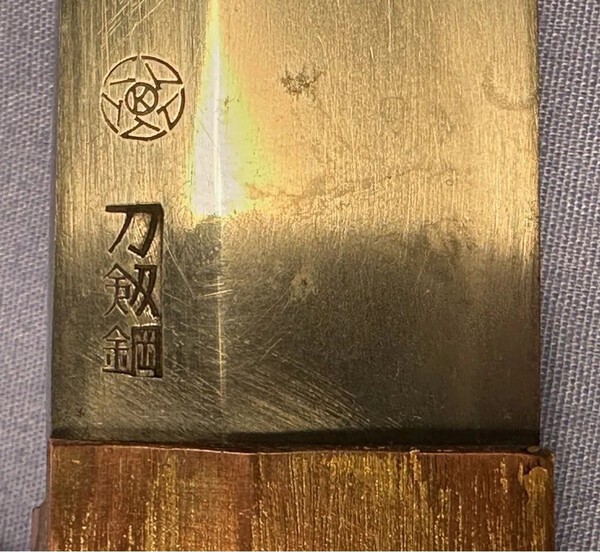
Thanks John, The "sword grade steel" makes sense. I've seen the letter 'k' inside a star before, but not the 'k' inside a circle inside a star inside another circle! Just wondering if any of the other militaria collectors have seen such a thing. Plus, "normally" aren't these types of stamps on the nakago? The location of this struck me as odd. thanks, Tom -
I saw this on eBay today. The sword appears to be legit, and of good quality. But I've never seen these stamps before, or in this location. The nakago is mumei. Hey Bruce and/or Kiipu do you have anything like this on file? What do you guys think? Thanks Tom M.
-
Japanese Type 95 Sword for NCOs
rebcannonshooter replied to Shamsy's topic in Military Swords of Japan
Hi Sam, I know the "other" Tom very well, (my wife and I are having dinner with him and his wife this weekend), whenever you get in the area we'll set something up! Tom M. -
Japanese Type 95 Sword for NCOs
rebcannonshooter replied to Shamsy's topic in Military Swords of Japan
Hi Sam, I'm not sure where in Oregon you live, but I have three Type 95's of various models. I'm extending an open invitation to come to my house and study them (as well as other military swords). I live in Idleyld Park, Oregon, so you can estimate how long of a drive it is. Let me know, Tom -
Not to hijack this thread, but I've never seen a Kikusui engraved on an Asano Kanezane. Has anybody seen one before? I'm a fan of Kanezane ( I have two) and would love to see more. Bruce do you have any on record? Tom
-
Hello Dan, There's a couple of things that I see that are inconsistent with a legitimate 95. I don't like the way the Bohi (groove) ends for a start. We need better pictures especially focus on the Habaki (collar) and how the Bohi ends next to it. Then photos of the blade tip and how the Bohi ends there. These are usual areas that the fakers get wrong. Better photos of the stamps on the Fuchi (collar) as well as the serial number and the stamp next to it. Tom
-
Hi Gus, Ray translated the major points of the appraisal for you, but it seems that there's a couple of things your confused on. The papers authenticate your sword to "Koto Suke Sada". Koto is not the first name of the sword smith, but as Ray indicated "Koto" is a general time period of sword manufacturing. The appraisers believe that it was made during the Tensho Period (1573-1592) which is adding a more specific time period rather than just a general koto estimate. As I indicated in my first post the sword is signed BISHU OSAFUNE SUKE SADA. Meaning the swordsmith's art name was Suke Sada, who lived in Osafune village, Bizen Province. Your sword is quite old and genuine, but I have no idea of sword values in Sweden. Everyone on this forum loves Japanese Swords, and we hope that all new sword owners understand that they are now "custodians" of a historical artifact, and give it the care it deserves. Tom
-
I see an oshigata (tang rubbing) attached to a description written in Japanese, which appears to be an appraisal. That's the document I'm talking about. (Also the swords appears to be several hundred years old) Tom
-
From the partial picture of the appraisal paperwork I can read "BISHU OSAFUNE SUKE SADA", which appears to match the signature on your sword. Since there were over 150 Suke Sada's that worked over several hundred years it's hard to tell which one from what you've provided. There is appraisal paperwork, take clear photos of it and post in the translation section, and I think most of your questions will be answered. But, it is a real Nihonto with some age. Tom
-
I shouldn't even guess.... but - Yoshimune?
rebcannonshooter replied to Bruce Pennington's topic in Translation Assistance
Hi Bruce, Fuller and Gregory list a YOSHITADA with a similar signature style. Tom Whoops! I meant YOSHI-SADA