rebcannonshooter
-
Posts
136 -
Joined
-
Last visited
Content Type
Profiles
Forums
Events
Store
Downloads
Gallery
Everything posted by rebcannonshooter
-
Help with a Date, Please
rebcannonshooter replied to Bruce Pennington's topic in Translation Assistance
Hi Bruce, I've seen a very similar kanji as an alternative form of the number ten. I'm assuming the variance is just the swordsmith's style. Tried to do an AI inquiry on it and got no where. Hope that helps, Tom -
Please help with signature, Shin Gunto blade
rebcannonshooter replied to Scogg's topic in Military Swords of Japan
Hi Sam, I have a drawer full of Shingunto parts (tsuba, fuchi, kabutogane, seppa, and menuki) that I will happily donate to your project. I, too have a passion to save abused swords. Give me a call with your needs, Tom -
Hi RobDam, I own a sword that's signed "Bizen Kuni Ju Osafune Gorozaemon Jo Kiyo-Mitsu saku" with a full length bo-hi. It's dated the 18th year of Temon/Tenbun (1549). If you're interested in a range of dates.
-
Thankyou Moriyama-san, I I did a long back and forth with AI on this kanji, and the AI wasn't able to explain anything about it being a variant. You are most generous with your time and knowledge, Thanks again, Tom
-
Moriyama-san, why does the "Nin" kanji have the extra strokes on it? (Mitsuhiro used 4 strokes on this kanji instead of 2), which had me scratching my head in confusion. "Nin" was the only thing that made sense there, but I never saw it written this way. Thankyou, Tom
-
NCO with Officer Sword
rebcannonshooter replied to Bruce Pennington's topic in Military Swords of Japan
Hi Bruce, I agree with Charles. In my younger days I built exact replica American Civil War Cannons, carriages, limbers and caissons. (ergo my user name) The Civil War was one of my passions. I've viewed hundreds of tintypes, especially from the beginning of the war, where soldiers would have their pictures taken with long guns, pistols, large knives and swords, even though they were privates and certainly not authorized to carry a sword or pistol. I imagine that that same martial spirit was prevalent with Japanese soldiers as well, so they would "borrow" a sword just for the photograph. Tom -
Translation assistance please, showato with hot stamp
rebcannonshooter replied to Scogg's topic in Translation Assistance
Hi Sam, I own a couple Kanezane, so I've always taken note when I see one of his swords. It looks like "No- Shu Seki (i think) Asano Kanezane Saku Kore. I've seen some odd renditions of Seki, but its somewhat similar to oshigata "E" in Slough's book. But, then again, Conway could be correct, because I also seen some odd "Ju" characters with his swords. Hope this helps, Tom -
WW2 Gunto Mei translation - any help appreciated
rebcannonshooter replied to Historynut's topic in Translation Assistance
Hi Uwe and others, I had a long drawn out back and forth with Google AI about what is the correct pronunciation of this swordsmith's name. According to AI this kanji has multiple valid readings: "its standard standalone reading is "Omi", but when used at the end of a male's given name it frequently takes the traditional reading of "Tomi". Both are linguistically plausible." However; according to "Seki Kaji Tosho", "Yoshi-omi" is the preferred pronunciation for this swordsmith. So Uwe, you are exactly right. Thanks for the correction, Tom -
WW2 Gunto Mei translation - any help appreciated
rebcannonshooter replied to Historynut's topic in Translation Assistance
Hi Uwe, I grabbed my copy of P.G. O'Neill's book on Japanese names, and he listed it as "tomi" as well. Its not a well known/used kanji, so is there a pronunciation rule I'm unaware of when used in conjunction with another kanji? Call out to SteveM, Help! Tom -
WW2 Gunto Mei translation - any help appreciated
rebcannonshooter replied to Historynut's topic in Translation Assistance
Hi Uwe, My reference book shows that kanji as "tomi" and there was a WW2 swordsmith with that signature listed as "Yoshi-Tomi". So I'm confused, is there an alternate pronunciation/spelling that I'm missing? Thanks, Tom -
WW2 Gunto Mei translation - any help appreciated
rebcannonshooter replied to Historynut's topic in Translation Assistance
Hi David, The fittings on your sword are very good quality, IJA swords had higher and lower quality no matter what the year of production, pierced tsuba vs solid etc. (They were purchased by the officer, so quality often came down to how much money the individual had to spend.) You are correct that things began to change by 1944. Hopefully Bruce will chime in with more on the changes and other details that occurred towards the end of the war, he's way more knowledgeable with that than me. Tom -
WW2 Gunto Mei translation - any help appreciated
rebcannonshooter replied to Historynut's topic in Translation Assistance
Hi David, Your sword appears to be a very good condition Army type 98. The signature is Yoshi-Tomi. On the opposite side is the date which appears to be: Sho-Wa Ju Hachi Nen Go Gatsu, the fifth month of 1943. The "wa" kanji is oddly written as is the "go" kanji, so I hope that I'm understanding the swordsmith's writing style. hope this helps, Tom -
I think Sam is right on the mark with his assessment. For me, the artificial rust on the nakago and the freshly drilled mekugi ana scream fake. Tom
-
Is it real or is it fake?
rebcannonshooter replied to Trav4ever's topic in General Nihonto Related Discussion
Hi Travis, I agree with Kantaro and Grey, it is a real Japanese sword (not a Chinese fake). Your sword is a wakizashi, that is, a sword whose blade length is between 12 inches and 24 inches. Although the blade condition is poor, a couple of pics show a hamon (the outline of the hardened edge which appears as whitish metal). The tsuba (sword guard) and tsuka (handle) were of good quality, but also now in poor condition. As far as the restoration goes, the bad news is that its going to be a very expensive process. There are only a few qualified sword polishers in the US and that very high cost (combined with the handle repair) would far exceed the value of the sword. All of that being said, search the message board for info on the care and handling, as Grey says avoid attempting to clean the blade, keep the sword lightly oiled and enjoy being the caretaker of a real Japanese sword. Tom PS what part of Pa are you from? I live in the Altoona/ Johnstown area half the year and could give your sword a look if your close. -
Can someone translate the Mei ?
rebcannonshooter replied to Ken Cline's topic in Translation Assistance
Hi Ken, Sorry, I'm not going to be able to tell you too much about your sword, but lets start with what we can see. The sword is a real Japanese sword called a wakizashi, traditionally a sword between 12 and 24 inches. For Samurai it was a companion sword carried along with a long sword (katana). Merchants and non-samurai could carry a sword of this length, but not a katana. The sword was carried edge up inserted through an obi. I'm guessing it is a Shinto period sword. That is, a sword made between 1596 and circa 1780. The condition of the polish is not good, so no details of the grain or hamon can be seen to help us evaluate it. Hawley lists only four Tadayuki working in Higo or Hizen, all between 1661 and 1845. Perhaps one of our better sword evaluators will weigh in, and can provide a better appraisal for you. Hope this helps, Tom -
Hi Marcin, the first kanji is "Yoshi", but I can't figure out the second. The date appears to be Dec. of 1943. Tom
-
Can someone translate the Mei ?
rebcannonshooter replied to Ken Cline's topic in Translation Assistance
Hi Ken, Mark beat me to it as I was typing. The signature appears to be: "Hi-Shu Ju Tada-Yuki". (the second kanji is poorly written, but I can't imagine any thing but Shu.) Hishu can refer to either Hizen or Higo province. There were a few Tadayuki from Hizen/Higo that worked in the mid to late 1600. Would need an overall photo and more detail to give you more than that. Tom -
Hi Christopher, The sword is signed "Bi-Shu Osa-Fune Suke-Sada" and dated "Tenmon (or Tenbun) Go-Nen Ni-Gatsu-Hi", a day in the second month of the fifth year of Tenmon or 1536. There were a LOT of swordsmiths who used the art name of Sukesada in Osafune Village. They were of varied skill levels, and during this time they were producing many many swords. That being said, I have a fondness for Bizen swords even during the high production times. You didn't give us any measurements, or description of the mounts, so we would need much more to go on to establish a value. Also the sword will need a polish and that's an expensive proposition, so factor that into the price! Hope this helps, Tom
-
Help with Asano Kanezane Nakago Inscription
rebcannonshooter replied to Conway's topic in Translation Assistance
Hi Con, The omote is a fairly typical nakirishimei: "No-Shu Ju Asa-No Kane-Zane Saku Kore". The ura side has me confused, on it he often would make an inscription about winning an award or the type of steel used etc, but this inscription is unfamiliar to me. Sorry I can't be more help, hopefully some of the better translators will weigh in. Tom -
Hi Freed025, It appears to read "SEKI-SHU SADA-YUKI" Tom M.
-
Hi John, I did inquire with the seller about additional info on the sword, unfortunately how it came to the US is lost to time. It would have been nice to have some additional provenance to link this to the general. He did have a son, but I couldn't find any history on him. It is also my understanding that this black wool knot was authorized for all officers in Meiji 45, and I am excited to hear that there is an example of a general officer carrying a sword in field grade mounts! I believe that this sword was an important possession of the general, and that he would continue to carry it. Tom
-
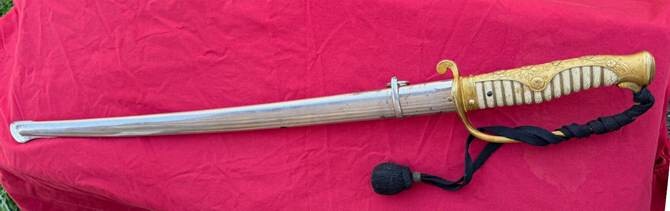
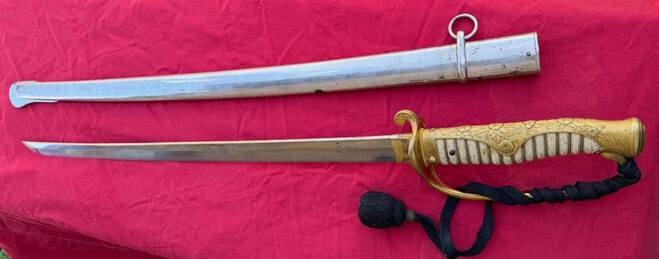
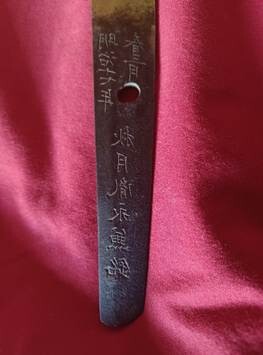
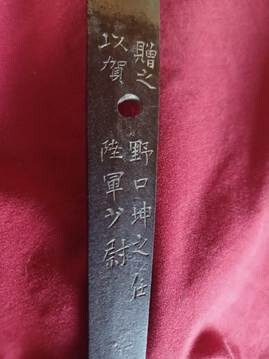
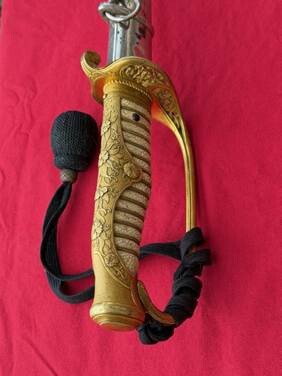
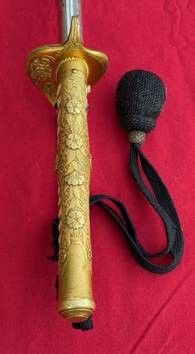
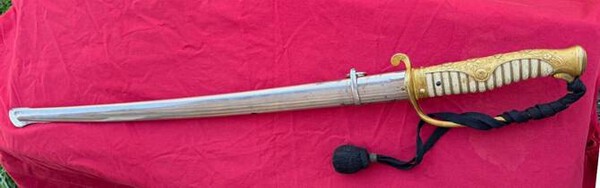
Sword of Lt. General Noguchi Kon’no I’d like to share some photos of an interesting sword I was able to acquire recently. The sword is housed in army Type19 field grade officer’s Kyu-gunto mounts, with a black wool, “German-style” sword knot with gold crown. The knot appears to be the type authorized in Meiji 45, and original to the sword when brought back to the U.S. The blade is a wakizashi, 21.25 inches long, rather straight, with a sori of only 3/16”. The hamon appears to be sanbon sugi, but with rounded peaks rather than the more typical pointed. Before purchasing it, I posted pictures of the nakago in the translation section of the NMB. Special thanks to Moriyama Koichi for helping with the translation and providing biographic info. Additional thanks to SteveM for his kind help with the horimono explanation (see the postings in the translation section). From the translation Moriyama-san provided: the sword was a gift from Akizuki Teijiro to Noguchi Kon’no in the spring of 1884 to celebrate the latter’s commissioning as an Army Second Lieutenant. (Dec 25, 1883). Akizuki Teijiro was a famous samurai who served the Matsudaira Clan. He was a senior commander of the Aizu forces during the Boshin War. Later in life, he became an educator and established a close relationship with Noguchi Kon’no, who was his protégé. Noguchi had numerous combat postings and promotions during the Sino/Japanese War. During the Russo/Japanese War, he was promoted to Colonel where he served as Chief of Staff of the Army’s 4th Infantry Division. He fought in the Battles of Oishibashi, Haichen and Shahe, and was seriously wounded during the Battle of Liaoyang. He returned to Japan to recover and was later promoted from Colonel to Major General in March of 1908. (Japan does not have the rank of Brigadier General like we have in the US). While a Major General, he commanded several different infantry brigades but fell ill in 1911. He was promoted to Lieutenant General in August of 1912 (Taisho gan-en) before being transferred to the reserve forces (retirement). The sword does not have the tortoiseshell handle that would be consistent with what a Major General would have carried during the 1908 to1912 time period (when he was of that rank). Nonetheless, I believe that this is, in fact, a sword owned and carried by the late Lt. General Noguchi Kon’no, IJA. The sword would have most certainly been carried by him while he was a colonel, but the presence of a Meiji 45 knot creates a conundrum. He was obviously a General when this knot was authorized, so does that mean this sword was still in active use? Would a sword in this furniture still have been acceptable for a general to carry? Anyway, I am honored to be the new caretaker of this sword, please enjoy the photos! I welcome all comments, corrections and speculations. Special shout out to Bruce Pennington, John (PNSSHOGUN) and Thomas (Kiipu), you guys have more expertise with Kyu-gunto and knots than I do, and I would love to hear your thoughts. Also, I would appreciate any evaluations from Nihonto experts of the blade itself, thank you. Any mistakes/errors are mine alone, and I attribute them to old age and too much alcohol in my youth. Respectfully submitted, Tom M.



-
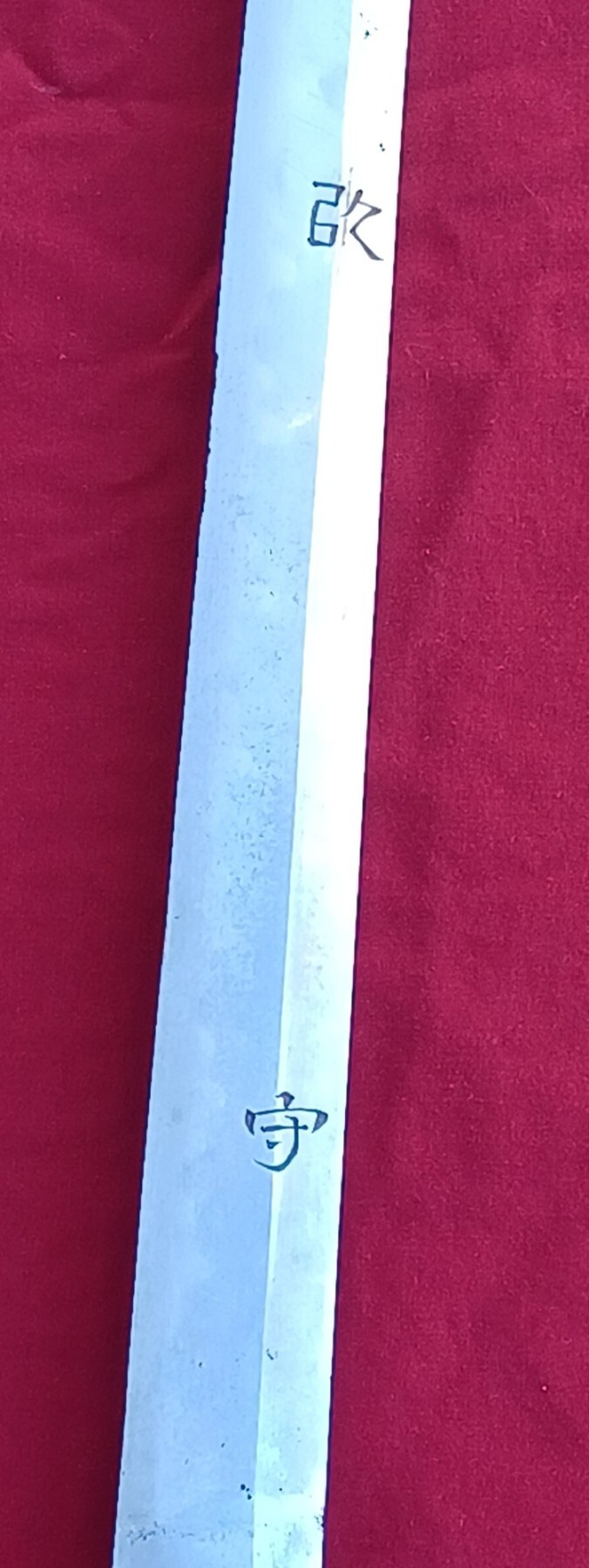
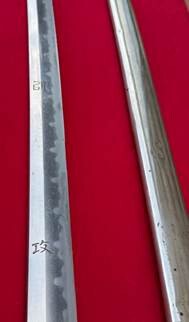
Thanks, John and Steve; I knew there were some carvings on the blade when I bought it but didn't realize that they were kanji until the blade arrived, and I got a clear look at them. Since this was a gift from an elder statesman to a young 2nd lieutenant at the start of his military career, an apothegm like that would make perfect sense. Thanks again, Tom
-
Hi John, The sword is in beautiful field grade officer's Kyu-gunto mounts. I'm planning on posting an article about LT. General Noguchi Kon'no with photos of the mounts and sword. Wanted to make sure what the horimono were on the blade first. Tom
-
Hello all, two weeks ago I posted two pics of the nakago of a sword I was buying. Moriyama-san was able to translate the very interesting inscription for me. The sword arrived today! There are four horimono on the blade. I initially thought that they might be Bonji, but now I believe they are Kanji. One of them appears to be "Shu", "to protect" not sure what the others are. Any help would be appreciated, Thanks in advance, Tom