Peter Bleed
-
Posts
1,866 -
Joined
-
Last visited
-
Days Won
8
Content Type
Profiles
Forums
Events
Store
Downloads
Gallery
Everything posted by Peter Bleed
-
Jean, You ask the most basic question of shinsa. Why do it? My personal opinion is that submission is usually undertaken out of 1) ignorance ("I wonder what this is?"), 2) insecurity ("Gee, I think this is what is is, but, I'm not sure"), or 3) arrogance ("I own it so it must be significant"). In place of these strategies, I recommend, 4) Reasoned hypothesis testing ("My best assessment is that it is either this or that . . . , and in either case, papers will add to the value." For common and easy to identify categories and without background research, shinsa simply doesn't make sense. Peter
-
The blade cries for shinsa. And Tampa is coming up Peter
-
Chris, To move this thread back to the film... I contacted the Kawasaki Reading Room (remember Kawasaki makes motorcycles and subway cars here in Lincoln - Go Big Red!). The Director would happily get a copy of an early film on swordsmithing. They would curate a copy - could one be held - and they have good contacts in Japan. So... Please get me the titles etc of the film - Nihongo de - and the contact information on the agency wich has the print. This looks like it should be doable. Peter
-
Chris, If Bob can help you, and a Japanese connection is what you need, go for it(!). Let me also humbly say that I have some suasion with the Kawasaki Reading Room at the University of Neberaska-Lncoln. I would also work hard on getting t copy of this film archved thru the UNL Center forDigial Research in the Humanities. And, would love to help. Please keep me in mind! Peter
-
I'm challenged. I hope someone will unpack this presentation. Peter
-
I agree with Arnold (as usual). These gomoku-zogan tsuba are a reflection and indication of what seems to have been a active recycling and "hustling" trade that was the low end of sword marketing during Late Edo times. Musui's Story, the autobiography of a ronin describes how he supported himself for a while by buying trading in fittings he bought in flea markets. Not all the hustle was for the foreign trade, I suspect. I think this tsuba may have begun life as an "Onin" style piece and it may have been flipped and turned before the scrap brass wires was fused on to the surface. Peter
-
Joe and Mark, Thank you. The Board worked. Peter
-
All right, gang, give me some practical advice. Others have have sought advce on purchases on eBay, from various online dealers, etc etc. What good is the NMB, if i can't ask a - hammm - practical question!!! I just got a call from a - well - slick. He offered me an 1850 field officers' sword (which i will put at $250) AND an aluminum handled Japanese non-com sword with NO saya, AND a saya (only) for a type 32 Army cavalry sword. So here's the question... should I invest 150 in the bare noncom sword and the singleton scabbard. Quckly, colleagues, the timer is running on this one! Peter
-
Thanks to those of you who explained this matter For what it is worth - not much! - my reaction when first seeing the sword on Andy's page was that the signature "looked" pretty good. But without (any) interest in the sword/era/school, and faith in Andy's typically erudite assessment (did he almost use a triple negative? they are likely to say it is not authentic...) I didn't get the books out. Now I wish had. Peter
-
1925 analysis of iron sands in Kuji region
Peter Bleed replied to Randy McCall's topic in General Nihonto Related Discussion
Thank you Randy. This was an interesting post. Northern Iwate had to have been pretty remote so this research was real adventure. I assume that this iron ore was largely used in the cast iron industry, but the role of northern steel working in early development of Japanese swords is way under appreciated. I wish he had done soem archeology while he was visiting those old mine shafts. Peter -
Here is what the motorcyclists have to say about Neil http://www.motorcyclemuseum.org/halloff ... acerID=208
-
I learned today, and must note with sorrow, that Neil Keen, a long time collector from the St. Louis area has passed away. Neil was a Hall of Fame flat track motorcycle racer with a sharp wit and a very good eye. I always appreciated his insights about well crafted objects, swords, fittings, or anything else. Neil faced medical issues for some time, but anyone who saw him whip thru the Chicago Show on his power chair could see that he never lost his racer's sensibilities. The world is reduced. Peter Bleed
-
Wonderful thread! I'd like to see all of these guards, but if I had to vote based on the information presented, I'd say they are all cast. Look closely at the "Soten" signature. The marks are round and soft. Chinese, Japanese? Who knows, all I can say is, I don't want these bad boys. But they will certainly confuse the market. Peter
-
Dear Friends, I just had a wonderful exchange with Jan Culbertson on Manchukouan short swords and with his permission, I am attaching it below. The take away message may be - keep asking til you get the answer you want. :D From: Jan Culbertson [mailto] Sent: Sunday, January 19, 2014 12:25 PM To: Peter Bleed Subject: Re: Manchukuoan short sword Hello Peter: At one point I was collecting photos of Manchukuo swords and daggers to make a book about them, but I gave up on the project because it was too hard to find pics of them. I remember having pics of this one though, and also one with two stars on the backstrap. I think the star is a symbol of rank (brigadier general). And yes, I am about 95% sure it is Manchukuo. Best regards, Jan ----- Original Message -----e From: Peter Bleed To: Culbertson_J@msn.com Sent: Sunday, January 19, 2014 9:34 AM Subject: Manchukuoan short sword Dear Mr. Culbertson As a long time collectors of Japanese swords (Chairman of the JSSUS 1980-1983) with a minor interest in Japanese colonialism , I recently acquired a short sword that I think was made for use in Manchukuo. I showed this on the Japanese sword Message Board and got essentially NO response. One collector suggested that it was a "fake", but I trust that it is vintage. It rather "looks" Japanese but I am sure that it was made on the continent. It has a "star and sorghum" motif that Jim Dawson presents, but he does not show a sword like it. The blade measures 40 cm long. I would appreciate any comments or reaction you might have. Thank you, Peter Bleed PhD.
-
Mat and Thomas, Thank you for your comments. Sword interest can lead in many different directions, but after 146 views and 2 comments, I think we can conclude that potential Manchukuoan swords are NOT a hot area of collector interest. Matt, your sword is just like a sword (plate 28-18) shown in Jim Dawson's terrific volume. It shows nothing like my short sword, so Thomas, you might be right. Still, I remain pretty darn sure that this is WWII vintage. It feels and just looks "right" (to me). Dawson does show a belt buckle from Mike Quigley"s collection that has has the same crest motif. Maybe my babies won't starve. All this to say, thanks! Peter
-
So, Chris, Is this the one you were going to put over the fire? Peter
-
For the sake of discussion - Identification / verification
Peter Bleed replied to batesman's topic in Nihonto
Jon, Welcome. You will have a great time, but I am not sure that I can outline a "thought process" that describes Japanese sword assessment. I think "collecting behavior" is far more important than any "thought process". I think you should look at swords, meet and chat with others, and see how swords actually move. I urge you to come to the upcoming Tampa sword show. And I'll bet there are collectors somewhere near you. Call them! The eBay item you asked us to consider seems completely typical of stuff that is out there. While you are touring eBay, you might wish to check out these items. http://www.ebay.com/itm/Facts-and-Funda ... 485f90c618 http://www.ebay.com/itm/The-Japanese-Sw ... 3389960ad8 http://www.ebay.com/itm/The-Connoisseur ... 1c3af09fd1 http://www.ebay.com/itm/The-Japanese-Sw ... 27dcdd5197 Again, welcome Peter -
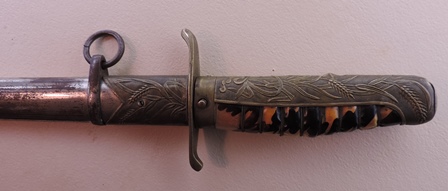
Dear Friends, I wish I could say that I did some scouting yesterday and found a really nice Sendai shinto - a Kunikane, say - that I would love to have in my collection, but . . . . that didn't happen. What i found seems to be a potentially unusual Manchukuon dagger. I hope somebody on this Board might find it worth seeing. The blade is a rather crudely formed shinogi-zukuri shape, 40 cm long with no habaki. I can't believe it is Japanese-made, but I am completely sure that it is WWII vintage. This is NOT a recent Chinese production. The hilt has fake tortoise shell wrap below a brass backstrap that features a Star surrounded by sorghum. This is the motif that Jim Dawson calls the third Manchukuo government symbol. The same motif is on the scabbard fittings. Has anyone ever seen another of these? Peter


-
Sendai shinto - esp Kunikane. A strong and persistent line marked by beautiful masame. Peter Bleed
-
1942 Shigefusa
-
talk, being cheap, let me suggest that the smigh name characters are "KIYOMICHI" Peter
-
A Few Questions on my Wakizashi
Peter Bleed replied to GetFuzzy2's topic in General Nihonto Related Discussion
Vern, I happen to be on line when you posted this blade. It seems kind of interesting, but in keeping with recent standards, I urge YOU to translate that signature. It start with "Fujiwara" so you can start with the smith's name. You can do this and it will be fun! Peter -
Adam, We may be hijacking this thread, but at that risk, let me say that prices seem a BIT less standardized that collectability. In general, it looks like prices are going down. Whatever the price, quality assessment seems more patterned. It is pretty easy to assess the quality of common signatures, to place most signed swords into a school or a lineage, and then to get a sense of what people think about that category. Likewise, obvious "take aways" of a particular sword (suriage, machi-okuri,odd length, kizu, yahh dahhh yahhh da) are rather easy to assess. We just saw it done with the two swords Roland invited us to think about. Both of those swords were made and I assume functioned as worthy "swords". The discussion we just had showed how to assess swords. And it sure looked for a while that the obvious and best action that a collector could take after that discussion, was waiting, saving his money, and getting a better sword. I assume that means one with a higher assessment and fewer take aways. As long as collecting standards are determined by broad the sword establishment, this is patterns will persist. Collectors who set their own standards, by for example collecting schools or lines that THEY happen to like, may be able to find reasons to acquire interesting swords that do not appeal to others. Peter
-
Roland and All, This has been an interesting discussion. We have all grown as a result of some expert and clear presentations.Thank you. The standards of 1) collecting, 2) of the sword market, and 3) of the collecting community all seem to becoming more concrete and clear. In this situation, I have to wonder if swords of the "middle rank" are going to fall in price. Is the middle falling out of the sword market? Peter
-
Forrest, My earlier quip about this smith - Nobuhide - being an optimist was based on the fact that he claimed to know of lucky days in June of 1945. There weren't many of those - at least for the Japanese. I would urge you to move slowly on rehaping the tip. There may be tempered edge still up there, Tho, in today's market, restoration would need LOTS more research and rationale.I find it interesting that the shira-saya has sayagaki to this smith. Peter