obiwanknabbe
-
Posts
442 -
Joined
-
Last visited
-
Days Won
4
Content Type
Profiles
Forums
Events
Store
Downloads
Gallery
Everything posted by obiwanknabbe
-

Mei help please, I think I am half way there.
obiwanknabbe replied to obiwanknabbe's topic in Translation Assistance
Gentlemen, Thank you so much for your input here. It seems the plot is thickening? The English major in me begs me to ask if any known smiths were noted for using plays on words in their mei? Same word Rakuyo, same pronunciation, but different meaning? Also referencing Kunihiro and a place he was known to work, settle down, and eventually die. Could this be a sword, made by another smith to honor THE Kunihiro's passing? Like a memorial? Just a shot in the dark. Kurt. K -
Mei help please, I think I am half way there.
obiwanknabbe replied to obiwanknabbe's topic in Translation Assistance
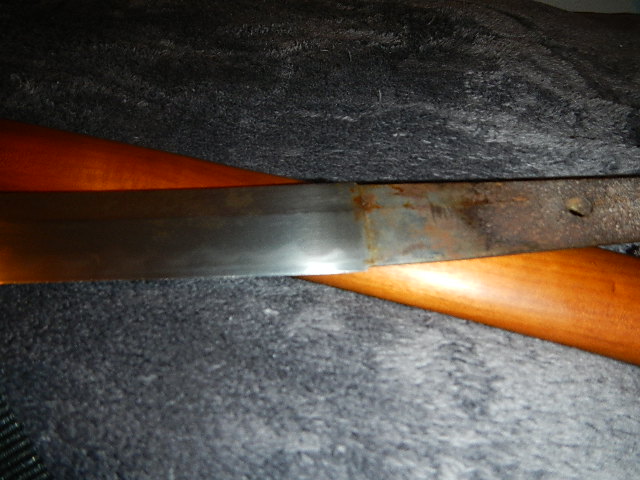
Sorry about my mixing terms. i am still learning and have much to learn. When i say the hamachi is even with the edge, i mean that it is not not bowed looking or wider at any point to the rest of the cutting surface. As you can see in the pic, it does not look tired at all. I have seen instances where a sword has been polished but not all the way down to the bottom of the hamachi so as to facilitate the use of the old habaki. That was what i was talking about.. Sorry for the confusion. Thanks again. Kurt. K -
Mei help please, I think I am half way there.
obiwanknabbe replied to obiwanknabbe's topic in Translation Assistance
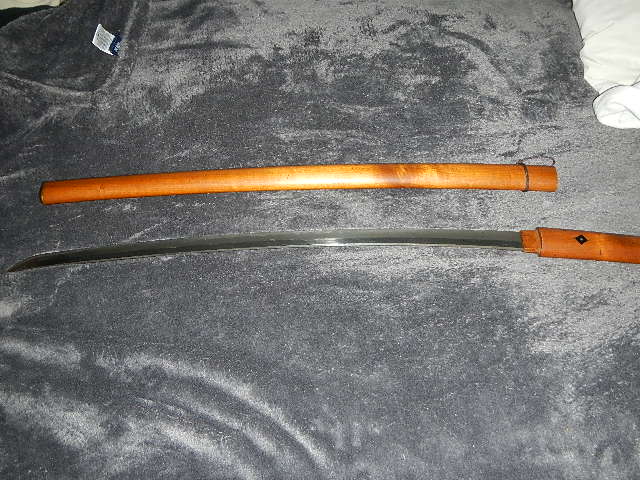
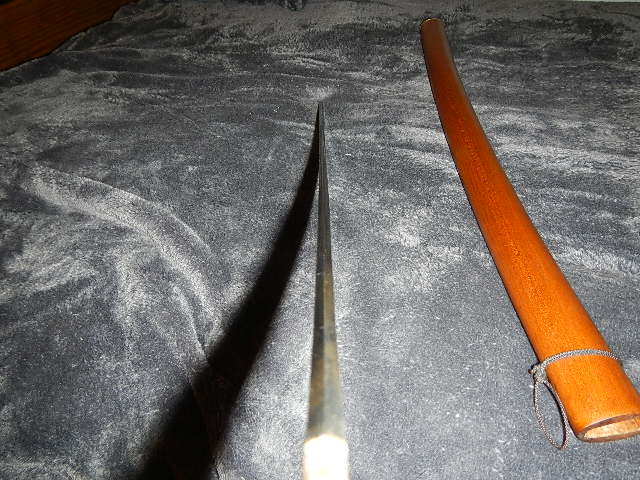
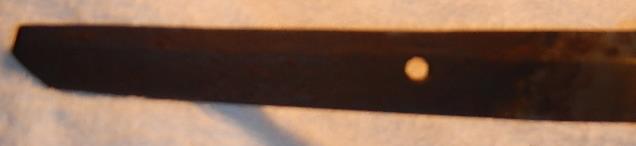
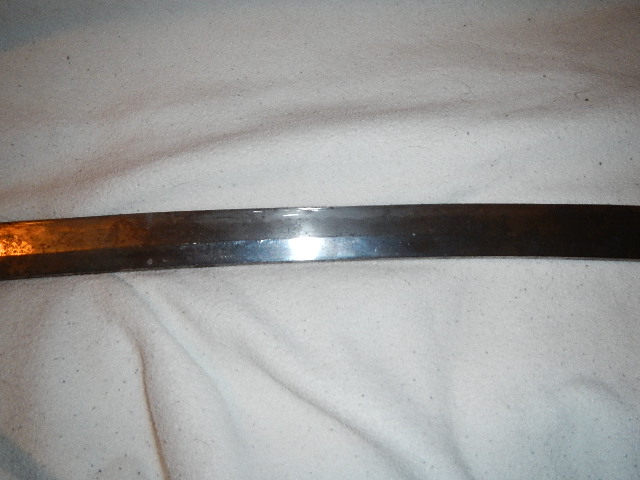
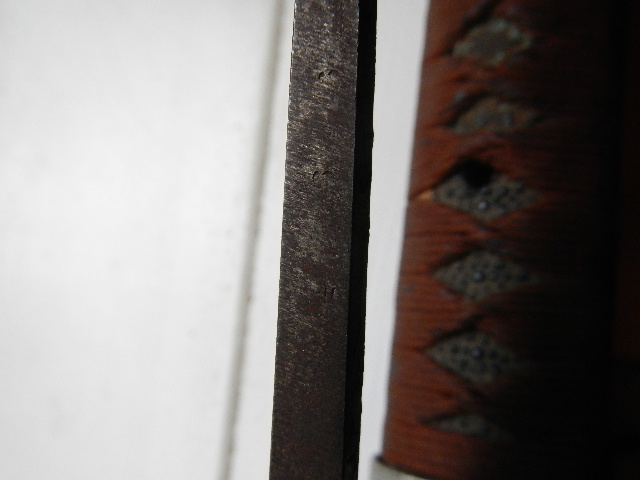
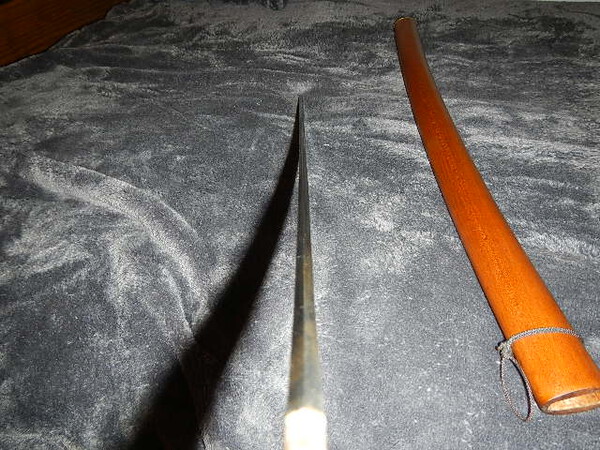
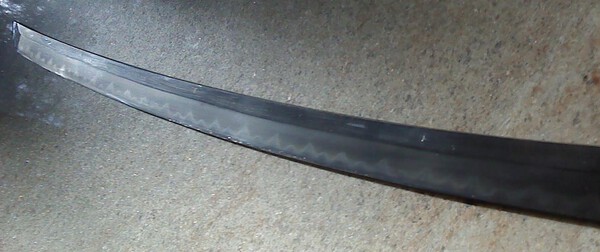
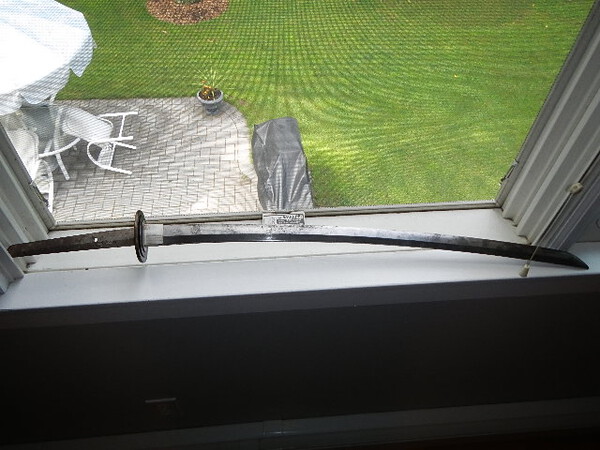
Here are the better pics i promised. Taken with a far better camera. I just wish i could upload higher res shots. Kurt. K Also, just thought i should add.. This blade is almost weightless in hand. The balance is superb.



-
Mei help please, I think I am half way there.
obiwanknabbe replied to obiwanknabbe's topic in Translation Assistance
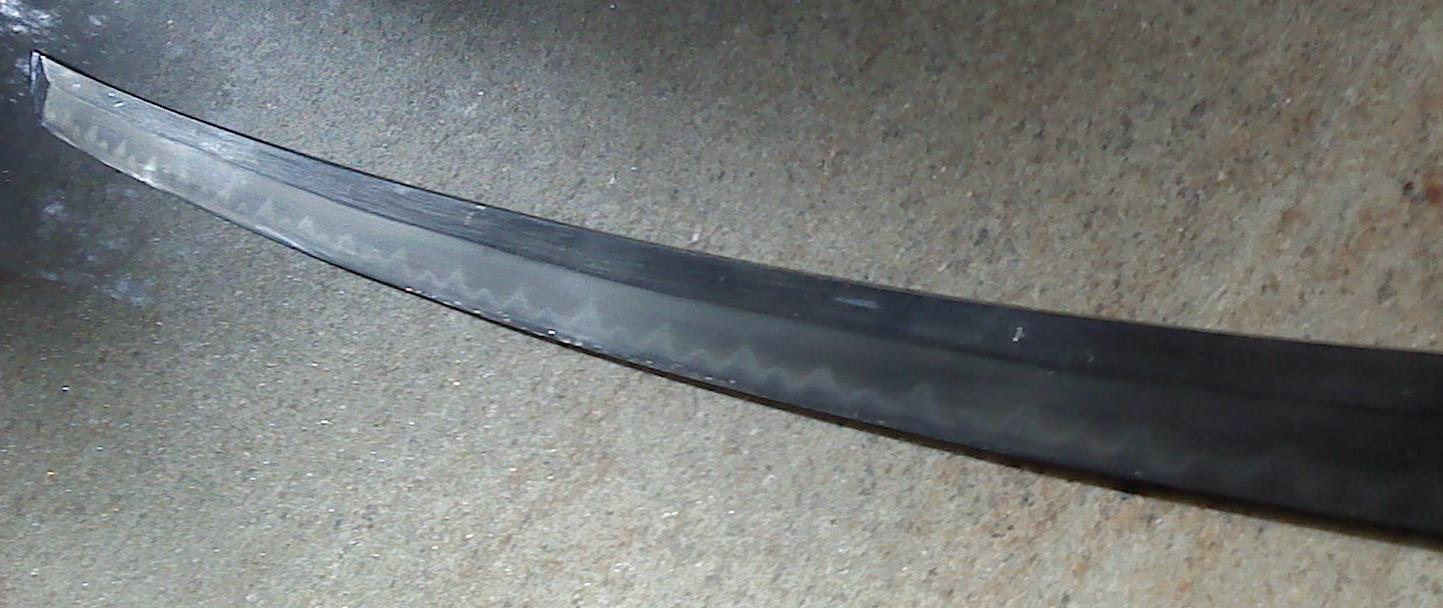
Wow.. a wealth of knowledge.. Thanks Gabriel! Yea sorry about the pics.. they were taken with my phone. Not the best option but all I had. I will try to take some really clear ones and post them up when I get home. As for flaws in the sword.. no.. none at all. That's what I find rather surprising . The quality of the blade is excellent (other then the described scuffs etc. The mune is straight as an arrow and the hada seems to be a really tight itame. Its in very old polish so its a bit hard to tell. I think it may be the original polish as the Hamachi is dead even with the rest of the blade? Then again, perhaps that is why its flat there. I'm smart enough to say I don't know. Kurt. K -
Mei help please, I think I am half way there.
obiwanknabbe replied to obiwanknabbe's topic in Translation Assistance
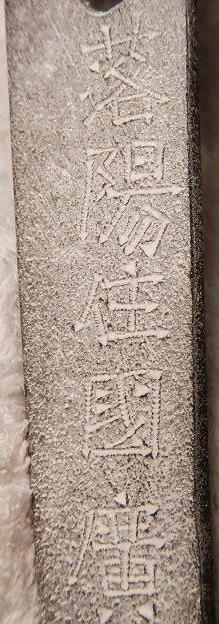
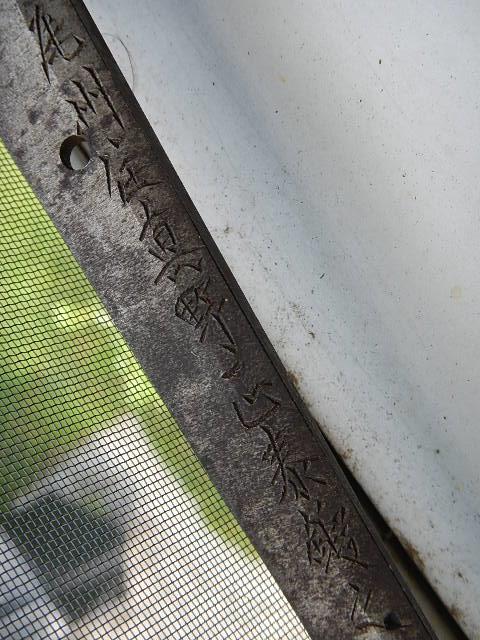
Well, if nothing else my Mei reading skills are getting better. Thanks so much for the help Gabriel If this is in fact Gimei, is it possible that it is an honorific form of it or some sort of Nakirishi mei from a student from much later on? The reason that i ask is that, from what i can see, the workmanship of this blade is top notch. Not a single forging flaw or opening anywhere to be seen. Am i wrong in thinking gimei was only done to con people because on its own this blade is really nice? Also, do you think im placing the time period correctly? Im only going by one clue here, the Ha not being sharp all the way down, but it would fit the student hypothesis if the blade was made in the shinshinto period. one final question.. (for now.. im full of them), the signature in the link you provided is slightly different. It reads Rakuyo Ichijo ju kunihiro. The signature i have does not say Ichijo, it just says jo, or am i wrong? There is no kanji for "Ichi" included in the mei. Could this be someone else entirely? While it my be irrelevant, i thought it worth noting that this sword is encased in a very nice, very old, extremely robust shira saya with a carved wooden habaki that fits like a glove. Someone took a lot of time to do this. well, one way or another, i have a really nice sword to enjoy. I am thinking of having this one touched up by a professional. Any ideas one the approximate value here? Could I go wrong @750 or did i take a bath on this one? Im trying to figure out if a polish is worth it. Best regards, Kurt. K -
Hi everyone.. Well it seems the gods of Nihonto have smiled upon me today. I came across this little (thought literally 27 inches) gem by talking to a customer of mine at the vineyard I manage. He said he had it and did not really need it. I said i have money, and suggested a trade. I'm in it for $750.00 usd so i don't think there is anyway i could have gone wrong here. Other than a few scuffs, minor stains, and a lil nick in the point, this sword is flawless. At any rate, I have given this mei my best shot. I think i did pretty well.. stress on "I THINK". The first one i cant find. I think the second one is "dai jo". The third I am 99.99% sure is "Ju". The last two I think are "Kuni Hiro". I also THINK that his blade is Shinshinto. It is not sharpened all the way to the habaki and from what i remember that was something done in the Shinshinto period. How did i do? Thanks again to all of you! Kurt .K



-
Oh, another neat trick I learned. Brass plating. Get some zinc sulfate. Its cheep and easy to find online. Next get a few piece of raw zinc. Most boating supply stores have it. In a glass container, mix 300ml of water with 30 grams of the zinc sulfate. Heat it to a boil. Now add a few pieces of the raw zinc. If you place very clean copper habaki into the solution, touching the raw zinc, it will chemically plate the habaki with a nice, thin coating that looks like silver. It looks really nice and takes about 5-10 mins. You have now zinc plated your habaki. Clearly, this can also be done with any copper piece. If you heat the plated habaki gently in a low oxygen flame to about 300*, the zinc ions diffuse into the copper and bond, forming brass on the surface. Its VERY easy and looks beautiful, turning a nice gold color. Plus, its much safer then messing with mercury. Kurt. K
-
VERY Nice job sir! You should be proud. I have made a few of them and can offer a piece of advice to anyone who is interested that adds some much needed precision the process, especially for beginners.. It adds a few extra steps, but it completely eliminates the constant "is it in the right place?" part of soldering. If i had to guess, it took a good while to get that machigane into the proper position, right? Next time, don't cut the excess on the main piece away to begin with. Use a thin piece of longer sheet copper that you cut, file, or hammer a wedge like shape into the edge of it (kind of like a dovetailed end). This portion will fit in between the open halves of the habaki and ultimately serve as the machigane. Put the habaki on the blade where it will match up tightly. Place the thin dovetailed end of the sheet in between the halves and mate it to the munemachi. Clap into place with some channel locks. You can drill 2 holes in the excess and pin it all together place with some spare nails or screws, or what ever fits the holes you drilled. Now that it is perfectly aligned, and WILL NOT MOVE, solder away. When cooled, cut the excess off with the pins in it and sand it down as you would before. It will match up every time. Regards and happy crafting, Kurt. K
-
George, thanks for the heads up. I have to say, joining this group was one of the best things I ever did. Nothing like a compendium of knowledge! Kurt.k
-
As with all obsessions, the second I got home i started to work on the saya. Turns out the "cosmetic" screw was actually a screw. I had to re-cut the head but with some patience i got it out. I then used a wooden block, as George suggested, to tap off the Koiguchi. It came off with just a few taps.. VICTORY!.. Sorta. The wood core is totally shot. It is about 40% dry rotted out. The bottom portion is still salvageable though. I may end up cutting the rotten section off and crafting a replacement for the top portion of the core. Now to the wood pile to see what i have floating around. Kurt. K
-
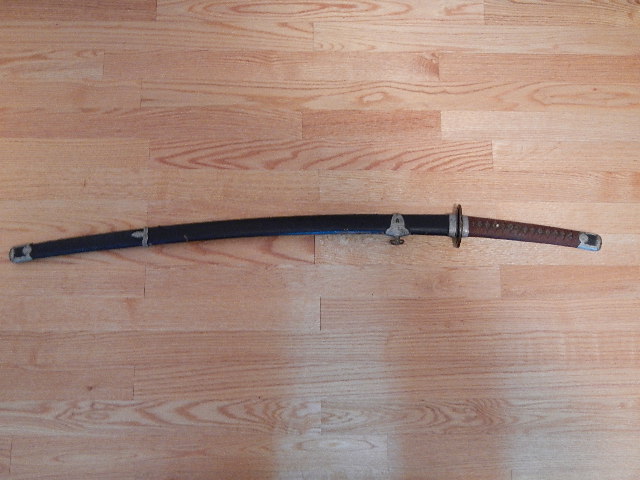
Thanks George, Sorry for no pics, but im at work (on break). It is a standard type 98 saya and I was planning on cleaning the original wood and reusing it. While I have the ability to make a new shira saya for it, I am trying to return the blade (A very nice Koa Isshin Mantetsu) to its original configuration. Honestly, I just like the way the military mounts look. The sword was in some rather poor condition Frankenstein mounts when I bought it. I have pieced together a new correct set of fittings along with this saya, which fits perfectly. It is full of dried cosomline and debris, however, which brings us to the conversation at hand. From what I can see, there was only one "real" screw on the mune side of the koiguchi. There appears to be another one on the front side which is cosmetic? Not made of steel but rather copper/brass which was cast onto the fitting and that was subsequently mauled by some previous owner. I will upload some photos when I get home later. Thanks, kurt
-
Hi everyone, Do any of you have any experience taking apart metal Gunto saya? I have one where the metal is in perfect condition but the wood core is shot. I would like to replace the wood,so as to help preserve the blade, but don't wish to break the fittings. Are they usually just pressed on? The koiguchi has a screw that i removed, but its still on there really tight. Also, is the wood core usually glued in or does it come out easily? Ideas? Comments? Thanks, Kurt. K
-
Hi everyone, I am curious why it is not an accepted practice to have a professional restore Tsuba while sending a sword to a polisher is fully embraced by the collecting community? Or is it? I realize that for some it would not be feasible, but in other cases, I would think that it would be (as in the case of a simple pierced iron Tsuba). I am sure that there are some that would say that it would make the item more difficult to date, but I would assume that it would be possible to leave the area under the sepa unaltered, much like the nagako of a blade? Am I missing something or is it just not a practice that has caught on yet? Thoughts? Comments? Kurt. K
-
Thanks guys. The reason I'm asking is because I found another one at a local antique shop (they really seem to be coming out of the wood work lately) and the guy is asking $650. Ebay is an easy way to see selling prices but there are just so many knockoffs that it has become really hard to tell what prices to go by. As for the blade, it is just about perfect from what i can see, but at the shop I could not get the tsuka off to inspect it further. Looks like the real deal though by all other features. Has the "right feel" if you know what i mean. Guess I better get myself some overtime because I KNOW that i wont be able to pass a blade up. Kurt. K
-
Hey everyone, While i realize this is a VERY general question, i was curious what the consensus was of my more learned peers regarding the going rate for a run of the mill, oil quenched, military mounted, showato is; assuming it is in great order? Do different smiths matter or do they all rate just about the same? I have heard it said that some stamps are more rare than others, but that can be put aside. Thanks in advance, Kurt. K
-
Hello everyone! Being new to the board, I have started to notice that there are many Nihonto related events being held in many places around the country (U.S) as well as abroad. I was curious if there were any such events that you folks may be aware of in the NY area? I don't think I have ever seen one discussed, but clearly that does not mean it does not happen. Thanks in advance, Kurt K
-
Hey all, I figured as a newbie on the board, I should also throw my hat into the ring here. While I am 37 now, I have been fascinated with the Japanese sword since i was 8 years old. As a child of the 80's, I think there existed a genetic predisposition towards bad Ninja movies. In one such film, Sho Kosugi's "Prey for Death", the main character is forced to make his own sword as his old one is broken. Being a self confident, and rather naive adolescent, I seized upon the notion that I TOO COULD MAKE MY OWN SWORD. We had a coal burning stove in our living room. That was the first piece of this soon to be tragic tale of invention. I took a few buckets full of anthracite out of the hopper on the side of the house, dug a hold in the horse shoe pit in our back yard, started a huge fire, rigged the exhaust of our shop vacuum as a blower, and proceeded to melt my fathers tools. The end result of my efforts were a few minor burns and a rather crude, twelve inch, metal toothpick. I was exceedingly disappointed, my father was pissed and proud, and the fire department had a few harsh words for me about starting a massive coal fire so close to the woods. I still have my "sword" though. A few days latter a neighbor comes knocking at my door. Mr. Moore was a metallurgist, and as it turned out a metal working guild member, who made a living in the R&D department of Grumman Aviation. He had heard about my black-smithing misadventure and was there to offer some training in real metalworking. I took him up on his offer and spent the next 5 years in his garage, learning the right way to put hammer to steel. That's where it started. Today, after 28 additional years of study and practice, I make my own blades with the flare that I originally hoped for as a child. With my corresponding 28 years of Martial arts study (everything from Ryukyo Kempo, to Genbukan Ninjitsu) a natural love for the real thing developed. I spend my leisure time raiding antique shops and estate sales in true Indiana Jones fashion (I even have the hat), exploring deep and dusty corners for whatever treasures they may hold. I have to say, in those endeavors, I have had some great luck and found some wonderful blades. So here's me, living on the raggedy edge of poverty/hunger, harboring an insatiable lust for these formidable works of art. That's my tale of woe, and so it will remain until such a time as I win the lottery. At least then I wont be hungry anymore .
-
Honest appraisal of Fred Lohman polishing.
obiwanknabbe replied to obiwanknabbe's topic in General Nihonto Related Discussion
Cabowen, That is what I thought as well. Now at least i know someone who knows more than i do agrees. Related, do you know what the deal with the punch mark is below the Mei? The first 2 blades have one, as does mine. It seems deliberate. As for the blades future, If a polish is going to cost $3500+ for a polish, do you have any idea (rough or otherwise) what this smiths blades are generally worth? I found a few that sold for some pretty prices,$3500- $4550, but two prices do not a good average make. I am in at $400 one this sword. Like i said, its in pretty good shape. The only real problem with it is that there is one ware just above the hamon a few inches past the habaki, and at an earlier point in time, some Darn fool took a belt sander and removed about 1/100th of an inch the cutting edge to dull it. Why someone would do this is beyond me, but they did. I went out on a limb when i bought it with the thinking that it had to be worth more than the $400 I haggled the dealer down to. Again, thank you Kurt K -
Honest appraisal of Fred Lohman polishing.
obiwanknabbe replied to obiwanknabbe's topic in General Nihonto Related Discussion
Thanks for your feed back guys. Cabowen, if you would indulge me, what leads you to believe that this is NOT nakirishi mei? Not that i doubt you. It would please me greatly to find out that it is shoshin mei. Are there some telltale signs that you see? I ask only to learn. Best regards, Kurt Knabbe -
Hi everyone. So here is the deal. Recently we discussed a blade that I picked up at a local antique shop (been hitting home runs lately). What i found turned out to be a Mano Masayasu. There is some conjecture as to whether or not this blade is Nakirishi mei or shoshinmei. Pictures and discussion of that blade can be found in the translation section under "Kai Gunto? translation". What do you folks think about Mr. Lohman's polishing service. The price is right, but how about the workmanship? Does this blade warrant more? Also, who would your recommend as an alternative? I dont have disposable income, but would really like to see this sword returned to former glory. Thoughts, comments? Thanks, Kurt. K

-
Thanks for the image cisco-san. So This makes it difficult. Am i correct in concluding that the image to the center has Yasuri mei is most similar to mine, being that the file strokes are completely horizontal and deeper cut? The "kore" is different though. My "kore" is closer to the image listed as Nakirishi mei. Then again, the "Yasu" is different too. I suppose this is why there can be so much debate on authenticating a Mei. Could this blade have been made by a student? Also, the punch mark at the bottom. Is that a telltale clue? Mine has one, and the first two images have them. Ideas on what that is about? Regarding a polish, $2k-3k is the range of cost I am familiar with, but is it worth it? If this smith of my blade is the one being discussed here, then he was rated Cho saku in 1941. The real question is would the polish be a wise investment? Side note, Where can i get a copy of that book? I searched for the author but nothing came up. What is the title? Thanks again folks Kurt Knabbe
-
Patrick, Thank you so much! I have not seen that variation of "kore".. Is it some kind of script kanji or just a very stylized inscription? Also, you think this is nakirishi mei? Anyone out there want to weigh in on whether this is worth sending out to be polished? Thanks again! Kurt
-
Hi folks, First off, sorry about the angle of the picture. The Mei is so big i had to tilt the camera to get the whole thing in the frame and still be close enough to be able see it clearly. Though covered in dried casmoline, the blade is actually in really nice shape and has an attractive gunome hamon. Also, and unless something is tricking me, there are signs of Nie (I see some sparkles at the boarders of the hamon and Ji). This confuses me as there appear to be some stamps along the mune side of the nagako but they are hard to make out. Water quenched showa-to perhaps? I have been trying to use the kanji pages to translate this signature but with little success. I have only been able to discern a few things (i think). The second kanji down looks like Shu which would mean that the one above it is a province. Which province eludes me as it does not appear on the Japanese sword index (perhaps not a common one?). I think the third Kanji is Ju The bottom looks similar to Kore but i dont think that's what it says. The rest are beyond my limited experience at present. Any assistance is appreciated Thanks in advance Kurt


-
O-wakizashi/Ko-katana translation help please
obiwanknabbe replied to obiwanknabbe's topic in Translation Assistance
Lance.. I like your idea. I have about 4 blades to finish before I can start something new, but its an interesting angle. Thanks. As for the Wakizashi, she will stay as she is. Like I said, i don't really plan on doing anything more with it. The blade looks good as a display and study piece (the original reason I purchased it) as it stands. I just wanted learned opinions. These are the types of conversations which are not generally covered in books. Kurt -
O-wakizashi/Ko-katana translation help please
obiwanknabbe replied to obiwanknabbe's topic in Translation Assistance
Thanks for your feedback guys. I thought Kane was part of it, but I have seen how additional kanji can change the pronunciation. As for the polishing. I can assure you Brian, I wont work on anything I think could be valuable. What you could not see in the picture was the other side of the blade, MASSIVE kitae Kizu and blistering, and warping of the mune. Mostly when I do work it is on one of my own blades. I have been smithing for about 15 years. Thanks again guys. Kurt